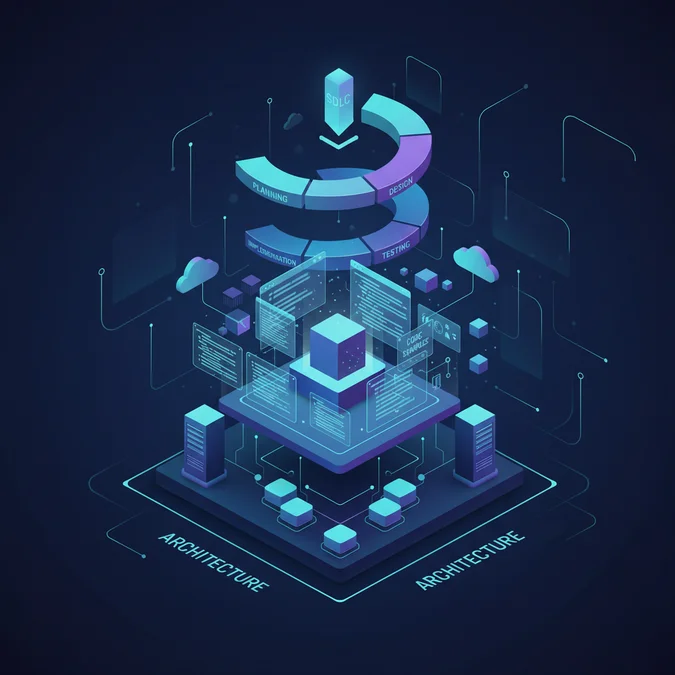

Developing computer software involves a structured process of designing, coding, testing, and deploying applications to solve specific problems or fulfill user needs. It encompasses the entire lifecycle from concept to maintenance, utilizing various methodologies and tools to create functional, efficient, and scalable digital solutions.
This guide provides a comprehensive, practitioner-level exploration of software development, moving beyond theoretical definitions to practical application. We will dissect the Software Development Life Cycle, analyze critical architectural considerations, and examine modern methodologies that drive efficient software creation. Our focus is on equipping engineers with the knowledge to make informed decisions and build robust systems.
Understanding the engineering trade-offs inherent in every decision, from technology stack selection to deployment strategy, is paramount. This article will furnish you with insights into best practices, real-world examples, and a forward-looking perspective on how emerging technologies, particularly AI, are reshaping the landscape of software engineering.
What is Software Development? A Comprehensive Overview
At its core, the software development definition encompasses the entire process of conceiving, specifying, designing, programming, documenting, testing, and bug fixing involved in creating and maintaining applications, frameworks, or other software components. To define software development accurately, it is the systematic approach to transforming abstract user requirements into tangible, functional software products.
When we explain software development, we refer to a multi-faceted discipline that leverages engineering principles to build solutions for diverse platforms, from embedded systems to global cloud services. The meaning of software development extends beyond mere coding; it integrates project management, quality assurance, system analysis, and continuous improvement. The goal is always to deliver software that is reliable, efficient, secure, and user-friendly.
Understanding the sw development meaning implies recognizing the iterative nature of the work. Developers constantly refine and enhance software based on feedback, evolving requirements, and technological advancements. Similarly, the software dev meaning underscores the collaborative effort required, involving cross-functional teams working in synergy to bring complex digital products to life.
Callout: The Essence of Software Development
Software development is not just about writing code; it is about problem-solving, innovation, and creating value through technology. It is a structured process that transforms ideas into functional digital tools, continuously adapting to meet user needs and technological progress.
This field is critical across all industries, powering everything from enterprise resource planning systems to mobile applications that enhance daily life. Its continuous evolution demands that practitioners remain adaptable, embracing new tools, languages, and paradigms to stay at the forefront of innovation.
The Software Development Life Cycle (SDLC): Key Stages and Practical Steps
The Software Development Life Cycle (SDLC) provides a structured framework for teams to follow when creating and maintaining software. It answers the fundamental question of how to develop a software product systematically, ensuring quality, efficiency, and alignment with business objectives. Adhering to an SDLC model is a cornerstone of effective software development in software engineering, promoting predictability and reducing risks.
Here are the key stages of a typical SDLC, presented as practical steps:
-
Requirements Gathering and Analysis:
This initial phase involves collecting detailed requirements from stakeholders. It answers: What problem will the software solve? Who are the users? What functionalities are essential? Techniques include interviews, surveys, and use case analysis. A clear, unambiguous Software Requirements Specification (SRS) document is the output, serving as the blueprint for subsequent stages.
-
Design:
Based on the SRS, architects and designers outline the system’s architecture, database structure, user interface, and overall system components. This stage determines how the software will be built. It encompasses high-level design (system architecture) and low-level design (component-level details, algorithms). Architectural patterns like microservices or monolithic structures are chosen here, considering scalability, maintainability, and performance.
-
Implementation (Coding):
In this stage, developers write the actual code based on the design specifications. This is where the theoretical blueprints become executable instructions. Choosing the right programming languages, frameworks, and development tools is crucial here. Clean code practices, version control, and modular development are emphasized to ensure a robust and maintainable codebase.
-
Testing:
Once the code is written, it undergoes rigorous testing to identify and fix defects. This includes unit testing, integration testing, system testing, and user acceptance testing (UAT). The goal is to ensure the software meets all specified requirements, performs as expected, and is free of critical bugs. Automated testing frameworks are widely used to accelerate this process and ensure consistency.
-
Deployment:
After successful testing, the software is deployed to the production environment, making it available to end-users. This stage involves careful planning, environment setup, configuration, and often, migration of existing data. Modern deployment strategies include continuous deployment (CD), blue/green deployments, and canary releases to minimize downtime and risk.
-
Maintenance:
The final, ongoing stage involves monitoring the software in production, addressing bugs, implementing enhancements, and adapting it to new environments or user needs. This includes corrective maintenance (bug fixes), adaptive maintenance (environmental changes), perfective maintenance (feature enhancements), and preventive maintenance (refactoring to improve future maintainability).
Each stage within the SDLC is interconnected, with feedback loops ensuring that issues or new requirements identified in later stages can inform adjustments in earlier ones. This systematic approach is fundamental to creating high-quality software solutions.
Software Architecture & Engineering: Design Patterns, Trade-offs, and Code Examples
Effective software architecture is the backbone of any successful application, defining its structure, behavior, and properties. It is a critical aspect of engineering that dictates how easily a system can scale, be maintained, and evolve. Architects must balance numerous concerns, making informed decisions that often involve significant trade-offs.
Architectural Patterns and Trade-offs
Choosing the right architectural pattern is paramount. Here is a comparison of common patterns:
| Pattern | Description | Advantages | Disadvantages | Key Trade-off |
|---|---|---|---|---|
| Monolithic | Single, unified codebase and deployment unit. All components reside within one application. | Simpler to develop initially, easier debugging, less operational overhead. | Difficult to scale specific components, slow development cycles for large teams, technology lock-in. | Initial simplicity vs. long-term scalability/flexibility. |
| Microservices | Collection of small, independent services, each running its own process and communicating via APIs. | Independent deployment/scaling, technology diversity, resilience, faster development for large teams. | Increased operational complexity, distributed data management, network latency, challenging debugging. | Scalability/flexibility vs. operational complexity. |
| Serverless | Event-driven execution of functions without managing servers, typically leveraging FaaS (Function as a Service). | No server management, automatic scaling, pay-per-execution cost model, rapid deployment. | Vendor lock-in, cold start latency, debugging distributed functions, execution duration limits. | Operational simplicity/cost efficiency vs. vendor lock-in/debugging challenges. |
Every architectural decision involves a trade-off. For instance, opting for microservices over a monolith gains scalability but introduces significant operational complexity. Understanding these implications is crucial for long-term success.
Design Patterns and sw programming
Beyond architecture, design patterns offer reusable solutions to common software design problems. They provide a blueprint for how to structure code, making it more maintainable and understandable. For instance, the Singleton pattern ensures only one instance of a class exists, while the Observer pattern defines a one-to-many dependency between objects.
Consider a simple example of the Factory Method pattern in Python, a common element in robust sw programming to decouple object creation from its usage:
class Dog:
    def speak(self):
        return "Woof!"

class Cat:
    def speak(self):
        return "Meow!"

def animal_factory(animal_type):
    if animal_type == "dog":
        return Dog()
    elif animal_type == "cat":
        return Cat()
    else:
        raise ValueError("Unknown animal type")

# Usage
my_dog = animal_factory("dog")
print(my_dog.speak()) # Output: Woof!

my_cat = animal_factory("cat")
print(my_cat.speak()) # Output: Meow!
This pattern makes the code more extensible; adding a new animal type only requires modifying the factory function, not the client code using the animals. Such patterns are fundamental to writing clean, modular, and maintainable software.
Callout: The Architect’s Mandate
A software architect’s primary role is not merely to draw diagrams, but to foresee system evolution, anticipate failure points, and select patterns that align with business goals while mitigating technical debt. It is a balance of foresight and practical engineering.
Modern Software Development Methodologies and Essential Tools
The landscape of software software development has been dramatically reshaped by modern methodologies that prioritize agility, collaboration, and continuous delivery. Traditional waterfall models, while structured, often struggled with adapting to changing requirements and delivering value quickly. Today, Agile and DevOps are the dominant paradigms.
Agile Methodologies
Agile is an iterative and incremental approach that focuses on delivering working software frequently, typically in short cycles called sprints. Key principles include:
- Individuals and interactions over processes and tools.
- Working software over comprehensive documentation.
- Customer collaboration over contract negotiation.
- Responding to change over following a plan.
Popular Agile frameworks include Scrum and Kanban. Scrum emphasizes short sprints (1-4 weeks), daily stand-ups, and defined roles (Product Owner, Scrum Master, Development Team). Kanban focuses on visualizing workflow, limiting work in progress, and maximizing flow.
DevOps Practices
DevOps extends Agile principles by fostering collaboration between development (Dev) and operations (Ops) teams. Its goal is to automate and streamline the entire software delivery process, from code commit to production deployment. Key practices include:
- Continuous Integration (CI): Developers frequently merge code changes into a central repository, where automated builds and tests are run. This helps detect integration errors early.
- Continuous Delivery (CD): Ensures that software can be released reliably at any time. Every change is released to a staging environment, and if it passes all tests, it is ready for production.
- Continuous Deployment: An extension of CD where every change that passes all automated tests is automatically deployed to production without manual intervention.
- Infrastructure as Code (IaC): Managing and provisioning infrastructure through code rather than manual processes, using tools like Terraform or Ansible.
- Monitoring and Logging: Implementing robust systems to track application performance, user behavior, and potential issues in real-time, enabling rapid response and informed decision-making.
Essential Tools for software software development
To effectively implement these methodologies, a robust toolchain is indispensable. These tools automate tasks, enhance collaboration, and improve code quality:
| Category | Tool Examples | Primary Function |
|---|---|---|
| Integrated Development Environments (IDEs) | VS Code, IntelliJ IDEA, Eclipse | Code editing, debugging, project management |
| Version Control Systems (VCS) | Git (GitHub, GitLab, Bitbucket) | Source code management, collaboration, history tracking |
| CI/CD Platforms | Jenkins, GitLab CI/CD, GitHub Actions, CircleCI | Automated builds, tests, and deployments |
| Containerization/Orchestration | Docker, Kubernetes | Application packaging, deployment, scaling |
| Testing Frameworks | JUnit, Pytest, Selenium, Cypress | Automated unit, integration, and end-to-end testing |
| Project Management | Jira, Trello, Asana | Task tracking, sprint planning, team collaboration |
| Monitoring & Alerting | Prometheus, Grafana, Datadog | System and application performance monitoring, incident management |
| Cloud Platforms | AWS, Azure, Google Cloud Platform | Hosting, infrastructure, managed services |
The synergy between modern methodologies and these powerful tools allows teams to deliver high-quality software faster and more reliably, directly impacting business success.
Types of Software Development: From Web to AI, and Future Trends
The domain of software development is vast, encompassing numerous specializations, each with its unique challenges, tools, and best practices. Knowing how to develop computer software effectively means understanding the specific context and requirements of each type.
Common Types of Software Development:
-
Web Development: Focuses on building applications accessible via web browsers. This includes frontend development (user interface, user experience, using HTML, CSS, JavaScript frameworks like React, Angular, Vue.js) and backend development (server-side logic, databases, APIs, using languages like Python, Node.js, Ruby, Java). Full-stack developers handle both.
-
Mobile Development: Involves creating applications for mobile devices. Native development uses platform-specific languages and tools (Swift/Objective-C for iOS, Kotlin/Java for Android). Cross-platform development uses frameworks like React Native or Flutter to build apps for multiple platforms from a single codebase.
-
Desktop Application Development: Creating software that runs natively on desktop operating systems (Windows, macOS, Linux). Technologies include C#, Java, Python with frameworks like Electron or Qt. While web and mobile dominate, desktop apps remain crucial for specialized tasks and high-performance needs.
-
Game Development: The process of creating video games. This involves complex graphics programming, physics engines, AI, and intricate user interaction. Engines like Unity and Unreal Engine are standard, utilizing languages like C++ and C#.
-
Embedded Systems Development: Writing software for non-computer devices, such as microcontrollers, IoT devices, or automotive systems. This often involves low-level programming (C, C++), real-time operating systems (RTOS), and careful resource management due to hardware constraints.
-
Data Science and Machine Learning (AI) Development: Focuses on building applications that analyze data, predict outcomes, or enable intelligent behavior. This involves statistical modeling, algorithm development, and using libraries like TensorFlow, PyTorch, and scikit-learn in languages like Python and R.
Future Trends in Software Development
The future of how we develop computer software is dynamic, driven by several key trends:
-
Artificial Intelligence (AI) and Machine Learning (ML) Integration: AI is not just a type of software but also a tool for software development. AI-powered code generation, intelligent testing, and automated debugging are becoming more prevalent. Developers will increasingly leverage ML models within their applications for features like personalization, predictive analytics, and natural language processing.
-
Low-Code/No-Code Platforms: These platforms enable rapid application development with minimal or no coding, empowering citizen developers and accelerating prototype creation. While not replacing traditional coding, they will augment development teams, focusing their efforts on complex, bespoke solutions.
-
Edge Computing: With the proliferation of IoT devices, processing data closer to its source (at the ‘edge’) reduces latency and bandwidth usage. Developing software for edge devices requires expertise in distributed systems, security, and resource-constrained environments.
-
Quantum Computing: Though still nascent, quantum computing promises to solve problems currently intractable for classical computers. Software development in this realm will involve new algorithms and programming paradigms, requiring a fundamental shift in computational thinking.
-
Enhanced Security and Privacy: As cyber threats evolve, secure software development practices will become even more critical. ‘Security by Design’ will be non-negotiable, with an increased focus on data privacy regulations and robust authentication/authorization mechanisms.
Callout: Adapting to the Future
To remain relevant, software developers must continuously adapt, not just mastering new languages or frameworks, but understanding the paradigm shifts brought by AI, distributed systems, and evolving security demands. Lifelong learning is the only constant.
These trends highlight a future where software development is more intelligent, automated, and distributed, demanding a broader and deeper skill set from practitioners.
Frequently Asked Questions
What is the fundamental meaning of software development?
Software development is the process of conceiving, specifying, designing, programming, documenting, testing, and bug fixing involved in creating and maintaining applications, frameworks, or other software components. It encompasses a structured approach to transform user needs into functional software products.
How does one typically develop a new software application?
Developing a new software application typically follows the Software Development Life Cycle (SDLC), starting with requirements gathering, followed by design, implementation (coding), testing, deployment, and ongoing maintenance. This iterative process ensures a robust and functional product.
What is the relationship between software development and software engineering?
Software engineering is the systematic, disciplined, quantifiable approach to the development, operation, and maintenance of software. Software development is the broader activity of creating software, while software engineering applies engineering principles and best practices to make that development process efficient, reliable, and scalable.
What does ‘sw programming’ refer to in the context of building software?
‘SW programming’ is an abbreviation for ‘software programming,’ which refers to the act of writing, testing, and maintaining the source code of computer programs. It’s a core component of software development, translating design specifications into executable instructions for computers.
What is ‘software ontwikkeling’ and how does it relate to English terms?
‘Software ontwikkeling’ is the Dutch term for ‘software development.’ It encompasses the entire process of creating, designing, programming, testing, and maintaining software applications. The meaning and scope are identical to its English counterpart, referring to the systematic creation of software products.
From understanding the fundamental software development definition to navigating complex architectural decisions and embracing modern methodologies, the journey to develop computer software is multifaceted and ever-evolving. We have explored the structured path of the SDLC, the critical trade-offs in architectural design, and the essential tools that underpin contemporary software engineering practices.
The future of software development is poised for significant transformation, with artificial intelligence, low-code platforms, and edge computing leading the charge. For practitioners, continuous learning and adaptability are not merely advantages but necessities. By mastering these core principles and staying abreast of emerging trends, engineers can continue to build innovative, efficient, and impactful digital solutions that shape our world.
NR Studio builds custom web apps, mobile apps, SaaS platforms, and internal tools for growing businesses. If you’re working through a technical decision, feel free to reach out — no commitment required.