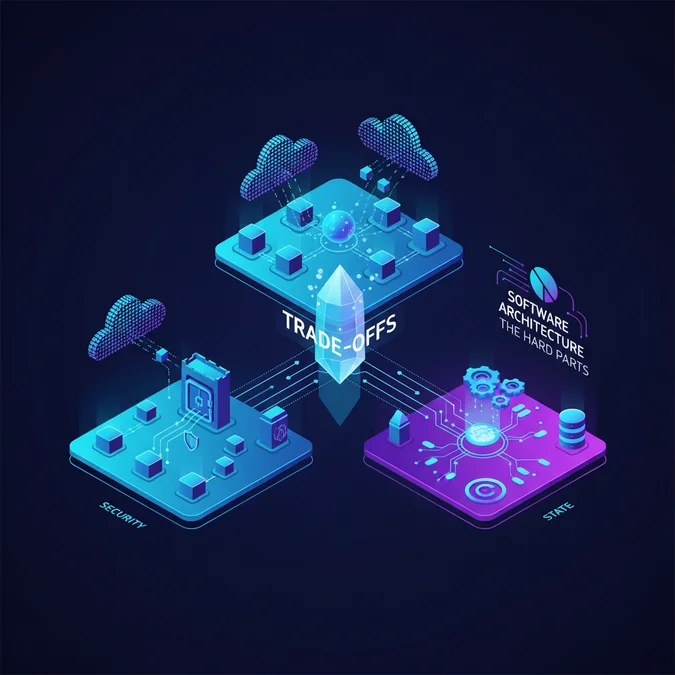

Software architecture the hard parts refers to the complex engineering trade-offs encountered when decomposing monolithic systems, managing distributed transactional integrity, and securing distributed state boundaries without compromising data consistency or introducing severe authorization vulnerabilities. Rather than choosing between abstract patterns, engineers must negotiate non-ideal compromises across persistence, network topologies, and threat models.
According to recent industry telemetry from the 2024 Stack Overflow Developer Survey, over 62 percent of backend engineers report that managing distributed data boundaries and securing decoupled service communication represents their greatest source of production regressions and operational overhead. Decomposing systems increases the attack surface across distributed interfaces, exposes state to out-of-order execution, and invalidates fundamental transactional guarantees once taken for granted within single-process runtimes.
As systems scale, security cannot be treated as an isolated layer bolted on after system boundaries are drawn. Every architectural choice, whether partitioning a shared relational database, orchestrating eventual consistency, or routing asynchronous messages, introduces distinct attack vectors. This analysis dissects the difficult engineering realities of modern system partitioning, zero-trust service communication, cryptographic data boundaries, and distributed failure mitigation.
Architectural Partitioning and the Illusion of Clean Decomposition
Software architecture the hard parts begins when teams transition from single-tier monoliths to decoupled services, discovering that modularity at the code level does not cleanly translate into operational independence. In a monolithic architecture running Laravel or a similar application runtime, boundary enforcement relies on object-oriented visibility, domain modules, and ACID-compliant database transactions. Once codebases are split into decoupled services, engineers trade predictable memory calls for inherently hostile, unreliable network channels.
The primary trap during system decomposition is component coupling disguised as microservices. When domain boundaries are drawn arbitrarily along user-interface concerns rather than transactional invariants, services end up tightly coupled via synchronous network calls. This pattern introduces distributed latency, operational brittleness, and systemic security weaknesses. Every network hop between services requires identity re-validation, serialized data sanitization, and complex defensive fallbacks against eavesdropping and transit tampering.
Analyzing System Partition Archetypes
Engineers evaluate partitioning strategies across two fundamental archetypes: functional decomposition and data-driven decomposition. Functional decomposition carves services around application capabilities, whereas data-driven decomposition organizes boundaries around data ownership, privacy, and regulatory storage constraints.
| Partitioning Approach | Coupling Risk | Data Consistency Mechanism | Primary Security Threat |
|---|---|---|---|
| Synchronous Request-Driven | Very High (Temporal and API coupling) | Two-Phase Commit / Direct Locking | Man-in-the-Middle, Identity Spoofing, Cascading DoS |
| Asynchronous Event-Driven | Low (Decoupled execution runtimes) | Eventual Consistency via Sagas | Event Tampering, Replay Attacks, Out-of-Order Execution |
| Shared Database Hybrid | Critical (Schema and Lock contention) | Centralized ACID Storage Engines | Privilege Escalation, Shared State Contamination |
| Isolated Database per Service | Low (Complete storage autonomy) | Outbox Pattern, Distributed Handshakes | Fragmented Audit Trails, Secret Leakage Across Services |
To safely evaluate system restructuring within an established team, engineers should align architectural boundaries with the formal stages of the application software development life cycle. Treating boundary extraction as an architectural rewrite without rigorous threat modeling frequently introduces severe horizontal privilege escalations, as internal service APIs are frequently deployed without the defensive validation layers present in consumer-facing ingress gateways.
Distributed Transactions, Saga Patterns, and Consistency Traps
The hardest challenge in distributed systems is maintaining invariant integrity across partitioned databases without locking downstream execution pipelines. In a monolithic system, an order placement updates inventory, bills credit balances, and creates delivery manifests within a single database transaction. If any sub-task fails, the database rollback operator restores the prior stable state automatically.
Distributed environments cannot reliably use Two-Phase Commit (2PC) over cloud networks. The coordinator node creates a single point of failure, and latency spikes across distributed participants hold row-level locks indefinitely, degrading throughput and enabling Denial-of-Service (DoS) vectors. Consequently, architects rely on the Saga pattern, executing transactions as a sequence of discrete, local database updates linked via asynchronous messages.
Choreography vs. Orchestration: Security and Operational Trade-offs
Sagas operate through either choreography or orchestration:
- Choreographed Sagas: Each service listens to domain events and decides autonomously whether to execute an action. While this approach avoids central coordinator bottlenecks, it obscures auditability. Detecting a fraudulent transaction or a poisoned event payload becomes exceptionally difficult when state transitions are distributed across dozens of autonomous event consumers.
- Orchestrated Sagas: A centralized orchestrator controls execution steps, explicitly dispatching command messages and tracking transaction completion. Orchestrators provide deterministic audit logs and centralized authorization checkpoints. However, if the orchestrator is compromised, an attacker can manipulate workflow logic, issue arbitrary compensating actions, and drain downstream state.
Compensating actions do not return reality to its original state; they apply a forward correction. If an inventory service reserves stock, the payment service fails, and the compensating action releases that stock, external actors observing the intermediate state may experience inconsistent reads. In financial or healthcare systems, intermediate state exposure introduces semantic vulnerabilities where malicious users exploit race conditions during delayed Saga compensations.
Zero Trust Communication Across Distributed Service Boundaries
A critical architectural anti-pattern is assuming an internal private network or service mesh provides an inherently trusted zone. Perimeter-only security fails when an attacker achieves remote code execution within a single peripheral service. Once inside the perimeter, unauthenticated internal HTTP or RPC endpoints allow lateral movement across the entire enterprise cluster.
Implementing Zero Trust requires mutual Transport Layer Security (mTLS) with cryptographically validated identity certificates for every intra-service communication channel, accompanied by scoped, short-lived authorization tokens. Downstream services must never trust upstream components based on their network location or IP addresses alone.
Implementing Cryptographic Token Validation in Distributed Runtimes
Internal services must validate user identity claims and caller privileges locally without querying central directory providers on every request. JSON Web Tokens (JWT) or PASETO tokens passing between services must be signed using asymmetric cryptographic keys (such as Ed25519 or RSA-4096) with strict issuer and audience validation.
<php
declare(strict_types=1);

namespace App\Infrastructure\Security;

use Firebase\JWT\JWT;
use Firebase\JWT\Key;
use Illuminate\Http\Request;
use Symfony\Component\HttpKernel\Exception\UnauthorizedHttpException;

final class InternalServiceTokenValidator
{
 public function __construct(
 private readonly string $trustedPublicKeyPem,
 private readonly string $expectedAudience,
 private readonly string $expectedIssuer
 ) {}

 /**
 * Validates an internal service-to-service transit token.
 * Enforces asymmetric signature, replay prevention, and audience isolation.
 */
 public function validateServiceCall(Request $request): object
 {
 $header = $request->header('X-Internal-Service-Auth');
 if (empty($header) ||!is_string($header)) {
 throw new UnauthorizedHttpException('Bearer', 'Missing internal security authorization signature.');
 }

 // Strip Bearer prefix if provided
 $token = str_starts_with($header, 'Bearer ')? substr($header, 7): $header;

 try {
 // Prevent algorithmic confusion (e.g. none attack or HMAC substitution)
 $decoded = JWT:decode($token, new Key($this->trustedPublicKeyPem, 'RS256'));
 } catch (\Throwable $e) {
 throw new UnauthorizedHttpException('Bearer', 'Signature verification failed: '. $e->getMessage());
 }

 // Verify cryptographic claims explicitly
 if (!isset($decoded->iss) || $decoded->iss!== $this->expectedIssuer) {
 throw new UnauthorizedHttpException('Bearer', 'Token issuer validation mismatch.');
 }

 if (!isset($decoded->aud) || $decoded->aud!== $this->expectedAudience) {
 throw new UnauthorizedHttpException('Bearer', 'Target service audience mismatch.');
 }

 if (!isset($decoded->exp) || $decoded->exp < time()) {
 throw new UnauthorizedHttpException('Bearer', 'Internal service token has expired.');
 }

 return $decoded;
 }
}
This validation pattern ensures that even if an edge ingress router is breached, the attacker cannot forge requests to downstream operational services without compromising the private signing keys hosted inside secure Key Management Services (KMS) or hardware security modules.
Event-Driven Asynchronous Topologies and Poison Message Handling
Asynchronous event buses such as Apache Kafka, RabbitMQ, and AWS SQS form the backbone of scalable, decoupled architectures. However, asynchronous topologies fundamentally decouple data producers from data consumers in time. This creates challenging operational problems around poison pills, message replay, and ordering guarantees that directly threaten data consistency.
A poison message contains data that triggers an unhandled exception within the consumer application runtime. If unmanaged, the consumer crashes, fails to acknowledge the message, receives the same message on restart, and enters a continuous failure cycle. This scenario halts processing for that entire consumer partition, introducing a localized Denial-of-Service condition.
Hardening Message Pipelines Against Malicious Payloads
Defending against asynchronous pipeline corruption requires strict structural controls:
- Strict Payload Schema Enforcement: Consumers must validate event bodies against versioned schemas before domain processing occurs. Unrecognized or malformed properties should trigger immediate routing to validation quarantine queues rather than execution pipelines.
- Dead Letter Queues (DLQ) with Exponential Backoff: A message that fails downstream processing must retry a limited number of times before being diverted into an encrypted Dead Letter Queue. Alerting mechanisms must flag DLQ accumulation immediately to on-call engineers.
- Replay Attack and Out-of-Order Defenses: Event buses do not guarantee strict global FIFO ordering across distributed consumer partitions. Consumers must record idempotent transaction IDs within an atomic cache or transactional table to avoid processing duplicate payloads.
Organizations building event-driven systems often experiment with rapid application development platforms to construct internal monitoring tooling and operational dashboards. Regardless of how operational dashboards are built, the underlying event-processing consumers must maintain immutable, append-only logs for every rejected message to satisfy strict auditing and compliance standards.
Securing Multi-Tenant State and Boundary Isolation
Partitioning data safely across multi-tenant environments remains one of the hardest challenges in software architecture. A single software vulnerability in tenant separation logic can expose thousands of customer records, leading to severe regulatory fines and catastrophic loss of trust. Multi-tenancy must be enforced cryptographically and structurally at the persistence layer rather than relying on application developers to remember scoped database query conditions.
There are three primary data isolation strategies used in multi-tenant architectures:
- Database-per-Tenant: Complete physical isolation. Each tenant maintains their own database instance. While this strategy offers the highest degree of security and simplified backups, it introduces significant operational maintenance overhead during schema migrations.
- Schema-per-Tenant: Shared database instance with distinct database schemas per tenant. This approach balances isolation with infrastructure utilization, though large tenant numbers can exhaust database connection pools and metadata caches.
- Shared Database, Shared Schema: Tenants share the same relational tables, separated exclusively by a tenant identifier column. This configuration has the highest risk of tenant data leakage, as a missing where clause in a custom SQL query directly exposes cross-tenant state.
Enforcing Defense-in-Depth with Row-Level Security
When relying on shared schemas, engineering teams must implement defense-in-depth using database-level protections, such as PostgreSQL Row-Level Security (RLS). Relying strictly on ORM scopes or application middleware is risky, as software updates can bypass filters through direct queries or analytical exports.
-- Enable PostgreSQL Row-Level Security on a critical financial table
ALTER TABLE customer_transactions ENABLE ROW LEVEL SECURITY;

-- Force row-level security even for table owners to avoid bypasses
ALTER TABLE customer_transactions FORCE ROW LEVEL SECURITY;

-- Create the isolation policy based on an active session variable
CREATE POLICY tenant_isolation_policy ON customer_transactions
 AS RESTRICTIVE
 USING (tenant_uuid = NULLIF(current_setting('app.current_tenant_id', true), ''):uuid);
By applying RLS policies, the relational database engine guarantees that queries return only the authenticated tenant rows, even if an application SQL injection vulnerability is present elsewhere in the codebase.
Database Deconstruction: Monolith to Independent Datastores
When decomposing a monolithic system, decoupling the application code is usually straightforward; decoupling the underlying relational database is where architectural failures happen. Monoliths rely heavily on relational foreign keys, distributed joins, and cascading constraints to maintain structural integrity. Removing these mechanisms requires replacing relational enforcement with application-level invariants.
Separating a monolithic database into isolated services presents several critical operational challenges:
- Cross-Domain Joins: Querying data that previously joined four relational tables across distinct domains now requires either client-side aggregation, operational read projections, or asynchronous event replication.
- Loss of Referential Integrity: If Service A deletes an entity, Service B cannot rely on a foreign key cascade to clean up orphaned dependent data. Service B must listen for asynchronous deletion events or perform lazy referential validation when processing dependent records.
- Distributed Read Scaling: As operational services split, reporting pipelines and user interfaces require aggregated views, often forcing teams to build complex Command Query Responsibility Segregation (CQRS) query projections.
Data Consistency Strategies for Partitioned Datastores
To safely decouple operational datastores, engineering teams employ transactional outbox patterns, dual-write strategies, or Change Data Capture (CDC) pipelines. Each method balances implementation complexity against the risk of state drift.
| Deconstruction Strategy | Data Latency | Operational Complexity | Failure Mode |
|---|---|---|---|
| Direct Dual-Writing | Zero (Synchronous) | Low | State drift occurs when downstream writes fail after primary commit. |
| Transactional Outbox Pattern | Sub-second (Poll/CDC) | Moderate | Outbox table lock contention under heavy transactional write volume. |
| Debezium / CDC Pipeline | Near Real-time | High (Requires Kafka/CDC infra) | Schema migration drifts can disrupt downstream CDC stream consumers. |
| Batch Synchronization | Minutes to Hours | Low | Stale reads, large replication windows, and high peak database load. |
When services handle internationalized user datasets or regional tenant information, architects often incorporate localization engines such as those detailed in our guide to multilingual architecture in Laravel. Storing dynamic localized state across independently partitioned databases requires strict versioning of linguistic schemas to avoid presentation inconsistencies during schema transitions.
Command Query Responsibility Segregation and Read-Model Security
Command Query Responsibility Segregation (CQRS) separates data mutation operations (Commands) from data retrieval operations (Queries). While this design improves read performance and write scalability, it introduces architectural complexity and opens unique attack vectors across the separated query models.
In standard architectures, authorization logic evaluates user roles against domain entities before returning results. In CQRS systems, query projections denormalize data across document stores or specialized search indexes (such as Elasticsearch or OpenSearch) to optimize performance. However, these read projections often omit domain authorization rules, creating scenarios where users access aggregated reports containing data they are not authorized to view individually.
Implementing Defense-in-Depth Query Projections
To prevent horizontal and vertical privilege escalation in CQRS architectures, teams must bake access control context into the read projections themselves. The following implementation pattern demonstrates how to update a denormalized projection while enforcing tenant and sensitivity classification tags directly on the materialized view.
<php
declare(strict_types=1);

namespace App\Infrastructure\Projections;

use Illuminate\Support\Facades\DB;

final class SecureAuditProjectionWorker
{
 /**
 * Materializes an event into an authorized, tenant-scoped read projection.
 * Guarantees that analytical reads enforce tenancy without requiring runtime joins.
 */
 public function projectRecordCreated(string $tenantId, string $recordId, array $data, string $classificationLevel): void
 {
 // We store sensitivity metadata directly alongside the projected document
 DB:table('read_projections_records')->updateOrInsert(
 [
 'tenant_id' => $tenantId,
 'record_id' => $recordId,
 ],
 [
 'payload' => json_encode($data, JSON_THROW_ON_ERROR),
 'data_classification' => $classificationLevel,
 'updated_at' => now(),
 ]
 );
 }

 /**
 * Reads from the denormalized store while strictly enforcing security clearance.
 */
 public function fetchAuthorizedProjections(string $tenantId, array $userClearanceLevels): array
 {
 return DB:table('read_projections_records')
 ->where('tenant_id', '=', $tenantId)
 ->whereIn('data_classification', $userClearanceLevels)
 ->get()
 ->toArray();
 }
}
Applying row-level access control metadata directly to read projections prevents security mismatches between the primary write models and read endpoints.
Distributed Rate Limiting, Cascading Failures, and Circuit Breakers
Distributed architectures fail in ways that monolithic systems do not. When a downstream microservice experiences resource exhaustion, memory contention, or unexpected load spikes, response times climb. In an unhardened system, upstream callers hold connections while waiting for responses, exhausting their own thread pools and network sockets. This triggers a cascading failure that can bring down the entire system.
Protecting distributed architectures against cascading failures requires a combination of bounded retries, distributed rate limiters, backpressure controls, and circuit breakers.
The Circuit Breaker Pattern
A circuit breaker acts as a protective wrapper around downstream network invocations. It monitors for failures and tracks three internal states:
- Closed: Normal operational state. Requests pass through directly to downstream dependencies. When network calls fail or time out above an error rate threshold, the breaker trips to Open.
- Open: Downstream dependencies are failing. The circuit breaker intercepts incoming requests immediately, returning a fallback response or throwing a predictable exception without consuming downstream network resources.
- Half-Open: After a cooldown period, the breaker allows a limited number of requests through to check downstream health. If these requests succeed, the breaker resets to Closed; if they fail, it immediately returns to Open.
Architects must pair circuit breakers with distributed rate limiting across edge ingress points and intra-service APIs. Token bucket or sliding-window algorithms hosted in distributed in-memory stores prevent single tenants from monopolizing platform capacity or orchestrating algorithmic denial-of-service attacks.
Cryptographic Key Management and Secure Secrets Lifecycle
Decoupled systems require secrets: API keys, asymmetric signing pairs, database credentials, and symmetric encryption keys for sensitive fields. In monolithic systems, secrets often reside in a single environment configuration file. In distributed architectures, distributing secrets across dozens of independent services creates significant security vulnerabilities.
Hardcoding secrets into source control or baking them directly into immutable container images exposes credentials to anyone with access to development environments or intermediate image registries. Similarly, relying on static environment variables can inadvertently expose secrets to unauthorized processes via debugging dumps, logging pipelines, or process inspection utilities.
Modern Secrets Architecture
Secure systems manage secrets through centralized infrastructure, such as HashiCorp Vault, AWS Secrets Manager, or Google Secret Manager. Production-ready architectures implement key management using the following standards:
- Dynamic Ephemeral Credentials: Rather than issuing permanent database passwords to microservices, the key management engine generates short-lived database roles dynamically. Credentials automatically expire after hours or minutes, limiting the damage if a service instance is compromised.
- Automatic Secret Rotation: Cryptographic keys used for data-at-rest encryption must rotate automatically on defined schedules. Services must support dual-decryption models, where new data is written using the newest key revision, while the previous key remains available in a read-only role to decrypt legacy rows until backfill jobs complete.
- Envelope Encryption for PII Data: Highly regulated data points (such as social security numbers, medical records, or primary banking identifiers) must not rely solely on disk-level encryption. Using envelope encryption, data is encrypted with a unique Data Encryption Key (DEK), which is then encrypted using a Key Encryption Key (KEK) managed inside a certified Hardware Security Module (HSM).
Observability and Distributed Tracing Under Regulatory Compliance
You cannot secure or debug what you cannot observe. In a monolithic application, diagnosing an issue involves tailing a central log file or running a localized APM profiler. In a decoupled architecture, a single user transaction may span fifteen independent service calls, six asynchronous queues, and three distinct databases. Distributed tracing is essential for maintaining production visibility across these complex execution paths.
However, observability introduces significant compliance and security trade-offs. Logging frameworks often capture incoming payloads, headers, and query parameters by default. Without sanitization, developers inadvertently stream Personally Identifiable Information (PII), unhashed passwords, session keys, and health records into centralized logging platforms such as Datadog, Splunk, or Elasticsearch.
Balancing Observability with Privacy Regulations
Under regulations such as GDPR, HIPAA, and CCPA, logging PII data into downstream platforms violates data protection rules. Once user information enters append-only logging clusters, satisfying a Right-to-be-Forgotten erasure request becomes technically and operationally difficult without breaking log integrity.
To build compliant observability pipelines, architects must implement centralized telemetry processors (such as the OpenTelemetry Collector) that scrub incoming attributes before they are written to disk. Log messages must be tied to a uniform correlation ID generated at the edge gateway, passed downstream via standard W3C TraceContext headers, and scrubbed of any raw user data payloads.
For additional architectural guides on building secure, modular, and performant backends, check out our baseline technical references: Explore our complete Laravel, Basics directory for more guides.
Navigating software architecture the hard parts requires making conscious, practical compromises rather than pursuing theoretical architectural perfection. Splitting monolithic systems without analyzing data consistency, atomicity requirements, and Zero Trust security boundaries typically replaces code-level coupling with brittle, insecure network dependencies. High-performing engineering organizations prioritize cohesive domain boundaries, enforce row-level tenant security at the database layer, and treat network boundaries as hostile environments by default.
Before decomposing monolithic codebases or moving to decoupled architectures, evaluate whether your operational maturity, distributed observability tooling, and security teams can handle the operational overhead of distributed systems. Embrace asynchronous workflows where eventual consistency is acceptable, enforce strict cryptographic zero-trust validation across every internal interface, and ensure that every architectural decision balances team velocity against data integrity and security.