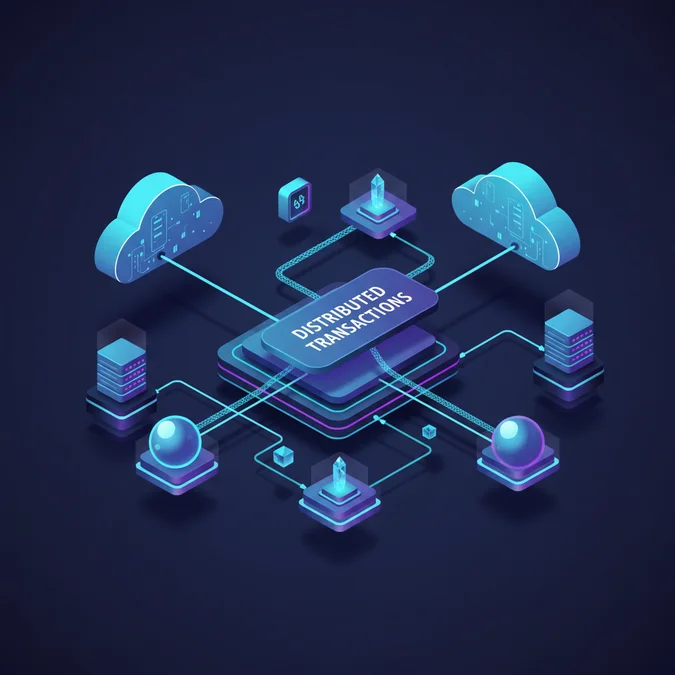

A distributed transaction fails silently at step three of four: the payment processor charges the customer, but the inventory service drops the allocation event due to a transient partition. The database lock on your local transaction released milliseconds earlier, leaving your architecture split between committed capital and unreserved physical goods. In a microservices landscape where distributed locking collapses throughput, traditional Two-Phase Commit is an anti-pattern that creates cascading availability outages.
The saga pattern solves this coordination failure by decomposing a distributed transaction into a sequence of isolated, local database transactions executed across service boundaries. Each step updates a local datastore and publishes an event or command that triggers the subsequent step. When a local transaction fails downstream, the pattern executes a compensating transaction sequence in reverse, retroactively rolling back changes to preserve eventual consistency without holding global locks.
However, running distributed transactions without centralized coordination introduces acute isolation anomalies, dual-write vulnerabilities, and the terrifying prospect of failed compensating steps. This engineering guide covers the mechanics of choreography versus orchestration, patterns for bridging the isolation gap, outbox table synchronization, and concrete strategies to prevent data corruption across distributed services in modern architectures.
Core Mechanics: What Is a Software Saga in Modern Systems?
Originally introduced in a 1987 research paper by Hector Garcia-Molina and Kenneth Salem, the software saga was conceived to handle Long-Living Transactions (LLTs) within centralized databases without exhausting connection pools or holding coarse-grained locks. In modern distributed architectures, the saga pattern has evolved into the standard blueprint for maintaining data consistency across independent microservices and Polyglot databases without coordinating distributed locking mechanisms.
Distributed Systems Rule: In distributed systems, Two-Phase Commit (2PC) guarantees immediate consistency (ACID) by blocking resources across the network until all participants vote to commit. This creates an availability ceiling governed by the product of individual service uptimes, turning the slowest network link into a global bottleneck. Sagas intentionally trade strict immediate consistency for high availability and low latency, guaranteeing eventual consistency through compensating logic.
+---------------------------------------------------------------------------------+
| TWO-PHASE COMMIT (2PC) vs SAGA |
+---------------------------------------------------------------------------------+
| 2PC (Synchronous, Locking): |
| Coordinator ---- Prepare ----> Service A (Holds Lock) |
| ---- Prepare ----> Service B (Holds Lock) |
| <--- OK --------- Service A |
| <--- OK --------- Service B |
| Coordinator ---- Commit -----> Service A (Releases Lock) |
| ---- Commit -----> Service B (Releases Lock) |
| |
| SAGA PATTERN (Asynchronous, Decoupled Local Transactions): |
| Service A [Commit T1] -- Event --> Service B [Commit T2] -- Event --> Service C |
| | |
| Error Occurs |
| v |
| Service A [<- Compensate C1] <-- Event -- Service B [<- Compensate C2] <--------+ |
+---------------------------------------------------------------------------------+
A saga structure consists of a directed sequence of local transactions: T1, T2.. Tn. Each local transaction Ti commits its state changes atomically within its own bounded context and database engine. If any step Tj encounters a business rule violation or unrecoverable error, the saga engine triggers a compensating transaction chain: Cj-1.. C2, C1, systematically undoing the effects of all preceding operations.
- Local Execution: Service 1 runs transaction
T1on its private database, committing immediately and emitting an event or command payload. - State Advancement: Downstream Service 2 receives the event, completes transaction
T2within its boundaries, and persists its internal state. - Terminal Failure: Service 3 encounters an unrecoverable failure during
T3(such as insufficient balance or inventory depletion). - Compensating Cascade: Failure signals trigger compensating transactions
C2on Service 2 andC1on Service 1, restoring the overall business state to an uncorrupted baseline.
Choreography vs Orchestration in the Microservices Saga Pattern
When implementing the microservices saga pattern, the foremost architectural decision is choosing between decentralized choreography and centralized orchestration. This decision dictates message topology, service ownership boundaries, operational debugging workflows, and blast radiuses across production teams.
Choreography relies on reactive event pub/sub. There is no central brain or master coordinator. Service A executes its local transaction and publishes a domain event to an asynchronous message broker like Apache Kafka or RabbitMQ. Service B listens for that domain event, executes its work, and publishes the next event. If Service C fails, it emits an alert event that prompts Service B and Service A to consume the message and run their compensating operations.
Conversely, orchestration introduces a dedicated coordinator service or workflow engine (such as Temporal, AWS Step Functions, or Camunda). The orchestrator maintains the global state machine, issues point-to-point commands to individual domain services, awaits responses, and decides whether to transition to the next state or initiate compensating rollback commands.
| Evaluation Vector | Event Choreography | Workflow Orchestration |
|---|---|---|
| Topology | Decentralized pub/sub (Kafka, RabbitMQ) | Centralized controller (Temporal, Step Functions) |
| Coupling | Loose coupling on domain events | Services coupled to command interfaces |
| End-to-End Latency | Extremely low (sub-15ms message passing) | Slight overhead (30ms to 100ms state engine transitions) |
| State Visibility | Distributed across service event logs | Single pane of glass in orchestrator state store |
| Testing Complexity | High; requires integration test suites or simulators | Low; state transitions unit-testable in isolation |
| Cyclic Dependencies | High risk of circular triggers at scale | None; directed acyclic graph (DAG) enforced |
| Blast Radius | Can cascade unnoticed across consumer fleets | Contained strictly within defined workflow executions |
To determine the proper design choice for your infrastructure, evaluate your team against the following architectural checklist:
- Choose Choreography when: Your transaction path contains four or fewer distinct steps, domain boundaries are mature, asynchronous event streams already drive business processes, and low end-to-end processing latency is paramount.
- Choose Orchestration when: Your workflow spans five or more distributed steps, business logic requires dynamic branch decision trees, you require point-in-time auditing of long-running steps, or transactions can stall for hours waiting for human approval or webhook callbacks.
Compensating Logic: Executing the Saga Pattern for Distributed Transactions
Unlike local RDBMS rollbacks that revert dirty write pages using the write-ahead log (WAL), compensating transactions in the saga pattern for distributed transactions are semantic forward adjustments. A compensating step does not physically restore a prior storage state. It creates a new transaction that programmatically counterbalances the business impact of a previously committed local action.
Critical Design Trap: Compensating transactions can fail. If a payment refund call times out, your system cannot merely throw an unhandled exception and terminate. The saga pattern assumes all compensations will eventually succeed. Therefore, all compensating actions must be engineered to be completely idempotent and resilient to infinite retry loops.
Engineers must categorize workflow steps into three distinct structural roles: Pivot Transactions, Retriable Transactions, and Compensatable Transactions. A Compensatable Transaction is any step that occurs before the point of no return; it requires a matching compensating task. The Pivot Transaction is the definitive moment of commitment. Once the pivot transaction completes, the overall saga cannot be aborted and must proceed forward. Any step after the pivot transaction is a Retriable Transaction, which cannot be compensated and must be retried with exponential backoff until it succeeds.
import time
import uuid
from typing import Dict, Any

class PaymentGatewayError(Exception):
 """Transient payment processing error."""
 pass

class SagaStep:
 def execute(self, payload: Dict[str, Any]) -> bool:
 raise NotImplementedError

 def compensate(self, payload: Dict[str, Any]) -> bool:
 raise NotImplementedError

class PaymentStep(SagaStep):
 def execute(self, payload: Dict[str, Any]) -> bool:
 idempotency_key = payload["payment_idempotency_key"]
 # Call payment processor with idempotency key
 print(f"[Payment] Charged ${payload['amount']} via key {idempotency_key}")
 return True

 def compensate(self, payload: Dict[str, Any]) -> bool:
 idempotency_key = f"refund_{payload['payment_idempotency_key']}"
 max_attempts = 5
 base_delay_seconds = 1

 for attempt in range(1, max_attempts + 1):
 try:
 # Compensations must retry aggressively until they succeed
 print(f"[Payment] Refunding attempt {attempt} for key {idempotency_key}")
 # Simulate external gateway call
 return True
 except PaymentGatewayError as exc:
 if attempt == max_attempts:
 print(f"[CRITICAL] Compensation failed permanently: {exc}. Routing to DLQ.")
 self._route_to_dead_letter_queue(payload)
 raise
 time.sleep(base_delay_seconds * (2 ** (attempt - 1)))
 return False

 def _route_to_dead_letter_queue(self, payload: Dict[str, Any]) -> None:
 # Write payload to dead-letter storage for manual intervention or runbook automation
 pass
When a compensating transaction times out, the workflow engine must invoke an exponential backoff routine with jitter. If maximum retries fail due to an unrecoverable validation defect, the payload must be pushed directly to a Dead Letter Queue (DLQ) paired with an alert that mobilizes on-call engineers or automated reconciliation workers.
Solving the Isolation Gap: The Saga Design Pattern in Microservices
The core structural vulnerability of the saga design pattern in microservices is the absence of distributed isolation. Sagas provide Atomicity (via compensation), Consistency (eventual), and Durability (via underlying datastores), but entirely lack the ACID ‘I’. Because every local transaction commits immediately to its respective database, uncommitted intermediate business states are visible to concurrent user threads and outside queries.
This absence introduces three primary data integrity anomalies that can corrupt business domains:
- Dirty Reads: Service A books a plane seat during step 1. Before step 2 fails and compensates step 1, a concurrent user views the seat as taken, resulting in false inventory depletion.
- Non-Repeatable Reads: Service A reads a customer discount tier. Concurrent transactions modify that tier before the saga reaches completion, producing mismatched transaction calculations.
- Lost Updates: Saga 1 overrides an account balance adjusted by concurrent Saga 2 without accounting for the intermediate delta, wiping out financial state transitions.
| Countermeasure Strategy | Operational Mechanism | Performance Cost | Primary Use Case |
|---|---|---|---|
| Semantic Locking | Applies an APPROVAL_PENDING or HELD status flag to records during active steps |
Low: negligible column update overhead | Order reservations, seat bookings, money movement |
| Commutative Updates | Orders operations mathematically so execution sequence does not alter final output | Zero: allows lock-free writes | Credit/debit aggregations, inventory count decrements |
| Pessimistic Versioning | Attaches monotonically incrementing sequence numbers to entity mutations | Medium: aborts outdated concurrent writes | Account profile updates, entitlement changes |
-- Example: Implementing a Semantic Lock in an Order Service
BEGIN;

-- Step 1: Insert the order not as APPROVED, but with a semantic lock state
INSERT INTO orders (
 id,
 user_id,
 total_cents,
 status,
 semantic_lock
) VALUES (
 '9b1deb4d-3b7d-4bad-9bdd-2b0d7b3dcb6d',
 'c20ad4d7-6a1e-45fa-bb38-ec7374b711e6',
 4999,
 'PENDING_PAYMENT',
 TRUE
);

-- Step 2: Prevent concurrent workflows from mutating this locked record
UPDATE user_credit_limits
SET available_credit_cents = available_credit_cents - 4999
WHERE user_id = 'c20ad4d7-6a1e-45fa-bb38-ec7374b711e6'
 AND available_credit_cents >= 4999;

COMMIT;

-- If subsequent saga steps succeed:
-- UPDATE orders SET status = 'CONFIRMED', semantic_lock = FALSE WHERE id = '..';

-- If downstream steps fail:
-- UPDATE orders SET status = 'CANCELLED', semantic_lock = FALSE WHERE id = '..';
By enforcing semantic locks, any concurrent transaction querying the entity encounters the lock flag and must either reject the operation, queue behind the lock, or gracefully present a pending state to the client interface.
Production Hardening: Pairing Sagas with the Transactional Outbox and Idempotency
A fatal point of failure in distributed sagas is the dual-write bug. If a service updates its local database and immediately executes an HTTP or AMQP message publish to advance the saga, one of the two actions will inevitably fail under network stress. If the database commit succeeds but the message broker goes down, the saga terminates midway, stranding downstream services. If the message publishes but the database write fails, downstream services process phantom actions.
To guarantee that local state updates and outgoing saga transitions are perfectly synchronized, production deployments must pair the saga engine with the Transactional Outbox pattern alongside strictly idempotent consumer handlers.
+---------------------------------------------------------------------------------+
| TRANSACTIONAL OUTBOX PIPELINE |
+---------------------------------------------------------------------------------+
| Service Boundary (Local ACID Transaction) |
| +-----------------------------------------------------------------------------+ |
| | BEGIN TRANSACTION; | |
| | 1. UPDATE accounts SET balance = balance - 100 WHERE id = 'user_123'; | |
| | 2. INSERT INTO outbox_events (id, aggregate_type, payload, status) | |
| | VALUES (gen_random_uuid(), 'ACCOUNT', '{"amount": 100}', 'PENDING'); | |
| | COMMIT; | |
| +-----------------------------------------------------------------------------+ |
| | |
| WAL Log Reader / Polling Agent |
| v |
| +-----------------------------------------------------------------------------+ |
| | Change Data Capture (Debezium / Tailer) reads outbox table commits | |
| | and streams events directly into Message Broker (Kafka topic: saga.commands)| |
| +-----------------------------------------------------------------------------+ |
| | |
| v |
| +-----------------------------------------------------------------------------+ |
| | Target Microservice / Orchestrator: Consumes message with Idempotency Key | |
| +-----------------------------------------------------------------------------+ |
+---------------------------------------------------------------------------------+- Single Local Commit: The service writes domain data and appends an event to an
outbox_eventstable within the exact same local ACID database transaction. - Asynchronous Relay: An independent Change Data Capture (CDC) worker such as Debezium, or a dedicated log tailer, captures the committed outbox records from the write-ahead log and pushes them to the messaging layer.
- Deduplication Guard: Downstream services consume the message using an idempotency key verification step before processing any application logic.
package main

import (
 "context"
 "database/sql"
 "errors"
 "fmt"
)

type ProcessPaymentCommand struct {
 EventID string
 TransactionID string
 AmountCents int64
 AccountID string
}

// HandleProcessPayment guarantees idempotent execution of saga commands
func HandleProcessPayment(ctx context.Context, db *sql.DB, cmd ProcessPaymentCommand) error {
 tx, err:= db.BeginTx(ctx, &sql.TxOptions{Isolation: sql.LevelReadCommitted})
 if err!= nil {
 return fmt.Errorf("failed to initialize tx: %w", err)
 }
 defer tx.Rollback()

 // Step 1: Idempotency check via unique event insertion
 query:= `INSERT INTO processed_events (event_id, processed_at) VALUES ($1, NOW()) ON CONFLICT (event_id) DO NOTHING`
 res, err:= tx.ExecContext(ctx, query, cmd.EventID)
 if err!= nil {
 return fmt.Errorf("error executing idempotency gate: %w", err)
 }

 rowsAffected, err:= res.RowsAffected()
 if err!= nil {
 return fmt.Errorf("error inspecting rows affected: %w", err)
 }
 if rowsAffected == 0 {
 // Message was already processed; exit cleanly without duplicating side-effects
 return nil
 }

 // Step 2: Execute actual domain mutation
 updateQuery:= `UPDATE accounts SET balance_cents = balance_cents - $1 WHERE id = $2 AND balance_cents >= $1`
 result, err:= tx.ExecContext(ctx, updateQuery, cmd.AmountCents, cmd.AccountID)
 if err!= nil {
 return fmt.Errorf("failed to debit account: %w", err)
 }

 affected, _:= result.RowsAffected()
 if affected == 0 {
 return errors.New("insufficient_funds")
 }

 // Step 3: Write response into outbox table inside same atomic transaction
 outboxQuery:= `INSERT INTO outbox_events (id, aggregate_id, event_type, payload) VALUES (gen_random_uuid(), $1, $2, $3)`
 _, err = tx.ExecContext(ctx, outboxQuery, cmd.TransactionID, "PAYMENT_PROCESSED", `{"status":"SUCCESS"}`)
 if err!= nil {
 return fmt.Errorf("failed to write outbox reply: %w", err)
 }

 return tx.Commit()
}
Implementing this dual pattern guarantees at-least-once message delivery while ensuring exactly-once processing behavior across every node in the saga chain.
Architectural Evaluation: When to Use Sagas and When to Avoid Them
The saga pattern is often misapplied as a universal default when migrating away from monoliths. Because sagas replace compile-time transactional safety with complex runtime recovery mechanisms, they incur heavy cognitive and operational tax. Engineering leaders must critically evaluate whether a distributed saga is strictly necessary, or whether the problem can be eliminated at the boundary design level.
- Avoid Sagas When Working within Single Datastores: If services can share a consolidated transactional database instance (even across distinct application schemas), standard local ACID transactions are vastly superior in performance, debuggability, and failure containment.
- Avoid Sagas When Low-Complexity Read-Repairs Suffice: If eventual consistency can be verified and fixed during consumer read operations (e.g. verifying cached balances against transactional logs on read), do not introduce multi-stage compensating workflows.
- Avoid Sagas in High-Contention Hotspots: Sagas struggle when thousands of concurrent transactions attempt to reserve the exact same resource (such as hot ticketing events). Semantic locks and compensation queues degrade rapidly under extreme lock contention.
- Use Sagas When Crossing Autonomous Network Boundaries: Apply sagas when transactions span independent third-party APIs (Stripe, Twilio, fulfillment centers), cross-cloud regions, or entirely discrete microservice teams with isolated data storage layers.
| Architecture Approach | Throughput (req/sec) | Operational Complexity | Consistency Level | Recovery Failure Mode |
|---|---|---|---|---|
| Monolithic ACID | 10,000+ | Low (Single WAL) | Immediate (Serial/Snapshot) | Automatic WAL rollback |
| Distributed 2PC | 100 to 500 | Very High (Blocking locks) | Immediate (Strict) | System hangs on coordinator failure |
| Choreographed Saga | 5,000 to 8,000 | Medium-High (Distributed tracing) | Eventual (ACD without I) | Compensating retries or DLQ triage |
| Orchestrated Saga | 2,000 to 5,000 | Medium (Workflow engine dependency) | Eventual (ACD without I) | Centralized recovery workflows |
Prioritize bounded context consolidation before opting for distributed sagas. If two microservices spend 80% of their operational cycles coordinating transactions across the network, they do not have independent domain models. Merge the services, preserve native transactional boundaries, and eliminate the architectural overhead entirely.
Frequently Asked Questions
What is the primary difference between 2PC and the saga pattern?
Two-Phase Commit relies on synchronous locks across distributed databases to ensure atomic ACID compliance, which limits throughput and creates single points of failure. The saga pattern for distributed transactions replaces global locking with a series of local transactions coordinated via messages, achieving eventual consistency through compensating steps.
How does a microservices saga pattern handle failed compensating transactions?
When a compensating transaction fails, systems must not simply abort. Instead, orchestrators use exponential backoff and retry policies until completion. If idempotency retries fail continuously, the microservices saga pattern workflow moves the transaction payload to a Dead Letter Queue for manual intervention or automated reconciliation.
Can a software saga provide full ACID transaction guarantees?
No. A software saga provides ACD guarantees: Atomicity (via compensation), Consistency (eventual), and Durability (via local databases), but lacks Isolation. Because intermediate states are visible immediately to concurrent requests, architects must implement semantic locks or version checks to guard against dirty reads.
When should you choose choreography over orchestration in a saga?
Choreography is optimal for simple, two-to-four step workflows with low operational overhead where services react directly to domain events. Orchestration is preferred when using a saga design pattern in microservices that requires complex, multi-step transactions, centralized state visibility, deterministic timeouts, auditability, and sophisticated compensation logic.
The saga pattern remains the standard architectural approach for managing distributed transactions across decentralized microservices. By trading synchronous locking for asynchronous local executions and deterministic compensating logic, sagas deliver high system availability and low latency at scale. However, this model shifts the burden of transaction isolation, dual-write prevention, and compensation recovery onto application engineers.
Building resilient sagas requires rigorous production hardening: pairing state updates with the Transactional Outbox pattern, enforcing strict consumer idempotency, and applying semantic locks to close the isolation gap. Before committing to a distributed saga implementation, rigorously inspect your domain boundaries. If service consolidation or native single-database ACID semantics are viable, favor simplicity. Where distributed boundaries are non-negotiable, design your transactions around backward and forward recovery from day one.