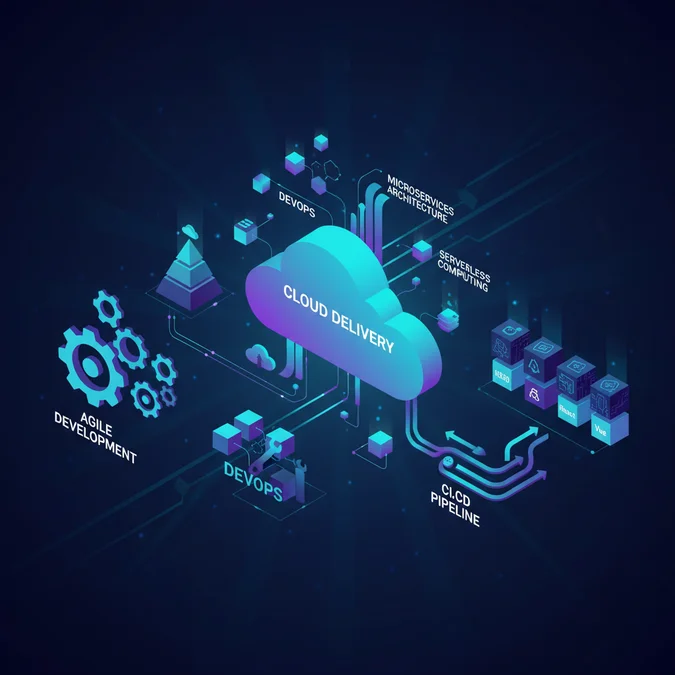

Rapid application development platforms are integrated software development ecosystems that provide pre-built scaffolding, declarative data modeling, automatic API generation, and runtime abstractions to compress delivery cycles without sacrificing programmatic control. Modern platforms combine code generation with opinionated framework conventions to eliminate repetitive infrastructural boilerplate.
Framework maintainers across major ecosystems are officially orienting modern application platforms toward composable, hybrid architectures. Rather than locking developers into closed-source visual builders, the current technical roadmap emphasizes declarative domain modeling, integrated type safety, and first-party toolchains that run entirely on native codebases. This approach positions developer velocity and production performance as complementary system properties rather than architectural compromises.
Core Architectural Mechanics of Rapid Development Platforms
At their technical foundation, rapid application development platforms abstract the standard request-response lifecycle through unified application metadata. Instead of manually engineering database migrations, object-relational mapping (ORM) entities, validation contracts, and administrative controllers as discrete units of work, the platform parses a centralized schema definition. This model-driven engine dynamically resolves database mutations and web presentation layers during runtime or generates compiled source files during deployment phases.
The underlying execution pipeline relies on four tightly coupled structural components:
- Unified Schema Compilers: Parsers that translate declarative data contracts (JSON, YAML, or native PHP/Python classes) into transactional SQL migrations, index configurations, and foreign key constraints.
- Automated Data Access Layers: Metaprogramming interfaces that construct parameterized SQL queries, handle hydrate cycles, and optimize relational graph joins without raw string assembly.
- State-Driven Interface Adapters: Server-driven UI components that automatically sync frontend states with backend state machines over high-throughput protocols like WebSockets or optimized JSON payloads.
- Declarative Security Gateways: Policy-based access layers that evaluate role-based authorization, sanitization rules, and cryptographic CSRF signatures prior to controller dispatch.
By decoupling business logic from infrastructural plumb lines, memory allocations and socket overhead are centralized within tested kernel layers. When engineered properly, this minimizes human error in high-throughput database interactions while providing native extension hooks for custom service classes.
Low-Code Frameworks vs Code-First Application Platforms
System architects frequently conflate visual drag-and-drop low-code tools with programmatic rapid development platforms. Low-code builders hide execution mechanics behind proprietary runtimes, resulting in strict database schema limits, memory bloat, and rigid vendor lock-in. Conversely, code-first rapid platforms supply opinionated scaffolding that compiles into clean, auditable repository files that developers can inspect, refactor, and profile.
| Evaluation Metric | Proprietary Low-Code Runtimes | Code-First Platforms (e.g. Laravel, Rails) |
|---|---|---|
| Underlying Runtime | Black-box vendor engines or sandboxed containers | Native PHP, Ruby, Python, or Go runtimes |
| Extensibility | Constrained to platform webhook and plugin APIs | Arbitrary native code, custom libraries, C extensions |
| Version Control | Proprietary revision histories or binary diffs | Standard Git branching, pull requests, CI/CD pipelines |
| Query Tuning | Minimal to zero visibility into execution plans | Full access to SQL query logs, EXPLAIN plans, custom raw bindings |
| Runtime Memory Footprint | High baseline overhead due to generic UI metadata engines | Deterministic memory footprint controlled by the application profiler |
Architecting for longevity requires evaluating these boundaries before technical debt accumulates. While visual tools deliver quick initial prototypes, they break down when relational queries demand complex foreign key partitioning, cursor pagination, or asynchronous concurrency queues.
Laravel as a Code-First Rapid Application Platform
Within modern backend ecosystems, the Laravel ecosystem exemplifies a code-first rapid development platform. Instead of imposing an unfamiliar visual builder, it offers a suite of battle-tested components that solve standard full-stack operational demands: Eloquent for ORM persistence, Artisan for schema orchestration, and integrated tooling like Nova and Filament for instantaneous admin administration panel composition.
The platform eliminates weeks of routine scaffolding via declarative abstractions. To manage complex lifecycle mutations cleanly, engineers often implement event handling patterns using observers to separate domain audits and peripheral syncs from primary transactional workflows. This separation preserves system maintainability as domain models expand over time.
Furthermore, native tooling like Laravel Octane changes the performance calculus by keeping the entire application framework resident in memory across incoming requests via Swoole or RoadRunner. Bootstrapping overhead, service container bindings, and configuration caching occur once on process initialization, yielding sub-millisecond response baselines for typical CRUD operations without forfeiting high-level abstractions.
Schema-Driven Scaffolding and Declarative Data Modeling
A high-velocity platform is only as resilient as its underlying data modeling paradigm. Declarative schema builders allow developers to specify entity configurations, indexes, and cascades through programmatic APIs that directly manage relational integrity. This eliminates brittle raw SQL migration drifts across distinct team branches.
Consider an enterprise tenancy schema where organizational partitions require immediate tenant indexing, audit tracking, and dynamic soft deletes. A code-first platform handles these constraints cleanly in version-controlled PHP definitions:
<php

declare(strict_types=1);

use Illuminate\Database\Migrations\Migration;
use Illuminate\Database\Schema\Blueprint;
use Illuminate\Support\Facades\Schema;

return new class extends Migration
{
 public function up(): void
 {
 Schema:create('tenant_invoices', function (Blueprint $table) {
 $table->uuid('id')->primary();
 $table->uuid('tenant_id')->index();
 $table->foreignId('customer_id')->constrained()->cascadeOnDelete();
 $table->string('invoice_number')->unique();
 $table->decimal('subtotal_amount', 12, 4);
 $table->decimal('tax_amount', 12, 4);
 $table->decimal('total_amount', 12, 4);
 $table->string('status', 32)->default('draft')->index();
 $table->jsonb('metadata')->nullable();
 $table->timestamps();
 $table->softDeletes();

 // Composite index to accelerate high-frequency tenant ledger queries
 $table->index(['tenant_id', 'status', 'created_at']);
 });
 }

 public function down(): void
 {
 Schema:dropIfExists('tenant_invoices');
 }
};
Declarative migrations like this compile directly to platform-specific DDL variants while maintaining exact alignment with ORM entity scopes. Because the schema declaration is native code, static analysis suites like PHPStan and Psalm can inspect database definitions upstream during continuous integration.
Database Performance and Query Optimization Strategies
Rapid application platforms often trade database efficiency for speed of authoring. When boilerplate CRUD operations are generated automatically, developers frequently introduce N+1 query loops, unindexed JOIN operations, and runaway memory usage during pagination. Maintaining high throughput requires explicit controls at the ORM abstraction layer.
Key optimization patterns include:
- Eager Loading Constraints: Forcing declarative relational joins at compile or query construction time to prevent secondary round trips to the database connection pool.
- Deferred and Cursor Pagination: Replacing expensive
OFFSETpagination models with cursor checkpoints that query indexed columns (such as auto-incrementing keys or timestamp sequences), reducing row scanning costs to O(1). - Selective Projection: Halting the default practice of fetching wildcard schemas (
SELECT *) by targeting only the columns consumed by the presentation layer, drastically shrinking network transport and object hydration overhead.
The code below demonstrates constructing an optimized cursor query designed to extract transactional data without exhausting heap memory buffers:
<php

declare(strict_types=1);

namespace App\Services;

use App\Models\TenantInvoice;
use Illuminate\Pagination\CursorPaginator;

final class InvoiceQueryService
{
 /**
 * Retrieve paginated tenant invoices utilizing indexed cursor points.
 */
 public function getPaginatedLedger(string $tenantId, int $perPage = 50): CursorPaginator
 {
 return TenantInvoice:query()
 ->select(['id', 'tenant_id', 'invoice_number', 'total_amount', 'status', 'created_at'])
 ->where('tenant_id', $tenantId)
 ->where('status', '!=', 'archived')
 // Utilizes composite index: [tenant_id, status, created_at]
 ->orderBy('created_at', 'desc')
 ->cursorPaginate($perPage);
 }
}
By bypassing standard offset scanning, this pattern protects PostgreSQL or MySQL memory caches from churn, even when processing sets with hundreds of thousands of historical records.
Managing Memory Footprints in Pre-Packaged Ecosystems
Rapid application platforms incorporate substantial dependency graphs to cover HTTP parsing, templating, session state, caching, and cryptographic tasks. In standard short-lived runtime paradigms, this results in significant file system I/O and object construction overhead on every single HTTP cycle. Left unmonitored, baseline memory allocations can easily exceed 30MB per request.
To mitigate runtime bloat while retaining high framework velocity, backend teams must actively tune their dependency injection graphs. Binding heavy service layers as singletons, stripping unused middleware pipelines, and disabling debugging telemetry in production environments drastically lowers per-worker memory saturation.
Furthermore, memory leaks represent a unique threat in long-running environments such as Swoole, FrankenPHP, or RoadRunner. Because worker processes remain in memory over tens of thousands of requests, stateful variables accidentally captured in static scopes or global singletons will slowly exhaust memory limits. Automated memory profiling within staging environments ensures that class properties and model hydrations cleanly dereference upon response dispatch.
Automating API Generation and Serialization Contracts
A cornerstone capability of any modern rapid application platform is automated API generation. Instead of manually engineering individual controllers, response serializers, and Swagger/OpenAPI documentation definitions, the platform leverages existing schema definitions to publish fully compliant REST or GraphQL endpoints.
However, blind serialization of ORM models leaks internal implementation details, such as password hashes, foreign key IDs, or raw timestamps. Enterprise application platforms counter this through strict resource transformation classes that establish immutable serialization boundaries:
<php

declare(strict_types=1);

namespace App\Http\Resources;

use Illuminate\Http\Request;
use Illuminate\Http\Resources\Json\JsonResource;

final class InvoiceResource extends JsonResource
{
 /**
 * Transform the resource into an API-safe array.
 */
 public function toArray(Request $request): array
 {
 return [
 'type' => 'invoices',
 'id' => (string) $this->id,
 'attributes' => [
 'invoice_number' => $this->invoice_number,
 'total_amount' => (float) $this->total_amount,
 'status' => $this->status,
 'issued_at' => $this->created_at->toISOString(),
 ],
 'links' => [
 'self' => route('api.v1.invoices.show', ['id' => $this->id]),
 ],
 ];
 }
}
These resource layers provide high throughput by mapping database models directly into lightweight JSON arrays without running intermediary nested transforms. They also support strict schema validation for inbound request payloads, ensuring incoming data is sanitized before reaching core persistence layers.
Security Implications: Guardrails vs Scaffolding Defaults
The core velocity advantage of rapid platforms creates unique security trade-offs. Default configurations generated by scaffolding engines frequently favor developer convenience over strict boundary enforcement. For instance, blanket mass-assignment settings, overly permissive Cross-Origin Resource Sharing (CORS) rules, and default sessions stored in plaintext files are common pitfalls.
To build secure software on top of rapid application engines, engineers must enforce explicit application boundaries:
- Strict Mass-Assignment Prevention: Forbid dynamic attribute injection across all ORM models to stop malicious parameter overriding.
- Rate Limiting and Throttling: Enforce Redis-backed IP and user-level throttling on all public-facing endpoints to shield the database from connection exhaustion.
- Automated Dependency Auditing: Incorporate static security analyzers in CI/CD pipelines to scan package manifests (e.g. Composer or npm locks) for known vulnerabilities.
- Scoped Authorization Policies: Ensure every single generated route passes through explicit access control matrices, verifying that authenticated users can only view entities belonging to their explicit organizational domain.
Relying on out-of-the-box scaffolding without hardening configuration options invites systemic data breaches. Real-world security requires layering explicit domain policies directly on top of the generic platform primitives.
Production Deployment and Infrastructure Architecture
Deploying software generated on rapid development platforms requires infrastructure that supports both static file compilation and dynamic runtime persistence. While simple monolithic apps can function on basic single-instance servers, resilient architectures decouple the presentation tier from persistent worker and database dependencies.
For teams looking to deploy custom instances without excessive managed service premiums, following a battle-tested infrastructure guide for server deployments provides the necessary blueprint for configuring systemd daemons, OPcache buffers, Nginx reverse proxies, and automated zero-downtime release scripts.
A resilient deployment pipeline separates production concerns into discrete, autoscaling tiers:
- Stateless Web Servers: Ephemeral compute instances running high-performance PHP-FPM, RoadRunner, or Swoole workers behind a global load balancer.
- Asynchronous Job Workers: Dedicated compute clusters running queue workers (via Redis or Amazon SQS) to process background tasks without delaying client HTTP lifecycles.
- Managed Relational Clusters: Highly available database instances configured with primary-replica replication and connection poolers like PgBouncer or ProxySQL.
- Centralized Object Storage: External, S3-compatible cloud storage layers holding all user-generated assets, ensuring the core container images remain completely stateless.
Decoupling these components allows engineering teams to scale individual application tiers according to precise bottlenecks, rather than universally over-provisioning standard hardware instances.
Long-Term Maintainability and Avoiding Scaffolding Debt
The ultimate failure mode of rapid application development platforms is scaffolding debt: the state where early velocity gains turn into structural paralysis because code generation generated massive amounts of repetitive boilerplate that cannot be cleanly refactored. When new features require alterations across hundreds of auto-generated controllers and forms, the platform has failed its primary objective.
To maintain long-term architectural stability, development teams must treat platform-generated code as disposable infrastructure. As soon as a business domain exhibits non-standard complexity, developers should extract those operations into dedicated Domain Service classes, Command Handlers, and Action objects.
Adhering to strict architectural layering prevents the framework from invading core business rules. Controllers and framework routes should act solely as HTTP dispatchers, passing validated inputs into framework-agnostic domain services. When your core domain models do not extend platform-specific database adapters, the underlying application can withstand upstream framework upgrades, major version transitions, and performance refactoring with minimal risk of breaking critical business logic.
Mastering the Fundamentals of Modern PHP Platforms
Developing resilient, highly maintainable systems requires a thorough grasp of the underlying platform runtime, its configuration patterns, and its service architecture. As framework-driven development becomes the standard for modern backend development, mastering these patterns ensures your engineering team can deliver production software rapidly without accumulating technical debt.
Explore our complete Laravel, Basics directory for more guides.
Rapid application development platforms offer unprecedented engineering velocity when their abstractions are paired with disciplined system architecture. By choosing code-first ecosystems that preserve native language ergonomics, teams avoid the structural traps of visual builders while bypassing months of tedious boilerplate setup. The true value of these platforms lies in their ability to accelerate foundational work without capping downstream performance or maintainability.
Ultimately, long-term engineering success depends on active stewardship of the underlying database, runtime memory allocations, and security perimeters. Treating platform abstractions as configurable launchpads rather than rigid operational containers ensures that systems scale seamlessly alongside user demand, delivering high reliability from the initial prototype all the way through enterprise production.