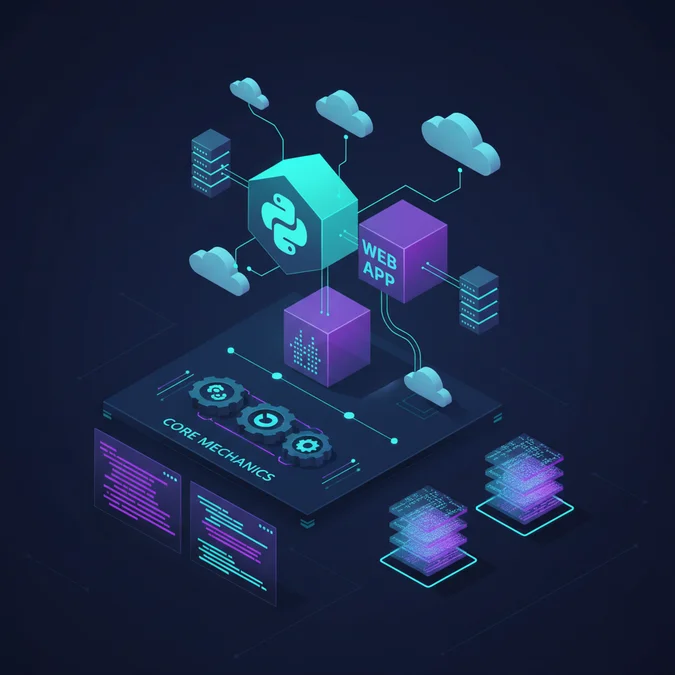

Python for backend development involves building server-side logic, APIs, and database interactions that power web applications and services. Its simplicity, vast ecosystem, and robust frameworks make it an exceptionally efficient choice for creating scalable, maintainable, and high-performance backend systems across various industries.
This article provides a practitioner-level guide to leveraging Python for backend development, covering everything from foundational architectural choices to advanced deployment strategies. We will explore essential frameworks like Django, Flask, and FastAPI, demonstrate practical code implementations, and discuss critical considerations for API design, security, and performance optimization. Our goal is to equip you with the knowledge and best practices necessary to architect and build robust Python backend applications that meet modern demands.
Introduction to Python Backend Development: Why Choose Python?
Python’s ascent in the realm of server-side programming is undeniable, making it a premier choice for backend development. Its clear, readable syntax significantly reduces development time and enhances code maintainability, which is crucial for complex applications. When considering `python for backend development`, developers often cite its versatility and the availability of powerful tools.
Python’s readability and extensive ecosystem accelerate development cycles and improve long-term project maintainability, making it ideal for robust backend systems.
The core advantages of using `python for backend` include:
- Rapid Development: Python’s high-level nature and rich standard library allow developers to write less code to achieve more, speeding up the development process.
- Vast Ecosystem and Libraries: From database connectors to machine learning libraries, Python boasts a comprehensive collection of third-party packages that can be easily integrated, reducing the need to write code from scratch.
- Scalability: While often debated, Python, especially with asynchronous frameworks and proper architectural patterns, can scale to handle significant loads.
- Community Support: A large and active community contributes to extensive documentation, tutorials, and readily available solutions for common challenges.
- Interoperability: Python integrates seamlessly with other languages and technologies, making it suitable for microservices architectures and existing system integrations.
These factors combine to make `python for backend development` a compelling proposition for startups and large enterprises alike, enabling the creation of powerful, data-driven applications.
Essential Python Backend Frameworks: Deep Dive & Comparison
Choosing the right framework is paramount for successful `python for backend development`. Each framework caters to different project requirements, development philosophies, and performance needs. Here, we delve into the three most prominent Python backend frameworks: Django, Flask, and FastAPI, providing a comparative analysis and practical code examples.
Django: The “Batteries Included” Framework
Django is a high-level Python web framework that encourages rapid development and clean, pragmatic design. It’s renowned for its “batteries included” philosophy, offering an ORM, admin panel, authentication system, and more out of the box. This makes it ideal for complex, data-driven applications where a full-stack solution is preferred.
# Django: A simple model and view

# models.py

from django.db import models
class Product(models.Model):
name = models.CharField(max_length=200)
price = models.DecimalField(max_digits=6, decimal_places=2)
def __str__(self):
return self.name
# views.py
from django.http import JsonResponse
from .models import Product
def product_list(request):
products = list(Product.objects.values(‘id’, ‘name’, ‘price’))
return JsonResponse({‘products’: products})
Flask: The Lightweight Microframework
Flask is a microframework for `python for backend development`. It provides the essentials for building web applications without imposing specific tools or libraries. Its lightweight nature offers maximum flexibility, making it perfect for small to medium-sized applications, APIs, and microservices where developers prefer to choose their own components.
# Flask: A basic API endpoint

from flask import Flask, jsonify
app = Flask(__name__)
products_db = [
{“id”: 1, “name”: “Laptop”, “price”: 1200.00},
{“id”: 2, “name”: “Mouse”, “price”: 25.00}
]
@app.route(‘/api/products’, methods=[‘GET’])
def get_products():
return jsonify(products_db)
if __name__ == ‘__main__’:
app.run(debug=True)
FastAPI: Modern, Fast, and Asynchronous
FastAPI is a relatively new, high-performance web framework for building APIs with Python 3.7+ based on standard Python type hints. It leverages Starlette for web parts and Pydantic for data validation and serialization, offering automatic interactive API documentation (Swagger UI/ReDoc). FastAPI is an excellent choice for building high-performance APIs and `python for backend` microservices that benefit from asynchronous operations.
# FastAPI: A simple asynchronous endpoint with Pydantic

from fastapi import FastAPI

from pydantic import BaseModel

from typing import List
app = FastAPI()
class Product(BaseModel):
id: int
name: str
price: float
products_db: List[Product] = [
Product(id=1, name=”Keyboard”, price=75.50),
Product(id=2, name=”Monitor”, price=300.00)
]
@app.get(‘/api/products’, response_model=List[Product])
async def get_products():
return products_db
Framework Comparison Table
| Feature | Django | Flask | FastAPI |
|---|---|---|---|
| Type | Full-stack Framework | Microframework | API Framework |
| Learning Curve | Moderate to High | Low to Moderate | Low to Moderate |
| Built-in Features | ORM, Admin, Auth, Templating | Minimal, Extension-based | Data Validation, Async, Docs |
| Performance | Good (Synchronous) | Good (Synchronous) | Excellent (Asynchronous) |
| Use Cases | Complex web apps, CMS, CRM | Small APIs, microservices, prototypes | High-performance APIs, microservices |
| Key Advantage | “Batteries included,” rapid full-stack dev | Flexibility, control over components | Speed, async support, automatic docs |
Each framework excels in different scenarios. Django provides a robust foundation for large applications, Flask offers unparalleled freedom for custom solutions, and FastAPI delivers modern, high-performance API development, solidifying Python’s versatility in backend engineering.
Building a Python Backend Application: Architecture & Code Examples
Architecting a `python for backend development` application effectively involves making critical decisions about structure, data flow, and component interaction. A well-designed architecture ensures scalability, maintainability, and performance. Here, we outline common architectural patterns and demonstrate practical implementation steps.
Common Architectural Patterns
- Monolithic Architecture: A single, unified codebase where all components are tightly coupled. Simpler to develop initially but can become challenging to scale and maintain for very large applications.
- Microservices Architecture: The application is broken down into small, independent services that communicate via APIs. Offers greater scalability, fault isolation, and technology flexibility, ideal for complex `python for backend` systems.
- Layered Architecture (N-tier): Divides the application into logical layers (e.g., presentation, business logic, data access). Promotes separation of concerns and easier management.
For most modern `python for backend development` projects, a microservices or layered approach within a monolithic structure (if starting small) is recommended for better modularity.
Step-by-Step Backend Application Structure
Let’s consider a simple FastAPI application demonstrating a layered structure with database integration.
- Project Setup: Create a virtual environment and install FastAPI, Uvicorn, and a database driver (e.g.,
SQLAlchemyfor PostgreSQL). - Database Model Definition (
models.py): Define your data structures using SQLAlchemy ORM. - Schema Definition (
schemas.py): Use Pydantic for data validation and serialization. - API Endpoints (
main.py): Implement CRUD operations using FastAPI, injecting database sessions.
mkdir my_backend_app

cd my_backend_app

python -m venv venv

source venv/bin/activate

pip install fastapi uvicorn 'psycopg2-binary' 'SQLAlchemy'
# models.py

from sqlalchemy import Column, Integer, String, Float, create_engine

from sqlalchemy.ext.declarative import declarative_base

from sqlalchemy.orm import sessionmaker
DATABASE_URL = “postgresql://user:password@host:port/dbname”
engine = create_engine(DATABASE_URL)
SessionLocal = sessionmaker(autocommit=False, autoflush=False, bind=engine)
Base = declarative_base()
class Item(Base):
__tablename__ = “items”
id = Column(Integer, primary_key=True, index=True)
name = Column(String, index=True)
description = Column(String, nullable=True)
price = Column(Float)
# Call Base.metadata.create_all(engine) to create tables
# schemas.py

from pydantic import BaseModel

from typing import Optional
class ItemBase(BaseModel):
name: str
description: Optional[str] = None
price: float
class ItemCreate(ItemBase):
pass
class Item(ItemBase):
id: int
class Config:
orm_mode = True
# main.py

from fastapi import FastAPI, Depends, HTTPException

from sqlalchemy.orm import Session

import models, schemas
app = FastAPI()
def get_db():
db = models.SessionLocal()
try:
yield db
finally:
db.close()
@app.post(“/items/”, response_model=schemas.Item)
def create_item(item: schemas.ItemCreate, db: Session = Depends(get_db)):
db_item = models.Item(**item.dict())
db.add(db_item)
db.commit()
db.refresh(db_item)
return db_item
@app.get(“/items/”, response_model=list[schemas.Item])
def read_items(skip: int = 0, limit: int = 10, db: Session = Depends(get_db)):
items = db.query(models.Item).offset(skip).limit(limit).all()
return items
# To run: uvicorn main:app –reload
Effective architecture in Python backend development prioritizes modularity, clear separation of concerns, and robust data handling, enabling applications to evolve and scale gracefully.
This structured approach ensures that your `python for backend` application is organized, testable, and scalable, laying a solid foundation for future enhancements.
Modern Deployment Strategies for Python Backends
Deploying a `python for backend development` application requires careful consideration of infrastructure, scalability, and maintenance. Modern practices emphasize containerization and cloud-native solutions to ensure reliability and efficiency. This section covers key deployment strategies.
Containerization with Docker
Docker has become the de facto standard for packaging applications and their dependencies into portable containers. This ensures consistency across different environments, from development to production. For `python for backend` applications, Docker simplifies dependency management and environment setup.
Docker Deployment Checklist:
- Define a
Dockerfilefor your application. - Create a
.dockerignorefile to exclude unnecessary files. - Build the Docker image.
- Run the Docker container, mapping ports.
- Consider Docker Compose for multi-service applications (e.g., app + database).
# Dockerfile example for a FastAPI application

FROM python:3.9-slim-buster
WORKDIR /app
COPY requirements.txt .
RUN pip install –no-cache-dir -r requirements.txt
COPY . .
CMD [“uvicorn”, “main:app”, “–host”, “0.0.0.0”, “–port”, “80”]
Cloud Platforms: AWS, GCP, Azure
Major cloud providers offer robust services for deploying `python for backend development` applications, providing scalability, managed databases, and global reach.
- AWS (Amazon Web Services): Services like EC2 (virtual servers), ECS/EKS (container orchestration), Lambda (serverless functions), and Elastic Beanstalk (PaaS) are popular for Python deployments.
- GCP (Google Cloud Platform): App Engine (PaaS), Cloud Run (serverless containers), GKE (Kubernetes), and Compute Engine (VMs) offer flexible deployment options.
- Azure (Microsoft Azure): Azure App Service (PaaS), Azure Kubernetes Service (AKS), and Azure Functions (serverless) provide comprehensive solutions for Python backends.
Choosing a cloud platform often depends on existing infrastructure, team expertise, and specific service requirements.
Serverless Architectures
Serverless computing, such as AWS Lambda, Google Cloud Functions, or Azure Functions, allows developers to run `python for backend` code without provisioning or managing servers. You only pay for the compute time consumed. This is ideal for event-driven architectures, APIs with spiky traffic, and microservices.
# AWS Lambda handler for a simple Python function

import json
def lambda_handler(event, context):
# Your Python backend logic here
message = “Hello from Python Lambda!”
return {
‘statusCode’: 200,
‘body’: json.dumps(message)
}
Modern deployment strategies for `python for backend development` focus on automation, scalability, and cost-efficiency, moving away from manual server management towards infrastructure as code and managed services.
API Design, Security, and Performance in Python Backends
Beyond functionality, a successful `python for backend development` project hinges on well-designed APIs, robust security, and optimal performance. These aspects are critical for user experience, data integrity, and operational efficiency.
API Design Principles
Effective API design ensures ease of use, consistency, and clear communication between clients and the `python for backend`. Two prevalent paradigms are RESTful and GraphQL.
- RESTful APIs: Representational State Transfer (REST) uses standard HTTP methods (GET, POST, PUT, DELETE) to perform operations on resources identified by URLs. They are stateless and widely adopted for their simplicity and cacheability.
- GraphQL APIs: Allows clients to request exactly the data they need, avoiding over-fetching or under-fetching. This can reduce network overhead and improve client-side performance, especially for complex data relationships.
Prioritizing clear, consistent API design, robust security measures, and continuous performance optimization is non-negotiable for any production-grade Python backend application.
Security Best Practices
Security is paramount in `python for backend development`. Common vulnerabilities must be mitigated.
- Authentication & Authorization: Implement robust user authentication (e.g., OAuth 2.0, JWT) and authorization mechanisms to control access to resources.
- Input Validation: Always validate and sanitize user input to prevent injection attacks (SQL injection, XSS).
- HTTPS: Enforce HTTPS for all communication to encrypt data in transit.
- Rate Limiting: Protect against brute-force attacks and API abuse by limiting the number of requests a client can make in a given period.
- Dependency Security: Regularly update and audit third-party libraries for known vulnerabilities. Tools like
safetycan help.
# Example: Basic JWT authentication in Flask (simplified)

# This is a conceptual snippet; a full implementation requires more layers.

from flask import Flask, request, jsonify

import jwt

import datetime
app = Flask(__name__)
app.config[‘SECRET_KEY’] = ‘your-secret-key’
@app.route(‘/login’, methods=[‘POST’])
def login():
username = request.json.get(‘username’, None)
password = request.json.get(‘password’, None)
if username == ‘user’ and password == ‘pass’:
token = jwt.encode({
‘user’: username,
‘exp’: datetime.datetime.utcnow() + datetime.timedelta(minutes=30)
}, app.config[‘SECRET_KEY’], algorithm=’HS256′)
return jsonify({‘token’: token})
return jsonify({‘message’: ‘Invalid credentials’}), 401
@app.route(‘/protected’, methods=[‘GET’])
def protected():
token = request.headers.get(‘Authorization’)
if not token or not token.startswith(‘Bearer ‘):
return jsonify({‘message’: ‘Token is missing!’}), 403
try:
data = jwt.decode(token[7:], app.config[‘SECRET_KEY’], algorithms=[‘HS256’])
return jsonify({‘message’: f”Hello, {data[‘user’]}! This is protected data.”})
except:
return jsonify({‘message’: ‘Token is invalid!’}), 403
Performance Optimization
Optimizing `python for backend` performance ensures responsiveness and scalability.
- Asynchronous Programming: Utilize
asynciowith frameworks like FastAPI to handle concurrent I/O operations efficiently, preventing blocking calls. - Caching: Implement caching mechanisms (e.g., Redis, Memcached) for frequently accessed data to reduce database load and response times.
- Database Optimization: Optimize database queries, use appropriate indexing, and consider connection pooling.
- Load Balancing: Distribute incoming traffic across multiple instances of your `python for backend` application to prevent single points of failure and improve throughput.
- Profiling: Use Python’s built-in profilers (e.g.,
cProfile) or third-party tools to identify performance bottlenecks in your code.
By meticulously addressing API design, security, and performance, developers can build robust and efficient `python for backend development` applications that stand the test of time and scale.
Frequently Asked Questions
Why is Python a good choice for backend development?
Python is an excellent choice for backend development due to its readability, extensive libraries, and powerful frameworks like Django and Flask. It supports rapid development, integrates well with other technologies, and offers a large, supportive community, making it versatile for various web applications and APIs.
What are the best Python frameworks for backend development?
The best Python frameworks for backend development include Django for robust, full-stack applications; Flask for lightweight, flexible APIs; and FastAPI for high-performance, modern web services. Each offers distinct advantages depending on project scale, performance needs, and development preferences.
Mastering `python for backend development` requires a holistic understanding of architectural patterns, framework choices, deployment strategies, and crucial non-functional requirements like security and performance. We have explored the compelling reasons to choose Python, examined leading frameworks like Django, Flask, and FastAPI, and provided practical insights into building and deploying robust backend systems.
By applying the principles and best practices discussed, from structured application design to modern cloud deployments and rigorous API security, engineers can build highly efficient and scalable `python for backend` applications. The versatility and rich ecosystem of Python continue to make it an invaluable asset in the evolving landscape of backend engineering.
NR Studio builds custom web apps, mobile apps, SaaS platforms, and internal tools for growing businesses. If you’re working through a technical decision, feel free to reach out — no commitment required.