
A NoSQL database, or ‘Not Only SQL’ database, is a non-relational data store offering flexible schemas, horizontal scalability, and diverse data models optimized for modern application requirements. It moves beyond the rigid structure of traditional relational databases to handle large volumes of unstructured or semi-structured data efficiently.
This article provides a practitioner’s guide to NoSQL databases, delving into their fundamental concepts, architectural paradigms, and the distinct categories that define this versatile class of data management systems. We will explore the motivations behind their adoption, analyze their core mechanics, and offer practical insights into when and how to leverage them effectively in enterprise-grade applications.
What is a NoSQL Database? Understanding Non-Relational and Not Only SQL
At its core, what is NoSQL refers to a class of database management systems that do not adhere to the traditional relational model, which relies on fixed schemas and SQL for data manipulation. The term has evolved significantly since its inception.
Initially, NoSQL stood for ‘No SQL’, emphasizing a complete departure from SQL. However, the more contemporary and accurate interpretation is ‘Not Only SQL‘. This nuanced definition acknowledges that while these databases are fundamentally non-relational database systems, some may offer SQL-like query interfaces or coexist seamlessly within ecosystems that also utilize relational databases. This ‘not only SQL‘ perspective highlights their flexibility rather than a strict exclusion of SQL.
The fundamental shift from relational databases stems from their need to address limitations in scalability, flexibility, and performance when dealing with massive datasets, rapidly changing data structures, and the demands of modern web and mobile applications. Traditional relational databases, while excellent for structured data and complex transactions requiring strong ACID properties, often face challenges scaling horizontally without significant architectural complexity. A non relational db, by contrast, is designed from the ground up for distributed environments and schema flexibility.
Key characteristics that differentiate NoSQL databases include:
- Flexible Schema: Unlike relational databases that require a predefined schema, NoSQL databases often allow for schema-less or dynamic schemas, making them ideal for handling unstructured and semi-structured data.
- Horizontal Scalability: Most NoSQL databases are designed for horizontal scaling, distributing data across many servers to handle increased load and data volume, often more cost-effectively than scaling up a single relational database server.
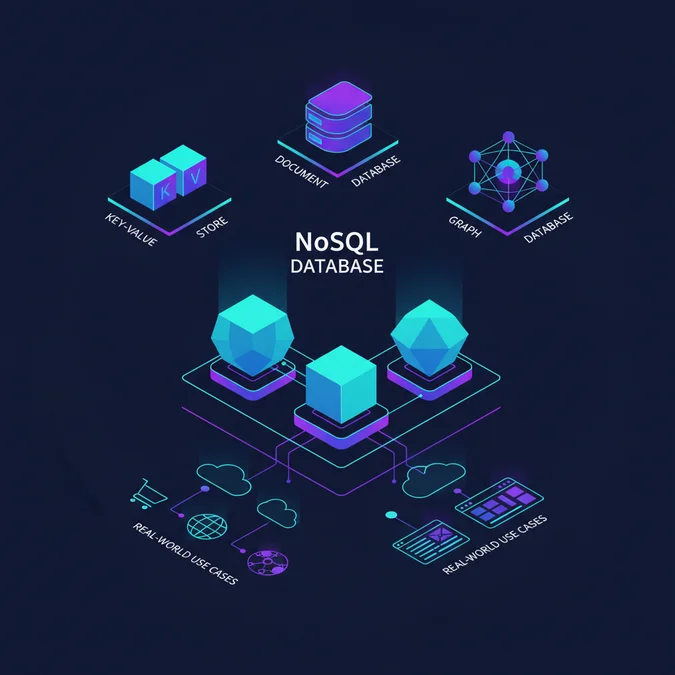
- Diverse Data Models: Instead of a single tabular model, NoSQL databases offer various data models, including key-value, document, column-family, and graph, each optimized for specific use cases.
- Eventual Consistency: While some NoSQL databases offer strong consistency, many prioritize availability and partition tolerance over immediate consistency, leading to ‘eventual consistency’ models suitable for highly distributed systems.
Understanding these foundational differences is crucial for selecting the right database technology for a given application’s requirements.
The Four Major Types of NoSQL Databases and Their Examples
The diverse landscape of NoSQL databases can generally be categorized into four primary types of NoSQL databases, each optimized for different data structures and access patterns. Understanding these categories and their respective strengths is crucial for effective database selection.
Here are the major types and their prominent NoSQL databases examples:
| Type | Description | Best Use Cases | Example Databases |
|---|---|---|---|
| Document Databases | Store data as semi-structured documents (e.g., JSON, BSON, XML), often nested. Each document is a self-contained unit. | Content management, user profiles, catalogs, e-commerce, blogging platforms. | MongoDB, Couchbase, DocumentDB |
| Key-Value Stores | The simplest NoSQL model, storing data as a collection of key-value pairs. Keys are unique identifiers, values can be any data type. | Caching, session management, real-time analytics, leaderboards, configuration data. | Redis, Amazon DynamoDB, Riak |
| Wide-Column Stores | Organize data into tables, rows, and dynamically named columns. Unlike relational tables, columns can vary from row to row within the same table. | Time-series data, operational logging, IoT data, large-scale analytics, sensor data. | Apache Cassandra, Apache HBase, Google Bigtable |
| Graph Databases | Store data in a network structure of nodes (entities) and edges (relationships). Optimized for traversing complex relationships. | Social networks, recommendation engines, fraud detection, knowledge graphs, network topology. | Neo4j, Amazon Neptune, ArangoDB |
Document Database Example: MongoDB
MongoDB, a leading document database, stores data in flexible, JSON-like documents. This allows for rich, hierarchical data structures and dynamic schemas.
// Insert a document
db.users.insertOne({
    name: "Alice Smith",
    email: "alice@example.com",
    address: {
        street: "123 Main St",
        city: "Anytown",
        zip: "12345"
    },
    interests: ["coding", "hiking"]
});

// Query documents
db.users.find({
    "address.city": "Anytown",
    "interests": "coding"
});
Key-Value Store Example: Redis
Redis, an in-memory key-value store, offers extreme speed for caching and real-time operations.
// Set a key-value pair
SET user:100:name "John Doe"
SET user:100:email "john@example.com"

// Get a value
GET user:100:name

// Use a hash for structured data
HSET user:200 name "Jane Doe" email "jane@example.com" age 30
HGETALL user:200
Wide-Column Store Example: Apache Cassandra
Cassandra excels at handling massive amounts of data with high availability and linear scalability, often used for time-series or IoT data.
// Create a keyspace (database)
CREATE KEYSPACE myapp WITH replication = {'class': 'SimpleStrategy', 'replication_factor': '1'};
USE myapp;

// Create a table
CREATE TABLE sensor_data (
    device_id text,
    timestamp timestamp,
    temperature float,
    humidity float,
    PRIMARY KEY (device_id, timestamp)
);

// Insert data
INSERT INTO sensor_data (device_id, timestamp, temperature, humidity) VALUES ('sensor_001', '2023-10-27 10:00:00+0000', 25.5, 60.2);

// Query data
SELECT * FROM sensor_data WHERE device_id = 'sensor_001' AND timestamp > '2023-10-27 09:00:00+0000';
Graph Database Example: Neo4j
Neo4j is optimized for storing and traversing highly connected data, using Cypher query language.
// Create nodes and relationships
CREATE (john:Person {name: 'John'})
CREATE (jane:Person {name: 'Jane'})
CREATE (movie:Movie {title: 'The Matrix'})
CREATE (john)-[:ACTED_IN {roles:['Neo']}]->(movie)
CREATE (jane)-[:REVIEWED {rating:5}]->(movie)

// Query for relationships
MATCH (p:Person)-[:ACTED_IN]->(m:Movie)
WHERE p.name = 'John'
RETURN p.name, m.title;
These examples illustrate the distinct approaches each NoSQL type takes to data modeling and querying, directly impacting their suitability for different application requirements.
NoSQL vs. Relational Databases: Architectural Trade-offs and Decision Criteria
The choice between a NoSQL database and a traditional relational database (SQL) is a critical architectural decision with far-reaching implications for scalability, performance, data integrity, and development velocity. While SQL databases have decades of maturity and strong transactional guarantees, NoSQL databases offer distinct advantages for modern, data-intensive applications.
| Feature | Relational (SQL) Databases | NoSQL Databases |
|---|---|---|
| Data Model | Structured, tabular, fixed schema. Relationships defined by foreign keys. | Flexible, dynamic schema (document, key-value, wide-column, graph). Relationships often embedded or linked. |
| Scalability | Primarily vertical scaling (more powerful server). Horizontal scaling is complex (sharding, replication). | Primarily horizontal scaling (distribute data across many commodity servers). Designed for distributed environments. |
| Consistency Model | Strong consistency (ACID properties: Atomicity, Consistency, Isolation, Durability). | Varies: Strong, eventual, or causal consistency. Often prioritizes Availability and Partition tolerance (AP in CAP theorem). |
| Query Language | Standardized SQL (Structured Query Language). | Varies by type: APIs, object-based queries (MongoDB), Cypher (Neo4j), CQL (Cassandra). |
| Schema Enforcement | Strict schema enforcement at write time. Data must conform to table definition. | Schema-less or flexible schema. Data structure can evolve dynamically with application changes. |
| Transaction Support | Robust, multi-row, multi-table transactions with strong isolation. | Transaction support varies; often limited to single documents/rows or eventual consistency for distributed transactions. |
| Complexity for Joins | Highly optimized for complex joins across multiple tables. | Joins are often handled at the application layer or through denormalization, less efficient for complex ad-hoc joins. |
Decision Criteria for Database Selection
Choosing between SQL and NoSQL involves evaluating project requirements against these architectural trade-offs:
- Data Structure and Schema Flexibility: If data is highly structured, requires complex joins, and has a stable schema, SQL is often a better fit. For unstructured, semi-structured, or rapidly evolving data, NoSQL’s flexible schema is advantageous.
- Scalability Needs: For applications requiring massive horizontal scalability to handle high traffic and large data volumes, especially with predictable access patterns, NoSQL databases are typically superior.
- Consistency Requirements: Applications demanding strong ACID transactions (e.g., financial systems, inventory management) often necessitate SQL databases. Where eventual consistency is acceptable (e.g., social media feeds, IoT sensor data), NoSQL offers greater performance and availability.
- Query Complexity: If complex, ad-hoc queries spanning multiple entities are common, SQL’s robust joining capabilities are valuable. For simple key-based lookups, document-based queries, or graph traversals, NoSQL excels.
- Development Speed: NoSQL’s flexible schemas can accelerate development by removing the need for upfront schema design and migration overhead, particularly in agile environments.
- Data Volume and Velocity: Big data scenarios with high ingest rates and petabytes of data often push relational databases to their limits, making NoSQL a more viable option.
The best approach often involves a polyglot persistence strategy, where different database types, both SQL and NoSQL, are used for different parts of an application based on their specific needs. This leverages the strengths of each system.
How NoSQL Databases Work: Core Mechanics and Scaling Strategies
Understanding the internal mechanisms of a NoSQL db is crucial for effective design and deployment. Unlike monolithic relational systems, NoSQL databases are inherently designed for distributed environments, leveraging concepts like sharding, replication, and various consistency models to achieve high availability and massive scalability.
Distributed Architecture
Most NoSQL databases operate on a distributed architecture, meaning data is spread across multiple servers, often referred to as nodes or a cluster. This distribution allows for:
- Horizontal Scalability: Adding more nodes to the cluster increases storage capacity and processing power.
- High Availability: If one node fails, others can continue to serve data, preventing downtime.
- Fault Tolerance: Data is often replicated across multiple nodes, ensuring data durability even in the event of hardware failures.
Sharding and Partitioning
Sharding, also known as partitioning, is a core technique used by NoSQL databases to distribute data across multiple machines. Data is divided into smaller, independent chunks (shards) based on a sharding key. Each shard resides on a separate server or set of servers. For example, in MongoDB, you might shard a collection based on a user ID:
// Enable sharding for a database
sh.enableSharding("mydatabase");

// Shard a collection based on a key
sh.shardCollection("mydatabase.users", { user_id: 1 });
This ensures that queries for a specific user ID are directed to the correct shard, improving performance and distributing the load.
Replication
Replication involves creating and maintaining multiple copies of data across different nodes. This serves two main purposes:
- Data Redundancy: Protects against data loss due to hardware failures.
- Read Scalability: Read requests can be distributed among replica nodes, increasing throughput.
Many NoSQL systems use a primary-secondary replication model (e.g., MongoDB replica sets) or a peer-to-peer model (e.g., Cassandra’s ring architecture) where all nodes can serve read and write requests.
Consistency Models
The CAP theorem (Consistency, Availability, Partition Tolerance) is fundamental to understanding NoSQL consistency. It states that a distributed system can only guarantee two out of these three properties simultaneously:
- Consistency (C): All clients see the same data at the same time.
- Availability (A): Every request receives a response, without guarantee that it contains the most recent version of the information.
- Partition Tolerance (P): The system continues to operate even if communication between nodes fails.
NoSQL databases often prioritize Availability and Partition Tolerance (AP) over strong Consistency (CP), leading to various forms of eventual consistency. In an eventually consistent system, if no new updates are made to a given data item, eventually all accesses to that item will return the last updated value. This model is acceptable for many web-scale applications where immediate global consistency is less critical than continuous availability and high performance.
For example, a DynamoDB write might return successfully before all replicas are updated, but eventually, all replicas will converge to the same value. Developers must account for this potential lag when designing applications around such systems.
Data Partitioning and Locality
Efficient data access in a distributed NoSQL system heavily relies on how data is partitioned and its locality. Designing effective partition keys that distribute data evenly and minimize cross-node communication is crucial for performance. Poorly chosen keys can lead to ‘hot spots’ where one node is overloaded while others are idle, negating the benefits of distribution.
Implementing NoSQL: Best Practices, Challenges, and When Not to Use It
Successfully implementing NoSQL solutions requires adherence to specific best practices, an awareness of common challenges, and a clear understanding of scenarios where NoSQL may not be the optimal choice. Adopting a NoSQL database without proper consideration can lead to significant technical debt and operational overhead.
NoSQL Implementation Best Practices
- Data Modeling for the Access Pattern: NoSQL data modeling is fundamentally different from relational modeling. Instead of normalizing data to avoid redundancy, NoSQL often denormalizes data and models it around the specific queries and access patterns of the application. Design your schema based on how data will be read and written.
- Choose the Right Database Type: Do not treat all NoSQL databases as interchangeable. Select the specific type (document, key-value, wide-column, graph) that best fits your data structure and application’s core requirements.
- Understand Consistency Models: Be explicit about your application’s consistency requirements. If eventual consistency is acceptable, design your application to handle potential read-after-write inconsistencies. If strong consistency is paramount for specific operations, ensure your chosen NoSQL database supports it or consider a polyglot approach.
- Plan for Scalability: Design your sharding keys and data distribution strategies early. A poorly chosen sharding key can lead to hot spots and negate the benefits of horizontal scaling.
- Implement Robust Error Handling: Distributed systems are complex. Implement comprehensive error handling, retries, and circuit breakers to manage network partitions, node failures, and transient errors.
- Monitor and Optimize: Continuously monitor your NoSQL database’s performance, resource utilization, and data distribution. Optimize queries, indexes, and cluster configuration based on observed bottlenecks.
- Security Considerations: Ensure proper authentication, authorization, encryption (at rest and in transit), and network isolation are in place, just as with any critical data store.
Effective NoSQL implementation prioritizes understanding the database’s specific architecture and consistency model, then aligning your application’s data access patterns and requirements accordingly. This ‘schema-on-read’ or ‘query-driven’ approach is a paradigm shift from traditional relational design.
Common Challenges in NoSQL Implementation
- Data Consistency Management: Managing eventual consistency can be complex for developers accustomed to ACID transactions.
- Complex Querying: While simple queries are fast, complex ad-hoc queries or multi-entity joins can be challenging or inefficient without proper denormalization.
- Lack of Standardization: Each NoSQL database often has its own query language, APIs, and operational tools, leading to a steeper learning curve and vendor lock-in.
- Operational Complexity: Managing distributed clusters, ensuring data integrity across replicas, and performing backups/restores can be more complex than with a single relational instance.
- Data Migration: Evolving schemas, while flexible, can still lead to complex data migration challenges in production environments.
When Not to Use NoSQL
While powerful, NoSQL databases are not a panacea. There are specific scenarios where they might not be the optimal choice:
- Applications Requiring Strong ACID Transactions: For systems like banking, financial ledgers, or complex inventory management where data integrity across multiple tables is non-negotiable and immediate consistency is critical, traditional relational databases often remain superior.
- Highly Relational Data with Complex Joins: If your data model is inherently relational and frequently requires complex, ad-hoc queries involving joins across many entities, a SQL database will likely offer better performance and simpler query development.
- Strict Schema Requirements: If your data structure is stable, well-defined, and unlikely to change, and you benefit from strict schema validation at the database level, a relational database can enforce this more naturally.
- Small Data Volumes with Limited Scaling Needs: For applications with modest data volumes and predictable, low-to-medium traffic, the operational complexity of a distributed NoSQL system might outweigh its benefits. A well-optimized relational database can often suffice.
- Existing Expertise and Ecosystem: If your team has deep expertise in relational databases and your existing ecosystem is built around SQL, the cost of retraining and retooling for NoSQL might not be justified unless there’s a clear scalability or flexibility bottleneck.
Frequently Asked Questions
What does ‘NoSQL’ truly mean, and how does it relate to ‘Not Only SQL’?
NoSQL, initially meaning ‘No SQL’, has evolved to ‘Not Only SQL’. This signifies that while these databases don’t primarily use SQL for data manipulation, they can sometimes integrate with SQL or coexist with relational systems, offering flexibility beyond a strict SQL-only paradigm.
What are the key characteristics that define a non-relational database?
Non-relational databases are characterized by their flexible schema, ability to handle large volumes of unstructured or semi-structured data, horizontal scalability, and diverse data models (e.g., document, key-value, graph). They prioritize availability and partition tolerance over strict ACID compliance in distributed environments.
Can you list some popular NoSQL databases and their primary use cases?
Popular NoSQL databases include MongoDB (document, for content management), Cassandra (wide-column, for high-volume writes), Redis (key-value, for caching), and Neo4j (graph, for relationship-heavy data). Each excels in specific scenarios where traditional relational databases might struggle with scale or data flexibility.
When is a NoSQL database the preferred choice over a traditional relational database?
A NoSQL database is preferred when dealing with large volumes of rapidly changing, unstructured, or semi-structured data, requiring high scalability and availability, or needing flexible schema evolution. Common use cases include real-time web applications, big data analytics, IoT, and content management systems.
What should you consider regarding not only sql database?
When assessing not only sql database, prioritize measurable technical outcomes, transparent communication, and experienced engineering guidance to ensure maximum ROI.
What should you consider regarding non relational database?
When assessing non relational database, prioritize measurable technical outcomes, transparent communication, and experienced engineering guidance to ensure maximum ROI.
NoSQL databases represent a fundamental evolution in data management, offering unparalleled flexibility, horizontal scalability, and performance for modern applications grappling with diverse and massive datasets. From document stores powering content platforms to graph databases unraveling complex relationships, each type addresses specific challenges that traditional relational systems might struggle with.
The shift from ‘No SQL’ to ‘Not Only SQL’ underscores their role not as replacements, but as powerful complements within a polyglot persistence strategy. By understanding their architectural nuances, consistency models, and the critical trade-offs involved, engineers can strategically deploy NoSQL databases to build highly performant, resilient, and scalable systems, ensuring data infrastructure aligns perfectly with evolving business demands and technical requirements.
NR Studio builds custom web apps, mobile apps, SaaS platforms, and internal tools for growing businesses. If you’re working through a technical decision, feel free to reach out — no commitment required.