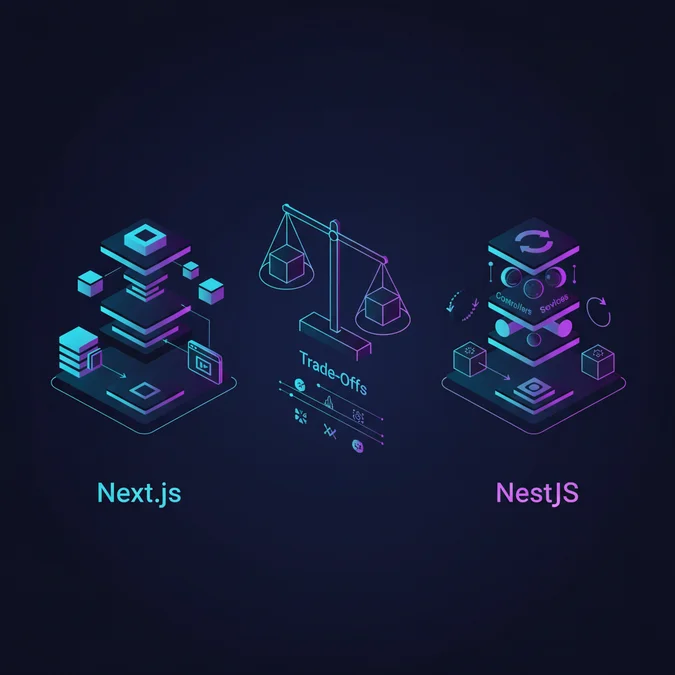

Next.js and NestJS solve fundamentally different architectural problems: Next.js is a React-based full-stack meta-framework optimized for rendering interfaces, Edge distribution, and Server-Side Rendering (SSR), whereas NestJS is an enterprise-grade backend TypeScript framework structured around dependency injection, modular encapsulation, and platform-agnostic server runtimes. Choosing between them is not a matter of brand preference, but an infrastructural decision regarding where application state, business logic, and compute boundaries reside.
A controversial reality often ignored in modern JavaScript engineering is that treating Next.js as your primary application backend is an architectural liability. Teams frequently attempt to save time by writing domain-level business logic, database transactions, and background queues inside Next.js Route Handlers and Server Actions. This approach usually backfires. Route Handlers run inside ephemeral, serverless runtime environments characterized by cold starts, aggressive connection-pool exhaustion, and unstructured spaghetti code. When your domain logic grows past simple CRUD operations, using Next.js as an all-in-one backend creates massive technical debt.
Conversely, deploying NestJS to simply proxy requests or render single-page applications introduces unnecessary boilerplate and administrative friction. To establish a performant and resilient architecture, engineering leads must evaluate runtime execution models, database persistence layers, transport protocols, and concurrency mechanics. This analysis examines both frameworks at the machine level, parsing their internals, operational constraints, and ideal architectural topologies.
Core Architectural Paradigms: Component-Driven vs Modular IoC
At the architectural layer, Next.js and NestJS represent entirely distinct paradigms. Next.js is fundamentally component-driven and page-centric. Built on top of React, its runtime model revolves around rendering lifecycles, route trees, and streaming HTML/React Server Component (RSC) wire formats to client browsers. Code organization in Next.js relies almost entirely on the filesystem App Router convention, where directory hierarchies dictate routing paths, layout nesting, and loading states.
NestJS takes inspiration from mature backend ecosystems like Angular and Spring Boot. It enforces an object-oriented, Modular Inversion-of-Control (IoC) architecture implemented via TypeScript decorators and metadata reflection. Rather than relying on directories to infer runtime behavior, NestJS explicitly models applications through modules, controllers, and providers. The IoC container manages the lifecycle of classes, automatically injecting dependencies where declared.
// NestJS: Explicit dependency injection and domain boundary encapsulation
import { Injectable, Module, Controller, Get, Param, ParseUUIDPipe } from '@nestjs/common';

@Injectable()
export class OrderService {
 // Injected data access or external client
 async findOne(id: string) {
 return { id, total: 104.50, status: 'FULFILLED' };
 }
}

@Controller('orders')
export class OrderController {
 constructor(private readonly orderService: OrderService) {}

 @Get(':id')
 async getOrder(@Param('id', new ParseUUIDPipe()) id: string) {
 return this.orderService.findOne(id);
 }
}

@Module({
 controllers: [OrderController],
 providers: [OrderService],
 exports: [OrderService],
})
export class OrderModule {}
In this NestJS example, structural boundaries are rigid. The controller maps HTTP transport mechanics, the pipe validates incoming types using static schemas, and the service isolates business domain rules. Compare this against Next.js, where an API route handler combines request parsing, validation, and domain execution within an isolated function export:
// Next.js: Route Handler with co-located logic (App Router)
import { NextRequest, NextResponse } from 'next/server';
import { z } from 'zod';

const ParamsSchema = z.object({
 id: z.string().uuid(),
});

export async function GET(
 request: NextRequest,
 { params }: { params: { id: string } }
) {
 const validation = ParamsSchema.safeParse(params);
 if (!validation.success) {
 return NextResponse.json({ error: 'Invalid ID format' }, { status: 400 });
 }

 // Business logic and data querying often bleed directly into the handler
 const order = { id: validation.data.id, total: 104.50, status: 'FULFILLED' };
 return NextResponse.json(order);
}
While the Next.js pattern affords rapid iteration for simple backends, it lacks native mechanisms for cross-cutting concerns like interceptors, guards, and unified dependency graphs. When working with teams where a software development specialist role must manage complex domain abstractions, NestJS provides the strict structural constraints necessary to prevent domain logic decay.
Runtime Environments: Serverless Node and Edge vs Persistent Daemons
Understanding the runtime host execution context reveals the sharpest contrast between Next.js and NestJS. Next.js is primarily engineered to execute in serverless, ephemeral compute runtimes such as AWS Lambda, Vercel Serverless Functions, or Vercel Edge Middleware (V8 Isolates). Each execution of a Route Handler or Server Action operates under the assumption that the compute instance may be instantly created, throttled, or destroyed.
NestJS operates under the classic daemon execution model. A NestJS process initializes once, bootstraps the entire dependency injection tree into memory, establishes persistent connection pools to databases and message brokers, and remains alive across millions of sequential HTTP requests. It typically runs within a long-lived Node.js process managed by Docker, Kubernetes, or Amazon ECS.
| Operational Metric | Next.js (Serverless Target) | NestJS (Persistent Daemon) |
|---|---|---|
| Cold Start Impact | 50ms to 1200ms depending on bundle size and VPC attachments | 0ms during traffic (cold boot occurs only at container deployment) |
| Memory Footprint | Small per-function slice (128MB to 1024MB allocations) | 150MB to 512MB continuous heap per worker thread |
| DB Connection Strategy | External HTTP proxies (Prisma Accelerate, Neon Serverless) | Native TCP connection pooling (pg-pool, TypeORM, MikroORM) |
| Background Processing | Not natively supported; requires external services or queues | Native event loop workers, BullMQ queues, cron workers |
| Long-Lived Protocols | No native WebSockets; relies on external pub/sub services | Native support for WebSockets (Socket.io/ws), gRPC, MQTT |
This operational divergence shifts how systems handle persistent state. If an application requires WebSocket connections to coordinate interactive states, running an active socket server inside Next.js on serverless infrastructure is impossible without offloading connections to external hosted brokers. NestJS can natively run WebSocket gateways and microservice transport listeners directly on its underlying HTTP server instance (Express or Fastify).
Database Persistence, TCP Sockets, and Connection Exhaustion
A critical failure point in scaling full-stack applications lies at the database driver layer. Relational databases like PostgreSQL and MySQL depend on persistent TCP sockets. In classic application architectures, a database allocates significant operating system resources to handle each incoming client connection. Managing pools effectively ensures optimal database health.
When developers deploy Next.js Route Handlers across a serverless fleet, a burst of 500 concurrent requests can spin up 500 isolated serverless containers. If each container initializes an ORM like Prisma or Drizzle without careful pool limits, the cluster instantly attempts to negotiate 500 individual TCP handshakes with Postgres. This causes immediate connection pool exhaustion, leading to connection timeouts and severe database CPU throttling.
// NestJS: Native connection pooling via TypeORM and PostgreSQL
import { Module } from '@nestjs/common';
import { TypeOrmModule } from '@nestjs/typeorm';

@Module({
 imports: [
 TypeOrmModule.forRoot({
 type: 'postgres',
 host: process.env.DB_HOST,
 port: 5432,
 username: process.env.DB_USER,
 password: process.env.DB_PASSWORD,
 database: process.env.DB_NAME,
 autoLoadEntities: true,
 synchronize: false, // Strict migration control for production environments
 extra: {
 // Explicit pool sizing for persistent daemons
 max: 20,
 idleTimeoutMillis: 30000,
 connectionTimeoutMillis: 2000,
 },
 }),
 ],
})
export class DatabaseModule {}
In NestJS, connection pools remain deterministic. If you deploy 4 container instances with a pool cap of 20, the database will never exceed 80 total connections, even if traffic surges to tens of thousands of requests per second. The application server queues internal tasks in memory rather than overwhelming database sockets.
For high-throughput systems performing complex bulk mutations, deterministic pooling becomes vital. When orchestrating massive data synchronization routines akin to batch operations discussed in Laravel upsert database implementations, having a dedicated backend daemon like NestJS provides granular control over transaction lifecycles, statement timeouts, and deadlocks that serverless environments cannot safely maintain.
Request Lifecycles: Middleware Pipelines vs Interceptor Chains
The execution path of an incoming HTTP request differs substantially between both platforms. Next.js App Router relies on two distinct layers: edge middleware and route-level execution. Edge middleware operates before static asset resolution and dynamic routing. It allows header mutations, cookie checks, and URL rewrites using a constrained V8 runtime environment that lacks standard Node.js APIs (such as the fs module or native cryptographic bindings).
// Next.js: Edge Middleware (runs on lightweight V8 isolate)
import { NextResponse } from 'next/server';
import type { NextRequest } from 'next/server';

export function middleware(request: NextRequest) {
 const token = request.cookies.get('session_token')?value;

 if (!token && request.nextUrl.pathname.startsWith('/dashboard')) {
 return NextResponse.redirect(new URL('/login', request.url));
 }

 const response = NextResponse.next();
 response.headers.set('x-processed-by', 'edge-gateway');
 return response;
}

export const config = {
 matcher: ['/dashboard/:path*'],
};
NestJS handles requests through an elaborate, multi-tiered lifecycle composed of six distinct stages: Global/Route Middleware, Guards, Interceptors (Pre-Controller), Pipes, Controller Handlers, and Interceptors (Post-Controller) followed by Exception Filters.
- Guards: Execute before any handler logic to evaluate authentication, permissions, and roles. Unlike basic middleware, guards access the ExecutionContext, exposing the class metadata and target method.
- Pipes: Transform and validate incoming payload shapes synchronously or asynchronously before your controller receives data.
- Interceptors: Bind extra logic before and after method execution. They can mutate returned payloads, handle timeouts via RxJS operators, or log execution metrics.
- Exception Filters: Provide a unified catch block across the entire application, mapping domain errors to deterministic HTTP responses.
// NestJS: Logging & Performance Interceptor using RxJS operators
import {
 Injectable,
 NestInterceptor,
 ExecutionContext,
 CallHandler,
 Logger,
} from '@nestjs/common';
import { Observable } from 'rxjs';
import { tap } from 'rxjs/operators';

@Injectable()
export class LoggingInterceptor implements NestInterceptor {
 private readonly logger = new Logger('HTTP');

 intercept(context: ExecutionContext, next: CallHandler): Observable<any> {
 const request = context.switchToHttp().getRequest();
 const { method, url } = request;
 const now = Date.now();

 return next.handle().pipe(
 tap(() =>
 this.logger.log(
 `${method} ${url} completed in ${Date.now() - now}ms`
 )
 )
 );
 }
}
This structured chain makes NestJS far more predictable for enterprise applications that enforce compliance auditing, structured tracing, and uniform error normalization across dozens of sub-domains.
Rendering Engines: React Server Components vs Headless API Backends
Next.js is primarily an interface rendering engine. Its crowning technical achievement is React Server Components (RSC). RSC blurs the physical line between backend and frontend by letting developers author UI components that execute solely on the server, streaming generated wireframes straight to the browser without transmitting JavaScript bundles.
This architecture drastically minimizes bundle sizes and eliminates client-side data fetching cascades. Next.js coordinates both the dynamic rendering pipeline and the visual representation simultaneously:
// Next.js: React Server Component fetching directly on the server
import { Suspense } from 'react';

async function MetricDisplay() {
 // Direct server-side data call within the component tree
 const res = await fetch('https://api.internal/metrics', { next: { revalidate: 60 } });
 const metrics = await res.json();

 return (
 <div className="p-4 border rounded">
 <h4>Active Nodes</h4>
 <p className="text-2xl font-bold">{metrics.nodeCount}</p>
 </div>
 );
}

export default function DashboardPage() {
 return (
 <main>
 <h1>System Telemetry</h1>
 <Suspense fallback={<p>Loading metrics..</p>}>
 <MetricDisplay />
 </Suspense>
 </main>
 );
}
NestJS does not concern itself with DOM nodes, component reconciliation, CSS parsing, or bundle optimizations. It is purely headless. While it is theoretically possible to configure NestJS with view engines like Handlebars or EJS, doing so bypasses the modern interactive web ecosystem. NestJS serves raw bytes: serialized JSON, Protocol Buffers, or binary streams.
When building systems that require robust scheduling, calendar logic, and event orchestration, developers often encounter integration boundaries. For instance, handling complex calendar event flows, such as those covered in Laravel Livewire FullCalendar architectures, highlights the distinction between a UI engine driving the view and a dedicated domain backend managing event collision detection, validation, and multi-tenant isolation. Next.js excels at presenting the calendar; NestJS excels at computing the underlying scheduling matrix.
Microservices, Transport Protocols, and Event Brokers
Modern distributed systems frequently decouple transport mechanics from business logic. An application might receive input over an HTTP REST API, ingest commands via gRPC from internal microservices, and process asynchronous telemetry over Apache Kafka or RabbitMQ.
Next.js is exclusively an HTTP/HTTPS server. It understands web requests, HTTP methods, headers, and streaming web responses. It has no internal abstractions for connecting directly as an event consumer to a Kafka partition or listening on raw TCP/gRPC ports without custom, unsupported hacks that defeat the purpose of the framework.
NestJS, by design, abstracts the underlying transport layer. A single NestJS application can simultaneously run as an HTTP Web Server and a gRPC Microservice listener using the built-in @nestjs/microservices package:
// NestJS: Microservice Bootstrap with gRPC and RabbitMQ
import { NestFactory } from '@nestjs/core';
import { MicroserviceOptions, Transport } from '@nestjs/microservices';
import { join } from 'path';
import { AppModule } from './app.module';

async function bootstrap() {
 const app = await NestFactory.create(AppModule);

 // Attach gRPC microservice listener
 app.connectMicroservice<MicroserviceOptions>({
 transport: Transport.GRPC,
 options: {
 package: 'order',
 protoPath: join(__dirname, 'proto/order.proto'),
 url: '0.0.0.0:50051',
 },
 });

 // Attach RabbitMQ consumer to the same domain logic
 app.connectMicroservice<MicroserviceOptions>({
 transport: Transport.RMQ,
 options: {
 urls: [process.env.RABBITMQ_URL || 'amqp://localhost:5672'],
 queue: 'orders_queue',
 queueOptions: { durable: true },
 },
 });

 await app.startAllMicroservices();
 await app.listen(3000);
}
bootstrap();
This multi-transport architecture allows developers to reuse the same business services, validation pipelines, and dependency injection graph across disparate network protocols without rewriting core domain code.
Memory Management, Concurrency, and Worker Offloading
Node.js runs on a single-threaded event loop backed by libuv. This makes non-blocking asynchronous I/O fast, but introduces severe vulnerabilities whenever a request triggers heavy CPU-bound computational work. In serverless Next.js deployments, a long-running CPU task will stall the execution thread, causing incoming requests assigned to the same cold-started container to queue or time out.
NestJS provides systematic primitives for dealing with concurrent workflows, background tasks, and CPU offloading through module integrations like BullMQ (Redis-backed queues), native Worker Threads, and dedicated Cron runners.
// NestJS: Background Job Processing via BullMQ
import { Processor, WorkerHost } from '@nestjs/bullmq';
import { Job } from 'bullmq';
import { Logger } from '@nestjs/common';

@Processor('image-processing')
export class ImageProcessor extends WorkerHost {
 private readonly logger = new Logger(ImageProcessor.name);

 async process(job: Job<{ fileId: string; buffer: string }>): Promise<any> {
 this.logger.log(`Processing image transcode for: ${job.data.fileId}`);

 // Execute CPU-intensive image compression or transformations here
 // Runs decoupled from incoming HTTP network requests

 return { status: 'COMPLETED' };
 }
}
Implementing reliable background queues within Next.js requires integrating third-party orchestration platforms like Inngest, Trigger.dev, or external AWS SQS/Lambda setups. Because Next.js serverless functions freeze their execution contexts immediately after an HTTP response is returned, developers cannot spawn detached asynchronous promises without risking immediate process termination by the cloud orchestrator.
Architectural Decision Matrix: When to Select Each Framework
Deciding between Next.js and NestJS requires looking past syntax and evaluating team composition, performance bottlenecks, and infrastructural topology. A robust blueprint for computer software development prioritizes matching runtime characteristics to business requirements.
| Project Requirement | Recommended Framework | Architectural Justification |
|---|---|---|
| SEO-Driven E-Commerce or Content Hub | Next.js | Dynamic SSR, incremental static regeneration (ISR), and client-bundle minimization via RSC. |
| High-Throughput Enterprise Core Banking/SaaS API | NestJS | Modular IoC, deterministic database connection pools, strict validation pipelines, and gRPC microservice capabilities. |
| B2B Admin Dashboard with Minimal Public SEO | Next.js or Hybrid (Next + Nest) | Next.js delivers fast client interactivity; NestJS handles complex role-based access control (RBAC) and data schemas. |
| Real-Time Multi-User Collaboration Tool | NestJS | Persistent TCP connections, native WebSockets, distributed pub/sub handling, and long-lived daemon memory. |
| Internal Rapid MVP Prototype | Next.js | Single-codebase ergonomics, co-located Route Handlers, and zero server configuration on managed cloud platforms. |
Engineering teams frequently discover that the optimal architecture is not Next.js or NestJS, but rather a unified composition: Next.js operating as the presentation-tier BFF (Backend-for-Frontend), and NestJS executing as the core domain microservice layer.
The Hybrid Topology: Next.js as BFF with NestJS Core Services
In scalable, enterprise-grade distributed systems, combining both frameworks yields superior results compared to forcing either to do work outside its design parameters. In this hybrid topology, Next.js acts as an intelligent Backend-for-Frontend (BFF), while NestJS handles core business domains, heavy database transactions, and integrations with third-party microservices.
The Next.js layer manages visual rendering, cookie-based session hydration, and localized data caching. When client components demand data, Next.js executes Server Components that query the internal NestJS API over an optimized private network (such as an AWS VPC or a Kubernetes internal cluster service mesh):
+-------------------------------------------------------+
| Client Web Browser |
+-------------------------------------------------------+
 | HTTPS (HTML/RSC Stream)
 v
+-------------------------------------------------------+
| Next.js App Server (Presentation BFF) |
| - React Server Components Rendering |
| - Cookie/Session Decryption & SSR HTML Hydration |
| - Edge Image & Asset Optimization |
+-------------------------------------------------------+
 | Internal mTLS / gRPC / HTTP
 v
+-------------------------------------------------------+
| NestJS Application Cluster (Domain Core) |
| - Modular Dependency Injection Graph |
| - Deterministic DB Connection Pool (PostgreSQL) |
| - Enterprise RBAC Guards & Pipe Validations |
| - Event-Driven Background Workers (BullMQ / Kafka) |
+-------------------------------------------------------+
 | | |
 v v v
+---------------+ +-----------------+ +------------+
| PostgreSQL | | Redis Cache/Pub | | RabbitMQ |
+---------------+ +-----------------+ +------------+
This separation of concerns preserves database connection stability and memory isolation on the NestJS side, while allowing Next.js to excel at delivering fast, SEO-optimized web pages to the edge.
Exploring the Framework Ecosystem
Mastering modern application architecture requires continuous evaluation of runtime layers, database performance, and framework abstractions. Understanding how different platforms tackle state, synchronization, and routing is essential when designing reliable web systems.
Explore our complete Laravel, Basics directory for more guides.
Next.js and NestJS address fundamentally different domains of the modern software stack. Next.js shines as a world-class interface rendering framework, leveraging React Server Components, hybrid edge routing, and streaming HTML to deliver exceptional client-side experiences. NestJS stands as a battle-tested, structured enterprise framework tailored for long-lived daemons, complex domain models, and decoupled microservice communication.
Attempting to build massive enterprise backends exclusively inside Next.js serverless functions invites infrastructural complexity, ephemeral resource constraints, and database connection failures. Conversely, running NestJS simply to spit out HTML templates creates unnecessary overhead. Architects who objectively analyze their project requirements regarding state persistence, compute lifecycles, and user experience will make the right architectural choice: deploy Next.js for your frontend presentation, run NestJS for your core system domain, or unite both in a clean, decoupled BFF topology.
Benchmarking Architecture Trade-offs?
Discuss real-world performance characteristics and production considerations for your specific workload.