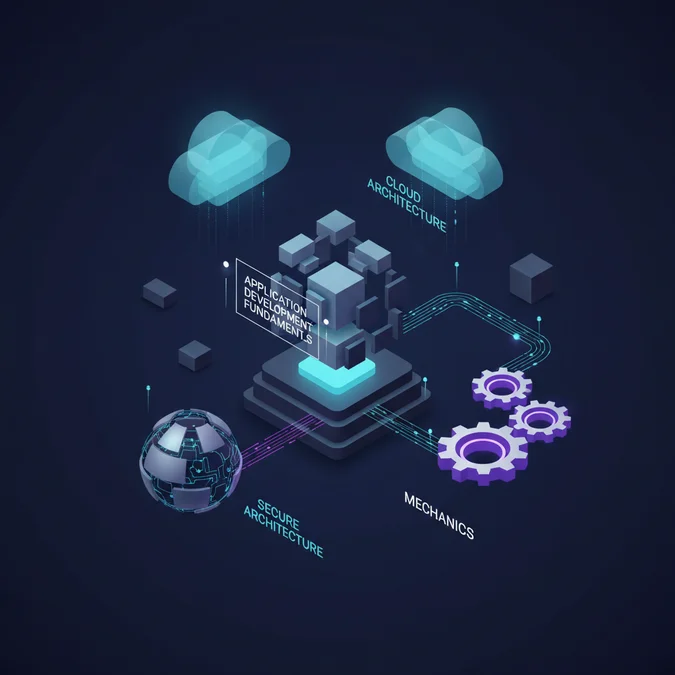

Application development fundamentals represent the core architectural principles, data lifecycle controls, programming models, and defensive engineering practices required to build reliable software systems from source code to production deployment. These fundamentals dictate how systems handle state, enforce authorization boundaries, parse untrusted inputs, isolate persistent storage, and maintain integrity under operational strain.
Many development teams treat fundamentals as merely memorizing language syntax or deploying rapid scaffolding. This shallow understanding creates fragile systems riddled with architectural technical debt, unindexed query bottlenecks, broken access control, and vulnerable dependency chains. Without a firm grounding in systems architecture, engineers routinely build applications that fail compliance audits, collapse under peak throughput, or leak sensitive customer data.
Approaching software construction from a security-first systems perspective transforms standard development. By embedding the OWASP Top 10 mitigation strategies, deterministic state modeling, resilient schema migrations, and defense-in-depth isolation directly into the foundational tier, teams eliminate systemic attack vectors before writing user-facing business logic.
Core Mechanics of Application Architecture and Runtime Lifecycles
At its core, application development is the translation of operational business rules into deterministic state machines running within constrained runtime environments. Every application, regardless of framework, consumes input events, validates payloads, queries and mutates state, and renders structured responses. Understanding the application execution cycle is the primary fundamental required to prevent memory exhaustion, race conditions, and injection vulnerabilities.
When an HTTP request enters an application runtime, it traverses a defined execution pipeline. In modern web runtimes such as PHP-FPM, Node.js, or Go HTTP servers, this request is encapsulated into a request context object. The runtime resolves routing, executes middleware chains for authentication and rate limiting, passes the context to a controller or command handler, interacts with persistent data stores, and streams the output back to the client.
The Request-Response Pipeline
- Transport and Ingress: Web servers or reverse proxies terminate TLS, strip invalid headers, enforce buffer limits, and route traffic to the application gateway.
- Middleware Stack: Interceptors process cross-cutting concerns, including CSRF token verification, session decryption, origin cross-checks, and IP throttling.
- Domain Dispatch: The router maps URI parameters and HTTP verbs to specific controllers, executing declarative validation rules before invoking the service layer.
- Persistence and State Transition: The application executes atomic database transactions using repository patterns or Object-Relational Mappers (ORMs).
- Serialization and Egress: The application serializes domain models, stripping internal properties and password hashes to prevent direct object reference leaks.
Failing to understand runtime constraints often leads teams to select inappropriate execution models. For instance, single-threaded event loops handle concurrent I/O efficiently but block under heavy cryptographic calculations, whereas process-per-request architectures isolate memory faults at the expense of higher initialization overhead for each inbound transaction.
Threat Modeling and Secure Systems Architecture from Day Zero
Secure engineering cannot be added to an application after release. Architecture must be evaluated against standard threat models such as STRIDE (Spoofing, Tampering, Repudiation, Information Disclosure, Denial of Service, and Elevation of Privilege) during initial planning. Establishing a zero-trust internal architecture protects backend resources when perimeter defenses fail.
Every boundary where data transitions between trust zones represents an attack vector. These boundaries exist between the browser and the web server, between the application server and the database, and between internal microservices communicating over remote procedure calls. Proper system design assumes that every incoming network packet, parameter, and header is actively hostile.
Foundational Threat Categories
- Broken Object Level Authorization (BOLA): Users access records belonging to other tenants by manipulating sequential IDs. Defense requires querying state using strictly scoped parent identifiers derived from authenticated sessions.
- Unrestricted Resource Consumption: Endpoints lacking pagination or execution timeouts allow attackers to exhaust CPU and memory pools through unbounded payload submissions.
- Injection Flaws: SQL, command, and LDAP injection occur when untrusted inputs are concatenated directly into interpreted evaluation strings.
Engineers refining their systemic design skills often evaluate structural methodologies taught in foundational programs, such as the academic software development curriculum, which highlights how early modeling choices directly reduce post-deployment operational failure rates.
Input Validation, Sanitization, and Defense Against Injection
Input validation is the first line of defense in application engineering. Untrusted input must be validated syntactically and semantically before reaching any business logic or persistence layer. Syntactic validation verifies that incoming strings match expected types, lengths, character sets, and formats. Semantic validation ensures the data makes operational sense within the current system state, such as verifying an end date occurs after a start date.
A critical rule of defensive development is never relying on blocklists. Attackers easily bypass string-matching blacklists using alternate encodings, null bytes, or obscure syntax variations. Instead, implementations must use strict allowlists that define the exact acceptable schema for every parameter.
Validation Mechanics Across Tiers
- Client-Side Validation: Enhances user experience by providing immediate feedback on malformed entries. It provides zero security guarantees because attackers bypass client scripts entirely using automated tools or direct HTTP requests.
- Gateway Validation: Reverse proxies and web application firewalls drop oversized payloads, inspect request signatures, and terminate malformed HTTP headers.
- Controller-Level Validation: Strongly typed form request objects enforce data constraints and reject unmatched parameters prior to invoking service classes.
- Database Schema Constraints: Foreign keys, unique indexes, column lengths, and check constraints enforce absolute data integrity at the lowest level.
Sanitization transforms input to render it safe for display or storage, such as stripping HTML tags. However, sanitization should never replace parameterized queries. The following code demonstrates secure input validation and parameterization within a modern framework context:
<php
declare(strict_types=1);

namespace App\Services;

use Illuminate\Support\Facades\DB;
use InvalidArgumentException;

class AccountTransferService
{
 public function transferFunds(string $sourceAccountId, string $targetAccountId, int $amountCents): void
 {
 // Syntactic constraint verification
 if ($amountCents <= 0) {
 throw new InvalidArgumentException('Transfer amount must be positive.');
 }

 // Parameterized database operations avoiding raw string interpolation
 DB:transaction(function () use ($sourceAccountId, $targetAccountId, $amountCents) {
 $sourceBalance = DB:table('accounts')
 ->where('id', '=', $sourceAccountId)
 ->lockForUpdate()
 ->value('balance_cents');

 if ($sourceBalance === null || $sourceBalance < $amountCents) {
 throw new InvalidArgumentException('Insufficient funds or invalid account.');
 }

 DB:table('accounts')
 ->where('id', '=', $sourceAccountId)
 ->decrement('balance_cents', $amountCents);

 DB:table('accounts')
 ->where('id', '=', $targetAccountId)
 ->increment('balance_cents', $amountCents);
 });
 }
}
Authentication, Session Management, and Access Control Architecture
Authentication confirms the identity of a principal, whereas authorization determines the actions that principal can execute. Conflating these two concepts causes broken access control, which consistently ranks as the most common security vulnerability in modern web applications. Robust application development requires distinct, decoupled layers for identity verification and permission enforcement.
Session state must be maintained securely across stateless HTTP connections. Modern architectures employ either opaque server-side session tokens stored in in-memory datastores like Redis or cryptographically signed client-side tokens such as JSON Web Tokens (JWT). While JWTs permit stateless verification across services, they introduce revocation difficulties. If a token is compromised, it remains valid until expiration unless a centralized blocklist is checked on every invocation, defeating the original purpose of stateless tokens.
Session Hardening Parameters
Session cookies transmitting access identifiers must enforce strict security attributes to prevent interception and manipulation:
- Secure: Forces cookies to travel exclusively over encrypted TLS connections, blocking cleartext interception.
- HttpOnly: Prevents client-side JavaScript access via
document.cookie, mitigating session theft via Cross-Site Scripting (XSS). - SameSite=Strict or Lax: Prevents browsers from including the cookie during cross-site requests, neutralizing Cross-Site Request Forgery (CSRF).
- Short Lifespans with Sliding Expiration: Minimizes the exposure window of compromised tokens while keeping active sessions alive.
Authorization models must implement Role-Based Access Control (RBAC) or Attribute-Based Access Control (ABAC). In RBAC, users possess roles, and roles map to explicit permissions. In ABAC, policies evaluate the subject, resource, action, and environment dynamically, allowing fine-grained conditions such as restricting record access based on geographic IP blocks or business operating hours.
Data Layer Architecture, Relational Integrity, and ORM Trade-Offs
Applications rely on persistent data stores to track domain state. Architecting the data layer requires deep attention to data integrity, indexing strategies, normalization rules, and query efficiency. Relying on an Object-Relational Mapper without understanding underlying SQL mechanics frequently causes performance degradation and resource contention in high-concurrency environments.
The N+1 query problem is a classic operational pitfall in ORM usage. It occurs when an application executes one query to fetch parent records, followed by N separate queries to fetch associated child entities for each parent row. A database handling 1,000 requests per minute can suddenly face hundreds of thousands of individual query dispatches, saturating the connection pool and exhausting database memory.
Relational Database Guarantees vs Object Mapping
| Metric or Feature | Raw SQL with Parameterization | Object-Relational Mapping (ORM) |
|---|---|---|
| Query Transparency | High; developers see the exact execution plan and indexed joins. | Low; abstract methods dynamically generate SQL, hiding subqueries. |
| Development Velocity | Moderate; requires manual schema binding and mapping logic. | High; enables rapid prototyping, migrations, and relationship definitions. |
| Mass Assignment Protection | Manual; parameters must be bound explicitly per query. | Built-in; configurable allowlists prevent unexpected column overwrites. |
| Connection Overhead | Minimal; developers optimize bulk inserts and streaming cursors. | Moderate to High; hydration cycles convert raw rows into heavy in-memory objects. |
To preserve database reliability during rapid feature development, systems require deterministic seeders and automated migration scripts to recreate environments accurately. Applying structured database seeding strategies ensures that local development mirrors production schemas and data relationships without leaking private customer records.
State Management, Determinism, and Software Lifecycle Models
A software application is a state machine that transitions between states based on incoming events and business logic rules. Managing application state deterministically means that given the same starting state and identical inputs, the system will always transition to the exact same end state without side effects. Nondeterministic behavior introduces subtle bugs, concurrency race conditions, and corrupted data.
To maintain control over evolving domain logic, development teams rely on structured engineering lifecycle models. Teams often construct disposable architectural spikes to validate risky integrations before committing production code. Leveraging a formal software prototyping approach allows architects to evaluate database locking mechanisms, throughput ceilings, and external API latency boundaries in an isolated sandbox.
Enforcing Deterministic State Mutations
Production software manages mutation integrity using several proven architectural patterns:
- Atomic Database Transactions: Wrapping multi-table operations in ACID transactions guarantees that if an intermediate step fails, all prior mutations rollback completely.
- Idempotency Keys: In distributed environments or payment workflows, API requests include a unique UUID. The server caches this key; duplicate requests return the original response rather than executing duplicate operations.
- Immutability in Domain Events: Instead of updating records in place, write operations record append-only audit logs. The current state is calculated by aggregating these discrete historical events.
- Optimistic Concurrency Control: Records maintain an incremental version column. Update statements verify that the version matches the local value, preventing users from accidentally overwriting concurrent changes.
The code below demonstrates optimistic locking using an incremental version identifier to prevent race conditions during inventory updates:
<php
declare(strict_types=1);

namespace App\Services;

use Illuminate\Support\Facades\DB;
use RuntimeException;

class InventoryService
{
 public function deductStock(string $productId, int $quantity): void
 {
 $maxRetries = 3;
 $attempt = 0;

 while ($attempt < $maxRetries) {
 $product = DB:table('products')->where('id', '=', $productId)->first();

 if (!$product || $product->stock < $quantity) {
 throw new RuntimeException('Stock allocation failed: insufficient units.');
 }

 // Enforce optimistic locking via version column check
 $updated = DB:table('products')
 ->where('id', '=', $productId)
 ->where('version', '=', $product->version)
 ->update([
 'stock' => $product->stock - $quantity,
 'version' => $product->version + 1,
 'updated_at' => now()
 ]);

 if ($updated === 1) {
 return;
 }

 $attempt++;
 usleep(50000); // Backoff for 50ms before retrying concurrency check
 }

 throw new RuntimeException('Concurrency conflict: transaction aborted after retries.');
 }
}
Cryptography Fundamentals: Protecting Data in Transit and at Rest
Modern security standards dictate that applications protect data integrity and privacy across both transit and storage layers. Implementing cryptography requires utilizing standardized, peer-reviewed primitives and managed platform libraries rather than writing custom algorithms. Proprietary cryptographic routines almost always contain mathematical or implementation flaws that allow attackers to recover plaintext.
Protecting data in transit requires mandatory TLS (Transport Layer Security) 1.3 across all communication paths, including external client connections and internal service-to-service calls. Runtimes must mandate strict cipher suites, employ HTTP Strict Transport Security (HSTS) with long durations, and enforce certificate validation on outgoing HTTP client libraries.
Data at Rest: Hashing vs Symmetric Encryption
Confusing hashing with encryption is a common architectural error that exposes user credentials to recovery:
- One-Way Hashing: Credentials such as passwords must never be encrypted with a reversible key. Instead, they must be hashed using adaptive, memory-hard algorithms such as Argon2id or bcrypt. These algorithms employ high work factors and unique cryptographic salts to resist parallel GPU cracking attacks.
- Authenticated Symmetric Encryption: Data requiring decryption (such as national tax identifiers or payment metadata) must be secured using authenticated encryption schemes such as AES-256-GCM or ChaCha20-Poly1305. These schemes produce an authentication tag that detects ciphertext tampering before decryption.
- Cryptographic Key Management: Encryption keys must never be stored in application source control or adjacent to the encrypted database records. Keys should reside in hardware security modules (HSM) or dedicated key management systems with automated rotation policies.
Proper cryptographic architectures also require constant-time comparison methods when evaluating message authentication codes (MACs) or access tokens. Standard string comparisons terminate at the first non-matching byte, creating subtle latency variations that allow attackers to deduce valid tokens byte by byte via side-channel timing attacks.
API Design, Serialization, and Broken Object Level Authorization
Application interfaces (APIs) serve as the primary contract between backends and frontends, mobile devices, and third-party systems. Well-designed APIs rely on predictable HTTP semantics, versioned URL spaces, structured JSON payloads, and clear status codes. However, from an engineering perspective, every exposed endpoint is an entry point that requires explicit authorization checks.
Broken Object Level Authorization (BOLA), historically known as Insecure Direct Object References (IDOR), occurs when an API endpoint accepts a user-supplied ID to read or mutate a record without verifying that the requesting user owns that object. This issue often stems from developers assuming that unpredictable UUIDs provide security through obscurity. UUIDs make guessing record keys harder, but they do not enforce tenant isolation.
Securing Serialization and Data Transfer Objects
Directly serializing internal ORM entities to JSON frequently leaks internal application state, such as soft-delete flags, hashed credentials, tenant IDs, and private internal notes. Secure applications mitigate this by routing all egress data through formal Data Transfer Objects (DTOs) or serialization transformers.
- Strict DTO Projections: Handlers map domain models to explicit DTO classes, ensuring that only intentionally whitelisted fields are serialized into the JSON output.
- Scoped Queries: Applications should enforce ownership boundaries directly within database queries rather than fetching the row first and checking permissions in code.
- Rate Limiting per Identity: Public and authenticated API routes must enforce rate limits based on token identifiers and IP addresses to prevent automated scraping and brute-force guessing.
Consider this standard implementation that prevents BOLA vulnerabilities by scoping queries to the authenticated tenant context:
<php
declare(strict_types=1);

namespace App\Http\Controllers;

use App\Models\Invoice;
use Illuminate\Http\JsonResponse;
use Illuminate\Http\Request;
use Symfony\Component\HttpKernel\Exception\NotFoundHttpException;

class InvoiceController
{
 public function show(Request $request, string $invoiceId): JsonResponse
 {
 $userId = $request->user()->id;

 // Direct object retrieval must be constrained by the tenant ownership scope
 $invoice = Invoice:query()
 ->where('id', '=', $invoiceId)
 ->where('organization_id', '=', $request->user()->organization_id)
 ->first();

 if (!$invoice) {
 // Return 404 rather than 403 to avoid confirming the existence of foreign IDs
 throw new NotFoundHttpException('Resource not found.');
 }

 return response()->json([
 'id' => $invoice->id,
 'amount_cents' => $invoice->amount_cents,
 'status' => $invoice->status,
 'issued_date' => $invoice->created_at->toIso8601String()
 ]);
 }
}
Observability, Structured Logging, and Error Handling Standards
An application operating in production without comprehensive observability is an unmonitored risk. Observability relies on three core operational pillars: structured logs, aggregated metrics, and distributed tracing. When an exception or performance degradation occurs, these telemetry systems allow engineers to diagnose the failure without altering production code or attempting to attach debuggers to live containers.
Error handling must be designed defensively. Applications should never output raw runtime stack traces, database schema errors, or internal hostnames to end users. Displaying detailed stack traces gives attackers valuable information regarding internal framework versions, table names, file paths, and unpatched third-party libraries. Instead, applications should return unique error correlation IDs to the client while writing full execution contexts to private logging aggregators.
Logging Safety and PII Protection
While exhaustive logging is vital for operations, logs that collect sensitive customer information create serious regulatory and compliance risks under GDPR, HIPAA, and PCI-DSS. Logging pipelines must sanitize payloads before writing them to disk or streaming them to external aggregation services.
- Automated Redaction: Configure logging frameworks to mask sensitive keys such as
password,token,card_number, andssn. - Structured Key-Value Formats: Emit logs in structured JSON rather than unstructured strings. This allows search engines to index fields efficiently without parsing slow regular expressions.
- Distributed Context Injection: Attach correlation identifiers (such as a
X-Request-IDheader) to every log line generated during a request lifecycle, allowing engineers to trace an execution path across load balancers, application nodes, and asynchronous workers.
Supply Chain Security and Dependency Hygiene
Modern applications rarely consist entirely of proprietary code. The average software project relies on hundreds of open-source dependencies installed via package managers like Composer, npm, or PyPI. This shared ecosystem accelerates development velocity, but it also creates supply chain vulnerabilities. A single compromised transitive dependency can run malicious shell scripts, harvest environment variables, or open backdoor shells inside production networks.
Dependency hygiene requires shifting security checks left into the local development workflow and continuous integration (CI) pipelines. Security teams must treat third-party libraries with the same skepticism as untrusted external network traffic.
Supply Chain Hardening Practices
- Lockfile Integrity: Always commit lockfiles (such as
composer.lockorpackage-lock.json) to version control. Build environments must install dependencies using commands that enforce cryptographic checksum verification and fail if discrepancies exist. - Automated Vulnerability Scanning: Integrate tools like
composer auditor automated software composition analysis (SCA) bots into CI pipelines to reject pull requests introducing known vulnerabilities. - Dependency Pinning: Avoid permissive semver ranges that automatically pull minor or patch updates during deployments. Updates must be applied deliberately and verified through automated test suites.
- Minimal Production Footprints: Exclude development and testing packages from production container builds. Development utilities often contain code generation or debugging tools that should never exist within a production runtime.
Testing Pyramid: Unit, Integration, and Static Analysis Mechanics
Verifying software correctness requires an automated, multi-tiered testing strategy. The classic testing pyramid guides development teams to balance broad, fast unit tests with focused integration tests and end-to-end user validations. Testing confirms that systems meet functional requirements while preventing regressions during iterative feature updates.
Static analysis forms the foundation of modern code quality and vulnerability mitigation. Static analysis engines inspect source code without executing it, identifying type errors, dead code paths, and security flaws like SQL concatenations or unvalidated redirects. Incorporating static analysis tools at maximum strictness catches bugs early in the development lifecycle when they are least expensive to correct.
Tiers of the Automated Verification Pipeline
- Static Analysis and Linters: Tools such as PHPStan, Psalm, and ESLint parse Abstract Syntax Trees (ASTs) to enforce type safety, coding standards, and structural consistency before executing test suites.
- Unit Tests: Fast tests that validate isolated business logic classes in memory. Unit tests rely on mock objects or pure functions and run in milliseconds, providing rapid feedback during active development.
- Integration Tests: Tests that verify interactions between application code and real external services, including database transactions, caching layers, and local queue workers.
- End-to-End (E2E) Tests: Automated browser or API tests that simulate full user workflows from authentication through to state mutation, verifying that runtime infrastructure functions correctly.
Application Development Investment and Cost Models
Budgeting for application development requires evaluating initial feature delivery alongside long-term operational maintenance, cloud infrastructure, and security compliance obligations. Development projects that ignore foundational concerns such as database indexing, automated test suites, and structured architecture often incur significant operational maintenance costs after launch.
Engineering engagements typically follow one of three pricing structures: time and materials (hourly billing), fixed-price contracts, or dedicated monthly retainers. Each pricing model presents distinct trade-offs regarding scope flexibility, risk distribution, and long-term codebase maintainability.
Cost Comparison Across Engagement Models
| Pricing Model | Typical Rate or Fee Range | Scope Flexibility | Financial Risk Profile |
|---|---|---|---|
| Hourly Contract (Senior Architectural Engineering) | $110 to $225 per hour | High; permits iterative changes, ongoing refactoring, and backlog pivoting. | Client bears risk of scope creep; requires strict sprint oversight. |
| Monthly Dedicated Team Retainer (3 to 5 Engineers) | $24,000 to $65,000 per month | High; stable team velocity focused on roadmap progression and security maintenance. | Predictable capital expenditure; requires sustained organizational backlog. |
| Fixed-Price Scope Contract (MVP Architectural Phase) | $35,000 to $120,000 per deliverable | Low; changes require formal change orders and renegotiated fees. | Agency bears estimation risk; team may rush implementation, causing technical debt. |
Beyond engineering salaries and contract fees, teams must budget for infrastructure, licensing, and defensive operations. Dedicated CI/CD infrastructure, production APM tooling, automated penetration testing (ranging from $6,000 to $25,000 per assessment), and managed database hosting add $800 to $4,500 per month for mid-tier enterprise software systems.
Exploring Foundational Framework Architectures
Mastering core application architecture requires continuous learning across framework paradigms, routing mechanics, ORM lifecycle hooks, and secure containerization strategies. Frameworks accelerate delivery by providing pre-built solutions for core operational requirements such as validation pipelines, session encryption, and migration runners.
Understanding how foundational patterns operate across enterprise ecosystems helps developers choose the appropriate tooling for their specific throughput, security, and scalability needs.
Explore our complete Laravel, Basics directory for more guides.
Factors That Affect Development Cost
- Architectural complexity and third-party integrations
- Compliance requirements (HIPAA, PCI-DSS, SOC 2)
- Database concurrency and high-availability targets
- Seniority and geographical distribution of the engineering team
Total development costs vary significantly depending on security scope, throughput scale, and the selected engagement model.
Frequently Asked Questions
What are the most important application development fundamentals?
The most critical fundamentals include understanding the HTTP request-response cycle, enforcing strict input validation and parameterized queries, implementing secure authentication and authorization models, managing deterministic database transactions, and practicing automated testing.
How do application fundamentals prevent security vulnerabilities?
Emphasizing fundamentals ensures that systems use allowlist validation to stop injection attacks, apply tenant-scoped database queries to mitigate broken object-level authorization, and handle cryptographic keys through secure management practices.
Why is the N+1 query problem considered a fundamental flaw?
The N+1 problem occurs when an application executes separate database queries for every child record in a loop rather than fetching associated data in a single joined query. This saturates connection pools, degrades throughput, and risks service outages.
What is the difference between authentication and authorization?
Authentication verifies the identity of an incoming user or machine, typically through passwords or session tokens. Authorization determines what actions, records, or endpoints that authenticated identity has permission to access or modify.
How much does it cost to build a secure software application?
Building a secure minimum viable product typically ranges from $35,000 to $120,000 under fixed contracts, or between $110 and $225 per hour for senior architectural engineers. Dedicated engineering teams generally cost between $24,000 and $65,000 per month.
Application development fundamentals extend far beyond basic syntax or quick feature implementation. Developing enterprise-grade software requires disciplined adherence to layered threat modeling, secure data lifecycle boundaries, deterministic concurrency controls, and comprehensive automated test suites. Systems designed with these foundational principles maintain higher uptime, scale efficiently under peak traffic loads, and protect critical assets from emerging security vulnerabilities.
To evaluate your current development workflows against defensive engineering standards, apply this baseline checklist:
- Input Boundaries: Are all incoming parameters validated through strict allowlists and bound to queries via parameterized statements?
- Identity Isolation: Are authorization checks enforced dynamically at the database query layer to eliminate BOLA vulnerabilities?
- Cryptographic Integrity: Are passwords hashed using Argon2id, and is data at rest secured with authenticated symmetric encryption (AES-256-GCM)?
- Automated Verification: Does your CI pipeline run automated static analysis and vulnerability scanning on every pull request?