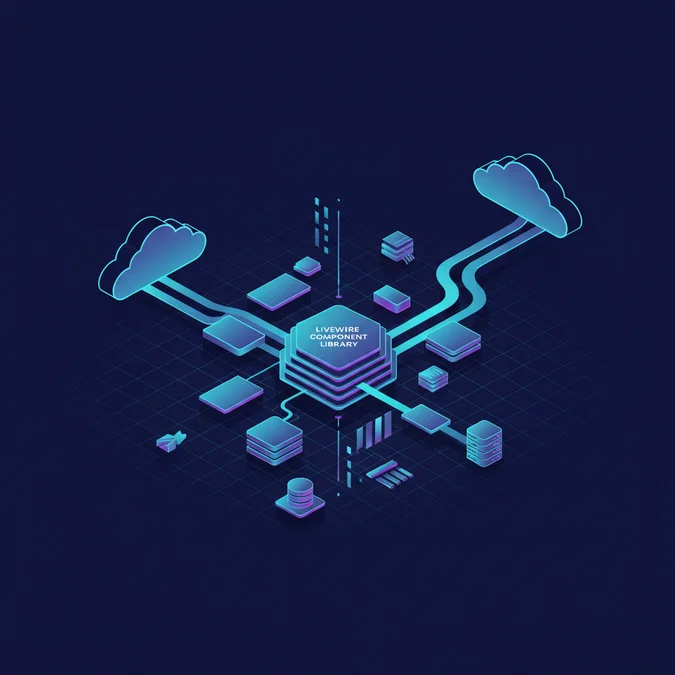

A Livewire component library is a modular collection of reusable, full-stack Blade components paired with server-side PHP classes that synchronize UI state over HTTP or WebSockets without custom JavaScript build steps. It packages interface widgets, reactive tables, and forms into self-contained units that run directly against Laravel application processes.
Technical limitation: Livewire component libraries cannot eliminate the inherent network round-trip penalty of server-side state machines. They are not built for client-rendered 60 FPS graphics, offline-first mobile synchronization, or low-latency canvas manipulation. When an application demands localized millisecond interactions without touching the edge, a pure client-side framework remains unavoidable.
For enterprise teams operating distributed cloud applications, deploying a standardized component library requires careful consideration of horizontal pod autoscaling, Redis session serialization, cache invalidation, and packet payload overhead. Moving beyond simple Blade UI components means treating Livewire components as stateful network entities governed by strict infrastructure boundaries.
Anatomy of an Enterprise Livewire Component Library
Modern Laravel development relies heavily on composable user interfaces. When teams scale out infrastructure across multiple Availability Zones, building ad-hoc Livewire components leads to code duplication, security oversights, and unpredictable memory consumption. An enterprise-grade Livewire component library standardizes how components serialize data, handle life cycles, and communicate across network boundaries.
Unlike simple Blade view packs, a Livewire component bundle contains both the presentation layer and the server-side controller state. Each component carries typed properties, rendering rules, authorization gates, and client side hydration protocols within a standalone package namespace.
Core Structural Components
- The PHP Class Definition: Encapsulates business logic, database queries, and reactive events. It manages internal state during the request lifecycle.
- The Blade Template: Provides the structural HTML, Livewire directives such as
wire:model,wire:click, and Alpine.js micro-interactions. - The State Hydration Pipeline: Handles the dehydration of server properties into signed JSON payloads sent to the browser, and the subsequent hydration back into typed PHP objects upon form submission.
- Asset Registration Hooks: Injects vendor-specific styles and bundled Alpine plugins through service providers without requiring manual client-side build steps in consuming applications.
Adhering to strict standards ensures that custom libraries can be published as internal Composer packages. This enables multiple domain-driven microservices to consume identical UI components while maintaining rigorous brand and security uniformity.
State Synchronization and Network Payload Mechanics
Under the hood, Livewire eliminates client-side state engines like Vuex or Redux by shifting the source of truth entirely to PHP. However, this shifts the computational and bandwidth burden directly onto server processes and network pipelines. Every interactive click, input debounce, or action triggers an AJAX POST request back to the server router.
When a Livewire component updates, it executes a strict mechanical cycle:
- The browser collects the updated property payload and the signed state checksum generated during the previous render.
- The payload transmits to the
/livewire/updateendpoint. - The Laravel server deserializes the payload, validates the cryptographic checksum to prevent tampering, and instantiates the component class.
- The server applies mutations, re-runs authorization, executes the
render()method, and diffs the resulting HTML against the snapshot. - A compressed JSON response delivers the mutated state and DOM morphing instructions back to the browser runtime.
If engineers inadvertently expose large Eloquent collections as public properties inside a component library, every single update serializes that entire dataset into the payload. When implementing modular component development patterns in Laravel, public properties must be strictly limited to primitives or lightweight Data Transfer Objects (DTOs).
<php

namespace Infrastructure\ComponentLibrary\Components;

use Livewire\Component;
use Livewire\Attributes\Locked;
use App\Models\ComputeCluster;

class ClusterMetricsCard extends Component
{
 // Locked prevents the client from tampering with this property over the wire
 #[Locked]
 public string $clusterId;

 // Keep internal network payload tiny: only expose scalar identifiers
 public int $refreshIntervalSeconds = 10;

 public function mount(string $clusterId): void
 {
 $this->clusterId = $clusterId;
 }

 public function render()
 {
 // Database calls stay server-side inside render() to prevent large payload bloat
 $metrics = ComputeCluster:where('uuid', $this->clusterId)
 ->select(['cpu_utilization', 'memory_usage', 'status'])
 ->firstOrFail();

 return view('component-library:livewire.cluster-metrics-card', [
 'metrics' => $metrics,
 ]);
 }
}
Horizontal Scaling and Stateful Session Management
When hosting applications that run Livewire component libraries on auto-scaling clusters, such as AWS ECS, EKS, or Google Cloud Run, default Laravel session behaviors break down. Livewire depends heavily on reliable CSRF token verification and serialized session metadata across sequential requests.
If a user initiates a multi-step form inside a component modal on Pod A, the subsequent debounced input event might route to Pod B via an Application Load Balancer. If sessions reside locally on the pod filesystem, the second request triggers a 419 Page Expired error, collapsing the application experience.
Session and Cache Decoupling
To support high availability, your infrastructure must offload session storage, cache operations, and component state locks to an in-memory database layer like AWS ElastiCache for Redis. Utilizing managed Redis clusters with multi-AZ failover guarantees that any pod in the cluster can hydrate a component payload seamlessly.
| Configuration Directives | Single Server (Local) | Distributed Cloud (Auto-scaled) | Production Impact |
|---|---|---|---|
SESSION_DRIVER |
file |
redis |
Prevents 419 token expiration across multi-pod routing |
CACHE_STORE |
file |
redis / memcached |
Enables shared transient storage across compute nodes |
LIVEWIRE_BACK_BUTTON_CACHE |
false |
true |
Controls browser DOM history reconciliation |
Sticky Sessions (ALB) |
Not Required | Optional (5m TTL) | Lowers Redis hydration latency under spike traffic |
While sticky sessions on AWS ALB or Cloudflare can mitigate cross-pod routing churn, they impair true horizontal load balancing during sudden traffic spikes. Engineering your component library to read and write exclusively from a high-throughput Redis tier is the only cloud-native solution for horizontal scaling.
Database Optimization and Caching with Component Libraries
A common pitfall when adopting third-party or internal Livewire component libraries is the introduction of hidden database bottlenecks. Because Livewire components can render dynamically based on internal poll loops or event listeners, an interface composed of twelve nested Livewire widgets can easily produce hundreds of unoptimized queries per minute per connected user.
To safeguard database clusters like Amazon Aurora or Google Cloud SQL from query exhaustion, component library developers must enforce aggressive query caching and eager loading strategies within component boundaries.
Applying a sensible cache expiration policy to database reads inside Livewire components prevents repeated round-trips for non-volatile metadata.
<php

namespace Infrastructure\ComponentLibrary\Components;

use Livewire\Component;
use Illuminate\Support\Facades\Cache;
use App\Models\BillingZone;

class BillingRegionSelector extends Component
{
 public?string $selectedZone = null;

 public function selectZone(string $zoneCode): void
 {
 $this->selectedZone = $zoneCode;
 $this->dispatch('zone-updated', zone: $zoneCode);
 }

 public function render()
 {
 // Cache read-heavy component reference data using low-overhead tags
 $zones = Cache:remember('billing_zones_list', 3600, function () {
 return BillingZone:where('is_active', true)
 ->orderBy('name')
 ->get(['code', 'name', 'currency']);
 });

 return view('component-library:livewire.billing-region-selector', [
 'zones' => $zones,
 ]);
 }
}
Implementing query caches directly inside library components prevents redundant I/O requests when multiple instances of a widget are rendered simultaneously on a dashboard.
Security Boundaries: Injection, Checksums, and Access Control
Livewire libraries expose distinct attack surfaces compared to traditional static Blade templates. Because every public property on a Livewire component is accessible and manipulable by the browser runtime, components must be engineered with defensive validation routines.
Livewire uses cryptographic HMAC checksums generated by Laravel application keys to ensure client payloads have not been modified. However, checksums alone do not validate authorization logic across distinct operations.
Defensive Component Architecture
Never rely on a hidden input or an unverified public ID property for state manipulation. If a component accepts an action to delete or update a record, verify permissions on the server during the action call itself.
<php

namespace Infrastructure\ComponentLibrary\Components;

use Livewire\Component;
use Livewire\Attributes\Locked;
use Illuminate\Support\Facades\Gate;
use App\Models\ServerNode;

class TerminateNodeAction extends Component
{
 #[Locked]
 public int $nodeId;

 public bool $confirmingTermination = false;

 public function confirm(): void
 {
 $this->confirmingTermination = true;
 }

 public function execute(): void
 {
 $node = ServerNode:findOrFail($this->nodeId);

 // Rigorous runtime authorization gate inside the action call
 Gate:authorize('terminate', $node);

 $node->update(['status' => 'deprovisioning']);

 $this->dispatch('node-terminated', nodeId: $this->nodeId);
 $this->confirmingTermination = false;
 }

 public function render()
 {
 return view('component-library:livewire.terminate-node-action');
 }
}
Integrating your components directly with robust role checking, like the mechanisms found in role-based access control workflows for Laravel, ensures that untrusted client requests are rejected immediately at the network perimeter before mutating core data stores.
CI/CD Pipeline Integration and Packaging Strategies
Standardizing a Livewire component library across a large team requires a dedicated CI/CD delivery pipeline. If engineers copy and paste Livewire classes between repositories, technical debt accumulates rapidly and dependency versions drift out of alignment.
A production-ready distribution model packages components as private Composer packages managed through private registries such as Private Packagist, GitLab Package Registry, or AWS CodeArtifact.
Automated Verification Pipeline Stages
- Static Analysis: Execute PHPStan or Psalm with the Livewire plugin enabled at level 8 or higher to capture uninitialized public properties and incorrect dynamic method calls.
- Blade Linting: Run tools like
blade-formatterand custom AST parsers to verify syntax consistency and check that required Livewire directives are properly closed. - Asset Compilation: Compile Tailwind CSS and bundled Alpine.js assets into standalone vendor distributions. This eliminates the requirement for parent applications to maintain custom PostCSS configurations.
- Automated Matrix Testing: Run Pest or PHPUnit against multiple PHP (8.2, 8.3) and Laravel (10.x, 11.x) versions to ensure cross-environment compatibility.
Structuring tests with orchestration tools built by the wider software engineering ecosystem ensures reliable upstream releases that do not break downstream consumer apps.
Production Monitoring, Telemetry, and Performance Metrics
Running Livewire component libraries at scale without telemetry is an operational hazard. Because Livewire handles interaction through dynamic POST requests to a single URI (/livewire/update), standard APM tools like Datadog, New Relic, or AWS CloudWatch will lump every component call into an identical HTTP transaction bucket.
This obscures slow component actions and hides memory leaks beneath aggregated traffic graphs.
Instrumenting the Livewire Lifecycle
To gain actionable observability, your component library should register custom OpenTelemetry or APM spans during request bootstrapping. By capturing the component’s class name and the specific action triggered, you can isolate degrading widgets quickly.
<php

namespace Infrastructure\ComponentLibrary\Providers;

use Illuminate\Support\ServiceProvider;
use Livewire\Livewire;

class ComponentTelemetryServiceProvider extends ServiceProvider
{
 public function boot(): void
 {
 Livewire:listen('component.hydrate', function ($component) {
 if (app()->bound('telemetry.tracer')) {
 $tracer = app('telemetry.tracer');
 $tracer->startSpan('livewire.hydrate', [
 'component' => get_class($component),
 ]);
 }
 });

 Livewire:listen('component.dehydrate', function ($component) {
 if (app()->bound('telemetry.tracer')) {
 $tracer = app('telemetry.tracer');
 $tracer->endSpan('livewire.hydrate');
 }
 });
 }
}
Tracking telemetry data at this granular level exposes slow database queries, excessive re-renders, and ballooning serialization payloads before they degrade user experiences across your production infrastructure.
Architectural Trade-Offs: Livewire vs Vue vs React Components
Deciding whether to build an internal component system on Livewire, Vue.js, or React requires balancing engineering velocity against compute resource constraints. No single architectural style fits every operational model.
Livewire excels at rapid development cycles for internal portals, admin interfaces, and data-dense dashboards where Laravel models are directly accessible. In contrast, decoupled Single Page Applications (SPAs) shift all presentation computing to client devices, reducing backend load at the expense of API surface complexity.
| Evaluation Dimension | Livewire Component Library | Vue 3 / React SPA | Traditional Blade Components |
|---|---|---|---|
| Server CPU Utilization | High (Frequent rendering) | Low (JSON APIs only) | Moderate (Initial render only) |
| Client Bundle Size | Minimal (HTML updates) | Large (JS Framework runtimes) | Very Low (Zero framework JS) |
| Network Latency Sensitivity | High (State round-trips) | Low (Client-managed state) | Low (Page-level navigations) |
| Development Velocity | Fast (Single stack) | Moderate (Dual stack & APIs) | Fast (Stateless only) |
| Offline Capability | None | Full (Service Workers) | None |
Engineering leadership must evaluate these characteristics when scoping new projects. High-throughput consumer-facing applications with millions of concurrent read operations often benefit from client-side frameworks, whereas operational platforms and mission-critical enterprise tools achieve lower total cost of ownership on Livewire.
Financial Costs and Procurement Analysis
When architecting or procuring a customized Livewire component library, engineering teams face significant budget variations depending on delivery models: subscribing to pre-built commercial component suites, contracting custom agency architecture, or dedicating internal engineering bandwidth.
Below is a realistic market breakdown of typical cost models for enterprise Laravel ecosystems.
| Procurement Model | Initial Financial Outlay | Recurring Maintenance Cost | Ideal Production Context |
|---|---|---|---|
| Commercial Library Licenses (e.g. Flux, WireUI Pro) | $250 to $1,500 (one-time or annual) | $100 to $400 / year | Standard MVPs and small team platforms |
| Specialized Agency Retainer | $10,000 to $35,000 setup | $4,000 to $12,000 / month | Large enterprise redesigns requiring customized design systems |
| Dedicated In-House Development | $45,000 to $90,000 (Internal CAPEX) | $15,000 to $30,000 / year (DevOps overhead) | Proprietary IP with strict security audits and bespoke cloud integration |
| Hourly Senior Contractor | $120 to $220 / hour | Variable on demand | Targeted component refactoring and telemetry instrumentation |
For standard digital products, purchasing enterprise licenses for established base libraries and building domain-specific extensions on top minimizes initial capital expenditure. However, organizations with sovereign infrastructure or air-gapped network demands require in-house custom component repositories that support strict regulatory audits and zero external CDN dependencies.
Explore the Laravel Basics Directory
Establishing high-availability component libraries is just one step in running resilient Laravel systems on cloud platforms. For more architecture teardowns, optimization guides, and operational workflows, check out our broader repository of technical documentation.
Explore our complete Laravel, Basics directory for more guides.
Factors That Affect Development Cost
- Commercial license fees vs proprietary internal development costs
- Database read volume and Redis instance sizing
- Continuous integration infrastructure and packaging registries
- Engineering hours dedicated to telemetry instrumentation and payload optimization
Costs range from minor software license fees for pre-built toolkits to significant custom software investments for audited enterprise design systems.
Standardizing UI architecture on a Livewire component library provides remarkable developer velocity while simplifying the modern web stack. By anchoring reactive operations directly in PHP, teams eliminate the friction of managing separate API contracts, hydration states, and decoupled frontend tooling.
However, running these components reliably in scalable cloud environments demands disciplined infrastructure engineering. Architects must implement Redis-backed session layers, eliminate data serialization bloat on public component properties, and isolate dynamic routes within APM instrumentation. When these guardrails are in place, a Livewire component library becomes a resilient, enterprise-ready engine for modern cloud applications.