
In 2026, the delta between a prototype and a production-grade LLM application is no longer about prompt quality. It is about architectural rigor. Engineers tasked with scaling these systems face a landscape where model performance, latency, and orchestration complexity collide. Mastering this domain requires moving beyond black-box API calls toward a deep understanding of transformer mechanics, vector search, and agentic control loops.
This roadmap bypasses the noise of surface-level tutorials, focusing instead on the engineering primitives required to build, deploy, and monitor scalable LLM systems. Whether you are looking to learn LLM architecture from the ground up or refine your existing orchestration stack, the following sections define the core technical competencies required for modern AI engineering.
Foundations for Those Who Need to Learn LLM Architecture
To successfully learn LLM mechanics, you must first demystify the transformer architecture. Modern engineering is not just about calling an endpoint, it is about understanding how tokens flow through layers, attention heads, and KV caches. Developers who skip these fundamentals consistently fail to debug issues related to context window saturation and output instability.
Engineering Note: Tokenization is the hidden bottleneck in most LLM applications. Understanding how different models handle byte-pair encoding (BPE) is critical for accurate cost estimation and latency prediction.
Production Readiness Checklist:
- Can you explain the difference between decoder-only and encoder-decoder architectures?
- Do you understand how temperature, top-p, and top-k affect the probabilistic nature of generation?
- Are you familiar with the memory footprint of KV caching during long-context inference?
- Can you identify when to use a local quantization strategy versus a remote API?
Evaluating the Best LLM Course for Beginners and Advanced Practitioners
Selecting an LLM course for beginners requires a discerning eye. The market is saturated with prompt-engineering fluff that lacks substance. For practitioners, the goal should be to find an LLM course that treats AI as a component of a larger software system rather than a standalone magic box.
| Criteria | Junior Path | Senior Path |
|---|---|---|
| Core Focus | API Integration | System Architecture |
| Tooling | LangChain/LiteLLM | Custom C++/CUDA Kernels |
| Evaluation | Manual Checks | Automated RAG Benchmarking |
| Cost Analysis | API Credits | Inference TCO Modeling |
The best LLMs courses in 2026 prioritize hands-on experimentation with open-source weights and distributed inference frameworks over passive video consumption.
Practical Implementation: Leveraging Free LLM Training Resources
The most effective free LLM training is found in the trenches of open-source repositories. Rather than paying for high-level theory, engineers should focus on reading the implementation code of production-grade orchestrators. By analyzing how these systems handle state management and error propagation, you gain a practical edge.
Core Implementation Pattern:
// Basic state management for agentic orchestration

async function executeChain(input, state) {

 try {

 const context = await retrieveContext(input);

 const response = await model.generate(input, context);

 return await validateResponse(response);

 } catch (err) {

 handleOrchestrationError(err);

 }

}
Key Training Resources:
- Research Papers: Focus on ‘Attention Is All You Need’ and ‘Retrieval-Augmented Generation for Knowledge-Intensive NLP’.
- GitHub Repos: Study the source code of frameworks like LlamaIndex and LangGraph.
- Model Cards: Review the technical specifications on Hugging Face for every model you deploy.
Standardizing Your LLM Training Courses and Development Pipeline
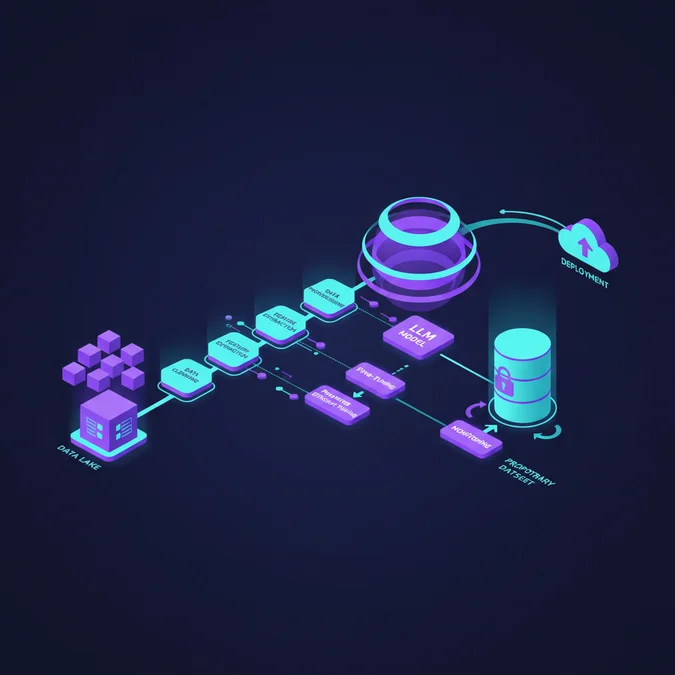
When integrating LLM training courses into a professional development cycle, you must treat your models as software artifacts. This means version control for weights, automated evaluation suites, and performance regression testing. The following table illustrates the standard production pipeline for an AI-integrated system.
| Pipeline Stage | Tooling Requirement |
|---|---|
| Data Ingestion | Vector DB (Pinecone/Milvus) |
| Fine-Tuning | PEFT/LoRA/QLoRA |
| Deployment | vLLM/Triton Inference Server |
| Monitoring | LangSmith/Arize |
Standardizing these flows ensures that your team moves beyond experimental scripts into reliable, repeatable deployment patterns.
Frequently Asked Questions
Where can I find a structured llm course for beginners that focuses on engineering?
Beginners should prioritize platforms that emphasize hands-on coding over theory. Look for curricula covering LangChain, vector databases, and model evaluation metrics. Recommended paths involve building projects from scratch rather than following passive video tutorials to ensure practical mastery of orchestration patterns.
Are there reputable free llm training materials available for developers?
Yes, high-quality free training is available through open-source project documentation, technical research papers from labs like OpenAI and Anthropic, and community-driven repositories on GitHub. Focus on learning through implementation by exploring existing agentic workflows rather than relying solely on paid certificate programs.
What should I look for when evaluating llm training courses?
Effective training courses must cover production-grade topics including latency optimization, cost management, data privacy, and evaluation frameworks. Avoid courses that focus exclusively on prompt engineering. Prioritize content that teaches how to integrate LLMs into existing software systems using modular orchestration tools.
Mastering LLM engineering is an iterative process of benchmarking, deploying, and refining. By focusing on architectural primitives and moving away from passive learning, you position yourself to build systems that are not just functional, but resilient and scalable.
Review your current stack against the production-readiness standards outlined here. If your workflow lacks automated evaluation or rigorous latency profiling, prioritize those areas before expanding your model capabilities.