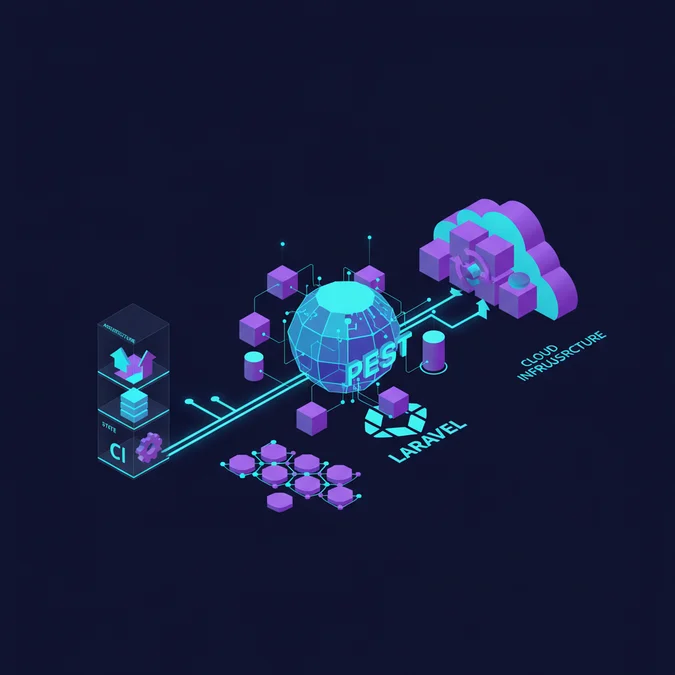

Pest is an expressive testing framework built on top of PHPUnit that provides closure-based syntax, compact test declarations, and deep integration with Laravel. It runs as a drop-in layer over PHPUnit, executing the same underlying runner while replacing class boilerplate with clean, declarative function calls for faster test authoring and maintenance.
However, Pest cannot solve underlying architectural defects, eliminate slow database transactions, or magically speed up I/O-bound integrations. It does not replace proper isolation strategies, mocking mechanisms, or system profiling. Adopting Pest without disciplined database lifecycle management and clean state separation will simply execute poorly architected tests faster.
When scaling Laravel test suites across microservices or complex monoliths, developers encounter distinct bottlenecks: memory leaks during long test runs, parallel test runner deadlocks, and brittle assertion maintenance. This guide examines the internal mechanics of Pest, detailing custom expectations, architectural boundaries, parallel execution profiles, and continuous integration pipelines.
Pest Architecture and PHPUnit Interoperability Mechanics
At its core, Pest is not a separate testing engine built from scratch. It functions as an ergonomic domain-specific language compiled directly into PHPUnit test cases at runtime. When you write a test using the test() or it() helper functions, Pest maps those closures into dynamic anonymous classes derived from PHPUnit\Framework\TestCase.
This design decision preserves complete backward compatibility. You can execute standard PHPUnit classes and Pest closure files within the same test run without separate binary invocations or isolated runners. This hybrid execution lifecycle functions through several concrete internal stages:
- File Parsing and Discovery: Pest traverses the directories specified in your configuration, scanning for files matching the standard naming convention (such as
*Test.php). - Closure Binding: Pest wraps every defined test closure inside a custom proxy object. This proxy dynamically binds the Laravel application instance, binding
$thisto an underlying extended test case class. - Interception of Test Hooks: Hooks such as
beforeEach(),afterEach(), anddataset()are intercepted and mapped directly to PHPUnit lifecycle methods likesetUp()andtearDown().
Understanding this architecture prevents common mistakes regarding scoping. Because Pest compiles closures onto an internal test case class, properties set on $this inside a test are scoped to that test execution alone. Here is how a standard test is written in Pest versus PHPUnit:
<php

// tests/Feature/BillingEngineTest.php
declare(strict_types=1);

use App\Models\Account;
use App\Services\BillingService;
use Illuminate\Foundation\Testing\RefreshDatabase;

uses(RefreshDatabase:class);

beforeEach(function () {
 // Setup runs inside the compiled TestCase context
 $this->account = Account:factory()->create([
 'currency' => 'USD',
 'balance_cents' => 5000,
 ]);
 $this->billing = app(BillingService:class);
});

test('billing service processes base debits accurately', function () {
 $transaction = $this->billing->debit($this->account, 1500);

 expect($transaction->status)->toBe('completed')
 ->and($this->account->fresh()->balance_cents)->toBe(3500);
});
The closure inside test() retains standard object binding, allowing full interaction with Laravel facades, service container bindings, and native framework assertions while removing the typical boilerplate class declarations.
Project Configuration and Environment Setup for Laravel
Integrating Pest into an existing or new Laravel project requires configuring composer dependencies, verifying binary plugins, and establishing strict environment controls. The foundation of this configuration lives within the Pest.php file inside your tests directory.
Install the core package alongside the Laravel plugin via Composer using the development flag:
composer require pestphp/pest pestphp/pest-plugin-laravel --dev
php artisan pest:install
The initialization command provisions a boilerplate tests/Pest.php file. This file controls global trait binding, global helper functions, and custom expectation definitions. In large systems, grouping test directories with explicit traits keeps suite configurations predictable:
<php

// tests/Pest.php
declare(strict_types=1);

use Illuminate\Foundation\Testing\RefreshDatabase;
use Illuminate\Foundation\Testing\DatabaseTransactions;
use Tests\TestCase;
use Tests\DuskTestCase;

/*
|--------------------------------------------------------------------------
| Test Suite Trait Bindings
|--------------------------------------------------------------------------
| Map specific directories to foundational base test classes and traits.
| Feature tests use full database refreshes, whereas Unit tests remain
| decoupled from the framework state to preserve sub-second execution.
*/

uses(TestCase:class, RefreshDatabase:class)->in('Feature');
uses(TestCase:class, DatabaseTransactions:class)->in('Integration');
uses(TestCase:class)->in('Unit');

/*
|--------------------------------------------------------------------------
| Shared Global Helper Functions
|--------------------------------------------------------------------------
*/
function authenticateAsAdmin(): \App\Models\User
{
 $user = \App\Models\User:factory()->create(['role' => 'admin']);
 test()->actingAs($user);
 return $user;
}
This structure guarantees that your Unit test suite does not boot database lifecycle listeners by default, preventing unnecessary performance degradation during local test cycles.
Writing Expressive Assertions with Pest Expectations API
Pest ships with an assertion layer referred to as the Expectations API. Instead of relying on static assertions such as $this->assertEquals($expected, $actual), Pest utilizes a fluent syntax starting with the expect() wrapper. This design enhances readability and simplifies method chaining.
Chainable assertions let you validate complex state trees without re-declaring targets:
<php

declare(strict_types=1);

use App\Models\Order;
use App\Enums\OrderStatus;

test('order processing recalculates tax and status transitions', function () {
 $order = Order:factory()->create([
 'subtotal' => 10000,
 'status' => OrderStatus:Draft,
 ]);

 $order->finalizeInvoice(taxRate: 0.08);

 expect($order)
 ->status->toEqual(OrderStatus:Finalized)
 ->tax_total->toBe(800)
 ->grand_total->toBe(10800)
 ->items->toHaveCount(0)
 ->and($order->processed_at)
 ->not->toBeNull()
 ->toBeInstanceOf(\Carbon\CarbonImmutable:class);
});
The distinction between toBe() and toEqual() mirrors PHP semantics:
- toBe(): Enforces identity checks (
===), asserting that two variables share the same type, value, and memory reference when comparing objects. - toEqual(): Enforces equivalence checks (
==), inspecting array structures and model attributes without demanding identical memory references.
For custom domain logic, Pest allows teams to build domain-specific custom expectations directly within tests/Pest.php:
<php

// Custom expectation definition in tests/Pest.php
expect()->extend('toBeAuthorizedFor', function (string $permission) {
 $user = $this->value;

 return $this->assertTrue(
 $user->hasPermissionTo($permission),
 "User [ID: {$user->id}] does not hold the required [{$permission}] permission."
 );
});

// Usage in a feature test
test('compliance officers hold auditing access', function () {
 $officer = \App\Models\User:factory()->create(['role' => 'compliance']);

 expect($officer)->toBeAuthorizedFor('audit.transactions');
});
Maintaining strict behavioral boundaries across systems requires writing clear validation routines, a principle detailed in our discussion of software development integrity across distributed teams.
Database Management Strategies: RefreshDatabase vs DatabaseTransactions
Database state isolation represents the single largest consumer of CPU and disk I/O time in Laravel test suites. Choosing the incorrect migration strategy can inflate continuous integration runtimes from minutes to hours. Pest supports Laravel’s standard isolation traits, each carrying architectural trade-offs.
| Strategy | Mechanism | Primary Strength | Critical Limitation |
|---|---|---|---|
RefreshDatabase |
Runs migrations once, then wraps tests in transactions; falls back to re-migrating if schemas alter. | Total schema fidelity; resets auto-increment keys and catches implicit commits. | Higher startup overhead on large schemas exceeding 200 migrations. |
DatabaseTransactions |
Wraps test in a PDO transaction rollback without verifying initial schema state. | Faster iteration speed; near-zero boot cost per test file. | Cannot detect uncommitted side-effects or code utilizing manual transaction commits. |
LazilyRefreshDatabase |
Postpones database initialization until a database call actually occurs in the test. | Zero database overhead for tests that do not query models. | Slightly less predictable setup timing when debugging query dispatchers. |
To implement selective lazy refreshing across your entire test architecture, attach LazilyRefreshDatabase globally in tests/Pest.php:
<php

use Illuminate\Foundation\Testing\LazilyRefreshDatabase;

uses(LazilyRefreshDatabase:class)->in('Feature', 'Integration');
When tests trigger code paths containing nested database transactions or explicit calls to DB:commit(), standard transaction rollbacks fail to clean the database state cleanly. In those specific files, override the behavior by declaring RefreshDatabase explicitly.
Data-Driven Testing Using Datasets and Shared Fixtures
Testing complex business rules across wide boundary conditions frequently leads to copy-paste code bloat. Pest solves this via with() and reusable datasets. Datasets supply inputs directly to test arguments, executing an independent sub-test for each data row.
Datasets can be declared inline, or shared across multiple test files by placing them in a dedicated tests/Datasets directory.
<php

// tests/Datasets/TaxRates.php
dataset('international_vat_rates', function () {
 return [
 'German Standard' => ['DE', 10000, 1900],
 'French Standard' => ['FR', 10000, 2000],
 'Luxembourg Reduced' => ['LU', 10000, 1700],
 'Zero Rated Export' => ['US', 10000, 0],
 ];
});
Consuming this dataset within a feature test ensures comprehensive test coverage while maintaining a clean, single-assertion block:
<php

// tests/Feature/TaxCalculationTest.php
declare(strict_types=1);

use App\Services\VatCalculator;

test('vat engine computes regional rates accurately', function (string $country, int $amount, int $expectedTax) {
 $calculator = new VatCalculator();

 $calculated = $calculator->calculate(amountCents: $amount, countryCode: $country);

 expect($calculated)->toBe($expectedTax);
})->with('international_vat_rates');
You can also evaluate combinations using matrix datasets. Supplying multiple datasets to with() computes a Cartesian product, verifying every possible combination of inputs:
<php

test('subscription tiers validate against billing frequencies', function (string $tier, string $interval) {
 $plan = \App\Services\PlanValidator:validate($tier, $interval);
 expect($plan->isValid())->toBeTrue();
})->with([
 'starter',
 'professional',
 'enterprise'
])->with([
 'monthly',
 'annually'
]);
Cartesian matrix tests expand test coverage quickly. However, monitor your total assertion count, as unconstrained matrix products can cause test execution times to skyrocket.
Mocking, Spying, and Container Binding in Pest
Unit and integration tests must frequently decouple from third-party APIs, remote payment gateways, and heavy message brokers. Pest integrates with Mockery while providing clean helper functions to bind mock objects into Laravel’s service container.
The global mock() and spy() helpers instantiate Mockery instances, bind them directly into the application container, and register destruction hooks automatically:
<php

declare(strict_types=1);

use App\Services\PaymentGatewayInterface;
use App\Services\OrderFulfillmentService;
use Mockery\MockInterface;

test('fulfillment dispatches charge request to payment gateway', function () {
 // Create and bind mock directly to the container
 $gateway = $this->mock(PaymentGatewayInterface:class, function (MockInterface $mock) {
 $mock->shouldReceive('charge')
 ->once()
 ->with(15000, 'usd')
 ->andReturn((object) ['status' => 'success', 'id' => 'tx_9921']);
 });

 $service = app(OrderFulfillmentService:class);
 $result = $service->process(orderId: 42, amountCents: 15000, currency: 'usd');

 expect($result->isSuccessful())->toBeTrue();
});
In systems driven by real-time metrics and dynamic interfaces, keeping test assertions isolated prevents side effects from breaking surrounding tests, an issue addressed when building reactive Laravel systems with heavy data workloads.
Alternatively, the spy() helper supports deferred validation, asserting that an action occurred after running domain logic rather than requiring upfront expectations:
<php

use App\Contracts\NotificationBroker;

test('order failure emits urgent operational alerts', function () {
 $broker = $this->spy(NotificationBroker:class);

 app(OrderFulfillmentService:class)->handleFailedCharge(orderId: 99);

 // Verify side effect post-execution
 $broker->shouldHaveReceived('sendAlert')->once();
});
Architecture Testing: Enforcing Domain Rules with Arch Plugin
Software architectures degrade when team members inadvertently breach domain boundaries, leak infrastructure dependencies into domain cores, or scatter debugging functions across production code. Pest includes a dedicated Architecture Testing engine that turns architectural standards into automated test assertions.
Install the architecture plugin if it is not already included in your Pest setup:
composer require pestphp/pest-plugin-arch --devCreate an tests/Feature/ArchitectureTest.php file to define system-wide architectural rules:
<php

declare(strict_types=1);

// Prevent debug calls in production files
arch('debugging statements are eliminated from source')
 ->expect(['dd', 'dump', 'ray', 'var_dump'])
 ->not->toBeUsed();

// Enforce strict typing across application directories
arch('models adhere to naming conventions and inheritance')
 ->expect('App\Models')
 ->toExtend('Illuminate\Database\Eloquent\Model')
 ->toOnlyBeUsedIn([
 'App\Repositories',
 'App\Services',
 'App\Http\Controllers',
 'Database\Factories',
 'Database\Seeders',
 ]);

// Keep domain models separated from HTTP concerns
arch('domain models do not access HTTP primitives')
 ->expect('App\Models')
 ->not->toUse(['Illuminate\Http\Request', 'Illuminate\Support\Facades\Request']);

// Ensure controllers remain thin and invoke action classes
arch('controllers depend only on action contracts')
 ->expect('App\Http\Controllers')
 ->not->toUse('App\Integrations');
These architecture tests run alongside normal unit and feature suites, analyzing abstract syntax trees (ASTs) via static reflection without booting classes into memory. This keeps execution overhead minimal while preventing architectural drift across pull requests.
Parallel Testing Execution and Database Concurrency
As test suites grow past 1,000 assertions, serial execution becomes a developer productivity bottleneck. Pest provides native parallel execution using Paratest under the hood. Invoking parallelism distributes tests across multiple system CPU cores simultaneously:
php artisan test --parallel
# Or directly via the pest binary./vendor/bin/pest --parallel --processes=8
Parallel testing introduces concurrency challenges when running database assertions. If eight test runners write to the same database simultaneously, deadlocks, race conditions, and corrupted assertions inevitably occur. Laravel handles this by provisioning isolated database instances per worker process.
When running under --parallel, Laravel detects the assigned runner token via the TEST_TOKEN environment variable, dynamic creating schemas such as testing_1, testing_2, up to the total number of parallel processes.
- Preparation Command: Run
php artisan test --parallel --recreate-databasesto drop and rebuild all parallel database schemas whenever schema migrations change. - State Isolation: Never rely on fixed seed sequences across parallel tests. Parallel tests run out of order, meaning test records must be created deterministically within each test using factories.
- File System Collisions: Avoid pointing mock disk drivers (
Storage:fake('s3')) to the exact same temporary local paths across concurrent workers. Namespace temporary files usinggetmypid()or the test token.
Properly configured parallel execution reduces continuous integration pipeline runtimes significantly:
# Optimize execution run via composer script./vendor/bin/pest --parallel --processes=4 --min=80.0The --min flag sets an explicit minimum code coverage threshold, terminating CI runs with an error if total coverage drops below the target limit.
Continuous Integration Optimization and GitHub Actions Workflows
A fast test suite in local development will still run slowly in CI if external dependencies, cache directories, and database preparation steps are poorly orchestrated. Running Pest within GitHub Actions requires configuring matrix caching, database containers, and parallel execution flags.
The following workflow establishes a continuous integration pipeline for Pest running against a dedicated MySQL container service:
name: Execute Application Test Suite

on:
 push:
 branches: [main]
 pull_request:
 branches: [main]

jobs:
 pest-tests:
 runs-on: ubuntu-latest

 services:
 mysql:
 image: mysql:8.0
 env:
 MYSQL_ROOT_PASSWORD: root_password
 MYSQL_DATABASE: testing
 ports:
 - 3306:3306
 options: >-
 --health-cmd="mysqladmin ping --silent"
 --health-interval=10s
 --health-timeout=5s
 --health-retries=3

 steps:
 - name: Checkout Codebase
 uses: actions/checkout@v4

 - name: Setup PHP Environment
 uses: shivammathur/setup-php@v2
 with:
 php-version: '8.3'
 extensions: mbstring, pdo, pdo_mysql, pcntl, redis
 coverage: pcov

 - name: Get Composer Cache Directory
 id: composer-cache
 run: echo "dir=$(composer config cache-files-dir)" >> $GITHUB_OUTPUT

 - name: Cache Composer Dependencies
 uses: actions/cache@v4
 with:
 path: ${{ steps.composer-cache.outputs.dir }}
 key: ${{ runner.os }}-composer-${{ hashFiles('**/composer.lock') }}
 restore-keys: ${{ runner.os }}-composer-

 - name: Install Dependencies
 run: composer install --prefer-dist --no-progress --no-interaction

 - name: Execute Migrations
 env:
 DB_CONNECTION: mysql
 DB_HOST: 127.0.0.1
 DB_PORT: 3306
 DB_DATABASE: testing
 DB_USERNAME: root
 DB_PASSWORD: root_password
 run: php artisan migrate --force

 - name: Execute Tests in Parallel
 env:
 DB_CONNECTION: mysql
 DB_HOST: 127.0.0.1
 DB_PORT: 3306
 DB_DATABASE: testing
 DB_USERNAME: root
 DB_PASSWORD: root_password
 run:/vendor/bin/pest --parallel --processes=2 --coverage --min=75
This workflow mounts MySQL, caches composer packages using the lockfile hash, and activates the lightweight PCOV extension to collect coverage without the severe runtime performance penalty associated with Xdebug.
Migrating from PHPUnit to Pest: Step-by-Step Transition
Migrating a large enterprise Laravel codebase containing hundreds of legacy PHPUnit test classes to Pest does not require a rewrite. Because Pest runs standard PHPUnit classes natively, teams can migrate files incrementally.
Follow this step-by-step transition plan to avoid disrupting active feature delivery:
- Install the Pest Drift Plugin: The Drift converter automates AST transformation from PHPUnit classes into Pest closures.
composer require pestphp/pest-plugin-drift --dev - Execute Migration on Isolated Directories: Avoid converting your entire suite at once. Run conversions on smaller, lower-risk feature subdirectories first:
./vendor/bin/pest drift tests/Feature/Auth - Verify Edge-Case Bindings: Inspect converted test files for custom assertion methods, private helper functions, and complex mock expectations that might require manual adjustments.
- Clean Up PHPUnit Base Classes: Once all files under a directory are converted, refactor legacy base classes (such as
tests/FeatureTestCase.php) into global trait calls intests/Pest.php.
Review this side-by-side comparison of an integration test before and after migration:
<php

// Legacy PHPUnit Test (tests/Feature/UserRegistrationLegacyTest.php)
namespace Tests\Feature;

use Tests\TestCase;
use App\Models\User;
use Illuminate\Foundation\Testing\RefreshDatabase;

class UserRegistrationLegacyTest extends TestCase
{
 use RefreshDatabase;

 public function test_user_can_register_with_valid_credentials(): void
 {
 $payload = ['email' => 'alex@example.com', 'password' => 'Secret123!'];
 $response = $this->postJson('/api/register', $payload);

 $response->assertStatus(201);
 $this->assertDatabaseHas('users', ['email' => 'alex@example.com']);
 }
}
The migrated Pest equivalent removes class nesting and simplifies state validation:
<php

// Migrated Pest Test (tests/Feature/UserRegistrationTest.php)
declare(strict_types=1);

test('user can register with valid credentials', function () {
 $payload = ['email' => 'alex@example.com', 'password' => 'Secret123!'];

 $this->postJson('/api/register', $payload)
 ->assertCreated();

 $this->assertDatabaseHas('users', ['email' => 'alex@example.com']);
});
Adopting this approach allows teams to migrate legacy test suites incrementally while delivering features on schedule.
Engineering Cost and Commercial Implementation Models
Upgrading test infrastructure, migrating legacy suites to Pest, and configuring high-throughput CI environments requires balancing developer time and infrastructure spend. Engineering organizations evaluate these updates using three primary commercial engagements: specialized consultancy retainers, fixed-scope architecture modernizations, or standard hourly technical staff augmentation.
| Engagement Model | Typical Pricing Structure | Project Scope & Target Deliverables | Operational Considerations |
|---|---|---|---|
| Hourly Staff Augmentation | $110 to $195 per hour | Converting tests incrementally; writing custom assertion helpers; refactoring existing feature tests alongside staff. | Costs can expand if internal domain models are unstable or database seeds are brittle. |
| Fixed-Scope Migration Project | $8,500 to $24,000 per project | Complete migration of 500+ PHPUnit tests to Pest, parallel setup, and baseline CI speed optimization. | Requires frozen test schemas and well-defined architecture specifications up front. |
| Monthly Platform Retainer | $4,500 to $12,000 per month | Ongoing CI speed profiling, flakiness elimination, testing standards enforcement, and architecture rule management. | Best suited for engineering teams shipping daily releases across multi-service monoliths. |
Beyond external labor, organizations must account for continuous integration compute costs. Unoptimized serial test suites that run for 45 minutes consume significantly more compute minutes than optimized parallel Pest suites that complete in under four minutes. For teams running 50 builds daily, parallelizing your test suite directly lowers continuous integration compute charges.
Further Explorations and Framework Foundations
Testing forms one critical pillar of a maintainable software architecture. Mastering database seed configurations, container lifecycles, and controller isolation sets the stage for building resilient Laravel applications.
Explore our complete Laravel, Basics directory for more guides.
Factors That Affect Development Cost
- Total number of legacy test classes requiring AST transformation
- Complexity of custom database seeds and factory dependencies
- CI runner concurrency limits and cloud provider compute charges
- Extent of third-party payment gateway or external API mocking
Total implementation and migration investments range from $8,500 for focused refactorings up to $24,000 for large enterprise test suites.
Frequently Asked Questions
Does Pest replace PHPUnit in Laravel?
Pest does not replace PHPUnit under the hood; it runs on top of it. Pest translates closures into standard PHPUnit TestCase classes at runtime, allowing PHPUnit and Pest files to execute alongside each other in the same suite.
Is Pest faster than standard PHPUnit?
Pest shares identical execution speed with PHPUnit because it runs on the exact same engine. However, Pest feels faster in practice thanks to its built-in parallel testing integration, minimal syntax overhead, and ergonomic CLI output.
Can I use standard Laravel assertions inside Pest?
Yes. All native Laravel test assertions, including assertDatabaseHas, assertStatus, and assertJson, are fully supported in Pest via the bound $this variable or chained off response closures.
How does Pest handle parallel testing databases?
Pest uses ParaTest to spawn isolated worker processes. Laravel assigns each process an integer token (TEST_TOKEN) and provisions separate, dedicated test databases to prevent transaction deadlocks and concurrent writes.
Adopting Pest transforms how engineering teams build and maintain automated test suites in Laravel. Moving away from verbose class boilerplate toward expressive closures reduces cognitive overhead, clarifies assertion intent, and encourages higher testing coverage across critical paths. However, switching testing syntax alone will not resolve slow test suites caused by unindexed queries, bloated factories, or coupled integration boundaries.
For sustained scale, pair Pest’s Expectations and Architecture plugins with parallel execution, lazy database refreshing, and focused CI caching. Treat your test suite with the same architectural rigor as your production codebase. Doing so creates an expressive, sub-minute test suite that enables safe, confident production deployments.