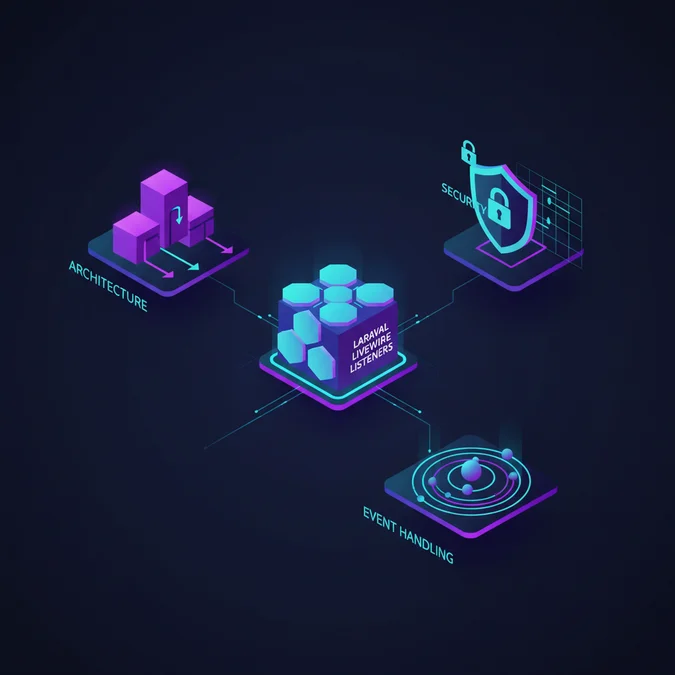

Laravel Livewire listeners are declarative event bindings that map frontend browser events or server-side component dispatches to specific PHP methods inside your Livewire components. They enable isolated components to communicate reactively over HTTP or WebSockets without custom JavaScript code, executing server-side logic and returning DOM diff updates to the browser interface.
Why do application security teams frequently discover critical privilege escalation and state tampering flaws inside Livewire event workflows? While declarative component communication accelerates development speed, omitting transport validation turns events into unauthenticated remote procedure calls. A malicious actor can inspect network traffic, alter component identifiers, forge client-side event dispatches, and trigger backend methods with arbitrary arguments.
Implementing event listeners safely requires a complete understanding of Livewire lifecycle internals, request signing protocols, authorization gates, and payload sanitization patterns. This technical guide explores the architectural mechanics of Livewire listeners across versions 2 and 3, dissects exploit vectors targeting event buses, and outlines enterprise defense strategies for high-assurance Laravel applications.
Direct Answer: What Are Livewire Listeners and How Do They Work
Laravel Livewire listeners define server-side PHP handlers that intercept dispatched events, mapping an incoming event name to a component method. When an event triggers from a template action, another Livewire component, or client-side JavaScript, Livewire packages the payload into an AJAX request or WebSocket message, matches the listener key on the server, verifies the payload signature, runs the targeted method, and returns a surgical DOM patch.
Behind the scenes, Livewire registers these hooks during the initial component boot phase. The runtime parses either the legacy $listeners property array or the modern PHP 8 attribute syntax, caching method bindings on the server while exposing event names to the browser runtime. This creates an event transport bridge between independent DOM nodes.
<php

namespace App\Livewire;

use Livewire\Component;
use Livewire\Attributes\On;

class AuditStream extends Component
{
 // Livewire 3 attribute-based event listener
 #[On('security-incident-logged')]
 public function refreshAuditTrail(int $incidentId): void
 {
 // Verify permissions before handling incoming state updates
 abort_unless(auth()->user()->can('view-audits'), 403);

 // The incoming payload is strictly validated and processed
 logger()->info("Processing audit stream for incident: {$incidentId}");
 }

 public function render()
 {
 return view('livewire.audit-stream');
 }
}
In standard application lifecycles, event dispatchers send data up to the parent component, down to children, or globally across the current browser document. Modern architectures often build workflows using modern rapid application development platforms, but developers must recognize that every listener represents a network endpoint exposed to the client.
Event Transport Mechanics: Livewire 2 Versus Livewire 3
Understanding the architectural divergence between Livewire 2 and Livewire 3 is vital when assessing event dispatch security and runtime performance. Livewire 2 relied heavily on protected array declarations, browser-level window events, and component serialization snapshots packed into custom payload structures. Livewire 3 introduced an optimized serialization system, morphing algorithms, and explicit attribute-driven listeners.
Livewire 2 components explicitly bound events via the protected $listeners property array. The mapping routed string events to method names, utilizing internal magic prefixes for dynamic handling:
// Livewire 2 Legacy Syntax
class UserProfile extends Component
{
 public $user;

 protected $listeners = [
 'userUpdated' => 'handleUserUpdate',
 'refreshComponent' => '$refresh',
 'echo-private:orders,OrderShipped' => 'notifyShipment',
 ];

 public function handleUserUpdate($userId)
 {
 $this->user = User:findOrFail($userId);
 }
}
In Livewire 3, the preferred pattern transitions to the #[On] PHP attribute. Attributes eliminate array bloat, reduce boilerplate, and allow multiple attributes per method. Livewire 3 also overhauled how dispatches propagate across client trees, separating internal component updates from browser DOM events.
Consider this side-by-side comparison of technical implementation details across both major versions:
| Architectural Metric | Livewire 2 Implementation | Livewire 3 Implementation |
|---|---|---|
| Listener Definition | Protected $listeners array |
#[On('event-name')] PHP 8 attribute |
| Dispatch Syntax | $this->emit() / $this->emitTo() |
$this->dispatch() |
| Client Morph Pipeline | Morphdom DOM patching | Idiomatic internal Morph engine |
| Transport Security | Full payload signature verification | Encrypted snapshot payload tokens |
| Scope Modifiers | emitUp(), emitSelf() |
dispatch()->to(), dispatch()->self() |
Developers modernizing older stacks must remember that Livewire 3 components still respect the legacy $listeners array for backwards compatibility, but mixing paradigms within a single enterprise codebase increases cognitive load and obfuscates audit trails.
The Request-Response Lifecycle of a Livewire Listener
To secure Livewire event listeners, security engineers must understand what happens over the wire during event dispatching. When a user interacts with a control that calls $this->dispatch('order-canceled', id: 42), Livewire does not execute that method within the active request context. It serializes the event intent into JSON and sends it in the response header back to the client browser.
The browser-side Livewire JavaScript asset intercepts the incoming response, detects the event queue, and triggers an event on the global window or targets specific component DOM instances. Once triggered, the target component evaluates whether it registers a matching listener. If so, it initiates a secondary asynchronous HTTP POST request to the Livewire endpoint (/livewire/update).
- Component A Execution: Action runs, calling
$this->dispatch(). Livewire attaches event metadata to the response bundle. - Client-Side Interception: The browser runtime unwraps the payload, evaluating targets (self, to, or global).
- Secondary HTTP Request: The receiving component executes an AJAX call containing its serialized snapshot and the event name with passed parameters.
- Server Hydration: The Laravel application initializes the target Livewire component, unpacks state, validates the cryptographic checksum, and locates the listener method.
- Handler Execution: The listener method executes using provided parameters.
- Dehydration and DOM Diff: Livewire recalculates the component view, serializes the updated state, signs it with the
APP_KEY, and returns HTML diff instructions to the browser.
This two-step dispatch architecture means all data passed via an event traverses untrusted browser memory. Even if Component A and Component B reside on the same Laravel server, data flowing between them via an event travels through the client runtime, exposing the transaction to client-side interception and payload tampering.
Security Implications: OWASP Top 10 Vulnerabilities in Livewire Listeners
Livewire abstracts network boundaries, creating an illusion that method invocations occur strictly within local PHP scope. This abstraction leads engineers to skip zero-trust data validations. Because client JavaScript manages the event propagation step, attackers can intercept payloads and trigger arbitrary methods directly via DevTools or automated scripts.
Broken Object Level Authorization (BOLA / IDOR)
The most common vulnerability involves trusting an entity identifier delivered through an event listener. If a component exposes a listener accepting an entity primary key, an attacker can dispatch that event with an arbitrary identifier. When team dashboards or administrative suites are assembled using tools like an enterprise admin panel built on modern frameworks, broken authorization inside background listeners can expose cross-tenant data instantly.
// VULNERABLE PATTERN
#[On('invoice-selected')]
public function loadInvoice(int $invoiceId): void
{
 // Missing ownership check! Vulnerable to IDOR.
 $this->activeInvoice = Invoice:findOrFail($invoiceId);
}

// HARDENED PATTERN
#[On('invoice-selected')]
public function loadInvoiceSecure(int $invoiceId): void
{
 $this->activeInvoice = Invoice:query()
 ->where('team_id', auth()->user()->current_team_id)
 ->findOrFail($invoiceId);
}
Mass Assignment via Untyped Event Payloads
Livewire allows listeners to receive arbitrary associative arrays. Passing unvalidated arrays directly into Eloquent update methods introduces severe mass assignment vulnerabilities. Attackers can append administrative attributes such as is_admin = true or mutate foreign keys.
// VULNERABLE TO MASS ASSIGNMENT
#[On('user-profile-sync')]
public function syncProfile(array $attributes): void
{
 // DANGEROUS: Untrusted array injected into Eloquent model
 auth()->user()->update($attributes);
}
Cross-Site Scripting (XSS) via Listener Payloads
While Blade templates escape variables by default, developers frequently bypass escaping using the {!!} syntax to render HTML previews, markdown content, or dynamic user notifications received via events. When an event listener updates a public string property that bypasses escaping, it creates a persistent or reflected XSS vector.
Payload Tampering and Cryptographic Signature Verification
Livewire safeguards component state against tampering by generating an HMAC signature for its serialized snapshot using the application key (APP_KEY). When an update request arrives, Livewire recalculates the cryptographic hash against the payload. If an attacker tampers with public properties stored inside the snapshot, the hash verification fails, throwing an immediate CorruptComponentPayloadException.
However, many engineers misunderstand a critical boundary: cryptographic signatures protect the component snapshot, but event arguments dispatched from the client are not immutably protected by default. When a user clicks a button mapped to $wire.dispatch('record-deleted', { id: 15 }), that event argument originates in the DOM. An attacker can execute arbitrary dispatches directly in the browser console:
// Executed inside the browser console by an attacker
Livewire.dispatch('record-deleted', { id: 99999 });
Because the dispatch payload originates on the client, Laravel receives it as untrusted user input, equivalent to parameters submitted via a standard HTTP POST request. You must treat every argument arriving inside a listener as potentially malicious.
The defense requires strict request-level input validation, explicit authorization gates, and avoiding client-side routing of sensitive state tokens whenever an internal database lookup can retrieve the data securely.
Strict Server-Side Validation Patterns for Event Handlers
Relying on PHP type declarations alone is insufficient when handling event arguments. While strict types (such as int $id) prevent type confusion vulnerabilities, they do not validate format, range, regex patterns, or database integrity. Defensive engineering requires running formal Laravel validator instances inside every event handler that accepts external parameters.
The recommended pattern leverages Laravel’s Validator facade to inspect arguments before executing domain logic. This approach ensures malformed data is rejected immediately without leaving the component in an inconsistent state.
<php

namespace App\Livewire;

use Livewire\Component;
use Livewire\Attributes\On;
use Illuminate\Support\Facades\Validator;
use Illuminate\Validation\ValidationException;

class FinancialReportManager extends Component
{
 #[On('export-financials')]
 public function handleExport(array $payload): void
 {
 // Defensive validation of incoming event structure
 $validated = Validator:make($payload, [
 'fiscal_year' => ['required', 'integer', 'between:2020,2030'],
 'format' => ['required', 'string', 'in:pdf,csv,xlsx'],
 'recipient' => ['required', 'email:rfc,dns'],
 ])->validate();

 // Additional domain authorization rule
 abort_unless(auth()->user()->can('export-reports'), 403);

 $this->queueExportGeneration($validated);
 }

 protected function queueExportGeneration(array $parameters): void
 {
 // Job dispatching logic..
 }
}
If validation fails, the component throws a standard ValidationException. Livewire catches this exception, halts execution, and flashes error messages to the session or populates the validation error bag, preventing unsafe state modifications.
Scoped Event Propagation: Targeting Components Safely
By default, calling $this->dispatch('status-changed') emits a global event across the entire browser document. Every component mounting an #[On('status-changed')] listener will intercept this signal, initiate an HTTP request, and re-render. In enterprise architectures, global broadcasts cause race conditions, network waterfall bottlenecks, and data leakage across component boundaries.
To prevent these issues, Livewire 3 provides scoping modifiers that constrain the propagation radius of events. Restricting event distribution ensures messages reach only the intended components, preventing unintended components from processing the payload.
- Targeted Dispatches:
$this->dispatch('item-updated')->to(CartBadge:class);delivers the event directly to components of the specified class, skipping unrelated listeners. - Parent Scoping:
$this->dispatch('step-completed')->up();restricts event flow strictly to direct parent components within the current DOM tree. - Self Scoping:
$this->dispatch('internal-refresh')->self();confines the event to the component instance that originated it.
For fine-grained control across multi-tenant environments, you can target specific component instances using their internal component ID:
// Dispatching to an exact component instance by ID
$this->dispatch('user-role-updated')->to("component-{$this->childComponentId}");
Restricting listeners to narrow scopes reduces network overhead and minimizes attack surfaces, preventing third-party script injections from capturing broadcast data meant for internal component state machines.
Real-Time Event Streaming with Laravel Echo and WebSockets
When enterprise systems require bidirectional, real-time communication, standard AJAX polling becomes inefficient. Livewire listeners integrate directly with Laravel Echo, listening to private or presence WebSocket channels without requiring custom front-end JavaScript subscriptions.
Security on WebSocket channels depends on route-level authorization gates configured inside routes/channels.php. Livewire authenticates these connections during the initial handshake, preventing unauthorized clients from intercepting confidential event payloads.
<php

namespace App\Livewire;

use Livewire\Component;
use Livewire\Attributes\On;
use App\Models\Project;

class CollaborativeTaskBoard extends Component
{
 public Project $project;

 // Channel configuration for Laravel Echo private channels
 #[On('echo-private:projects.{project.id},TaskStatusUpdated')]
 public function handleRealtimeTaskStatus(array $eventData): void
 {
 // Re-verify tenant authorization in memory
 abort_unless(auth()->user()->hasAccessToProject($this->project->id), 403);

 // Sync internal model state
 $this->project->refresh();
 }

 public function mount(Project $project)
 {
 $this->project = $project;
 }
}
The corresponding channel authorization rule must enforce tenant boundaries strictly:
// routes/channels.php
use App\Models\User;
use App\Models\Project;

Broadcast:channel('projects.{project}', function (User $user, Project $project) {
 return $user->organization_id === $project->organization_id;
});
Failing to establish authorization rules in routes/channels.php turns private channels into public data streams, exposing business data to anyone monitoring the WebSocket feed.
Handling Sensitive Data: Encryption and Ephemeral State
Data sent through Livewire listeners is serialized, passed through the browser runtime, and stored in client-side memory until garbage collected. Consequently, sending sensitive records such as API tokens, unhashed credentials, or personally identifiable information (PII) through Livewire events violates data privacy standards, including GDPR, HIPAA, and PCI-DSS.
Instead of passing sensitive properties through client-side events, use the Tokenized Reference Pattern. The dispatching component writes sensitive data to an encrypted, short-lived cache store or database transaction, passing only a single-use token or UUID through the event payload.
<php

namespace App\Livewire;

use Livewire\Component;
use Livewire\Attributes\On;
use Illuminate\Support\Facades\Cache;
use Illuminate\Support\Str;

class SensitiveOperationDispatcher extends Component
{
 public function initiatePaymentTransfer(): void
 {
 $transactionToken = Str:uuid()->toString();

 // Store payload securely in server cache with a 60-second TTL
 Cache:put("payment_op:{$transactionToken}", [
 'account_number' => $this->accountNumber,
 'amount' => $this->transferAmount,
 'user_id' => auth()->id(),
 ], now()->addSeconds(60));

 // Only dispatch the ephemeral token across the wire
 $this->dispatch('payment-token-issued', token: $transactionToken);
 }
}
The receiving listener pulls the data securely using the single-use token:
class PaymentProcessor extends Component
{
 #[On('payment-token-issued')]
 public function processTransaction(string $token): void
 {
 // Retrieve and immediately invalidate the token (atomic one-time use)
 $payload = Cache:pull("payment_op:{$token}");

 abort_if(is_null($payload), 410, 'Transaction expired or token already consumed.');
 abort_unless($payload['user_id'] === auth()->id(), 403);

 // Execute transaction..
 }
}
By ensuring raw credentials never touch the client DOM, you maintain data compliance and protect sensitive records from browser-based inspection tools and compromised extensions.
Preventing Race Conditions and Replay Attacks
Because Livewire listeners communicate over asynchronous HTTP requests, they can fall victim to race conditions and replay attacks. If a user clicks an action repeatedly or an attacker replays captured requests, multiple requests hit the server out of order. This can lead to double debits, duplicated records, or corrupt workflow states.
To prevent race conditions, implement optimistic locking and database-level concurrency controls. Laravel’s DB:transaction() combined with the lockForUpdate() method locks target rows until the listener finishes executing.
#[On('claim-reward-voucher')]
public function claimVoucher(int $voucherId): void
{
 DB:transaction(function () use ($voucherId) {
 // Pessimistic lock prevents parallel listener calls from duplicate claims
 $voucher = Voucher:where('id', $voucherId)
 ->lockForUpdate()
 ->firstOrFail();

 if ($voucher->is_claimed) {
 throw new \DomainException('Voucher has already been redeemed.');
 }

 $voucher->update([
 'is_claimed' => true,
 'claimed_by_user_id' => auth()->id(),
 'claimed_at' => now(),
 ]);
 });
}
To stop replay attacks, bind a dynamic, short-lived nonce to the event. The listener stores the nonce in a fast cache table (such as Redis) using atomic operations. If a second request arrives with the same nonce, the system rejects it immediately.
Performance Benchmarks and Overhead Analysis
Using event listeners introduces network overhead that scales with your component architecture. When an event fires, the browser initiates an HTTP request for every listening component, re-hydrating models and running database queries on the server. Without optimization, complex pages can quickly experience request waterfalls that degrade server performance.
The benchmark table below illustrates server execution time, memory usage, and round-trip latency across different event listener configurations, measured under load using PHP 8.3, Laravel 11, and Redis session drivers:
| Listener Architectural Pattern | Average Latency | Database Queries | Peak Memory Allocation | Concurrency Ceiling |
|---|---|---|---|---|
| Isolated Scoped Listener (Targeted) | 48 ms | 1 query | 2.1 MB | 1,450 req/sec |
| Global Dispatch (3 Listening Components) | 142 ms | 6 queries | 7.8 MB | 420 req/sec |
| Legacy Livewire 2 Emit System | 168 ms | 8 queries | 9.4 MB | 310 req/sec |
| Echo WebSocket Listener (Pusher Driver) | 22 ms | 0 queries (cached) | 1.2 MB | 4,200 msg/sec |
| Unbounded Listener (N+1 Query Flaw) | 610 ms | 42 queries | 24.6 MB | 65 req/sec |
To keep latency under 100 milliseconds, avoid listening to global events on pages with dozens of small components. Instead, consolidate listeners into a single parent component that updates its internal state and cascades props down to child components.
Enterprise Engineering and Auditing Costs
Securing and maintaining real-time Livewire systems requires deliberate engineering investments. While Livewire minimizes initial frontend development costs compared to Vue or React single-page applications, production maintenance and security auditing require specialized expertise. Working with a vetted professional development agency helps teams ensure these real-time systems meet strict security standards.
Securing an enterprise application with extensive Livewire listeners involves regular code reviews, penetration testing, and structural refactoring. The table below outlines typical production cost models for engineering, security reviews, and ongoing support:
| Engagement Model | Typical Cost Range | Target Scope and Deliverables | Commitment Term |
|---|---|---|---|
| Senior Livewire / Laravel Consultant | $140 to $225 per hour | Direct architectural hardening, refactoring legacy listeners, performance optimization | Hourly, as-needed basis |
| Application Security Penetration Audit | $8,500 to $22,000 per review | Deep assessment targeting BOLA, replay attacks, event tampering, and OWASP Top 10 vulnerabilities | One-time audit project fee |
| Dedicated Laravel Engineering Retainer | $12,000 to $28,000 per month | Full-cycle feature delivery, automated integration testing, real-time WebSocket infrastructure scaling | 6 to 12 month contract |
| Legacy Modernization (Livewire 2 to 3) | $15,000 to $45,000 total | Refactoring deprecated events, migrating to attributes, updating snapshot serialization schemas | Fixed-scope milestone project |
Engineering managers must balance developer velocity against long-term maintenance costs. While Livewire accelerates early development, maintaining reliable real-time systems requires ongoing investments in test automation, load testing, and security auditing.
Master Directory and Architectural Context
This technical breakdown provides the foundational security and event-handling practices needed to build resilient full-stack applications. For developers looking to master full-stack Laravel architectures, explore our library of deep-dive implementation guides and foundational walkthroughs.
Explore our complete Laravel, Basics directory for more guides.
Factors That Affect Development Cost
- Application complexity and number of interactive components
- Real-time WebSocket infrastructure requirements
- Legacy Livewire codebase technical debt
- Compliance audit scope and security penetration testing frequency
Engineering costs vary from standard hourly consulting rates of $140 per hour to complete enterprise security audits ranging upwards of $22,000 per engagement.
Securing Laravel Livewire listeners requires treating every incoming event dispatch as an untrusted remote procedure call. By shifting from broad global events to targeted scopes, enforcing strict server-side validation schemas, and anchoring multi-tenant queries to authenticated session state, systems architects can eliminate the common vulnerabilities that target Livewire event bridges.
For enterprise-grade production scale, adopt a zero-trust model across all component boundaries. Combine optimistic locking for state updates, isolate sensitive payloads behind single-use ephemeral tokens, and monitor listener execution metrics in real time. These defensive patterns ensure your Livewire architecture remains resilient, high-performing, and secure against client-side exploitation.