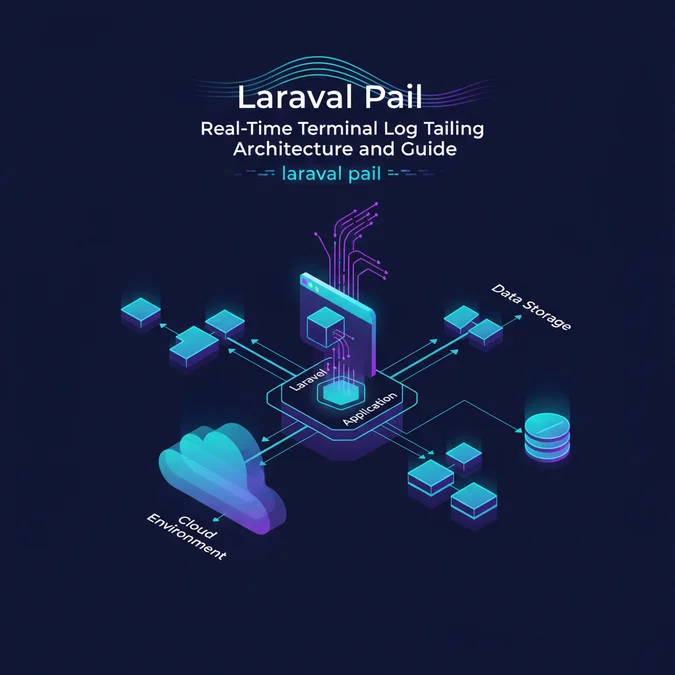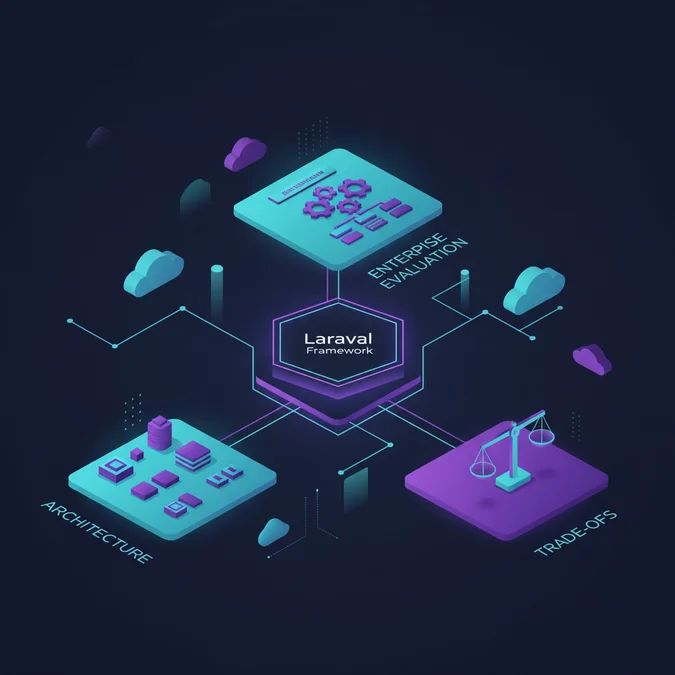

The Laravel framework is an open-source PHP web application framework built on top of modular Symfony components, designed around the Model-View-Controller pattern to deliver structured database abstraction, asynchronous queues, native authentication, and dependency injection. It eliminates repetitive scaffolding code so engineering teams can construct scalable, production-grade applications with standardized architectural patterns.
Today, Laravel powers hundreds of thousands of production platforms across global enterprises, venture-backed startups, and critical web utilities. In an engineering landscape dominated by distributed services and diverse runtime choices, Laravel retains top-tier adoption by standardizing common infrastructure burdens while maintaining developer velocity across full-stack applications.
Selecting an application foundation requires evaluating technical mechanics, operational complexity, long-term vendor reliance, and total cost of ownership. This analysis explores Laravel’s underlying mechanics, lifecycle handling, database ergonomics, cloud storage workflows, and enterprise migration strategies.
Core Mechanics: Request Lifecycle and the Service Container
Every HTTP request delivered to a Laravel application begins inside public/index.php. This front controller acts as the universal entry point, loading Composer autoloader definitions and retrieving an instance of the foundational Application kernel from bootstrap/app.php. From there, execution flows through global and route-specific HTTP middleware stacks before reaching the target controller or closure.
At the center of this execution chain sits the Service Container, an inversion-of-control (IoC) engine responsible for resolving class dependencies automatically via PHP reflection. By binding interfaces to concrete implementations within registered Service Providers, engineering teams can swap critical operational modules without refactoring domain logic.
<php

namespace App\Providers;

use Illuminate\Support\ServiceProvider;
use App\Contracts\PaymentGatewayInterface;
use App\Services\StripePaymentGateway;

class PaymentServiceProvider extends ServiceProvider
{
 /**
 * Register interface bindings in the container.
 */
 public function register(): void
 {
 // Bind an abstract contract to an explicit implementation
 $this->app->singleton(PaymentGatewayInterface:class, function ($app) {
 return new StripePaymentGateway(
 config('services.stripe.secret'),
 config('services.stripe.webhook_tolerance')
 );
 });
 }
}
During application boot, the framework iterates through registered providers, invoking their register() methods to bind zero-dependency abstractions before invoking their boot() methods to execute cross-service setup. Understanding this two-phase initialization prevents lifecycle race conditions when orchestrating complex third-party tools.
Architects must recognize the lifecycle differences between classic FastCGI environments and persistent execution servers such as Laravel Octane running on Swoole or RoadRunner. In classic PHP-FPM execution, state resets completely between incoming requests, preventing memory leaks at the cost of bootstrap overhead. Under persistent runtimes, the Service Container persists in RAM across requests, demanding strict memory hygiene and preventing long-lived references to request-scoped instances.
Database Operations: Eloquent ORM vs Query Builder
Laravel ships with two distinct mechanisms for persistence: Eloquent ORM, which adheres to the Active Record design pattern, and the fluent Query Builder, which provides direct SQL abstraction. Active Record maps database tables directly to object instances where each model instance represents a single row carrying business logic and persistence methods.
While Eloquent dramatically reduces boilerplate for CRUD operations, Active Record models carry non-trivial memory overhead. A complex model hydration step instantiates internal attribute bags, dynamic mutation caches, and relationship proxies. In high-throughput reporting systems or batch processing scripts, instantiating thousands of Eloquent models can exhaust allocated PHP worker memory.
| Evaluation Metric | Eloquent ORM | Database Query Builder | Raw SQL PDO |
|---|---|---|---|
| Pattern | Active Record | Fluent Data Mapper API | Direct String Execution |
| Memory Footprint | High (approx. 2-5 KB per row instance) | Low (plain stdClass objects) | Minimal (raw associative arrays) |
| Hydration Cost | High (casts, relations, mutators) | Low (direct scalar mapping) | Zero (engine level native) |
| Developer Velocity | Maximum (built-in relations, scopes) | Moderate (explicit join syntax) | Low (manual parameter binding) |
To prevent performance degradation when traversing relational graphs, developers must address the standard N+1 query problem using eager loading. Eloquent addresses this with the with() builder directive, bundling relational keys into single vectorized WHERE IN queries rather than dispatching round-trip queries per parent row.
<php

// Inefficient: Generates 1 query for orders + N queries for customers
$orders = Order:all();
foreach ($orders as $order) {
 echo $order->customer->name;
}

// Optimized: Generates exactly 2 queries regardless of count
$orders = Order:with('customer')->limit(250)->get();
foreach ($orders as $order) {
 echo $order->customer->name;
}
For analytical workloads, bulk ETL routines, or microservice queries processing massive datasets, the fluent Query Builder using DB:table('orders')->cursor() yields memory efficiency by reading single rows via unbuffered PDO queries instead of buffering entire result sets in memory.
Asynchronous Processing and Background Workers
Decoupling compute-heavy workloads from synchronous HTTP request-response cycles is fundamental to building scalable web applications. Laravel includes a unified queue abstraction layer supporting backends such as Redis, Amazon SQS, Beanstalkd, and relational databases. This infrastructure allows time-intensive tasks, such as third-party API communication, PDF generation, and report aggregation, to execute out-of-band.
Jobs are authored as serializable PHP classes dispatched to explicit queue channels. Workers monitor queues using the queue:work command, continuously pulling payloads, restoring serialized dependencies, and invoking the target execution logic.
<php

namespace App\Jobs;

use App\Models\Invoice;
use App\Services\PdfGenerator;
use Illuminate\Bus\Queueable;
use Illuminate\Contracts\Queue\ShouldQueue;
use Illuminate\Foundation\Bus\Dispatchable;
use Illuminate\Queue\InteractsWithQueue;
use Illuminate\Queue\SerializesModels;

class GenerateInvoicePdf implements ShouldQueue
{
 use Dispatchable, InteractsWithQueue, Queueable, SerializesModels;

 public int $tries = 3;
 public int $timeout = 60;

 public function __construct(public Invoice $invoice) {}

 public function handle(PdfGenerator $generator): void
 {
 // Accessing the invoice model automatically pulls fresh state
 $generator->renderAndStore($this->invoice);
 }
}
Managing worker topologies requires proper process monitoring via utilities like Supervisor or container orchestrators such as Kubernetes. In high-scale deployments, managing worker concurrency prevents deadlocks on relational databases. For teams scaling infrastructure while maintaining code quality, incorporating standardized pipelines highlighted in our software engineering process guide provides the automated testing verification required before rolling out asynchronous queue changes to production clusters.
Laravel Horizon introduces real-time telemetry for Redis queues, providing insight into throughput, job wait times, memory utilization, and failure spikes. This operational observability allows teams to configure dynamic autoscaling pools based on queue depth metrics rather than raw host CPU thresholds.
Enterprise Storage Architecture and Asset Pipelines
Storage management in scalable web systems requires decoupling persistent state from ephemeral compute nodes. Laravel handles this through Flysystem, an abstraction layer that unifies local disks, SFTP servers, and cloud object stores behind an identical file manipulation API. Moving application assets from local disks to object storage eliminates disk sync issues across autoscaled application instances.
When handling high-volume asset ingestion, proxying multi-gigabyte payloads through web workers wastes application thread pool capacity and drives up compute costs. Teams can instead leverage cloud-native object storage primitives, as documented in our breakdown of architecting secure cloud object storage in Laravel, enabling front-end clients to stream assets directly to cloud storage endpoints using presigned URLs.
<php

namespace App\Http\Controllers;

use Illuminate\Http\Request;
use Illuminate\Support\Facades\Storage;
use Illuminate\Http\JsonResponse;

class DirectUploadController extends Controller
{
 public function generatePresignedUrl(Request $request): JsonResponse
 {
 $request->validate(['filename' => 'required|string']);

 $client = Storage:disk('s3')->getClient();
 $expiry = '+15 minutes';

 $command = $client->getCommand('PutObject', [
 'Bucket' => config('filesystems.disks.s3.bucket'),
 'Key' => 'uploads/'. auth()->id(). '/'. $request->filename,
 'ContentType' => $request->input('content_type', 'application/octet-stream'),
 ]);

 $presignedRequest = $client->createPresignedRequest($command, $expiry);

 return response()->json([
 'url' => (string) $presignedRequest->getUri(),
 'headers' => $presignedRequest->getHeaders(),
 ]);
 }
}
Decoupled storage layers ensure that web applications remain stateless. This stateless design permits immediate blue-green deployments, instant autoscaling during demand surges, and isolated recovery architectures across isolated availability zones.
Modern Frontend Options: Inertia, Livewire, and Headless APIs
Engineering leadership evaluating Laravel must choose an appropriate client-side integration model. Rather than forcing a singular approach, Laravel supports three primary architectural paths for building user interfaces:
- Blade and Laravel Livewire: A server-driven paradigm where PHP classes handle reactive user interactions over WebSockets or HTTP diffs without requiring dedicated JavaScript component states. Teams building interactive dashboards often choose this method, as seen when implementing Livewire interactive calendar components without managing duplicate TypeScript interfaces.
- Inertia.js Monoliths: A hybrid pattern replacing server-side Blade templates with single-page application (SPA) frontends written in Vue, React, or Svelte. Inertia uses standard Laravel routing, session authentication, and controllers, removing the need for dedicated REST or GraphQL translation layers while preserving the client-side user experience of an SPA.
- Decoupled Headless REST/GraphQL APIs: Exposing pure JSON endpoints to independently deployed Single Page Applications, mobile applications, or distributed microservices using Laravel Sanctum or Laravel Passport for tokenized OAuth2 authentication.
| Architecture Model | Primary Advantages | Trade-offs & Constraints | Ideal System Scope |
|---|---|---|---|
| Blade + Livewire | Zero client API boilerplate, fast feature delivery, unified PHP codebase | Increased server CPU cycles for DOM diffing, latency-sensitive interactions | Internal dashboards, operational SaaS tools, admin panels |
| Inertia.js (Vue/React) | Native SPA UX, client routing without separate API layer, shared validation | Client-server coupling, requires Node SSR pipeline for strong SEO | Customer-facing web apps, consumer portals, multi-tenant SaaS |
| Decoupled Headless API | Independent client deployments, multi-client support, decoupled team ownership | Duplicate schema definitions, complex state management, CORS overhead | Mobile-first products, public developer platforms, distributed services |
Selecting among these frontend architectures requires balancing team composition, SEO requirements, and interface complexity. Monolithic Inertia architectures allow small, highly coordinated engineering teams to outpace larger teams burdened by managing disparate client and server repositories.
Framework Benchmarks: Laravel vs Symfony, Django, and Node.js
Architectural decisions require comparing operational characteristics against competitive ecosystems. Laravel shares roots with Symfony, while competing directly with Python’s Django and Node.js runtimes such as NestJS or Express.
Under standard PHP-FPM execution, Laravel incurs framework boot overhead for every request, resulting in lower raw request throughput compared to long-running event loops like Node.js. However, when benchmarked using Laravel Octane on modern multi-core servers, the throughput profile shifts dramatically, closing the gap with asynchronous JavaScript runtimes while retaining structured relational data tools.
| Framework & Runtime | Requests Per Second (Octane/FPM) | Memory Footprint (Baseline) | ORM Ecosystem | Ecosystem Maturity |
|---|---|---|---|---|
| Laravel 11 (Octane/Swoole) | 12,500 – 18,000 req/sec | ~45 MB per worker process | Eloquent (Active Record) | High (Broad package registry) |
| Laravel 11 (PHP-FPM) | 1,200 – 2,100 req/sec | ~18 MB per request cycle | Eloquent (Active Record) | High (Standard ecosystem) |
| Symfony 7 (PHP-FPM) | 1,800 – 2,800 req/sec | ~14 MB per request cycle | Doctrine (Data Mapper) | High (Strict enterprise focus) |
| Django 5 (WSGI/Gunicorn) | 1,100 – 1,900 req/sec | ~28 MB per worker | Django ORM (Active Record) | High (Broad data ecosystem) |
| NestJS (Node.js/Fastify) | 15,000 – 24,000 req/sec | ~65 MB runtime base | TypeORM / Prisma (Data Mapper) | Moderate (Rapid package churn) |
Raw throughput represents only one dimension of real-world operational health. In most business applications, network latency, distributed cache serialization, and database index optimization dictate system latency long before PHP runtime execution overhead impacts user experience. Selecting a framework based exclusively on raw synthetic micro-benchmarks often overlooks ongoing maintenance expenses and slower development velocity.
Build vs Buy: When to Choose Laravel for Custom Platforms
When enterprise organizations require complex business systems, technology leaders face the classic choice: purchase an off-the-shelf SaaS tool, configure a specialized commercial off-the-shelf (COTS) product, or build a proprietary platform using a modern framework like Laravel. Commercial solutions provide immediate deployment for standardized workflows but often introduce severe licensing constraints, vendor lock-in, and costly customization hurdles.
Building a proprietary system on Laravel makes financial and technical sense when the core workflows represent a competitive differentiator. For example, organizations modernizing their learning infrastructures often discover that pre-packaged software fails to support complex institutional workflows. Evaluating the technical factors in custom software platform engineering demonstrates that bespoke architectures avoid annual recurring seat-license inflation while granting absolute authority over data ownership and regulatory governance.
Conversely, purchasing commercial software remains the rational choice for utility business functions such as payroll processing, standard accounting ledgers, or customer support ticketing. Building custom software on Laravel for commoditized business processes redirects engineering capital away from customer-facing features that drive business growth.
Total Cost of Ownership: Pricing, Retainers, and Project Capital
Budgeting for an enterprise-grade Laravel application requires accounting for architectural design, custom engineering, continuous integration, hosting infrastructure, and ongoing maintenance. Total Cost of Ownership (TCO) spans initial capital expenditure (CapEx) along with predictable monthly operational expenses (OpEx).
| Engagement & Cost Model | Standard Rate / Range | Typical Project Horizon | Best Suited For |
|---|---|---|---|
| Hourly Specialist Consulting | $120 – $250 / hour | Ad-hoc, ongoing code reviews | Architecture audits, performance profiling, legacy refactoring |
| Dedicated Engineering Team | $14,000 – $35,000 / month | 6 to 24 months continuous | Large-scale platform builds, continuous feature delivery |
| Fixed-Scope Enterprise MVP | $45,000 – $120,000 total | 3 to 5 months milestone-driven | Defined core systems, internal workflow automation |
| Enterprise Core Transformation | $150,000 – $450,000+ total | 9 to 18 months phased rollout | Replacing legacy monoliths, multi-tenant SaaS platforms |
| Managed Platform Hosting (AWS/Forge) | $250 – $3,500 / month | Recurring infrastructure | Compute, managed Aurora/Redis clusters, high-scale S3 storage |
Engineering labor comprises the vast majority of software platform spend. Lower initial estimates from non-specialized generalists often result in technical debt that compounds ongoing support overhead. Investing in solid system design, automated testing suites, and standard deployment automation reduces total ownership costs over a multi-year operational lifecycle.
Enterprise Migration Strategies: From Legacy Code to Modern Laravel
Migrating legacy monoliths, such as aging Zend, CodeIgniter, or raw PHP 5.x systems, to modern Laravel requires defensive, incremental migration patterns. Attempting a complete, high-risk greenfield rewrite often stalls while production requirements evolve mid-cycle.
The recommended approach uses the Strangler Fig pattern. An HTTP reverse proxy, such as Nginx, Cloudflare Workers, or AWS Application Load Balancer, sits in front of both systems. New endpoints and decoupled domain modules are built inside the new Laravel application, while existing legacy traffic routes to the legacy environment.
- Edge Routing Decoupling: Configure the edge reverse proxy to inspect request paths. Traffic targeting newly modernized modules routes directly to the Laravel cluster, while all remaining paths fall back to the legacy host.
- Shared Session State: Deploy a shared Redis cluster accessible by both runtimes to maintain shared user authentication sessions, avoiding abrupt logouts as users transition between legacy and modern pages.
- Data Synchronization: Utilize database triggers or Change Data Capture (CDC) pipelines via Debezium and Kafka to maintain consistency between legacy tables and modernized schemas until the final cutover.
- Complete Cutover and Retirement: Systematically migrate remaining route groups until the reverse proxy sends zero traffic to the legacy host, allowing you to decommission the legacy servers entirely.
This phased rollout methodology minimizes business disruption, ensures individual release cycles remain verifiable, and provides rapid rollback paths if production edge cases emerge.
Security Baselines and Long-Term Maintainability
Modern enterprise platforms require continuous adherence to rigorous security baselines. Laravel incorporates defensive defaults directly into its core HTTP kernel, protecting systems against common web vulnerabilities out of the box:
- Cross-Site Request Forgery (CSRF): The framework automatically generates and validates unguessable tokens for every non-idempotent HTTP request (POST, PUT, PATCH, DELETE) via the
VerifyCsrfTokenmiddleware. - SQL Injection Mitigation: Eloquent ORM and the Query Builder utilize PDO parameter binding across all database drivers, preventing attackers from injecting malicious SQL fragments into input fields.
- Cross-Site Scripting (XSS) Prevention: The Blade templating engine uses contextual escaping on all
{{ $variable }}outputs by default, invoking PHP’shtmlspecialcharsto neutralize embedded JavaScript payloads. - Mass-Assignment Guardrails: Model attributes require explicit allowlisting using
$fillableor denylisting using$guarded, preventing malicious actors from escalating privileges by injecting fields such asis_admininto raw request inputs.
Long-term software maintainability depends on clean architectural separation. As business logic expands, teams should avoid letting controllers grow into bloated classes containing hundreds of lines of code. Instead, adopt dedicated architectural patterns such as Action Classes, Domain Invariants, and Form Request validators. Encapsulating single business tasks into dedicated single-responsibility classes simplifies comprehensive automated testing and prevents regressions as teams expand.
Explore the Laravel Basics Directory
Building resilient, scalable web applications requires a firm grasp of foundational architectural concepts, state management techniques, and deployment workflows. To continue expanding your technical knowledge across foundational framework concepts, review our structured library of deep-dive articles.
Explore our complete Laravel, Basics directory for more guides.
Factors That Affect Development Cost
- Application complexity and domain modeling requirements
- Legacy system migration and data synchronization scope
- High-throughput concurrency requirements (Octane, Redis clustering)
- Frontend architectural choice (Livewire vs Inertia vs Decoupled React/Vue)
- Compliance, penetration testing, and security auditing requirements
Enterprise Laravel platform builds typically range from $45,000 for focused MVPs to over $450,000 for legacy replacements with dedicated engineering teams.
The Laravel framework provides an established balance of developer velocity, structured design patterns, and enterprise scalability across modern engineering ecosystems. Its comprehensive service container, expressive database abstraction, and native background processing tools allow engineering teams to build, deploy, and maintain complex platforms with confidence.
By understanding core lifecycle mechanics, selecting optimal frontend integrations, and planning deliberate infrastructure investments, technical leaders can build robust web systems designed for sustained reliability and long-term business value.