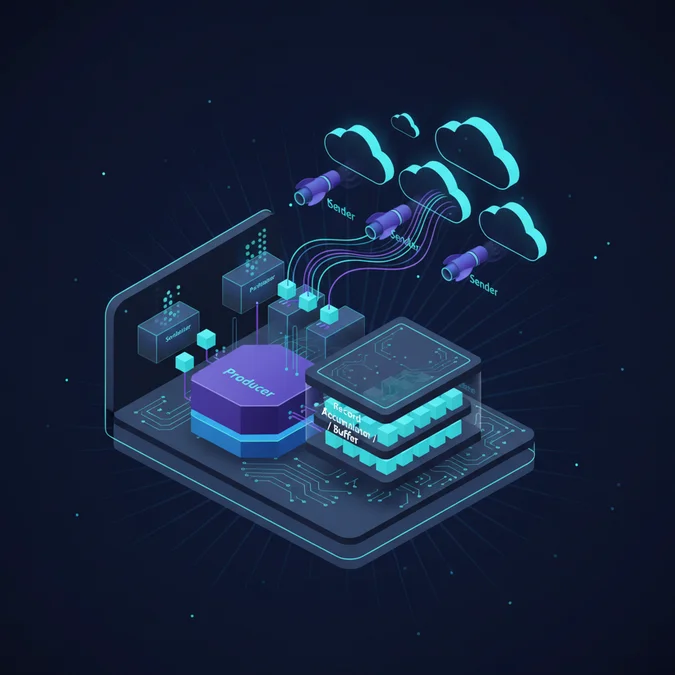

Kafka data ingestion serves as the primary gateway for streaming architectures, transforming disparate source signals into a unified, durable event log. At its core, effective ingestion is not merely about moving bytes from point A to point B. It is about maintaining strict ordering, ensuring schema consistency, and managing the inevitable backpressure that occurs when high-velocity sources outpace downstream processing capabilities.
In 2026, building a resilient pipeline requires a departure from monolithic ingestion scripts toward modular, observable, and governed workflows. This article provides the architectural blueprint for designing ingestion systems that minimize operational overhead while maximizing throughput, reliability, and data integrity across distributed environments.
Foundational Concepts of Kafka Data Ingestion
Kafka data ingestion defines the process of capturing events from external systems and committing them to Kafka topics. This process acts as the critical bridge between operational databases, log files, IoT sensors, and the analytical ecosystem. Understanding the lifecycle of an event is essential for maintaining data quality.
Technical Insight: Ingestion is fundamentally an asynchronous task. Your producer must handle retries, serialization, and buffering without blocking the source system’s primary execution threads.
Key architectural components include the Producer API, which handles the network abstraction, and the serialization layer, which enforces the binary format of your records. By establishing a clear separation between the extraction logic and the transport layer, engineering teams can swap source systems without refactoring the entire pipeline.
Comparative Taxonomy: Connectors vs Custom Producers
Choosing the right tool for Kafka ingestion depends on the trade-off between operational simplicity and architectural control. The following table provides a decision matrix to guide your selection process.
| Feature | Kafka Connect | Custom Producers | Stream Processing |
|---|---|---|---|
| Development Effort | Low (Declarative) | High (Imperative) | Medium |
| Operational Overhead | Managed/Standardized | High (Custom Monitoring) | High |
| Flexibility | Limited by Plugins | Infinite | High |
| Maintenance | Low | High | Moderate |
| Use Case | Standard Data Sync | Complex Logic/Legacy | Transformation |
Kafka ingestion via Connect is the preferred choice for standard RDBMS or cloud storage integrations. However, when your pipeline requires complex pre-processing, such as real-time PII masking or conditional routing, custom producers provide the necessary hooks to intercept and mutate data payloads before they hit the wire.
Implementation Mechanics and Code Patterns
Production-grade ingestion requires careful management of buffer memory and delivery guarantees. The following Java snippet demonstrates a resilient producer pattern designed for high-throughput environments.
Properties props = new Properties();
props.put(ProducerConfig.ACKS_CONFIG, "all");
props.put(ProducerConfig.ENABLE_IDEMPOTENCE_CONFIG, true);
props.put(ProducerConfig.LINGER_MS_CONFIG, 20);
props.put(ProducerConfig.BATCH_SIZE_CONFIG, 65536);

KafkaProducer<String, byte[]> producer = new KafkaProducer<>(props);
// Ensure error handling for async sends
producer.send(record, (metadata, exception) -> {
 if (exception!= null) logger.error("Ingestion failed", exception);
});
Production Readiness Checklist
- Enable idempotent producers to prevent duplicate messages during network retries.
- Configure the Schema Registry to enforce serialization contracts and prevent breaking changes.
- Implement dead-letter queues to catch malformed records without halting the pipeline.
- Set appropriate compression types like Snappy or Zstd to reduce egress costs.
Production Readiness and Operational Governance
Governance in Kafka ingestion is not an afterthought; it is a prerequisite for security. As pipelines scale, controlling what data enters the cluster becomes as important as how fast it moves. Schema evolution is the primary mechanism for governance, ensuring that producers and consumers remain compatible even as business requirements change.
- Schema Enforcement: Use Avro or Protobuf to prevent schema-on-read failures.
- PII Masking: Implement interceptor patterns to sanitize sensitive fields at the producer level.
- Backpressure Monitoring: Monitor producer buffer exhaustion metrics to detect when source systems are pushing data faster than the brokers can acknowledge.
- Audit Logging: Tag ingestion events with metadata regarding the source origin and timestamp.
Scaling Pipelines for 2026 and Beyond
Scaling in 2026 moves beyond simple partitioning. With the adoption of KRaft mode, management of controller metadata has become significantly more efficient, allowing for larger clusters and faster recovery times. Tiered storage further optimizes ingestion by offloading historical data to cost-effective object stores without impacting read latency for real-time consumers.
Architectural Direction: Future-proof your ingestion pipelines by adopting decoupled storage architectures. By separating the ingestion throughput from the historical retention capacity, you gain the ability to scale your producers independently of your data lake storage requirements.
[Source Systems] -> [Kafka Cluster (KRaft)] -> [Tiered Storage (S3/GCS)]
 | | |
[High Throughput] [Metadata Efficiency] [Cost Optimization]
Frequently Asked Questions
What is the primary difference between Kafka Connect and custom Kafka ingestion clients?
Kafka Connect is a declarative, out of the box framework for streaming data between Kafka and external systems. Custom clients, conversely, offer granular control over serialization and logic, requiring more maintenance but providing flexibility for highly specialized or non-standard ingestion requirements in complex environments.
How do I optimize performance during high-volume Kafka ingestion?
Performance optimization for Kafka ingestion involves tuning batch sizes, linger time, and compression settings on the producer side. Additionally, ensuring partition alignment matches consumer parallelism and monitoring broker resource utilization is essential to maintaining high throughput without sacrificing latency during heavy load.
Mastering Kafka data ingestion requires balancing the ease of standardized connectors with the power of custom producer patterns. By prioritizing schema governance, idempotent delivery, and observable backpressure, you build pipelines that survive the realities of high-scale distributed systems.
As you transition to 2026 standards, focus on decoupling your storage layers and leveraging KRaft to simplify cluster management. The goal is to create a self-healing ecosystem where data flows reliably from source to destination with minimal human intervention.