
Pushing multi-thousand-token system prompts across distributed microservices introduces severe architectural friction. When your production application executes millions of requests per day, relying on extensive few-shot prompt engineering balloons operational token costs, pushes p99 latency beyond acceptable service-level agreements, and introduces unpredictable schema violations. Fine-tuning bridges this structural gap by internalizing behavioral patterns, style constraints, and deterministic response formats directly into base model weights.
Targeted weight adaptation transforms non-deterministic foundational checkpoints into lean, domain-specialized engines. Instead of continuously passing exhaustive domain rules, contextual examples, and structural schemas over the wire, weight customization burns these priors directly into the neural layers. This architectural transition lowers per-request prompt token overhead by upwards of 70 percent, stabilizes output parsing, and unlocks sub-second latency targets at scale.
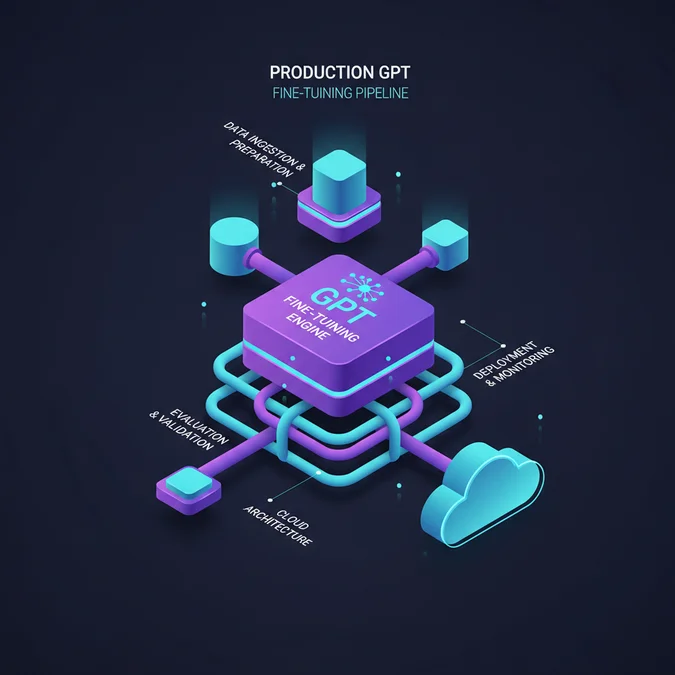
Achieving stable fine-tuning in modern production ecosystems requires moving past superficial JSONL formatting. Engineering a sustainable pipeline demands rigorous dataset validation, automated token profiling, disciplined hyperparameter control to prevent catastrophic forgetting, and systematic post-training regression testing. This operational blueprint details how to design, execute, and evaluate production-grade pipelines using modern OpenAI base models.
Architectural Taxonomy: When to Fine-Tune GPT vs Prompt Engineering and RAG
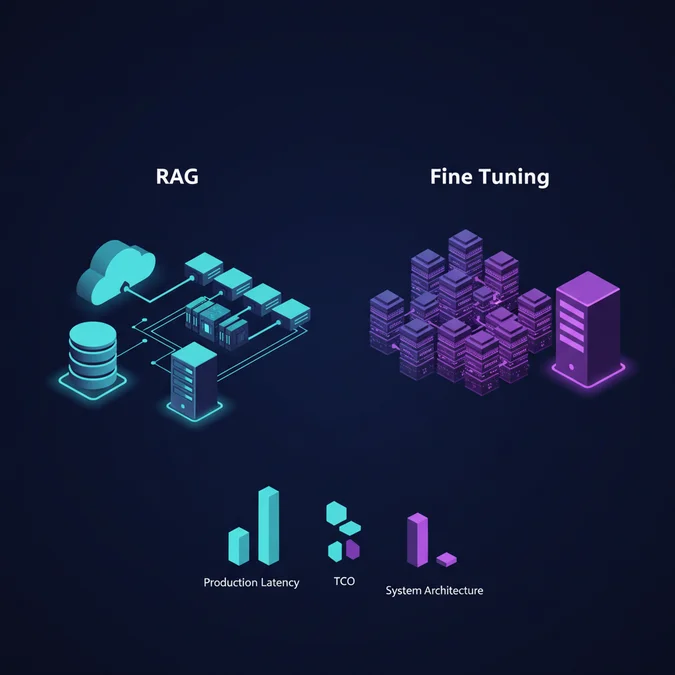
A common architectural failure in modern AI engineering is treating model adaptation techniques as interchangeable replacements rather than complementary tiers. System designers frequently attempt to solve factual hallucination problems using weight fine-tuning, or conversely, try to force complex stylistic adherence solely through in-context few-shot prompts. In practice, prompt engineering, Retrieval-Augmented Generation (RAG), and weight fine-tuning address three distinct engineering vectors: operational context, factual grounding, and behavioral alignment.
To establish where gpt fine tuning provides the highest return on investment, we map architectural techniques against critical engineering constraints:
| Dimension | Prompt Engineering | Retrieval-Augmented Generation | Model Weight Fine-Tuning |
|---|---|---|---|
| Primary Objective | Immediate instruction compliance and dynamic task definition | Dynamic factual grounding and live data access | Behavioral styling, structure adherence, and tone alignment |
| Inference Latency Impact | High: 2,000+ prompt tokens increase time to first token (TTFT) | Moderate to High: Vector search overhead plus large injected context | Low: Minimal system prompt required, yielding minimal TTFT |
| Information Freshness | Static to prompt creation | Real-time: Queries live indexes and vector databases | Static to training checkpoint snapshot |
| Hallucination Surface | Moderate: Reliant on attention across long contexts | Low: Constrained by retrieved context chunks | High for factual data, Low for structural formatting |
| Unit Economics | Linear token cost scaling with prompt size | Retrieval storage, embedding generation, and prompt token fees | Amortized upfront training fee with lower per-call token costs |
The architectural pattern below illustrates how modern production systems orchestrate these layers, delegating factual grounding to dynamic vector indexes while relying on a specialized model to enforce output semantics and execution logic:
[Client Request] ──► [API Gateway] ──► [Vector Retrieval / RAG Engine] (Dynamic State)
 │
 ▼
 [Compact Context Injection]
 │
 ▼
 [Fine-Tuned GPT-4o-mini Weights]
 (Pre-trained Schema & Determinism)
 │
 ▼
 [Strict JSON Output to Client]
Architectural Decision Rule: Never attempt to fine tune gpt models with the sole expectation of teaching them mutable business facts. Base model weights represent lossy knowledge stores. Use RAG for real-time information retrieval, and leverage fine-tuning to lock down response structure, reduce repetitive system instructions, and master complex multi-step reasoning syntax.
Model Selection Matrix: GPT-4 Fine-Tuning Checkpoints and Platform Support
Selecting the optimal foundational checkpoint dictates training duration, inference throughput, and downstream operating expenditure. In current production environments, the legacy practice of adapting standard GPT-3.5 checkpoints has been entirely superseded by modern architectures like GPT-4o and GPT-4o-mini, which offer native multimodal support, expanded context windows, and superior structural compliance.
Enterprise teams executing gpt 4 fine tuning must evaluate checkpoints across operational thresholds rather than benchmark metrics alone:
| Base Checkpoint | Context Window | Fine-Tuning Cost (Per 1M Tokens) | Inference Input / Output (Per 1M Tokens) | Optimal Production Use Cases |
|---|---|---|---|---|
gpt-4o-mini-2024-07-18 |
128,000 tokens | $3.00 | $0.30 / $1.20 | High-volume API classification, micro-agent routing, strict JSON serialization |
gpt-4o-2024-08-06 |
128,000 tokens | $25.00 | $3.75 / $15.00 | Complex multi-step legal synthesis, medical reasoning, complex visual schema analysis |
babbage-002 / davinci-002 |
16,384 tokens | $0.40 / $6.00 | $0.40 / $2.00 | Legacy text completion, embedding distance scoring, sub-token pattern modeling |
When implementing chat gpt fine tuning, infrastructure engineers must navigate platform differences between direct OpenAI API access and Azure OpenAI Service:
- OpenAI Direct API: Provides immediate zero-day access to updated snapshot checkpoints, faster experiment deployment cycles, and fine-grained validation metrics through integrated reporting tools.
- Azure OpenAI Service: Mandates data residency isolation within compliant VPC boundaries (FedRAMP, HIPAA), integrates with enterprise private link backbones, but frequently trails direct API feature releases and requires distinct quota allocation requests.
Use the following operational checklist before provisioning compute for base model adaptation:
- Confirm candidate tasks cannot be solved deterministically using structured output modes on un-tuned models.
- Verify that inference query volumes justify the initial data curation and training run capital costs.
- Ensure candidate checkpoints support continuous fine-tuning iterations without sudden upstream deprecation windows.
Dataset Engineering: Programmatic Curation, Tokenization, and Validation
The performance ceiling of an adapted model is directly bounded by dataset quality. Feeding unstructured or noisy conversation dumps into a training queue produces catastrophic degradation in conversational coherence. To properly finetune gpt models, your dataset must be structured as valid JSONL files containing structured message objects: system, user, and assistant.
High-integrity dataset curation requires strict programmatic validation before pushing payloads to training endpoints. The following production-grade script leverages tiktoken to enforce schema conformity, compute token distributions, identify outliers, and calculate exact training dataset pricing:
import json
import tiktoken
from collections import defaultdict
from typing import Dict, List, Any

ENCODING_NAME = "o200k_base"
MAX_TOKEN_LIMIT = 4096
MIN_CONVERSATION_TOKENS = 15

def validate_and_profile_dataset(file_path: str) -> Dict[str, Any]:
 encoding = tiktoken.get_encoding(ENCODING_NAME)
 stats = {
 "total_conversations": 0,
 "total_tokens": 0,
 "token_distribution": [],
 "schema_errors": defaultdict(int),
 "format_violations": []
 }

 with open(file_path, "r", encoding="utf-8") as f:
 for line_idx, raw_line in enumerate(f):
 stats["total_conversations"] += 1
 try:
 entry = json.loads(raw_line.strip())
 except json.JSONDecodeError:
 stats["schema_errors"]["invalid_json"] += 1
 stats["format_violations"].append(f"Line {line_idx}: Malformed JSON string")
 continue

 if "messages" not in entry or not isinstance(entry["messages"], list):
 stats["schema_errors"]["missing_messages_array"] += 1
 continue

 messages: List[Dict[str, str]] = entry["messages"]
 conv_tokens = 0
 has_system, has_user, has_assistant = False, False, False

 for msg in messages:
 role = msg.get("role")
 content = msg.get("content", "")

 if not role or not content:
 stats["schema_errors"]["empty_role_or_content"] += 1
 continue

 if role == "system":
 has_system = True
 elif role == "user":
 has_user = True
 elif role == "assistant":
 has_assistant = True

 conv_tokens += len(encoding.encode(content)) + 4

 if not (has_user and has_assistant):
 stats["schema_errors"]["missing_dialogue_pair"] += 1

 if conv_tokens > MAX_TOKEN_LIMIT:
 stats["schema_errors"]["token_limit_exceeded"] += 1
 elif conv_tokens < MIN_CONVERSATION_TOKENS:
 stats["schema_errors"]["insufficient_tokens"] += 1

 stats["total_tokens"] += conv_tokens
 stats["token_distribution"].append(conv_tokens)

 return stats

if __name__ == "__main__":
 profile = validate_and_profile_dataset("curated_training_set.jsonl")
 print(f"Valid Conversations: {profile["total_conversations"]}")
 print(f"Total Billable Tokens: {profile["total_tokens"]}")
 print(f"Schema Errors: {dict(profile["schema_errors"])}")
Adhere strictly to this dataset preparation checklist prior to scheduling training runs:
- Eliminate duplicate query structures using semantic embedding distance checks to prevent overfitting on narrow lexical paths.
- Ensure every assistant turn contains pristine, syntactically valid serialization without markdown wrappers if raw JSON output is intended.
- Reserve an unpolluted, deterministically split test split representing at least 15 percent of total samples for out-of-sample evaluation.
Implementation Blueprint: Executing and Polling Training Jobs via the OpenAI SDK
Orchestrating training jobs programmatically requires resilient networking logic capable of handling large dataset uploads, setting explicit hyperparameter overrides, and maintaining resilient polling loops. Relying on simple, unmonitored scripts introduces risk when handling enterprise fine tuning chatgpt pipelines that run over several hours.
Execute model adaptation workflows using the following multi-step architecture:
- Staging Dataset Assets: Upload validated local JSONL partitions directly to the storage bucket using the designated fine-tune file purpose.
- Hyperparameter Declaration: Explicitly configure epoch depth, batch sizing strategies, and learning rate multipliers rather than relying on default automatic heuristics.
- Asynchronous State Polling: Track training transitions across states using an exponential backoff loop to catch network timeouts or unexpected training loss spikes.
import time
import sys
from openai import OpenAI, OpenAIError

client = OpenAI()

def run_fine_tuning_pipeline(training_file_path: str, validation_file_path: str, base_model: str = "gpt-4o-mini-2024-07-18") -> str:
 try:
 print("Uploading training file..")
 with open(training_file_path, "rb") as t_file:
 training_response = client.files.create(file=t_file, purpose="fine-tune")

 print("Uploading validation file..")
 with open(validation_file_path, "rb") as v_file:
 validation_response = client.files.create(file=v_file, purpose="fine-tune")

 print(f"Staged Training File ID: {training_response.id}")
 print(f"Staged Validation File ID: {validation_response.id}")

 job = client.fine_tuning.jobs.create(
 training_file=training_response.id,
 validation_file=validation_response.id,
 model=base_model,
 hyperparameters={
 "n_epochs": 3,
 "batch_size": "auto",
 "learning_rate_multiplier": 1.2
 },
 suffix="prod-v1-router"
 )
 print(f"Created Fine-Tuning Job: {job.id}")

 backoff_seconds = 10
 while True:
 job_status = client.fine_tuning.jobs.retrieve(job.id)
 status = job_status.status
 print(f"Job Status: {status} | Trained Tokens: {job_status.trained_tokens}")

 if status == "succeeded":
 print(f"Job Completed Successfully. Fine-Tuned Model: {job_status.fine_tuned_model}")
 return job_status.fine_tuned_model
 elif status in ["failed", "cancelled"]:
 error_details = job_status.error
 raise RuntimeError(f"Fine-tuning terminated with status {status}: {error_details}")

 time.sleep(backoff_seconds)
 backoff_seconds = min(backoff_seconds * 1.5, 120)

 except OpenAIError as e:
 print(f"OpenAI SDK Exception encountered: {e}", file=sys.stderr)
 raise

if __name__ == "__main__":
 fine_tuned_model_id = run_fine_tuning_pipeline(
 "train_prepared.jsonl",
 "val_prepared.jsonl"
 )
Production Rigor: Hyperparameters, Loss Curves, and Catastrophic Forgetting
Improper training optimization leads directly to catastrophic forgetting, a failure mode where an adapted model masters narrow stylistic quirks while completely losing foundational reasoning, instruction following, or tool-calling capabilities. Stabilizing weights during training requires disciplined tuning across three primary hyperparameters:
| Hyperparameter | Default Engine Behavior | Recommended Manual Configuration | Production Engineering Impact |
|---|---|---|---|
n_epochs |
Auto-calculated (usually 3 to 5) | 1 to 3 for datasets > 1,000 samples; 3 to 4 for < 500 samples | High epoch counts cause token memorization, vocabulary collapse, and hallucination on unseen inputs. |
learning_rate_multiplier |
Auto-selected based on dataset size | 0.05 to 0.2 for GPT-4o; 1.0 to 1.5 for GPT-4o-mini | Lower values preserve existing base reasoning capabilities; higher values aggressively force style convergence. |
batch_size |
Dynamic allocation (0.2% of dataset) | 1 to 8 instances per batch depending on token variance | Smaller batch sizes introduce stochastic noise that aids generalization; larger batches stabilize gradient trajectory. |
Anti-Forgetting Architecture: To preserve generalized reasoning while fine-tuning on specialized formats, inject a synthetic regularization buffer into your dataset. Mix in approximately 10 to 15 percent generic, multi-turn conversational data covering core logical deduction, general knowledge queries, and math validation alongside your specialized domain samples.
When monitoring the fine-tuning loss curve through training step telemetry, interpret trajectory shapes as follows:
- Healthy Convergence: Validation loss tracks training loss downward continuously, flattening smoothly without erratic upward divergence.
- Overfitting Signature: Training loss steadily declines toward zero while validation loss reverses and climbs steeply. Stop iterations early to preserve general alignment.
- Underfitting Signature: Both training and validation loss remain flat across successive epochs. Re-evaluate dataset sample diversity, token count per example, and increase the learning rate multiplier.
Automated Evaluation Frameworks and Total Cost of Ownership Economics
Deploying a fine-tuned checkpoint directly to production without comparative regression scoring introduces significant operational risk. Production validation requires a programmatic evaluation harness combining deterministic schema validators with LLM-as-a-judge scoring frameworks to evaluate performance against the un-tuned base checkpoint.
import json
from openai import OpenAI
from typing import Dict, Any

client = OpenAI()

def evaluate_model_regression(
 candidate_model: str,
 benchmark_sample: Dict[str, Any]
) -> Dict[str, Any]:
 test_prompt = benchmark_sample["input"]
 expected_output = benchmark_sample["expected_output"]

 response = client.chat.completions.create(
 model=candidate_model,
 messages=test_prompt,
 temperature=0.0
 )
 generated_text = response.choices[0].message.content

 judge_prompt = f"""
 Analyze the following generated model output against ground truth.
 Grade compliance on a strict 1-5 scale for:
 1. JSON schema validity
 2. Absence of hallucinations
 3. Style adherence

 Input: {test_prompt}
 Ground Truth: {expected_output}
 Generated Output: {generated_text}

 Return strictly JSON: {{"score": int, "reason": "string"}}
 """

 judge_eval = client.chat.completions.create(
 model="gpt-4o",
 messages=[{"role": "user", "content": judge_prompt}],
 response_format={"type": "json_object"},
 temperature=0.0
 )

 evaluation_result = json.loads(judge_eval.choices[0].message.content)
 return {
 "candidate_output": generated_text,
 "evaluation": evaluation_result
 }
Evaluating the total cost of ownership (TCO) between standard prompt engineering and fine-tuned architectures demonstrates why fine-tuning is an essential tool for high-throughput microservices. Consider a production workload executing 1,000,000 inference requests per month:
| Metric Profile | Standard GPT-4o (Few-Shot Prompting) | Fine-Tuned GPT-4o-mini (Zero-Shot) |
|---|---|---|
| Prompt Tokens Per Call | 2,500 tokens (System rules + 4 dynamic examples) | 250 tokens (Compact system directive) |
| Completion Tokens Per Call | 300 tokens | 300 tokens |
| Monthly Input Token Fee | $9.375 ($3.75 / 1M tokens) | $0.075 ($0.30 / 1M tokens) |
| Monthly Output Token Fee | $4.500 ($15.00 / 1M tokens) | $0.360 ($1.20 / 1M tokens) |
| Amortized Training Run Fee | $0.00 | ~$6.00 (One-time dataset adaptation) |
| Total Monthly Operating Cost | $13.875.00 | $441.00 |
By extracting complex behavioral instructions from the prompt and baking them directly into fine-tuned weights, engineering teams unlock substantial operational cost reductions while simultaneously cutting round-trip network latency.
Frequently Asked Questions
How do you fine tune ChatGPT for domain-specific tasks?
To fine tune ChatGPT, curate a clean JSONL dataset containing hundreds of role-aligned conversational examples. Upload the file to the OpenAI API, initiate a fine-tuning job targeting models like GPT-4o-mini, and configure custom hyperparameters to align model tone, formatting, and structural adherence.
When is a chat GPT fine tune superior to in-context retrieval?
A chat GPT fine tune is superior when enforcing strict output schemas, tone consistency, and low-latency processing across millions of queries. While RAG supplies dynamic external facts, fine-tuning hardcodes behavioral patterns and vocabulary, dramatically slashing prompt token overhead and reducing per-request latency.
What are the common causes of failure during GPT model training?
Common failure modes include improper JSONL formatting, token limit violations, data contamination, and aggressive hyperparameter tuning that leads to catastrophic forgetting. Insufficient training volume or contradictory ground-truth pairs also cause training loss to plateau without improving real-world inference accuracy.
How does fine-tuned inference pricing compare to base frontier models?
Fine-tuned model inference incurs a slight premium per token compared to its respective base checkpoint. However, fine-tuning smaller models like GPT-4o-mini often outperforms standard GPT-4 in niche tasks, lowering overall operational costs by up to 80 percent due to shorter system prompts.
Fine-tuning modern GPT models transitions an organization away from fragile, high-latency prompt engineering toward deterministic, microsecond-efficient AI services. When applied to structured domain challenges, weight adaptation simplifies client-side orchestration, locks in strict serialization schemas, and eliminates continuous prompt token overhead across high-throughput production microservices.
Building sustainable machine learning pipelines demands treating data curation with the same rigor as compiled application code. By pairing automated schema validation and balanced hyperparameter tuning with continuous out-of-sample regression testing, engineering teams can safely deploy specialized models that preserve broad reasoning capabilities while excelling at targeted production workloads.