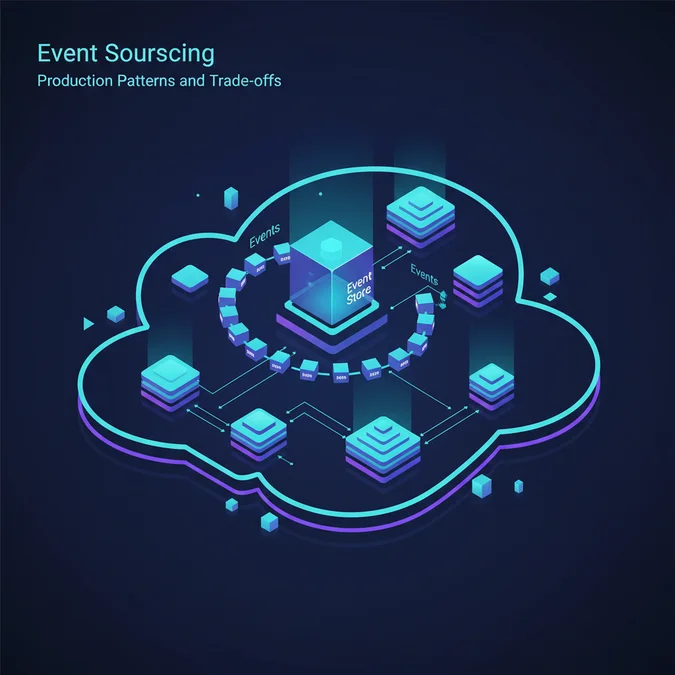

In highly distributed systems, the traditional CRUD model often collapses under the weight of audit requirements, complex state transitions, and the need for temporal observability. When your application state is no longer a static snapshot but a derivative of a continuous stream of changes, the storage layer must shift from mutable updates to immutable, append-only logs.
This article provides an engineering-first framework for evaluating the event database, dissecting the trade-offs between specialized event stores, message brokers, and relational systems. We move beyond marketing claims to analyze the operational realities of throughput, consistency, and long-term schema evolution in 2026 production environments.
Core Anatomy of an Event Database
An event database is fundamentally distinct from a standard RDBMS because it treats the event log as the source of truth rather than a secondary audit trail. While a relational database is optimized for random access and row-level updates, an event database is engineered for sequential writes and efficient stream consumption.
Technical Callout: The core requirement of an event database is strictly ordered, immutable persistence. If your storage engine supports direct row updates via SQL UPDATE, it is not serving as an event store in the true sense, as it permits the destruction of historical context.
Key architectural characteristics include:
- Append-Only Semantics: Writes are strictly additive, ensuring that the history of the system is preserved.
- Temporal Querying: The ability to project state at any point in time by replaying events from a specific offset.
- Optimistic Concurrency Control: Mechanisms to handle versioning conflicts without locking the entire stream.
Selecting the Right Database for Event Sourcing
Choosing the correct database for event sourcing requires a clear understanding of your workload characteristics. Whether you prioritize low-latency delivery or long-term durability, the choice of storage engine dictates your system’s ceiling.
| Engine Type | Write Throughput | Consistency Model | Best Use Case |
|---|---|---|---|
| EventStoreDB | High | Strong | Complex domain models |
| Apache Kafka | Very High | Eventual | High-volume event streaming |
| DynamoDB | High | Tunable | Serverless event sourcing |
| PostgreSQL (JSONB) | Moderate | Strong | Small-scale monoliths |
For systems requiring strict ordering and strong consistency, event-native stores are superior. Conversely, if your architecture demands massive scale and high-frequency pub/sub, log-based message brokers are the industry standard.
Consolidating Leading Event Databases in One API
Managing leading event databases in one API is a common requirement for teams transitioning between providers or maintaining multi-region deployments. By implementing an abstraction layer, you decouple your business logic from the underlying storage implementation.
interface EventRepository { async append(streamId: string, event: Event): Promise<void> async read(streamId: string, fromVersion: number): Promise<Event[]> async snapshot(streamId: string, state: any): Promise<void>}This pattern allows you to swap backends (e.g. from a local testing database to a production Kafka cluster) without modifying your core domain logic, provided the underlying driver satisfies the interface contracts.
Performance Metrics and Operational Trade-offs
Operational maturity in event-driven systems is measured by your ability to manage state growth. As streams grow, replay times increase, necessitating snapshotting and compaction strategies to maintain performance.
| Metric | Target | Optimization Strategy |
|---|---|---|
| Replay Latency | < 500ms | Periodic snapshotting |
| Storage Cost | Low | Log compaction/tiering |
| Write Latency | < 10ms | Async acknowledgement |
Production Readiness Checklist:
- Implement snapshotting every 100 events to bound replay time.
- Configure retention policies to drop events older than the current snapshot threshold.
- Monitor consumer lag as a primary indicator of system health.
- Ensure idempotency in event handlers to survive network partitions.
Engineering for Fault Tolerance and Schema Evolution
Schema evolution is the silent killer of long-lived event-sourced systems. Because events are immutable, you cannot simply change a column type. You must manage versioning through upcasting or projection-time transformations.
// Upcasting pattern to handle schema changes during replayfunction upcast(event) { if (event.version === 1) { return {..event, payload: {..event.payload, timestamp: new Date() }, version: 2 }; } return event;}Schema Strategy Checklist:
- Versioning: Include a schema version field in every event header.
- Upcasting: Create middleware that translates legacy events to the current schema during the read phase.
- Parallel Pipelines: Run dual-projections during migration periods to ensure data integrity before cutting over.
Factors That Affect Development Cost
- Storage throughput requirements
- Retention policy complexity
- Snapshot frequency
- Multi-region replication needs
Costs vary significantly based on the volume of ingestion and the duration of historical event retention required by the business.
Frequently Asked Questions
What is the primary difference between a standard RDBMS and an event database?
An event database is purpose-built for append-only workloads, prioritizing high-velocity ingestion and immutable history. Unlike standard RDBMS, which focus on state mutation, an event database treats the stream of changes as the primary record, allowing for precise temporal reconstruction of application state through event replay.
How do I choose the best database for event sourcing?
Choosing the best database for event sourcing requires evaluating the system’s requirements for strong consistency, replay throughput, and compaction capabilities. Look for engines that provide native support for optimistic concurrency, efficient snapshotting, and strict ordering guarantees to handle complex distributed state transitions reliably.
Is it possible to manage leading event databases in one API?
Yes, managing leading event databases in one API is achievable through the implementation of a unified abstraction layer or an event mesh. By decoupling the event producers from the underlying storage engine, teams can switch between storage providers while maintaining a consistent interface for ingestion and consumption.
Selecting an event database is a strategic architectural decision that impacts your system’s scalability for years. By focusing on append-only performance, strong consistency requirements, and robust schema management, teams can build resilient event-sourced systems that survive the complexities of distributed computing.
Review your throughput requirements and consistency needs against the benchmarks provided, and prioritize building an abstraction layer early to maintain flexibility as your infrastructure matures.