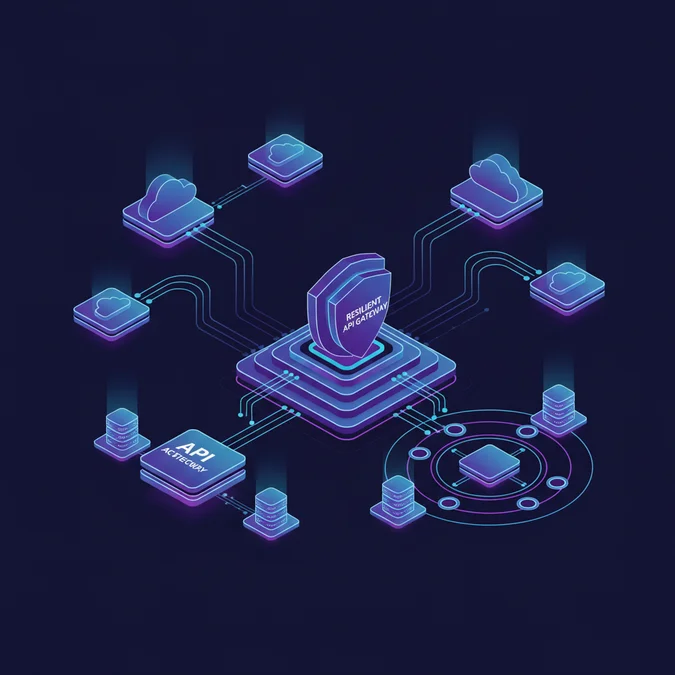

A production API architecture is the distributed fabric that connects client ingress, protocol serialization, gateway routing, service mesh policies, and datastore persistence into a cohesive, fault-tolerant boundary. At scale, an API is not merely a collection of REST endpoints or an OpenAPI specification: it represents a fault domain, an authentication envelope, and a high-throughput pipeline subject to network partitions, connection pool exhaustion, and cascading tail latencies.
When external traffic spikes from 10,000 to 500,000 requests per second, superficial design patterns disintegrate. Microservices collapse under thundering herds, unindexed database queries saturate connection pools, and lack of wire-level payload optimization turns network interfaces into primary bottlenecks. Building systems that withstand these conditions demands an architectural blueprint engineered around deterministic routing, strict wire protocol selection, and zero-trust service-to-service communication.
This technical guide deconstructs modern, battle-tested API architecture for distributed environments. From edge ingress topologies and protocol benchmarks to distributed idempotency controls and zero-downtime contract evolution, we dissect the primitives required to sustain sub-millisecond P99 latencies across complex multi-region clusters in 2026.
Foundational Principles of Scalable API Architecture
A scalable api architecture decouples the concerns of ingestion, identity verification, traffic shaping, and business logic execution across physical and logical boundaries. In naive architectures, client clients connect directly to monolithic backends or microservices that handle authentication, business transactions, rate limits, and database writes within a single runtime instance. This coupled topology creates severe single points of failure, amplifies blast radiuses during denial-of-service events, and forces backend services to burn excessive compute cycles terminating TLS handshakes and parsing raw transport protocols.
Production rule: Never expose internal service topologies directly to consumer clients. Every external request must transition across distinct trust, transport, and policy boundaries before touching business domain logic.
Modern distributed architectures enforce strict boundary isolation by bifurcating traffic into north-south ingress flows and east-west service-to-service fabrics. By offloading cross-cutting operational concerns to dedicated proxies and ingress layers, backend engineers can optimize service micro-architectures strictly for state transitions and transactional consistency.
Core Architectural Tenants
- Protocol Decoupling: Client-facing protocols (HTTP/1.1, HTTP/2, HTTP/3, WebSockets) must be terminated at the edge and translated into optimized binary protocols (gRPC/Protobuf) for internal communication.
- Stateless Policy Enforcement: Rate limiting, bot mitigation, and JSON Web Token (JWT) validation should occur before requests reach internal compute nodes, relying on distributed in-memory datastores like Redis or memory-mapped eBPF filters.
- Bulkheading and Isolation: Downstream dependencies must be encapsulated behind circuit breakers, isolated worker pools, and dedicated thread pools to prevent an outage in an auxiliary service from draining cluster-wide resources.
- Observability by Design: Distributed tracing contexts, correlation IDs, and structured logging hooks must be injected at edge ingress and propagated through every layer of the network hop.
System Architecture Checklist: Scalable Ingress
- [ ] Edge Anycast DNS with automated DDoS mitigation routing traffic to the nearest Point of Presence (PoP).
- [ ] Ingress reverse proxies handling mutual TLS (mTLS) termination, SSL session resumption, and HTTP/3 QUIC connection migration.
- [ ] Centralized distributed rate limiters utilizing token-bucket algorithms to reject abusive consumers at edge gateways.
- [ ] Separation of public-facing API schemas from internal Protobuf RPC interfaces via translation layers.
- [ ] Independent autoscaling profiles configured for compute gateways versus storage-heavy downstream domains.
Deconstructing Clean API Structure Across Distributed Tiers
A robust distributed api structure divides system responsibilities into five discrete tiers: Edge Acceleration, Ingress Gateway, Service Mesh Fabric, Application Services, and the Persistence Layer. Structuring systems in this manner isolates failure domains and ensures that changes to network routing or authentication standards do not require refactoring underlying domain code.
[ Client Applications / Mobile / Public Web ] (Internet) (HTTP/1.1, HTTP/2, HTTP/3) [ Edge CDN / Anycast PoP / WAF ] (Tier 1: Global Edge Termination) (Backbone WAN Transit) [ Ingress API Gateway / Envoy Proxy ] (Tier 2: Edge Routing & Auth Boundaries) (mTLS / East-West) [ Service Mesh Sidecars (Istio / Envoy) ] (Tier 3: Inter-Service Mesh Fabric) (Local IPC / Internal gRPC) [ Microservices Runtime / Workers ] (Tier 4: Business Logic & Domain Core) (Connection Pools) [ Distributed Persistence: DB / Kafka / Cache ] (Tier 5: Distributed Data & Event Layer)Architectural warning: Bypassing the Ingress API Gateway to allow direct client access to internal microservices voids zero-trust guarantees, creates port sprawl, and makes centralized token revocation practically impossible.
The table below breaks down the technical responsibilities, dominant technologies, and primary failure modes for each tier in an enterprise deployment.
| Tier Layer | Core Responsibilities | Representative Tech Stack | Primary Failure Modes |
|---|---|---|---|
| 1. Global Edge Termination | DDoS mitigation, static response caching, SSL offloading, GeoDNS routing | Cloudflare, AWS CloudFront, Fastly | Edge cache poisonings, DNS routing desynchronization |
| 2. Ingress API Gateway | JWT validation, dynamic request routing, API key quotas, payload decompression | Envoy, Kong, Traefik, Emissary-Ingress | Memory exhaustion under regex routing, unauthenticated bypasses |
| 3. Service Mesh Fabric | mTLS enforcement, sidecar proxying, internal load balancing, circuit breaking | Istio, Linkerd, Consul Connect | Sidecar CPU throttling, mTLS certificate expiration outages |
| 4. Application Services | Domain logic, transactional state transitions, event generation | Go, Rust, Java Quarkus, Node.js | Thread starvation, out-of-memory panics, unhandled runtime errors |
| 5. Persistence & Event Layer | ACID guarantees, event sourcing, distributed state storage | PostgreSQL, ScyllaDB, Apache Kafka, Redis | Lock contention, disk I/O saturation, replication lag cascades |
Production REST API Architecture Diagram and Traffic Lifecycle
Understanding a production rest api architecture diagram requires tracing the exact wire lifecycle of an incoming HTTP request as it traverses physical infrastructure, edge routers, virtualization layers, and application code. Below is an end-to-end trace diagram depicting the complete ingress and egress flow.
+-----------------------------------------------------------------------------------+ | Step 1: Client initiates HTTPS POST /v1/orders | +-----------------------------------------------------------------------------------+ | (TLS 1.3 Handshake + SNI) v +-----------------------------------------------------------------------------------+ | Step 2: Edge Cloudflare PoP (WAF inspection, Bot Score, TLS Termination) | +-----------------------------------------------------------------------------------+ | (Keep-Alive HTTP/2 over Private Transit) v +-----------------------------------------------------------------------------------+ | Step 3: Envoy Ingress API Gateway (JWT decode, Rate Limit check via Redis) | +-----------------------------------------------------------------------------------+ | (Extract Traceparent header, inject span_id) v +-----------------------------------------------------------------------------------+ | Step 4: Service Mesh Ingress Controller (mTLS handshake to Pod Sidecar) | +-----------------------------------------------------------------------------------+ | (Local loopback 127.0.0.1:8080) v +-----------------------------------------------------------------------------------+ | Step 5: Order Service Application Engine (Runs domain logic, validates schema) | +-----------------------------------------------------------------------------------+ | | | (Read/Write via Pool) | (Publish Domain Event) v v +----------------------------------+ +--------------------------------------------+ | Step 6a: Aurora PostgreSQL Pod | | Step 6b: Apache Kafka Cluster | +----------------------------------+ +--------------------------------------------+Detailed Request Lifecycle Breakdown
- TLS Negotiation and Edge Routing: The client executes a TLS 1.3 handshake with the closest edge Point of Presence. Web Application Firewall (WAF) inspects payload signatures, decrypts TLS, evaluates bot profiles, and forwards clean requests over an internal backbone WAN.
- Gateway Ingress and Context Injection: The edge API Gateway intercepts the request. It parses authorization headers, runs a distributed token bucket query against Redis, validates the JWT signature using cached public JSON Web Key Sets (JWKS), and injects standard W3C
traceparentheaders. - Mesh Routing via Envoy Sidecar: Ingress proxies route the call into a Kubernetes cluster. The service mesh sidecar enforces an east-west mutual TLS handshake with cryptographic identities provided by SPIFFE/SPIRE, transparently decrypting payload frames before delivering to the local application socket.
- Domain Execution and Data Mutex: The order application consumes the request, validates the input structure, acquires an idempotent lock, and writes the state change within a transactional boundary in PostgreSQL.
- Asynchronous Event Fanout: The service publishes an
OrderCreatedrecord to an Apache Kafka topic for downstream fulfillment, sends an HTTP 201 response back down the network chain, and updates distributed tracing metrics.
API Architecture Design Trade-offs: Protocol Benchmarks and Wire Formats
Choosing the right transport layer is a fundamental inflection point in api architecture design. Teams routinely default to JSON over HTTP/1.1 without considering network packet serialization cost, wire size, or the performance impacts of HTTP head-of-line blocking. In high-throughput, low-latency microservices, protocol selection directly dictates operational costs and CPU footprints.
HTTP/1.1 enforces textual encoding, meaning every payload attribute is transmitted as ASCII characters. In contrast, Protobuf (used by gRPC over HTTP/2 and HTTP/3) packs structured data into dense, variable-length binary byte streams. Below are empirical production benchmarks comparing serialized payload sizes, throughput capabilities, and serialization CPU overhead across modern protocols.
| Protocol & Format | Avg Payload Size (1k records) | Requests Per Second (4-Core CPU) | Serialization Latency (P99) | Multiplexing Support | Browser Compatibility |
|---|---|---|---|---|---|
| REST (JSON over HTTP/1.1) | 482 KB | 8,400 req/sec | 4.2 ms | No (HOL Blocking) | Universal Native Support |
| REST (JSON over HTTP/2) | 410 KB (HPACK) | 14,200 req/sec | 3.8 ms | Yes (Single TCP Stream) | Universal Native Support |
| gRPC (Protobuf over HTTP/2) | 118 KB | 42,600 req/sec | 0.7 ms | Yes (Single TCP Stream) | Requires gRPC-Web Proxy |
| GraphQL (JSON over HTTP/2) | 360 KB | 9,100 req/sec | 5.1 ms | Yes (Single TCP Stream) | Universal Native Support |
| gRPC (Protobuf over HTTP/3) | 118 KB | 46,100 req/sec | 0.6 ms | Yes (QUIC Streams) | Experimental / Non-native |
Architectural Selection Matrix
Use REST over HTTP/2 or HTTP/3 for all public-facing, third-party, and north-south client ingress. The ubiquity of standard HTTP tooling, developer familiarity, browser native fetch mechanics, and cache-control headers makes it unmatched for external consumers.
Use gRPC over HTTP/2 or HTTP/3 strictly for internal east-west inter-service communication. The 75% reduction in wire footprint and sub-millisecond serialization speeds liberate significant compute cycles on ingress nodes, slashing cloud networking transit costs and infrastructure footprints.
How to Architect API Systems for High Concurrency and Sub-Millisecond P99
When you architect api platforms to handle intense concurrency, graceful degradation and determinism become paramount. You cannot scale modern systems purely by provisioning more pods: uncoordinated retries, database lock contention, and unbounded queues create catastrophic cascading failures. Three software primitives solve these issues: Distributed Idempotency, Rate Limiting, and Trace Propagation.
Production rule: Any POST, PUT, or PATCH operation that mutates state or processes payments must implement distributed idempotency with atomic state locks. Retried network calls must never trigger duplicate transactions.
Below is a production-grade implementation of an idempotency middleware in Go. It uses Redis with distributed locking primitives to guarantee that duplicate requests returning within an operational window yield identical, cached responses without re-executing business transactions.
package middleware import ( "context" breed "crypto/sha256" breed "encoding/hex" breed "errors" breed "net/http" breed "time" "github.com/redis/go-redis/v9" ) type IdempotencyManager struct { rdb *redis.Client } func NewIdempotencyManager(client *redis.Client) *IdempotencyManager { return &IdempotencyManager{rdb: client} } // Handler intercepts requests and enforces unique execution based on Idempotency-Key func (m *IdempotencyManager) EnforceIdempotency(next http.Handler) http.Handler { return http.HandlerFunc(func(w http.ResponseWriter, r *http.Request) { if r.Method == http.MethodGet || r.Method == http.MethodHead { next.ServeHTTP(w, r) return } key:= r.Header.Get("Idempotency-Key") if key == "" { http.Error(w, "Missing Idempotency-Key header", http.StatusBadRequest) return } ctx:= r.Context() lockKey:= "idempotency:lock:" + key valKey:= "idempotency:val:" + key // Try to acquire distributed lock (valid for 30s processing window) success, err:= m.rdb.SetNX(ctx, lockKey, "processing", 30*time.Second).Result() if err!= nil { http.Error(w, "Internal storage error", http.StatusInternalServerError) return } if!success { // Another worker is running or completed this exact request. // Check if finished response payload already exists cachedPayload, err:= m.rdb.Get(ctx, valKey).Result() if errors.Is(err, redis.Nil) { http.Error(w, "Concurrent request in progress. Retry shortly.", http.StatusConflict) return } else if err!= nil { http.Error(w, "Internal storage error", http.StatusInternalServerError) return } w.Header().Set("Content-Type", "application/json") w.Header().Set("X-Cache-Lookup", "HIT-IDEMPOTENT") w.WriteHeader(http.StatusOK) w.Write([]byte(cachedPayload)) return } // Execute underlying handler and record the final state downstream rec:= &responseRecorder{ResponseWriter: w, statusCode: http.StatusOK} next.ServeHTTP(rec, r) // Cache output for 24 hours to guarantee deduplication if rec.statusCode < 500 { m.rdb.Set(ctx, valKey, string(rec.body), 24*time.Hour) } m.rdb.Del(ctx, lockKey) }) } type responseRecorder struct { http.ResponseWriter statusCode int body []byte } func (rec *responseRecorder) WriteHeader(code int) { rec.statusCode = code rec.ResponseWriter.WriteHeader(code) } func (rec *responseRecorder) Write(b []byte) (int, error) { rec.body = append(rec.body, b..) return rec.ResponseWriter.Write(b) }Distributed Rate Limiting via Token Bucket
To defend against noisy neighbors and malicious actors without exhausting gateway memory, integrate token bucket algorithms backed by Redis cluster nodes using single-roundtrip Lua scripts. Rather than rejecting client requests with brute-force dropping, return standard 429 Too Many Requests status codes alongside Retry-After and X-RateLimit-Reset headers. This standard enables downstream clients to throttle automated requests back to manageable thresholds.
Distributed Governance, Schema Evolution, and Zero-Downtime Versioning
Even the most robustly engineered API will fail if internal contracts drift or client systems break during routine deployments. Achieving zero-downtime evolution in a distributed system requires treating data contracts as immutable artifacts governed by programmatic policies.
Contract Testing and Deprecation Protocol
Never rely on documentation or human communication to prevent breaking API changes. Instead, integrate automated schema registries and contract verification suites into continuous integration pipelines.
- [ ] Additive Change Mandate: Field names and structures must only be appended, never renamed or mutated in place.
- [ ] Backward Compatible Encoders: In Protobuf and JSON schemas, unseen or unknown fields must be preserved and ignored during deserialization rather than panicking.
- [ ] Automated Breaking Detection: Buf or OpenAPI diff tooling fails continuous integration builds if an existing field index, type, or property path is deleted.
- [ ] Client Contract Verification: Consumer-driven contracts (e.g. Pact) execute against mock provider nodes to verify expectations prior to cluster rollouts.
- [ ] Multi-Version Coexistence: Support overlapping version paths (e.g.
/v1/and/v2/) running simultaneously for an explicit sunset window.
| Change Type | REST (JSON) Protocol | gRPC (Protobuf) Protocol | Permissible in Production? |
|---|---|---|---|
| Add Optional Field | Add key to JSON response | Assign new field number | Yes (Zero downtime) |
| Rename Existing Field | Breaks client parsers | Changes Protobuf name only | REST: No (Breaking) / gRPC: Yes |
| Delete Existing Field | Breaks unmarshaling code | Causes field number collision | No (Requires full deprecation cycle) |
| Change Field Type | String to Int causes fatal panic | Wire type deserialization error | Strictly Forbidden (Major Version Bump) |
| Add New Enum Value | Client unmarshaler ignores or fails | Unknown enum mapped to 0 (default) | Yes (If clients handle default fallback) |
When deprecating fields or endpoints, communicate programmatic timelines directly through standard headers. Deliver Sunset: <HTTP-Date> and Deprecation: @<Unix-Timestamp> headers on all legacy endpoints. Configure your ingress gateway to capture traffic logs matching deprecated routes, pinpointing unmigrated upstream consumer clients long before endpoints are physically excised from the codebase.
Frequently Asked Questions
What is the primary difference between an API gateway and a service mesh in modern API architecture?
An API gateway handles north-south edge traffic, authenticating external clients, enforcing public rate limits, and routing requests. A service mesh manages east-west internal traffic between microservices, enforcing mutual TLS, granular telemetry, and low-latency internal load balancing within the cluster boundary.
How do you maintain backward compatibility when evolving an enterprise API structure?
Maintain backward compatibility by avoiding breaking field removals or renames. Introduce additive schema changes, use optional fields with safe defaults, employ Protobuf field indices or GraphQL deprecation tags, and support parallel URL path or header versions during extended deprecation windows.
When should engineering teams architect API endpoints using gRPC instead of REST?
Architect API endpoints with gRPC for internal, inter-service east-west communications requiring ultra-low latency, bidirectional streaming, strict Protobuf contract definitions, and multiplexed connections. Reserve REST for public north-south ingress where universal browser compatibility and caching simplicity are paramount.
What core components must appear in a comprehensive REST API architecture diagram?
A production REST API architecture diagram must include edge DNS/CDN layers, TLS termination proxies, an API Gateway for routing and authentication, a distributed cache layer, ingress controllers, internal microservices with sidecar proxies, and downstream persistence datastores.
A resilient API architecture is the foundational difference between an engineering organization that sustains high velocity under load and one that stumbles from one production incident to the next. By decoupling your ingress tier from internal business domains, selecting wire formats based on concrete serialization benchmarks, and embedding zero-trust sidecars, your infrastructure gains the mechanical sympathy required to scale predictably.
As you transition your services toward higher concurrency, prioritize deterministic reliability primitives: distributed idempotency keys, token bucket ingress limiters, and end-to-end telemetry propagation. Build your schemas with immutable backwards compatibility, automate contract enforcement in CI, and treat your API contracts as permanent production boundaries.