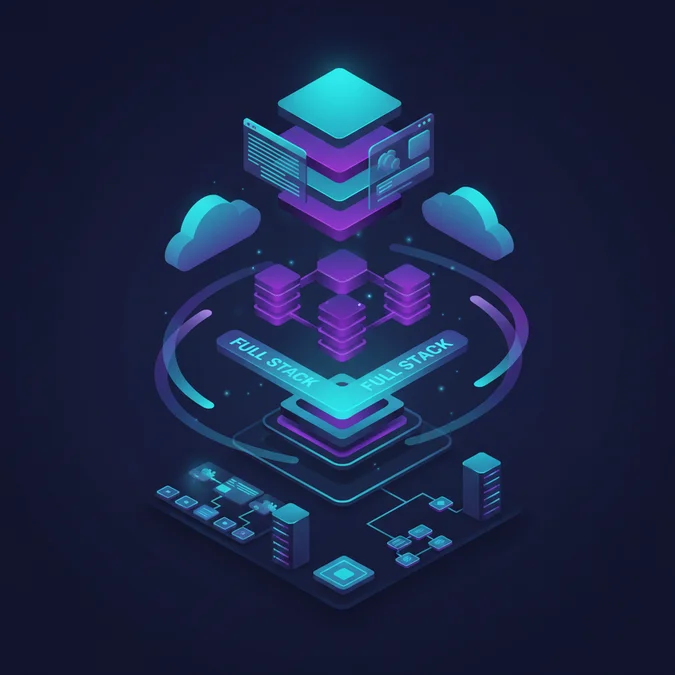

A development stack is a comprehensive set of software components, including frontend, backend, database, and server, that collectively power an application. It defines the technological ecosystem for building, deploying, and running software, ensuring seamless interaction between all parts of the system.
Understanding the intricacies of a modern development stack is paramount for any engineering team in 2026. This article provides a practitioner’s guide, delving into architectural patterns, the core mechanics of popular stacks, and practical implementation insights. We will equip you with a robust framework for selecting, optimizing, and future-proofing your technological foundation, ensuring your applications are performant, secure, and scalable.
Understanding the Development Stack: Definition and Core Components
At its core, a development stack is the complete set of technologies used to build and run a software application. It encompasses everything from the user interface to the underlying infrastructure, providing a holistic environment for development. The choice of a stack profoundly impacts project feasibility, scalability, performance, and long-term maintainability.
A typical development stack is composed of several distinct, yet interconnected, layers:
- Frontend: This is the client-side, user-facing part of the application. It includes everything a user sees and interacts with in their web browser or mobile device. Technologies here typically involve HTML, CSS, JavaScript, and frameworks like React, Angular, or Vue.js.
- Backend: Also known as the server-side, this layer handles application logic, data processing, user authentication, and communication with the database. Common backend languages include Node.js, Python, Ruby, Java, PHP, and Go, often coupled with frameworks like Express, Django, Ruby on Rails, or Spring Boot.
- Database: Responsible for storing, organizing, and retrieving application data. Databases can be relational (SQL, like PostgreSQL, MySQL) or non-relational (NoSQL, like MongoDB, Cassandra, Redis). The choice depends heavily on data structure, scalability needs, and consistency requirements.
- Server: The hardware and software that host the backend application and serve frontend assets. This can range from traditional bare-metal servers to virtual machines, containerized environments (Docker, Kubernetes), or serverless platforms (AWS Lambda, Azure Functions). Web servers like Nginx or Apache often sit in front of the application server.
Callout: A well-chosen development stack acts as the blueprint for your application’s architecture, directly influencing its performance characteristics, security posture, and the agility with which new features can be deployed. Ignoring its fundamental components is akin to building a house without a stable foundation.
Architectural Patterns for Robust Full Stack Apps
Building a robust full stack app requires more than just selecting technologies; it demands a thoughtful architectural approach. The chosen pattern dictates how components interact, how data flows, and how the application scales and evolves. Three primary patterns dominate modern application development:
Monolithic Architecture
In a monolithic architecture, all components of an application (user interface, business logic, data access layer) are tightly coupled and deployed as a single, indivisible unit. This approach is straightforward to develop and deploy initially, making it suitable for smaller projects or startups with limited resources.
- Advantages: Simpler to develop, test, and deploy; easier debugging; lower operational overhead initially.
- Disadvantages: Becomes complex and difficult to maintain as the application grows; scaling requires scaling the entire application; technology lock-in; slower development cycles for large teams.
Microservices Architecture
Microservices break down an application into a collection of small, independent services, each running in its own process and communicating via lightweight mechanisms, often HTTP APIs. Each service focuses on a single business capability and can be developed, deployed, and scaled independently.
- Advantages: Improved scalability (individual services can scale independently); technology diversity (different services can use different stacks); enhanced fault isolation; faster development for large teams.
- Disadvantages: Increased operational complexity (distributed systems are harder to manage); complex debugging; higher resource consumption; requires robust inter-service communication and data consistency strategies.
Serverless Architecture
Serverless architecture, often implemented with Function-as-a-Service (FaaS), allows developers to build and run application code without provisioning or managing servers. The cloud provider dynamically manages the allocation and provisioning of servers. Developers only pay for the compute time consumed by their code.
- Advantages: Reduced operational costs (pay-per-execution); automatic scaling; reduced operational overhead; faster time to market.
- Disadvantages: Vendor lock-in; cold starts (initial latency for functions); stateless nature can be challenging; debugging and monitoring can be more complex due to distributed nature.
Callout: The choice between monolithic, microservices, or serverless significantly impacts development velocity, operational complexity, and the ultimate scalability of your full stack app. Evaluate project size, team expertise, and long-term growth projections carefully.
Popular Web Development Stacks: MERN, LAMP, and Modern Choices
The landscape of stack web development is vast and constantly evolving. While foundational principles remain, specific technology combinations gain and lose popularity. Here, we examine some of the most prevalent and impactful development stacks in use today, highlighting their components and ideal use cases.
MERN Stack
An acronym for MongoDB, Express.js, React, and Node.js. This JavaScript-centric stack is highly popular for building single-page applications and dynamic web experiences.
- MongoDB: A NoSQL document database.
- Express.js: A minimalist web framework for Node.js, handling backend routing and middleware.
- React: A JavaScript library for building user interfaces.
- Node.js: A JavaScript runtime environment, allowing JavaScript to be used on the server-side.
Ideal Use Case: Real-time applications, single-page applications (SPAs), JSON-heavy APIs, projects requiring full-stack JavaScript development.
LAMP Stack
One of the oldest and most enduring web stacks, LAMP stands for Linux, Apache, MySQL, and PHP. It’s renowned for its stability, widespread adoption, and vast community support.
- Linux: The operating system.
- Apache: The web server.
- MySQL: A relational database management system.
- PHP: The server-side scripting language.
Ideal Use Case: Content Management Systems (CMS) like WordPress, e-commerce platforms, traditional server-rendered web applications, projects requiring strong community support.
JAMstack
JAMstack (JavaScript, APIs, Markup) represents a modern architectural approach focused on delivering fast, secure, and scalable websites and applications. It pre-renders content and serves it directly from a CDN, relying on client-side JavaScript for dynamic functionality and APIs for backend operations.
- JavaScript: Handles dynamic interactions on the client-side.
- APIs: Provide backend functionality (e.g., authentication, database access).
- Markup: Pre-built static HTML served from a CDN.
Ideal Use Case: Static sites, blogs, marketing websites, e-commerce stores (with headless CMS), projects prioritizing performance and security.
MEAN Stack
Similar to MERN, MEAN replaces React with Angular, another popular JavaScript framework for building dynamic user interfaces. It offers a structured approach for large-scale enterprise applications.
| Stack | Frontend | Backend | Database | Server/OS | Key Advantage | Typical Use Cases |
|---|---|---|---|---|---|---|
| MERN | React | Express.js (Node.js) | MongoDB | Node.js Runtime | Full JavaScript ecosystem, dynamic UIs | SPAs, real-time apps, APIs |
| LAMP | HTML/CSS/JS | PHP | MySQL | Apache (Linux) | Maturity, vast ecosystem, cost-effective | CMS (WordPress), e-commerce, traditional web apps |
| JAMstack | React/Vue/Svelte (Static Gen) | APIs (e.g., Lambda, Stripe) | None (or external API) | CDN (Static Hosting) | Performance, security, scalability | Blogs, marketing sites, e-commerce (headless) |
| MEAN | Angular | Express.js (Node.js) | MongoDB | Node.js Runtime | Structured, enterprise-grade SPAs | Complex enterprise applications, dashboards |
| Python/Django | HTML/CSS/JS | Django (Python) | PostgreSQL/MySQL | Gunicorn/Nginx (Linux) | Rapid development, ‘batteries included’ | Web apps, data science platforms, APIs |
| Ruby on Rails | HTML/CSS/JS | Ruby on Rails (Ruby) | PostgreSQL/MySQL | Puma/Nginx (Linux) | Convention over configuration, productivity | Prototyping, SaaS applications |
Each of these stacks offers a unique set of trade-offs in terms of development speed, performance, scalability, and ease of maintenance. The selection often comes down to specific project requirements and team expertise.
Choosing the Right Development Stack: A Strategic Framework for 2026
Selecting the optimal development stack is a critical decision that influences a project’s entire lifecycle. In 2026, with an ever-expanding array of technologies, a strategic framework is essential. Consider the following factors:
1. Project Requirements and Scope
- Application Type: Is it a complex enterprise application, a simple marketing website, a real-time chat, or a mobile app? Different applications naturally lend themselves to different stacks.
- Performance Needs: Does the application require extremely low latency (e.g., gaming, trading platforms) or can it tolerate higher response times? This impacts language, database, and caching choices.
- Scalability: How many users are expected initially, and what is the projected growth? A stack capable of horizontal scaling is crucial for high-growth applications.
- Security: Are you handling sensitive data (e.g., financial, medical)? Robust security features and compliance certifications must be a priority.
- Time to Market: Is rapid prototyping and deployment a key driver? Frameworks with ‘batteries included’ or strong component libraries can accelerate development.
2. Team Expertise and Resources
- Current Skillset: Leveraging existing team knowledge in a specific language (e.g., JavaScript, Python) or framework can significantly reduce ramp-up time and increase productivity.
- Hiring Pool: Consider the availability of developers proficient in the chosen stack. Niche technologies might offer unique advantages but could make hiring challenging.
- Learning Curve: How quickly can the team adapt to new technologies within the stack? A steep learning curve can delay projects and increase costs.
3. Ecosystem and Community Support
- Libraries and Tools: A rich ecosystem of third-party libraries, tools, and integrations can drastically speed up development and solve common problems.
- Community Size: A large, active community provides extensive documentation, tutorials, and support, making troubleshooting easier.
- Long-term Viability: Assess the stability and future trajectory of the technologies within the stack. Is it actively maintained? Are there clear roadmaps?
4. Budget and Operational Costs
- Development Costs: This includes developer salaries, tooling, and licensing.
- Infrastructure Costs: Hosting, database services, CDN, and managed services contribute significantly. Serverless architectures can reduce fixed costs but may have variable costs.
- Maintenance Costs: Long-term updates, security patches, and debugging efforts.
Checklist for Stack Selection:
- Define Core Requirements: What problem does the application solve? What are its key features?
- Assess Performance & Scalability Targets: What are the non-negotiable performance metrics?
- Evaluate Team Skills: What technologies does your team excel in? What’s the hiring market like?
- Research Ecosystem & Trends: Is the stack well-supported and future-proof?
- Estimate TCO (Total Cost of Ownership): Consider development, infrastructure, and maintenance.
- Conduct Proof-of-Concept (POC): For critical or complex areas, build small POCs to validate technical choices.
- Consider Future-Proofing: How easily can components be swapped or updated as technology evolves?
Optimizing Your Development Stack: Performance, Security, and Scalability
Once a development stack is chosen, the focus shifts to ensuring it performs optimally, remains secure, and can scale effectively. These three pillars are interdependent and critical for long-term success.
Performance Optimization
Achieving high performance involves tuning every layer of the stack:
- Frontend:
- Code Splitting and Lazy Loading: Load only necessary JavaScript and components.
- Image Optimization: Compress images, use modern formats (WebP), and implement responsive images.
- Caching: Leverage browser caching, service workers, and CDN for static assets.
- Minification and Bundling: Reduce file sizes of HTML, CSS, and JavaScript.
- Backend:
- Database Indexing: Properly index frequently queried columns to speed up data retrieval.
- Query Optimization: Write efficient SQL/NoSQL queries, avoid N+1 problems.
- Caching (Server-side): Implement in-memory caches (Redis, Memcached) for frequently accessed data.
- Asynchronous Operations: Use non-blocking I/O and message queues for long-running tasks.
- Infrastructure:
- CDN (Content Delivery Network): Serve static assets globally for faster delivery.
- Load Balancing: Distribute traffic across multiple servers to prevent overload.
- Connection Pooling: Efficiently manage database connections.
Security Best Practices
Security must be baked into every stage of development, not an afterthought:
- Input Validation: Sanitize and validate all user inputs to prevent injection attacks (SQL, XSS).
- Authentication and Authorization: Implement strong authentication (MFA) and granular authorization roles. Use secure token-based systems (JWT) for APIs.
- Data Encryption: Encrypt data both in transit (TLS/SSL) and at rest (database encryption).
- Dependency Management: Regularly update libraries and frameworks to patch known vulnerabilities. Use vulnerability scanners.
- API Security: Implement rate limiting, API keys, and OAuth for secure API access.
- Secrets Management: Never hardcode API keys, database credentials, or sensitive configurations. Use environment variables or dedicated secrets management services.
- Regular Audits and Penetration Testing: Proactively identify and fix security flaws.
Scalability Strategies
Designing for scalability from day one prevents costly refactoring later:
- Horizontal Scaling (Scaling Out): Adding more servers or instances to distribute the load. This is often preferred over vertical scaling.
- Vertical Scaling (Scaling Up): Increasing the resources (CPU, RAM) of existing servers. Has limits.
- Stateless Applications: Design backend services to be stateless, making them easier to scale horizontally.
- Database Sharding/Replication: Distribute database load across multiple servers. Read replicas improve read performance.
- Message Queues: Decouple services and handle spikes in traffic by processing tasks asynchronously (e.g., RabbitMQ, Kafka, AWS SQS).
- Microservices/Serverless: Architectures inherently designed for independent scaling of components.
Callout: Proactive optimization for performance, rigorous adherence to security protocols, and strategic planning for scalability are non-negotiable for any production-grade development stack. These efforts ensure application resilience and user trust in 2026 and beyond.
Practical Code Examples: Implementing Key Stack Components
To illustrate the practical implementation of development stack components, let’s look at simplified examples demonstrating basic interactions between a frontend, backend, and database. While these are minimal, they highlight core concepts.
Example 1: Simple Node.js (Express) Backend with MongoDB
This snippet shows a basic Express.js server connecting to MongoDB and defining an API endpoint to fetch data.
server.js (Backend)
const express = require('express');
const mongoose = require('mongoose');
const cors = require('cors');

const app = express();
const PORT = process.env.PORT || 3000;

// Middleware
app.use(cors());
app.use(express.json());

// MongoDB Connection
mongoose.connect('mongodb://localhost:27017/mydatabase', {
  useNewUrlParser: true,
  useUnifiedTopology: true,
})
.then(() => console.log('MongoDB connected successfully'))
.catch(err => console.error('MongoDB connection error:', err));

// Define a simple Schema and Model
const ItemSchema = new mongoose.Schema({
  name: String,
  description: String,
});
const Item = mongoose.model('Item', ItemSchema);

// API Route to get all items
app.get('/api/items', async (req, res) => {
  try {
    const items = await Item.find();
    res.json(items);
  } catch (err) {
    res.status(500).json({ message: err.message });
  }
});

// API Route to add an item
app.post('/api/items', async (req, res) => {
  const item = new Item({
    name: req.body.name,
    description: req.body.description,
  });
  try {
    const newItem = await item.save();
    res.status(201).json(newItem);
  } catch (err) {
    res.status(400).json({ message: err.message });
  }
});

app.listen(PORT, () => {
  console.log(`Server running on port ${PORT}`);
});
Example 2: React Frontend Consuming the Backend API
This React component fetches data from the Node.js backend and displays it.
App.js (Frontend)
import React, { useState, useEffect } from 'react';
import axios from 'axios';

function App() {
  const [items, setItems] = useState([]);
  const [newItemName, setNewItemName] = useState('');
  const [newItemDescription, setNewItemDescription] = useState('');

  useEffect(() => {
    fetchItems();
  }, []);

  const fetchItems = async () => {
    try {
      const response = await axios.get('http://localhost:3000/api/items');
      setItems(response.data);
    } catch (error) {
      console.error('Error fetching items:', error);
    }
  };

  const addItem = async () => {
    try {
      await axios.post('http://localhost:3000/api/items', {
        name: newItemName,
        description: newItemDescription,
      });
      setNewItemName('');
      setNewItemDescription('');
      fetchItems(); // Refresh the list
    } catch (error) {
      console.error('Error adding item:', error);
    }
  };

  return (
    <div style={{ padding: '20px' }}>
      <h1>MERN Stack Example</h1>
      <div>
        <input
          type="text"
          placeholder="Item Name"
          value={newItemName}
          onChange={(e) => setNewItemName(e.target.value)}
        />
        <input
          type="text"
          placeholder="Item Description"
          value={newItemDescription}
          onChange={(e) => setNewItemDescription(e.target.value)}
          style={{ marginLeft: '10px' }}
        />
        <button onClick={addItem} style={{ marginLeft: '10px' }}>Add Item</button>
      </div>
      <h2>Items</h2>
      <ul>
        {items.map((item) => (
          <li key={item._id}>
            <strong>{item.name}</strong>: {item.description}
          </li>
        ))}
      </ul>
    </div>
  );
}

export default App;
Architectural Insight: Data Flow
In this simplified MERN example, the data flow is as follows:
- The React frontend sends an HTTP GET request to
http://localhost:3000/api/items. - The Node.js Express backend receives this request.
- Express’s route handler calls the MongoDB database (via Mongoose) to find all items.
- MongoDB returns the item data to the Express backend.
- Express sends the JSON response back to the React frontend.
- The React component updates its state with the new data and re-renders the list of items.
This demonstrates the fundamental client-server-database interaction that forms the backbone of most web applications, regardless of the specific technologies chosen within the development stack.
Frequently Asked Questions
What are the essential layers of any development stack?
A typical development stack comprises four essential layers: the frontend (user interface), backend (server-side logic), database (data storage), and server (hosting the application). These layers work cohesively to deliver a functional application by handling different aspects of data processing and user interaction.
How do I choose between a monolithic and microservices architecture for my project?
Choosing between monolithic and microservices depends on project scale and complexity. Monoliths are simpler for small projects, offering easier deployment and development. Microservices suit large, complex systems requiring independent scaling, technology diversity, and team autonomy, though they introduce operational overhead and complexity.
What is the difference between a full stack developer and a backend developer?
A full stack developer possesses expertise across all layers of a development stack, including frontend, backend, and database management. A backend developer specializes exclusively in server-side logic, database interactions, and API development, without direct involvement in the user interface or client-side experience.
Why is security a critical consideration when building a development stack?
Security is paramount in a development stack to protect sensitive data, prevent unauthorized access, and maintain user trust. Vulnerabilities in any layer, from frontend to database, can lead to breaches, data loss, and significant reputational and financial damage, necessitating robust security measures throughout the stack.
The choice and effective management of a development stack are foundational to the success of any software project. From defining core components to adopting strategic architectural patterns, and from selecting popular technology combinations to diligently optimizing for performance, security, and scalability, each decision carries significant weight.
As technology continues its rapid evolution in 2026, a deep understanding of these principles, coupled with a pragmatic approach to implementation, will empower engineering teams to build resilient, high-performing, and future-ready applications. By applying the frameworks and insights discussed, developers can confidently navigate the complexities of modern development, delivering exceptional digital experiences.
NR Studio builds custom web apps, mobile apps, SaaS platforms, and internal tools for growing businesses. If you’re working through a technical decision, feel free to reach out — no commitment required.