
Engaging professional companies that build websites is crucial for establishing a robust online presence and achieving business objectives. These specialized firms offer expertise in design, development, and digital strategy, transforming conceptual ideas into functional, high-performing web platforms. Selecting the right partner involves understanding service models, evaluating technical capabilities, and aligning on project scope and budget.
This guide provides a practitioner-level framework for businesses navigating the complex landscape of web development services. We will dissect various provider types, offer a rigorous vetting checklist, demystify pricing structures, and outline the complete project lifecycle to ensure your investment yields tangible results. Our aim is to equip you with the knowledge to make informed decisions and secure a development partner capable of delivering a superior digital product.
Understanding Companies That Build Websites: Your Options
The digital landscape offers a diverse array of companies that build websites, each with distinct advantages and suitability for different business needs. Understanding these options is the first step in identifying the right partner for your project, whether you are a startup needing a foundational presence or an enterprise requiring a complex web application.
Broadly, companies that build websites can be categorized into several types:
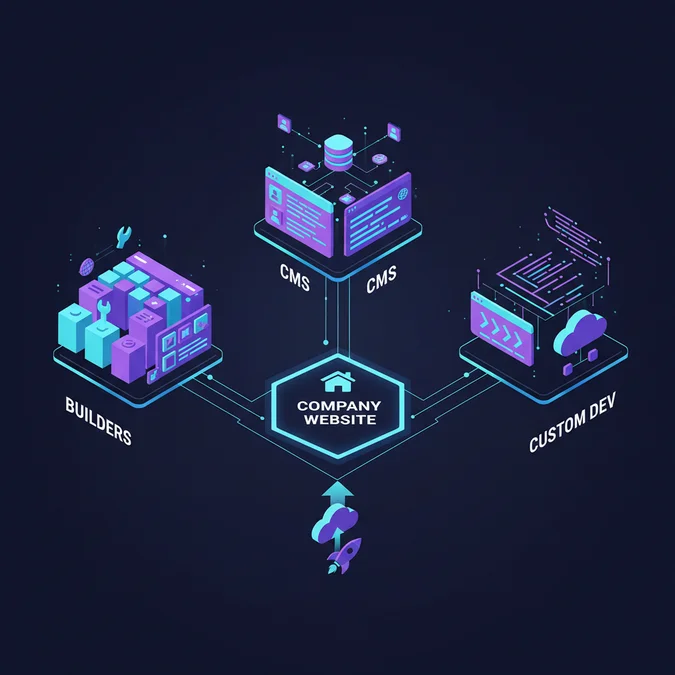
- Website Builders (DIY Platforms): Services like Squarespace, Wix, or Shopify provide intuitive drag-and-drop interfaces for users to create websites without coding knowledge. They are ideal for small businesses, personal portfolios, or e-commerce ventures with limited customization needs and budget constraints. While cost-effective, they offer restricted flexibility and scalability compared to custom development.
- Freelance Developers: Individual professionals offering specialized skills in web design, front-end, or back-end development. Freelancers can be a cost-effective solution for smaller, well-defined projects or specific tasks. However, managing multiple freelancers for a larger project can be complex, and their availability for ongoing support may vary.
- Small Web Agencies/Boutique Firms: These firms typically comprise a small team of designers, developers, and project managers. They often specialize in certain niches, technologies, or design styles, offering a more personalized service than larger agencies. They are suitable for small to medium-sized businesses seeking a balance between cost, quality, and dedicated attention.
- Full-Service Digital Agencies: Larger organizations that provide a comprehensive suite of services, including web design, development, digital marketing, SEO, content creation, and branding. They are equipped to handle complex, large-scale projects requiring diverse expertise and strategic guidance. These agencies offer robust project management and long-term partnership potential but come with a higher price point.
- Enterprise Web Development Firms: These are specialized agencies focusing exclusively on complex, high-traffic, and mission-critical web applications for large corporations. They often have deep expertise in specific industries, advanced integrations, and scalable architectures. Their services are premium, tailored for significant digital transformation initiatives.
When evaluating companies that build websites, consider your project’s complexity, budget, timeline, and long-term goals. A clear understanding of your requirements will guide you toward the most appropriate service provider.
Freelancers vs. Agencies: Choosing Your Professional Website Design Company
Deciding between a freelance developer and a professional website design company is a pivotal choice that impacts project outcomes, cost, and long-term support. Each model presents distinct advantages and disadvantages, making the ‘best’ option highly dependent on your specific business context and project requirements.
A freelancer is an independent contractor, often specializing in a particular area such as front-end development, UI/UX design, or specific CMS platforms. They typically offer more competitive rates due to lower overheads and can provide direct, one-on-one communication. However, a single freelancer’s capacity is limited, and they may lack the diverse skill sets required for complex projects that demand graphic design, back-end engineering, quality assurance, and project management simultaneously.
Conversely, a professional website design company, especially a full-service agency, brings a multidisciplinary team to the table. This team typically includes project managers, UX/UI designers, front-end developers, back-end developers, QA specialists, and potentially digital marketing experts. This integrated approach ensures comprehensive coverage of all project facets, from initial concept to deployment and ongoing support. While often more expensive, an agency provides structured processes, accountability, and the collective knowledge of multiple experts, reducing risk and improving the quality of the final product. For projects requiring significant strategic input, scalability, and long-term partnership, a professional website design company is generally the more robust choice.
| Feature | Freelancer | Professional Website Design Company (Agency) |
|---|---|---|
| Cost Efficiency | Generally lower hourly rates or project fees due to minimal overhead. | Higher overall project costs, reflecting team salaries, infrastructure, and comprehensive services. |
| Skill Set & Expertise | Specialized in one or a few areas, may require hiring multiple individuals for diverse needs. | Multidisciplinary team (design, development, QA, PM, marketing) providing holistic solutions. |
| Project Management | Often self-managed, requiring significant client oversight for larger projects. | Dedicated project managers, structured methodologies (Agile, Scrum), clear communication channels. |
| Scalability | Limited by individual capacity; difficult to scale for larger or urgent projects. | Easily scalable, with resources allocated based on project demands and deadlines. |
| Reliability & Support | Availability can be inconsistent; long-term support depends on individual’s capacity and commitment. | Guaranteed availability, formal support contracts, dedicated teams for maintenance and updates. |
| Accountability | Individual accountability, which can be high for simple projects but risky for complex ones. | Contractual obligations, established reputation, and legal entity provide higher accountability. |
| Project Complexity | Best suited for small, well-defined tasks or specific feature development. | Ideal for complex, large-scale projects requiring strategic planning, diverse expertise, and multiple integrations. |
How to Vet Companies That Build Websites: A Comprehensive Checklist
Vetting potential companies that build websites is a critical phase that determines the success of your project and the return on your investment. A thorough evaluation process goes beyond reviewing portfolios; it delves into their operational methodologies, technical prowess, and cultural fit. Utilize this checklist to systematically assess prospective web development partners.
Agency Vetting Checklist:
- Portfolio and Case Studies:
- Review their past work, focusing on projects similar in scope, industry, or technical complexity to yours.
- Look for measurable results: Did their work improve client conversions, traffic, or user engagement?
- Request examples of projects that faced challenges and how they were resolved.
- Technical Expertise and Stack:
- Inquire about their core technologies: Are they proficient in modern frameworks (React, Vue, Angular), back-end languages (Node.js, Python, PHP), and database solutions?
- Do they have experience with specific platforms relevant to your needs (e.g., Shopify, Magento, WordPress for e-commerce or CMS)?
- Understand their approach to scalability, security, and performance optimization.
- Ask about their development environment, version control (e.g., Git), and continuous integration/delivery (CI/CD) practices.
- Project Management Methodology:
- Which methodologies do they employ (Agile, Scrum, Waterfall)? How do they ensure transparency and client involvement?
- Ask about their communication plan: How often will you receive updates? What tools do they use (Jira, Asana, Slack)?
- Clarify their change request process and how scope creep is managed.
- Team Structure and Roles:
- Who will be working on your project? Request an introduction to key team members (project manager, lead developer, designer).
- Understand the ratio of designers to developers, and how quality assurance (QA) is integrated into the workflow.
- Inquire about team stability and turnover rates.
- Client References and Testimonials:
- Always request at least three recent client references and speak with them directly.
- Ask references about communication, adherence to deadlines and budget, problem-solving, and post-launch support.
- Pricing Models and Transparency:
- Discuss their preferred pricing model (fixed-price, time & material, retainer).
- Ensure all costs are clearly itemized, including licensing, third-party integrations, and potential overage charges.
- Request a detailed proposal outlining deliverables, timelines, and payment schedules.
- Post-Launch Support and Maintenance:
- What kind of warranty or bug-fix period do they offer post-launch?
- Detail their ongoing maintenance packages, including security updates, performance monitoring, and content management support.
- Understand their service level agreements (SLAs) for critical issues.
- Intellectual Property and Contracts:
- Clarify ownership of the code and design assets upon project completion.
- Review their contract terms thoroughly, focusing on deliverables, payment terms, warranties, and dispute resolution.
- Cultural Fit and Communication Style:
- Assess their responsiveness and clarity during initial conversations.
- Do their values align with your company’s? A good cultural fit fosters a more productive long-term partnership.
A rigorous vetting process for companies that build websites is not just about finding technical competency, but about securing a reliable partner committed to your long-term digital success.
Web Development Costs: Pricing Models and Deliverables from Professional Companies
Understanding the financial aspects of web development is crucial when engaging a professional website design company. Project costs are influenced by numerous factors, including complexity, features, technology stack, and the chosen pricing model. Transparency in budgeting and clear expectations regarding deliverables are paramount for a successful engagement.
Common Pricing Models:
- Fixed-Price Model: This model is suitable for projects with clearly defined scopes, requirements, and deliverables. The professional website design company provides a single, upfront cost for the entire project. While it offers budget predictability, any significant changes to the scope during development can lead to change orders and increased costs.
- Time & Material (T&M) Model: Ideal for projects with evolving requirements, research and development components, or those where the scope cannot be fully defined at the outset. The client pays for the actual hours spent by the development team and the materials used. This model offers flexibility but requires careful monitoring of hours and progress to stay within budget.
- Retainer Model: Often used for ongoing support, maintenance, continuous development, or dedicated team augmentation. The client pays a recurring fee for a set number of hours or services per month. This model fosters a long-term partnership and ensures consistent access to the professional website design company’s expertise.
Key Factors Influencing Cost:
- Project Scope and Complexity: Simple informational websites cost significantly less than complex e-commerce platforms, custom web applications, or platforms requiring extensive third-party integrations.
- Feature Set: The number and intricacy of features (e.g., user authentication, payment gateways, custom calculators, CRM integration) directly impact development time and cost.
- Design Customization: Bespoke UI/UX design is more expensive than using pre-built templates or themes.
- Technology Stack: Niche or cutting-edge technologies may require specialized developers, potentially increasing costs.
- Content Creation: Professional copywriting, photography, and videography add to the overall budget.
- Third-Party Integrations: APIs for payment processing, marketing automation, or analytics platforms can incur additional development and licensing fees.
- Post-Launch Support: Ongoing maintenance, security updates, and performance monitoring are essential but represent additional costs, often under a retainer.
| Deliverable Category | Description | Cost Impact |
|---|---|---|
| Discovery & Strategy | User research, competitor analysis, technical specification, project roadmap, wireframes. | Foundational, often 5-15% of total. Essential for reducing later rework. |
| User Experience (UX) Design | Information architecture, user flows, usability testing, prototyping. | Significant, 10-25%. Directly impacts user satisfaction and conversion. |
| User Interface (UI) Design | Visual design, branding, mockups, style guides, responsive design. | Moderate to High, 10-20%. Custom, pixel-perfect designs increase cost. |
| Front-End Development | Converting UI designs into interactive web pages using HTML, CSS, JavaScript frameworks (React, Vue, Angular). | High, 20-35%. Complex interactions and animations increase effort. |
| Back-End Development | Server-side logic, database management, API development, integrations (Node.js, Python, PHP). | High, 20-40%. Core functionality, data security, and scalability. |
| Content Management System (CMS) | Integration and customization of platforms like WordPress, Drupal, headless CMS solutions. | Moderate, 5-15%. Customizations can add significant cost. |
| E-commerce Functionality | Product catalogs, shopping carts, payment gateways, inventory management (Shopify, Magento). | High, 15-30%. Security, compliance, and complex business logic. |
| Quality Assurance (QA) & Testing | Functional testing, cross-browser compatibility, performance testing, security audits. | Essential, 5-10%. Reduces bugs and ensures reliability. |
| Deployment & Launch | Server setup, domain configuration, go-live procedures, basic SEO setup. | Low, 2-5%. Critical for a smooth transition to live environment. |
| Post-Launch Support & Maintenance | Bug fixes, security updates, performance monitoring, feature enhancements, hosting. | Ongoing, typically monthly retainer. Crucial for long-term health and evolution. |
When reviewing proposals, ensure they clearly itemize these deliverables and associate them with specific costs and timelines. A professional website design company will provide a transparent breakdown, allowing you to understand where your investment is allocated and how it aligns with your strategic objectives.
From Concept to Launch: The Web Project Lifecycle with Expert Companies
The web project lifecycle, as executed by expert companies that build websites, is a structured, iterative process designed to transform an initial idea into a fully functional and optimized digital product. Understanding these stages empowers businesses to engage effectively with their development partners and ensures alignment at every critical juncture.
- Discovery and Planning:
- Objective: Define project goals, target audience, technical requirements, and overall strategy.
- Activities: Stakeholder interviews, competitor analysis, user research, technical feasibility study, creation of a detailed project brief, scope definition, and initial wireframes or sitemaps.
- Outcome: A comprehensive project roadmap, functional specifications, and a clear understanding of the project’s vision and constraints. This phase is crucial for laying a solid foundation.
- Design (UI/UX):
- Objective: Create an intuitive, engaging, and visually appealing user experience and interface.
- Activities: User journey mapping, wireframing, prototyping, mockups, graphic design, branding integration, and responsive design considerations. Iterative feedback sessions with the client are central here.
- Outcome: Approved visual designs and interactive prototypes that represent the website’s look, feel, and user flow across various devices.
- Development and Implementation:
- Objective: Translate the approved designs and functional specifications into a working website or application.
- Activities: Front-end development (HTML, CSS, JavaScript frameworks), back-end development (server-side logic, database integration, API creation), CMS integration, third-party service integration, and initial content population.
- Outcome: A functional, coded website or application, often developed in stages or sprints, allowing for continuous review and adjustments.
- Testing and Quality Assurance (QA):
- Objective: Identify and rectify bugs, ensure functionality, performance, security, and cross-browser compatibility.
- Activities: Unit testing, integration testing, system testing, user acceptance testing (UAT), performance testing, security audits, and cross-device compatibility checks.
- Outcome: A stable, bug-free, and high-performing website that meets all specified requirements and quality standards.
- Deployment and Launch:
- Objective: Make the website live and accessible to the public.
- Activities: Server configuration, domain setup, database migration, final content review, SEO optimization (technical SEO), analytics integration, and a carefully orchestrated go-live procedure.
- Outcome: The website is successfully launched, publicly available, and ready for user interaction.
- Post-Launch Support, Maintenance, and Optimization:
- Objective: Ensure the website remains secure, performs optimally, and evolves with business needs and technological advancements.
- Activities: Bug fixing, security updates, performance monitoring, backups, content updates, feature enhancements, SEO monitoring, analytics review, and ongoing strategic consulting.
- Outcome: A continuously improving digital asset that supports business growth, adapts to user feedback, and stays competitive in the market. Many expert companies that build websites offer comprehensive retainer packages for this phase.
Modern Web Technologies: What Top Companies That Build Websites Use
In today’s rapidly evolving digital landscape, the choice of technology stack is a critical differentiator for companies that build websites. Modern web development prioritizes performance, scalability, security, and developer experience. Understanding the technologies employed by leading firms can help you assess their capabilities and ensure your project is future-proof.
Top companies that build websites often leverage a combination of established and emerging technologies to deliver robust and efficient solutions:
- Front-End Frameworks: React, Angular, and Vue.js dominate client-side development. They enable the creation of dynamic, single-page applications (SPAs) and complex user interfaces with superior performance and responsiveness. These frameworks facilitate component-based development, making code reusable and easier to maintain.
- Back-End Languages and Frameworks: Node.js (with frameworks like Express.js or NestJS) is popular for its full-stack JavaScript capabilities, enabling fast, scalable network applications. Python (with Django or Flask) is favored for data-intensive applications, AI/ML integration, and rapid development. PHP (with Laravel or Symfony) remains a robust choice for enterprise-level applications and content-heavy sites.
- Content Management Systems (CMS): Beyond traditional monolithic CMS platforms like WordPress or Drupal, many companies are adopting Headless CMS solutions (e.g., Strapi, Contentful, Sanity). These decouple the content management layer from the presentation layer, offering greater flexibility for delivering content across various platforms and enabling JAMstack architectures.
- JAMstack Architecture: This modern approach, standing for JavaScript, APIs, and Markup, focuses on pre-rendering content and serving it directly from a CDN. It delivers exceptional performance, enhanced security, and simplified scaling. Companies that build websites using JAMstack often combine static site generators (like Next.js, Gatsby) with Headless CMS and serverless functions.
- Cloud Platforms and Serverless: AWS, Google Cloud Platform (GCP), and Microsoft Azure provide scalable infrastructure, managed databases, and serverless computing options (e.g., AWS Lambda, Google Cloud Functions). These enable developers to focus on code rather than server management, leading to more efficient and cost-effective deployments.
- Databases: Both relational databases (PostgreSQL, MySQL) and NoSQL databases (MongoDB, Cassandra) are used, selected based on data structure, scalability needs, and query patterns.
- DevOps and CI/CD: Automation tools like Docker, Kubernetes, Jenkins, and GitLab CI/CD pipelines are integral for efficient development, testing, and deployment workflows, ensuring faster iteration cycles and higher code quality.
When evaluating companies that build websites, inquire about their preferred tech stack and how it aligns with your project’s specific requirements for performance, scalability, security, and maintainability. A forward-thinking agency will articulate how their technology choices contribute to your long-term business goals.
Factors That Affect Development Cost
- Project scope and complexity
- Feature set and integrations
- Design customization level
- Technology stack choice
- Content creation requirements
- Post-launch support and maintenance plans
- Agency’s experience and location
Web development costs vary significantly based on project specifics, ranging from a few thousand dollars for simple sites to well over a hundred thousand for complex enterprise solutions.
Frequently Asked Questions
What is the difference between a web designer and a web developer?
A web designer focuses on the visual aesthetics and user experience (UX/UI) of a website, creating layouts, graphics, and interactive elements. A web developer, on the other hand, builds the functional aspects, writing code to bring the design to life, manage databases, and ensure server-side operations. A professional website design company often employs both roles.
How much does it cost to hire companies that build websites?
The cost to hire companies that build websites varies significantly based on project complexity, features, and the agency’s expertise. Simple websites might range from $5,000 to $15,000, while complex e-commerce or custom web applications can exceed $50,000 to $100,000. Pricing models typically include fixed-price, hourly, or retainer agreements.
How do I choose the right professional website design company for my business?
To choose the right professional website design company, evaluate their portfolio, client testimonials, and technical expertise. Look for clear communication, transparent pricing, and a well-defined project methodology. Ensure they understand your business goals and offer ongoing support. A thorough vetting process is crucial for a successful partnership and long-term online presence.
What should I expect from the web development process?
The web development process typically involves several stages: discovery and planning, design (wireframes, mockups), development (coding, database integration), testing (QA, bug fixing), deployment (launch), and ongoing maintenance/optimization. Reputable companies that build websites will provide regular updates and involve you at each critical milestone to ensure project alignment and success.
Choosing the right partner from the multitude of companies that build websites is a strategic decision that profoundly impacts your digital footprint and business success. By meticulously evaluating service models, implementing a rigorous vetting process, understanding diverse pricing structures, and familiarizing yourself with the web project lifecycle, you can significantly mitigate risks and maximize your return on investment.
The journey from concept to a launched, high-performing website is complex, but with a professional website design company that aligns with your vision and technical requirements, it becomes a streamlined and rewarding experience. Focus on transparency, clear communication, and a shared commitment to quality to forge a partnership that delivers not just a website, but a powerful digital asset tailored for your future growth.
NR Studio builds custom web apps, mobile apps, SaaS platforms, and internal tools for growing businesses. If you’re working through a technical decision, feel free to reach out — no commitment required.