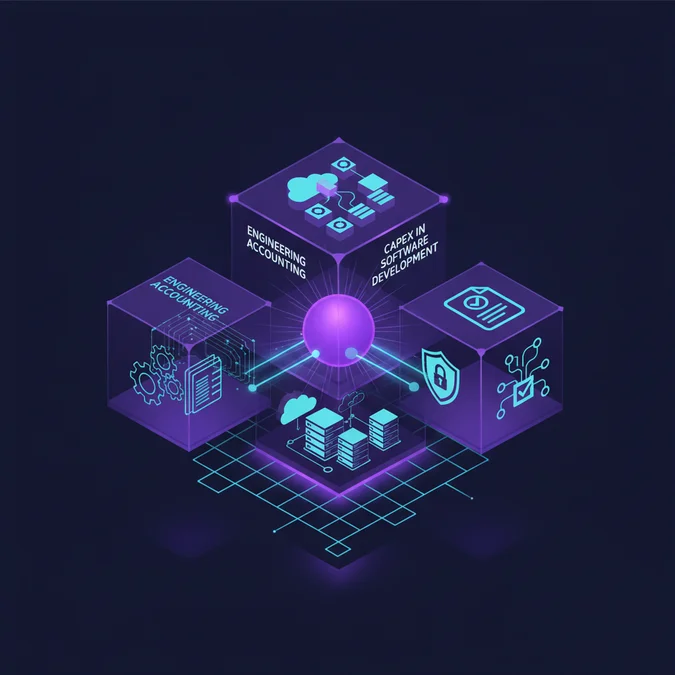

Why do engineering organizations continue to treat software development strictly as an operational burden when significant portions of internal systems represent long-term capital assets? CapEx in software development refers to the practice of capitalizing the internal and external engineering investments required to build, upgrade, or significantly enhance long-lived software systems, transferring costs from immediate operating expenses (OpEx) onto the balance sheet as amortizable intangible assets.
From an architectural and security governance perspective, distinguishing between capital expenditures and operational maintenance is far more than a financial bookkeeping mechanism. It defines how teams track architectural modifications, isolate security controls, enforce compliance standards like SOC 2 and ISO 27001, and document system longevity. When engineering teams fail to establish precise boundaries between capital-grade platform improvements and recurring bug patches, they compromise both financial audits and technical debt oversight.
This analysis breaks down the technical mechanics of software capitalization, covering international accounting thresholds, Git tracking systems, automated CI/CD compliance controls, and the rigorous security requirements demanded during multi-year system amortization lifecycles.
Accounting Frameworks and the Technical Definition of Capitalized Software
Capitalizing software development costs requires meeting rigorous statutory standards established under US GAAP (specifically ASC 350-40 for internal-use software and ASC 985-20 for software sold or leased) and IFRS under IAS 38. From an engineering standpoint, an engineering task cannot be classified as capital expenditure merely because it requires substantial engineering effort. The task must definitively create new functional capability, extend structural longevity, or substantially upgrade processing capacity.
Under both financial frameworks, software development is partitioned into three distinct phases:
- Preliminary Project Phase: Involves evaluating technical alternatives, conducting feasibility proof-of-concepts, reviewing cryptographic schemes, and vetting third-party dependencies. All effort in this stage must be expensed as OpEx.
- Application Development Phase: Covers the actual writing of production code, database schema migrations, hardware provisioning for testing, configuration of authorization layers, and creation of automated integration suites. Work in this stage is capitalized as CapEx once technical feasibility is established and management commits to funding.
- Post-Implementation and Operation Phase: Encompasses production monitoring, log aggregation, routine vulnerability patching, routine database indexing, and bug remediation. Work in this phase represents operating expenses and cannot be capitalized.
The critical technical distinction rests on whether the code delivers net-new asset value or sustains existing baseline operation. For example, migrating an API gateway from basic sessions to an identity platform using token authentication options for Laravel backends introduces net-new architectural capability. This migration qualifies as CapEx. Conversely, bumping package patch versions in a lockfile to address Common Vulnerabilities and Exposures (CVEs) is maintenance and remains OpEx.
The Three Development Stages and Their Technical Boundaries
Architects must map engineering lifecycle activities to capitalization criteria with zero ambiguity. Auditors evaluate capitalization schedules against verifiable change control records. Misclassifying maintenance tasks as capital assets risks accounting restatements and compliance penalties.
| Development Phase | Permitted Engineering Activities | Prohibited Engineering Activities | Accounting Treatment |
|---|---|---|---|
| Preliminary Phase | Architecture diagrams, technology evaluation, security threat modeling, feasibility prototyping | Production schema design, API scaffolding, writing production business logic | Strictly OpEx |
| Application Development | Writing core application logic, developing infrastructure-as-code, pipeline automation, end-to-end integration tests | Fixing pre-existing defects, routine library maintenance, server operating system updates | CapEx Eligible |
| Post-Implementation | Vulnerability remediation, minor bug fixes, production observability, server provisioning churn | Architectural modernization, total re-engineering of database layers, major feature extensions | Strictly OpEx |
To withstand technical and financial inspection, engineering leads must codify these boundaries directly within version control and project issue trackers. When engineers refactor code, that effort is only capitalizable if the refactoring explicitly introduces new operational performance thresholds, such as redesigning a synchronous pipeline into an asynchronous event stream to handle a 10x throughput surge. Refactoring legacy code solely to reduce stylistic linter errors is preventative maintenance and must be categorized as OpEx.
Git Tagging, Commits, and Automated Attribution Mechanics
Relying on manual engineer timecards to allocate CapEx hours creates systemic errors, auditor skepticism, and security tracking gaps. The most resilient mechanism for tracking capitalizable engineering effort is metadata extraction directly from version control commits, pull requests, and automated ticket transitions.
By enforcing structured commit messages and PR metadata through automated linting, organizations build an immutable, tamper-resistant trail that ties code changes directly to capital projects. Consider the following automated GitHub Actions workflow, which validates that every pull request introduces required metadata flags distinguishing capital features from operational maintenance:
name: Capitalization Compliance Linter
on:
 pull_request:
 types: [opened, edited, synchronize]

jobs:
 audit-metadata:
 runs-on: ubuntu-latest
 steps:
 - name: Validate PR Accounting Attributes
 uses: actions/github-script@v7
 with:
 script: |
 const prBody = context.payload.pull_request.body || '';
 const capExPattern = /Capitalization-Type:\s*(CapEx|OpEx)/i;
 const projectPattern = /Project-Code:\s*PROJ-[0-9]{4,6}/i;

 if (!capExPattern.test(prBody)) {
 core.setFailed('Missing or invalid Capitalization-Type header in PR description.');
 }
 if (!projectPattern.test(prBody)) {
 core.setFailed('Missing valid Project-Code identifier for asset tracking.');
 }
In this workflow, an issue cannot merge into the mainline branch without explicit classification. This system creates an auditable record that ties every line of code to a specific asset identifier. If an audit challenges whether an internal data layer was an enhancement or ongoing maintenance, engineers point to the commit history, unit tests, and corresponding pull request justification.
Architectural Decision Records for Capitalization Audit Trails
Financial auditors examining capitalized internal assets evaluate technological obsolescence and management intent. If an asset is capitalized for three years but abandoned after six months due to unviable technical choices, the business faces immediate asset impairment write-offs. This outcome invites intense administrative scrutiny. Engineering teams must document why an architecture was selected, what performance parameters were committed, and when the project formally exited the preliminary research phase.
Documenting these transitions is best accomplished by implementing formal architectural decision record standards across code repositories. An ADR provides timestamped, cryptographically verifiable proof of the shift from preliminary evaluation to application development:
# ADR-0042: Migration of Event Ingestion to Kafka Broker Cluster

## Status
Accepted (Capital Project: PROJ-8812)

## Context
The existing monolithic messaging bus cannot sustain peak ingest rates of 50,000 requests per second. The preliminary feasibility phase evaluated Redis Pub/Sub, RabbitMQ, and Apache Kafka. Performance benchmarks concluded Kafka fulfills the 5-year retention and partition requirements.

## Technical Boundary Determination
- Preliminary Phase End Date: 2024-03-15 (Expensed as OpEx)
- Application Development Phase Start Date: 2024-03-16 (Capitalized as CapEx)

## Asset Longevity
Estimated structural utility: 48 months.
Security review confirmed compliance with enterprise data retention and at-rest AES-256 encryption policies.
ADRs serve as primary technical evidence during external accounting and security reviews. They connect architectural trade-offs, security validations, and balance-sheet asset creation into a unified documentation framework.
Security Implications of Long-Term Amortized Codebases
When software is capitalized, it is placed on an amortization schedule, typically spanning three to five years. In contrast to physical hardware, amortized code carries a unique operational risk: vulnerability accumulation. Code classified as a long-term capital asset can easily become frozen in place because teams hesitate to alter an asset undergoing structured depreciation.
Treating code as an immutable capital asset without budgeting for continuous security updates introduces severe vulnerabilities:
- Vulnerability Drift: Open-source runtime components and third-party dependencies inevitably age. A framework version deemed secure at the capitalization date will accumulate critical CVEs within twelve to eighteen months.
- Technical Debt Masking: Teams may avoid refactoring structural flaws because rewriting a capitalized asset can trigger early asset impairment on balance sheets. This dynamic traps organizations in vulnerable architectural patterns.
- Incomplete Threat Models: Capital projects often define security requirements only at initial rollout. If threat surfaces expand, the project budget may lack allocations for recurring penetration testing, because testing an existing asset is classified as non-capitalizable OpEx.
Security engineers must insist that every capitalized software asset includes an operational maintenance covenant. While the initial functional architecture constitutes CapEx, ongoing automated vulnerability triage, software composition analysis (SCA), and secret rotation mechanics must be explicitly funded as OpEx across the asset’s active life.
Data Compliance, Encryption, and Governance Across Asset Lifecycles
Capitalized software handling sensitive personal data, healthcare records, or payment credentials must comply with statutory mandates, including GDPR, HIPAA, and PCI-DSS. Capitalization requires proving that the asset will maintain regulatory compliance over its projected lifespan. Building non-compliant architecture invalidates the asset’s presumed longevity, forcing sudden write-offs if regulatory bodies prohibit its use.
Architects must embed compliance controls directly into the foundational layer of any capitalized platform. Consider this example of an encryption-at-rest service layer developed as part of an auditable internal framework:
<php

declare(strict_types=1);

namespace App\Infrastructure\Security;

use RuntimeException;

/**
 * Capital Asset ID: ASSET-CRYPTO-2024
 * Component: Enterprise Field-Level Encryption Engine
 * Compliance: PCI-DSS v4.0 Scope Reduction, ISO 27001 Annex A.10
 */
final class FieldLevelCipher
{
 private string $key;
 private const CIPHER_ALGO = 'aes-256-gcm';
 private const TAG_LENGTH = 16;

 public function __construct(string $secretKey)
 {
 if (mb_strlen($secretKey, '8bit')!== 32) {
 throw new RuntimeException('Cryptographic key must be exactly 256 bits.');
 }
 $this->key = $secretKey;
 }

 public function encrypt(string $plaintext, string $associatedData = ''): string
 {
 $iv = random_bytes(12);
 $tag = '';

 $ciphertext = openssl_encrypt(
 $plaintext,
 self:CIPHER_ALGO,
 $this->key,
 OPENSSL_RAW_DATA,
 $iv,
 $tag,
 $associatedData,
 self:TAG_LENGTH
 );

 if ($ciphertext === false) {
 throw new RuntimeException('Encryption pipeline failure.');
 }

 // Serialized format: IV (12 bytes) + Tag (16 bytes) + Ciphertext
 return base64_encode($iv. $tag. $ciphertext);
 }
}
Developing an enterprise-grade field-level cipher like the example above represents a core application development activity that satisfies CapEx criteria. Once deployed, however, running regular automated key-rotation jobs and auditing access logs fall under daily operations (OpEx). Cleanly delineating the construction of security controls from their execution protects both accounting and compliance audits.
Contractor Allocation and Partner Engineering Governance
When enterprise organizations hire external engineering services to build custom software, accounting policies permit the full capitalization of third-party invoice costs, provided the work directly targets the application development phase. However, outsourcing development introduces unique supply-chain risks, source-code intellectual property challenges, and architectural security vectors.
When working with an external agency, such as a specialized software development vendor for complex builds, your engineering management team must enforce clear contractual boundaries regarding CapEx tracking. Every statement of work (SOW) must isolate feature development from ongoing production maintenance and warranty defect resolutions.
Contractual and Architectural Controls
- Auditable Milestone Sign-offs: Invoices must map directly to completed, verifiable milestones rather than generic open-ended retainers. Auditors demand deterministic evidence that contract payments correspond to merged, working code.
- Static Analysis Quality Gates: Ingested vendor code must pass through automated static application security testing (SAST) pipelines before milestone payments receive approval. Importing insecure, vulnerability-laden code introduces technical debt that degrades the capitalized asset.
- Intellectual Property and Chain-of-Custody: All vendor commit history must maintain intact digital signatures (GPG commit signing), verifying individual developer identities to satisfy SOC 2 trust principles.
Failing to verify these deliverables can prevent third-party development costs from qualifying as CapEx, forcing the organization to expense the entire contract as an immediate operating cost.
Asset Decommissioning, Refactoring, and Impairment Protocols
In modern cloud environments, software assets change constantly. Microservices, serverless components, and data stores rarely remain untouched for five years. When an engineering team decides to retire an internal tool, deprecate a microservice, or rewrite a subsystem to improve latency, they initiate an accounting event known as asset impairment.
Under ASC 360 and IAS 36, an asset is impaired when its carrying value on the balance sheet exceeds its recoverable service capacity. If an internally capitalized microservice has 18 months of remaining amortization, but the team replaces it with a new architecture, the remaining carrying value must be written off immediately as an impairment expense.
To avoid unexpected balance-sheet write-offs, engineering organizations should adopt modular software lifecycles:
- Micro-Asset Deprecation: Track large systems as collections of discrete, independently amortizable components rather than a single monolithic asset. If one service is retired, only its isolated fraction is impaired.
- Refactoring Trigger Limits: Establish code churn thresholds. If refactoring a service requires replacing more than 50% of the active lines of code, evaluate whether the initiative constitutes an operational overhaul or the creation of a replacement capital asset.
- Security Deprecation Runbooks: When decommissioning an asset, follow rigorous cryptographic sanitization procedures. Purge database stores, decommission key-management aliases, delete production ingress routes, and preserve Git repository histories for legal discovery.
Coordinating architectural refactoring with finance ensures structural upgrades do not trigger sudden, unexpected write-downs.
Exploration of Laravel Architectural Foundations
Building resilient, auditable web applications requires establishing strict code separation, automated quality gates, and transparent dependency controls. To review practical tutorials on framework fundamentals, database migration lifecycles, and backend architectural standards, explore our primary reference index.
Explore our complete Laravel, Basics directory for more guides.
Deepening your understanding of baseline framework mechanics ensures that internal platform investments maintain their functional integrity and security baseline across their operational lifespans.
Treating internal software development as a balance-sheet asset changes how engineering teams design, review, and maintain production code. Aligning architectural workflows with capitalization rules gives engineering leaders a reliable framework to defend platform initiatives, enforce strict version-control discipline, and ensure enterprise investments remain auditable and secure.
For engineering teams implementing software capitalization, success relies on three technical practices: automate Git classification to remove manual tracking errors, enforce immutable ADRs for every major architectural change, and never sacrifice recurring operational security budgets to maximize paper capitalization rates. Structuring your engineering operations around these principles preserves system security while maintaining complete accounting integrity.