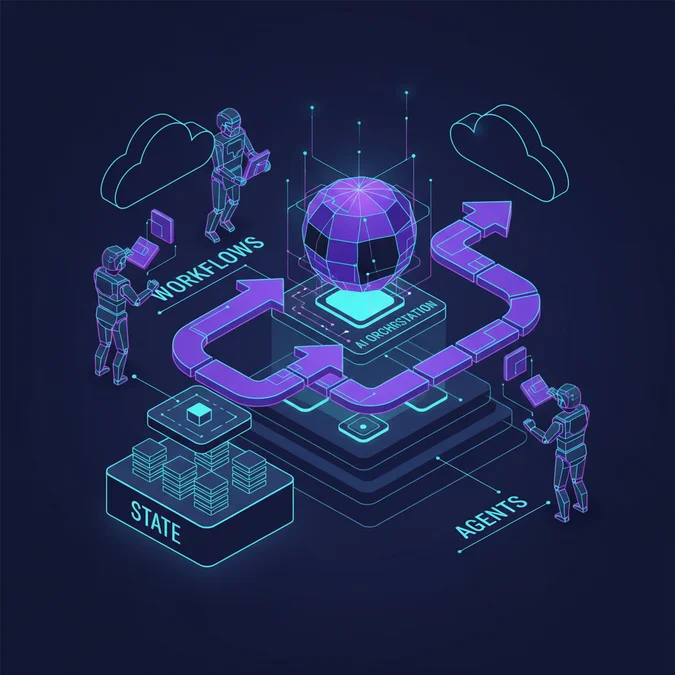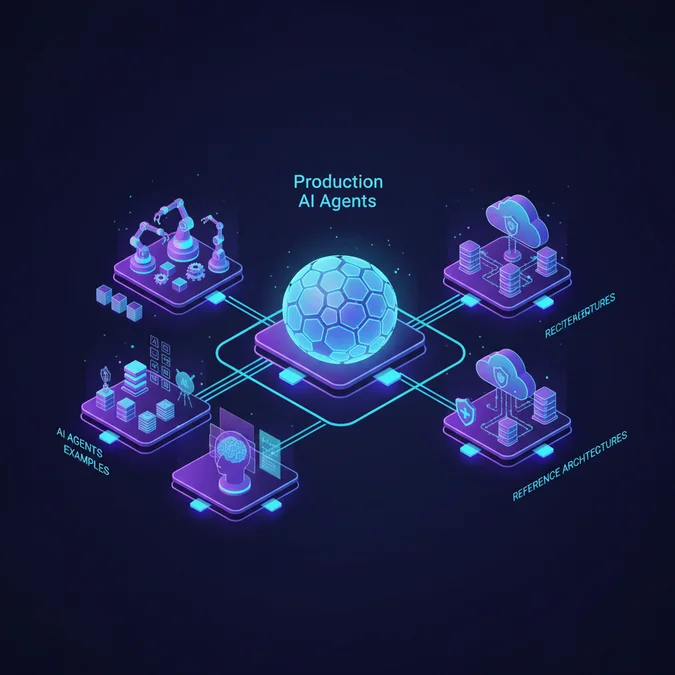

A production AI agent is an autonomous software system that couples a large language model with dynamic memory, deterministic tool-execution environments, and a cyclic feedback loop to achieve target goals without per-step human intervention. While standard LLM interfaces function as stateless request-response transformers, autonomous agents continuously observe environment states, formulate plans, invoke external interfaces via structured schema contracts, inspect outputs, and self-correct across multi-step execution graphs.
Building reliable agentic systems requires moving past brittle single-prompt chains. When LLM loops run unconstrained in mission-critical environments, non-deterministic model outputs frequently trigger cascading tool failures, cyclic execution traps, and compounding state drift. In 2026, enterprise architectures demand resilient orchestration frameworks, strict sandboxing, and deterministic state transitions.
This guide examines architectural patterns, production-ready Python implementations, enterprise framework comparisons, and operational guardrails required to run resilient AI agents at scale.
Architectural Anatomy: What Distinguishes Modern AI Agents
Understanding modern agentic architecture requires dissecting how an agent differs from a linear retrieval-augmented generation (RAG) pipeline or a simple API wrapper. A standard RAG pipeline executes a directed acyclic graph (DAG): retrieve context, inject into prompt, generate response. In contrast, an autonomous agent maintains an evolving execution state machine driven by observation, evaluation, and action loops.
+-----------------------------------------------------------------------+
| AI AGENT CONTROL LOOP |
| |
| +-------------+ +-------------------+ +------------------+ |
| | Environment | --> | State Interpreter | --> | Reasoning Engine | |
| | Observation | | (Context Window) | | (LLM Planner) | |
| +-------------+ +-------------------+ +------------------+ |
| ^ | |
| | v |
| +-------------+ +-------------------+ +------------------+ |
| | State Store | <-- | Schema Validation | <-- | Tool Invocation | |
| | (Postgres) | | (Pydantic / Zod) | | (JSON Schema) | |
| +-------------+ +-------------------+ +------------------+ |
+-----------------------------------------------------------------------+
Consider an enterprise agent example such as a Tier-2 customer billing agent. A standard chatbot informs a user about a refund policy; an agent inspects the customer’s stripe ledger, invokes an anti-fraud heuristic endpoint, verifies authorization status, runs the refund transaction, and updates the CRM record. This requires deterministic state tracking and dynamic runtime reasoning.
Core Architectural Principle: Autonomous agents convert non-deterministic natural language queries into deterministic, schema-validated execution steps over external environments while maintaining persistent memory across cyclic state updates.
The foundational components of modern agent architectures include:
- Reasoning Engine: Foundation model capable of native structured outputs (JSON schema) and tool-use selection (e.g. function calling).
- Working and Long-Term Memory: Short-term scratchpads stored within runtime context windows combined with long-term semantic indices (vector databases) and relational checkpoint stores (PostgreSQL / Redis).
- Deterministic Tool Registry: Strongly typed interfaces exposing REST, GraphQL, gRPC, or CLI commands with explicit failure boundaries.
- State Machine Execution Graph: Orchestration primitives that support cyclical transitions, conditional branching, and explicit checkpointing for human-in-the-loop (HITL) pauses.
| Capability Dimension | Stateless LLM Wrapper | Sequential RAG Chain | Autonomous Agent Loop |
|---|---|---|---|
| Execution Pattern | Static single-turn call | Linear multi-step DAG | Dynamic iterative cyclic graph |
| Tool Interaction | None (pure generation) | Hardcoded pre-retrieval | Dynamic runtime tool selection |
| State Persistence | External session context | Static context ingestion | Evolving intermediate scratchpad |
| Error Recovery | None (returns failure) | Static fallback branching | Self-correcting ReAct iteration |
| Autonomy Level | L1 (Deterministic tool) | L2 (Assisted execution) | L3 to L4 (Conditional autonomy) |
Generative AI Agents Examples Across Mission-Critical Infrastructure
Examining generative ai agents examples within complex infrastructure reveals how autonomous systems manage dynamic, unpredictable systems. These implementations depart from consumer chat applications, handling mission-critical failure resolution, automated codebase refactoring, and multi-source threat intelligence.
1. Self-Healing DevOps Incident Triage Agent
In high-throughput microservice ecosystems, incident triage represents a prime candidate for agentic automation. These ai agents examples in real life demonstrate how autonomous loops interact with live distributed systems to diagnose and remediate production bottlenecks.
- Telemetry Ingestion: The agent detects an anomaly via Prometheus/PagerDuty alert webhooks (e.g. HTTP 504 error spikes on an authentication gateway).
- Diagnostics Formulation: The agent initiates a diagnostic loop: queries Elasticsearch for trace logs, correlates request IDs, and calls Kubernetes APIs to inspect pod health.
- Root-Cause Analysis: Correlating pod memory limits against OOMKilled events, the agent determines that a recent rollout caused memory leaks in pod replica sets.
- Remediation Planning and Tool Execution: The agent generates an executable rollback plan, invokes
kubectl rollout undo deployment/auth-service, and continuously queries metric telemetry to verify latency normalization. - Post-Mortem Generation: The agent logs an audit trail in Jira, attaching raw logs, executed shell commands, and time-to-mitigation analytics.
2. Automated Codebase Refactoring and Security Patching
Unlike standard code completion tools, an autonomous refactoring agent modifies codebases iteratively while validating changes against regression suites.
import subprocess
from typing import Dict, Any

class RefactoringAgent:
 def __init__(self, workspace_path: str, linter_cmd: str, test_cmd: str):
 self.workspace = workspace_path
 self.linter_cmd = linter_cmd
 self.test_cmd = test_cmd
 self.iteration_budget = 5

 def run_verification(self) -> Dict[str, Any]:
 lint_result = subprocess.run(self.linter_cmd, shell=True, cwd=self.workspace, capture_output=True, text=True)
 if lint_result.returncode!= 0:
 return {"status": "failed", "stage": "linter", "output": lint_result.stderr}

 test_result = subprocess.run(self.test_cmd, shell=True, cwd=self.workspace, capture_output=True, text=True)
 if test_result.returncode!= 0:
 return {"status": "failed", "stage": "unit_tests", "output": test_result.stdout}

 return {"status": "passed", "stage": "complete", "output": "All suites green."}

 def execute_patch_cycle(self, patch_generator_fn):
 for step in range(self.iteration_budget):
 patch = patch_generator_fn(iteration=step)
 self.apply_patch(patch)

 validation = self.run_verification()
 if validation["status"] == "passed":
 return {"status": "success", "iterations": step + 1}

 # Self-correcting feedback loop
 patch_generator_fn.inject_feedback(validation["output"])

 return {"status": "exhausted_budget", "iterations": self.iteration_budget}

 def apply_patch(self, patch_content: str):
 with open(f"{self.workspace}/patch.diff", "w") as f:
 f.write(patch_content)
 subprocess.run("git apply patch.diff", shell=True, cwd=self.workspace)
3. Automated Threat Intelligence and SecOps Hunter
Security operations centers deploy generative agents to triage high-volume intrusion detection alerts. An agent inspects perimeter firewall drops, correlates IP addresses against OSINT feeds (e.g. AlienVault OTX, VirusTotal), verifies IAM audit trails via AWS CloudTrail, and dynamically generates temporary IP-block policies inside Cloudflare or AWS WAF, isolating compromised nodes without human delay.
Dissecting Enterprise AI Agent Products and Orchestration Frameworks
When selecting architectural runtimes, engineering leaders must balance declarative graph abstractions against flexible multi-agent communication fabrics. Modern ai agent products fall into distinct operational tiers, ranging from deterministic stateful runtimes to emergent role-based frameworks.
The current framework landscape features distinct approaches to state handling, loop execution, and orchestration:
| Framework / Product | Orchestration Model | State Management | Execution Control | Production Readiness |
|---|---|---|---|---|
| LangGraph | Cyclic directed graphs | Persistent checkpointers (PostgreSQL) | Fine-grained graph edges with HITL | Enterprise grade |
| AutoGen (v0.4+) | Event-driven actor runtime | Distributed message bus | Dynamic conversational branching | High (Scalable microservices) |
| CrewAI | Role-based sequential/hierarchical | Thread-level local memory | Declarative task assignments | Medium (Rapid prototyping) |
| LlamaIndex Workflows | Event-driven async state machines | Step-based context passing | Deterministic typed events | High (Data-centric agents) |
To evaluate these frameworks alongside commercial examples of ai agents in use, engineering teams should evaluate four critical operational criteria:
- Deterministic Flow Control: Does the framework allow rigid, deterministic edges where code controls logic, or does it rely exclusively on the LLM to decide the next execution node?
- State Persistence and Time-Travel: Can you serialize the entire agent memory at step N, replay execution from step N-1 with modified parameters, and inspect diffs?
- Sandboxed Execution Runtimes: Are tool invocations isolated via microVMs (e.g. Firecracker, Fly.io, or Docker containers), or does the runtime execute raw system calls on host hardware?
- Human-in-the-Loop Interoperability: Does the runtime natively support asynchronous execution pauses that wait for external authorization webhooks before running destructive tools?
End-to-End Implementation: Building a ReAct Incident Response Agent in Python
The ReAct (Reasoning + Acting) loop remains the foundational execution pattern for autonomous systems. The implementation below demonstrates a fully operational, type-safe incident response agent targeting a simulated infrastructure environment. This production ai agents examples implementation highlights schema enforcement, error traps, and self-correcting logic without abstract high-level wrappers.
Implementation Requirement: Production agent tools must validate all payload inputs against strict schemas using Pydantic or native typed interfaces. Never pass unvalidated model JSON directly to system shells.
import json
import re
from typing import Callable, Dict, Any, List
from pydantic import BaseModel, Field

# --- 1. TOOL SCHEMAS AND IMPLEMENTATIONS ---

class QueryMetricsPayload(BaseModel):
 service_name: str = Field(.. description="Target microservice identifier")
 metric_key: str = Field(.. description="Metric to query, e.g. cpu, memory, error_rate")

class RestartServicePayload(BaseModel):
 service_name: str = Field(.. description="Microservice identifier to reboot")
 force: bool = Field(False, description="Force terminate pods immediately")

def tool_query_metrics(service_name: str, metric_key: str) -> str:
 metrics_mock = {
 "auth-api": {"cpu": "45%", "memory": "94%", "error_rate": "12.4%"},
 "payment-gateway": {"cpu": "12%", "memory": "28%", "error_rate": "0.01%"}
 }
 data = metrics_mock.get(service_name, {}).get(metric_key, "Metric not found")
 return json.dumps({"service": service_name, "metric": metric_key, "value": data})

def tool_restart_service(service_name: str, force: bool = False) -> str:
 if service_name not in ["auth-api", "payment-gateway"]:
 return json.dumps({"status": "error", "message": f"Unknown service {service_name}"})
 return json.dumps({"status": "success", "action": "pod_recycle", "service": service_name, "forced": force})

# --- 2. DETERMINISTIC AGENT RUNTIME ---

class IncidentAgent:
 def __init__(self):
 self.tools: Dict[str, Callable] = {
 "query_metrics": tool_query_metrics,
 "restart_service": tool_restart_service
 }
 self.max_loops = 5

 def system_prompt(self) -> str:
 return """
You are an SRE incident remediator. Follow the exact pattern:
Thought: [Analyze situation and describe intent]
Action: [Tool name: query_metrics | restart_service]
Action Input: [Valid JSON payload matching tool schema]
Observation: [Result of action].. (repeat Thought/Action/Observation if needed)
Final Answer: [Remediation summary]
"""

 def execute_mock_llm(self, conversation_history: str) -> str:
 # Deterministic simulation of an LLM ReAct generation cycle
 if "Observation:" not in conversation_history:
 return (
 'Thought: The auth-api is reporting errors. I must query its memory usage.\n'
 'Action: query_metrics\n'
 'Action Input: {"service_name": "auth-api", "metric_key": "memory"}'
 )
 elif '"value": "94%"' in conversation_history and "restart_service" not in conversation_history:
 return (
 'Thought: Memory is near capacity at 94%. I need to restart the auth-api to flush leaking buffers.\n'
 'Action: restart_service\n'
 'Action Input: {"service_name": "auth-api", "force": true}'
 )
 else:
 return (
 'Thought: The service was restarted successfully.\n'
 'Final Answer: Incident resolved: auth-api memory cleared via forced restart.'
 )

 def step(self, task: str) -> str:
 history = f"{self.system_prompt()}\nTask: {task}\n"

 for cycle in range(self.max_loops):
 llm_response = self.execute_mock_llm(history)
 history += llm_response + "\n"

 if "Final Answer:" in llm_response:
 return llm_response.split("Final Answer:")[-1].strip()

 action_match = re.search(r"Action:\s*([a-zA-Z_0-9]+)", llm_response)
 input_match = re.search(r"Action Input:\s*(\{.*\})", llm_response, re.DOTALL)

 if not action_match or not input_match:
 return "Execution failed: Invalid ReAct formatting from model."

 action = action_match.group(1).strip()
 action_input = input_match.group(1).strip()

 if action not in self.tools:
 observation = f"Error: Tool {action} does not exist."
 else:
 try:
 payload = json.loads(action_input)
 observation = self.tools[action](**payload)
 except Exception as e:
 observation = f"Tool Execution Error: {str(e)}"

 history += f"Observation: {observation}\n"

 return "Failed: Maximum iteration limit reached without resolution."

if __name__ == "__main__":
 agent = IncidentAgent()
 resolution = agent.step("auth-api latency spike reported. Triage and remediate immediately.")
 print(f"Agent Result: {resolution}")
This implementation enforces three core structural constraints required in production: (1) schema-bounded inputs via JSON structure, (2) an isolated tool invocation boundary with comprehensive try-except guards, and (3) a hard-coded loop ceiling (max_loops = 5) to eliminate infinite token-burning iterations.
Production Hardening: Circuit Breakers, State Drifts, and Guardrails
Running autonomous agents in production introduces distinct failure modes rarely encountered in standard web services. When an agent manages external environments, runtime failures do not merely result in dropped requests; they can exhaust API budgets, corrupt remote data stores, or flood networks with repetitive commands.
Primary Agent Failure Modes
- Non-Deterministic State Drift: As scratchpad context expands over long execution paths, intermediate errors compound, leading the model to hallucinate previous actions or forget the initial goal.
- Recursive Tool Loops: Models encountering unexpected tool errors often retry the exact same failing arguments continuously, burning context tokens and triggering API rate limits.
- Indirect Prompt Injection: When reading untrusted external data (such as emails, bug reports, or database tables), embedded malicious instructions can hijack the agent’s reasoning loop.
Production Hardening Strategy
Enterprise teams must enforce defensive engineering practices before deploying autonomous agents to production environments:
- Recursion Limits: Hard-code maximum execution steps (typically 5 to 10 iterations) per user request to block infinite cycles.
- Token Circuit Breakers: Track dynamic token burn across reasoning loops. Abort the execution if cumulative context window usage exceeds predetermined budgets.
- Human-in-the-Loop (HITL) Checkpoints: Enforce asynchronous human sign-offs on any state-modifying action flagged as high-impact (e.g. dropping database tables, transferring funds, or updating firewalls).
- Deterministic Output Parsing: Rely exclusively on API functional interfaces (e.g. structured outputs) rather than fragile regex parsing of unstructured model thoughts.
class TokenCircuitBreakerException(Exception):
 pass

class AgentGuardrail:
 def __init__(self, token_limit: int, allowed_destructive_tools: List[str]):
 self.token_limit = token_limit
 self.cumulative_tokens = 0
 self.destructive_tools = allowed_destructive_tools

 def track_usage(self, prompt_tokens: int, completion_tokens: int):
 self.cumulative_tokens += (prompt_tokens + completion_tokens)
 if self.cumulative_tokens > self.token_limit:
 raise TokenCircuitBreakerException(
 f"Execution halted: cumulative token usage {self.cumulative_tokens} exceeded limit {self.token_limit}"
 )

 def intercept_action(self, tool_name: str, payload: dict) -> bool:
 if tool_name in self.destructive_tools:
 # Require external human confirmation webhook
 return self.request_human_approval(tool_name, payload)
 return True

 def request_human_approval(self, tool_name: str, payload: dict) -> bool:
 # Emit notification event to Slack or OpsGenie and pause state thread
 print(f"[SECURITY ALERT] Action '{tool_name}' requires human sign-off. Payload: {payload}")
 return False # Suspends execution until signed token received
High-Impact AI Agent Ideas for Enterprise Engineering Teams
When transitioning from baseline automation to autonomous agentic architectures, internal engineering operations yield the highest return on investment. The following vetted ai agent ideas address high-friction workflows across enterprise engineering teams, balancing technical complexity with immediate operational value.
| Agent Domain | Core Tools and Integrations | Execution Pattern | Primary Value Driver |
|---|---|---|---|
| Dynamic Cloud FinOps Agent | AWS Cost Explorer, Terraform, GitHub PR APIs | Scheduled batch evaluation + Auto PR generation | Automated termination of orphaned staging clusters and rightsizing EC2/RDS allocations. |
| Autonomous Flaky Test Triage | Datadog CI visibility, Jest/Pytest runners, Git | Event-driven on CI failure | Isolates nondeterministic unit tests, reproduces race conditions in sandbox, and drafts patches. |
| Enterprise API Migration Agent | Abstract Syntax Tree (AST) parsers, OpenAPI specs, Git | Interactive pull request lifecycle | Refactors breaking API changes across downstream consumer codebases automatically. |
| Automated SOC Vulnerability Patching | Snyk, Dependabot, GitHub Actions, Docker Registry | Vulnerability alert ingestion loop | Bumps dependency versions, resolves semantic version conflicts, and verifies clean builds. |
To successfully deliver these systems, select use cases where the action space is constrained by clear boundaries, the cost of an intermediate failure is minimal, and the agent’s work can be verified programmatically through tests, linters, or existing CI/CD gates.
Frequently Asked Questions
What are the core differences between an AI copilot and an autonomous AI agent?
An AI copilot operates synchronously, providing suggestions and awaiting human confirmation for every action. In contrast, an autonomous AI agent plans sequences, executes external API tools, monitors environmental feedback, and iterates over self-correcting loops independently without requiring constant human intervention.
What are the most common examples of AI agents in use within production software?
Common examples of AI agents in use include autonomous DevOps remediators that query metrics and cycle pods, security agents that patch vulnerabilities, customer service bots resolving end-to-end refunds, and automated code reviewers validating pull requests against enterprise compliance rules.
How do generative AI agents handle tool hallucinations and infinite execution loops?
Production generative AI agents prevent failure through strict schema enforcement via Pydantic, static execution recursion limits, deterministic circuit breakers, and human-in-the-loop checkpoints triggered whenever confidence scores drop below runtime thresholds or state updates exceed maximum token budgets.
Which frameworks are best suited for building commercial AI agent products?
Leading frameworks for commercial AI agent products include LangGraph for deterministic cyclic graphs, AutoGen for multi-agent conversations, and CrewAI for role-based orchestration. High-throughput production systems often pair these frameworks with temporal orchestrators and sandboxed execution environments.
Modern AI agents represent a fundamental architectural transition from passive linguistic completions to autonomous, tool-driven software systems. Moving these architectures from experimental scripts to production-grade deployments requires treating the LLM as an unpredictable reasoning component inside a deterministic state machine. Engineering teams must build robust infrastructure around models: schema-validated tool boundaries, isolated execution runtimes, persistent graph checkpointers, and hard token circuit breakers.
As you architect agentic workflows in 2026, evaluate state models rigorously, isolate destructive side effects behind human verification gates, and construct comprehensive unit tests over your agent execution traces to ensure operational resilience.