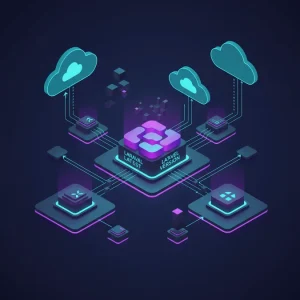
As we approach 2026, the landscape of content delivery has shifted from monolithic architectures toward highly decoupled, API-first ecosystems. For organizations managing rapidly growing content repositories, the selection of a headless CMS is no longer merely a choice of interface, but a foundational decision regarding data distribution, edge caching, and infrastructure resilience. The architectural roadmap for modern content platforms is moving toward distributed edge computing, where content delivery must be globally performant, immutable, and strictly versioned.
NR Studio observes that many growing teams struggle because they view the CMS as a database rather than a content orchestration layer. This article explores the technical requirements for choosing a headless platform that supports horizontal scaling, sophisticated CDNs, and robust integration pipelines. We will analyze the infrastructure implications of your choice, ensuring that your content delivery remains performant as your traffic spikes and your content volume grows exponentially.
The Evolution of API-First Content Orchestration
In 2026, the industry standard for content platforms is shifting toward strict schema-driven development. A robust headless CMS must treat content as structured data, utilizing GraphQL or high-performance REST endpoints that support partial data fetching. When a platform grows, the bottleneck is rarely the CMS UI, but rather the latency introduced by fetching redundant data payloads. Your chosen CMS must offer native support for field-level resolution, allowing your frontend to request only the specific fragments required for a given view.
Furthermore, the shift toward server-side generation at the edge means your CMS must support granular webhook triggers. When content is updated, the CMS should not just notify a central build server; it must be capable of triggering incremental site regeneration (ISR) or invalidating specific cache tags across your global CDN. This level of orchestration is critical for maintaining consistency without sacrificing performance. If your CMS lacks native support for granular webhook payloads, you will quickly find yourself limited by global build times that scale linearly with the size of your content repository, eventually leading to deployment failures during high-traffic events.
Architectural Latency and Global Edge Distribution
The core challenge of a growing content site is maintaining low time-to-first-byte (TTFB) across diverse geographic regions. Your headless CMS should ideally function as a source of truth that integrates seamlessly with edge-side caching mechanisms. When selecting a platform, evaluate its ability to serve content from a global network of read-replicas. If the CMS forces all API requests back to a centralized origin server located in a single region, your application will suffer from inherent network latency that cannot be overcome by frontend optimization alone.
Consider the impact of database sharding and read-only replicas on your content pipeline. A mature headless CMS architecture for 2026 provides a clear separation between the authoring environment and the delivery API. The delivery API should be highly available, decoupled from the write-heavy authoring environment, and capable of being replicated across multiple cloud regions. By ensuring that your content delivery layer is geographically distributed, you mitigate the risk of a single point of failure and significantly improve the user experience for a global audience. This infrastructure pattern is essential for high-availability systems that cannot afford downtime during peak traffic spikes.
Managing Schema Drift in Large-Scale Content Models
As your content grows, your data schema will inevitably evolve. A common architectural failure in growing content sites is the lack of version control for content models. In 2026, the best headless CMS solutions provide robust migration tools that treat schema changes as code. This means you should be able to define your content types, field validations, and relationships in a format that can be versioned within your repository—such as JSON or TypeScript-based definitions—and pushed to the CMS via a CLI or CI/CD pipeline.
Without automated schema management, you risk ‘schema drift,’ where the frontend code assumes a data structure that no longer matches the reality in the CMS. This leads to runtime errors, broken components, and a brittle deployment process. To prevent this, your development lifecycle must include automated checks that validate your frontend queries against the current schema definition. By treating your CMS schema as a first-class citizen in your development workflow, you ensure that content updates and code deployments remain synchronized, preventing the accumulation of technical debt that often plagues rapidly scaling content platforms.
Infrastructure Integration and CI/CD Pipelines
A headless CMS is only as effective as its integration with your deployment pipeline. For a growing site, you must automate the bridge between content updates and site deployment. This requires a CMS that provides robust webhooks and native integration with modern CI/CD providers. When an editor publishes an article, your infrastructure should trigger an automated build process that fetches the latest content, validates the schema, and deploys the static assets or serverless functions to your edge network.
Avoid platforms that rely on manual intervention for content syncs. Instead, look for event-driven architectures where the CMS acts as the primary event source. By leveraging event-driven triggers, you can orchestrate complex workflows such as multi-stage staging environments, automated image optimization pipelines, and real-time cache invalidation. This level of automation is what separates static, brittle sites from resilient, dynamic platforms. If your CMS requires a manual ‘build’ button, you are already behind the curve for 2026, as the demand for instant content propagation necessitates a fully automated, programmatic approach to content delivery.
Security Constraints and API Authentication
Security is often an afterthought in CMS selection, but for a growing site, it is the primary concern. Your headless CMS should enforce strict role-based access control (RBAC) and support modern authentication protocols like OAuth2 or OIDC. Furthermore, consider the security of your delivery API. Are you exposing sensitive content, or are you utilizing a public-facing read-only API with strictly defined scope? A secure architecture ensures that your production API keys have read-only access and are restricted by domain or IP if necessary.
Beyond authentication, consider the risk of API-based denial-of-service attacks. A headless CMS that does not implement rate limiting on its delivery endpoints can be a target for malicious scraping or brute-force attempts. Ensure your infrastructure includes a Web Application Firewall (WAF) or an API gateway in front of your CMS endpoints to monitor traffic patterns and block suspicious activity. Protecting your content API is not just about keeping data safe; it is about ensuring that your system resources remain available for legitimate user traffic, which is critical for maintaining the uptime of your growing content platform.
Data Portability and Future-Proofing
Vendor lock-in is a significant risk for long-term projects. As you grow, you may find that the features you initially required are no longer sufficient, or that your performance needs exceed the platform’s capabilities. A high-quality headless CMS in 2026 must support comprehensive data portability. This means you should be able to export your content, assets, and schema definitions in a standardized format—such as JSON or XML—without losing metadata, relations, or file references. If a vendor makes it difficult to migrate your data out of their system, you are inherently limited in your ability to pivot as your business requirements change.
When evaluating a platform, perform a trial migration. Export your current content and attempt to re-import it into a staging instance. This exercise will reveal the hidden complexities of the CMS’s data structure and ensure that you are not building on a proprietary foundation that will trap your data. Future-proofing your content architecture allows you to maintain control over your digital assets, ensuring that you can adapt to new technologies or transition to a different headless provider if the need arises without significant downtime or data loss.
Horizontal Scaling and Content Asset Management
Managing media assets is a common point of failure for growing content sites. As your library of images, videos, and documents expands, the burden on your CMS to serve these assets can become immense. A professional-grade headless CMS should not store binary assets directly in its primary database; instead, it should integrate with a dedicated Cloud Object Storage service, such as AWS S3 or Google Cloud Storage, and utilize a high-performance Content Delivery Network (CDN) for serving these files globally.
Furthermore, ensure that your asset management pipeline includes automated image transformation and compression. Serving high-resolution, unoptimized assets is a performance killer. By using a service that dynamically transforms images based on user device and screen resolution, you can significantly reduce page load times and bandwidth consumption. This architectural approach keeps your CMS database lean and performant, allowing it to focus on what it does best: managing structured metadata and text content. Separating your asset storage from your content data is a fundamental practice for building a system that can scale to millions of users without degradation.
Observability and Monitoring for Content APIs
In a headless architecture, your CMS is a critical dependency. If the CMS API fails, your site fails. Therefore, you must implement comprehensive observability for your content delivery layer. This includes logging every API request, tracking response times, and monitoring error rates. By integrating your CMS with monitoring tools like Datadog, Prometheus, or New Relic, you can proactively identify performance bottlenecks and potential outages before they affect your users.
Effective monitoring should also extend to the health of your webhooks and background jobs. If a content update fails to propagate to your edge cache, you need to know immediately. Implement alerts for failed webhooks and retries for transient network errors. By treating your CMS as a distributed service that requires constant monitoring, you build a culture of reliability. This proactive stance on performance and availability is what distinguishes a robust enterprise-grade content architecture from a simple hobbyist setup. Always ensure that you have clear visibility into the entire lifecycle of your content, from the moment an editor clicks ‘save’ to the moment the change is reflected on the user’s screen.
Building a Resilient Content Ecosystem
The ultimate goal of selecting the right headless CMS is to build a resilient, modular ecosystem. By choosing a platform that prioritizes API performance, schema flexibility, and integration capabilities, you create a foundation that can grow alongside your business. Remember that the CMS is just one component of your stack; it must play nicely with your frontend framework, your cloud infrastructure, and your CI/CD pipelines. As you scale, you will likely need to integrate additional services, such as search engines (e.g., Algolia), personalization engines, or analytics platforms. A well-architected headless CMS makes these integrations straightforward and maintainable.
As you refine your approach, consider how you are optimizing your database schema to support these future integrations. A clean, normalized data structure will serve you far better than a deeply nested, overly complex model that is difficult to query. By focusing on simplicity and performance, you ensure that your team can continue to ship features and content at velocity, regardless of the size of your repository or the volume of your traffic. [Explore our complete Software Development directory for more guides.](/topics/topics-software-development/)
Factors That Affect Development Cost
- Infrastructure complexity
- Global CDN requirements
- Integration with third-party services
- Data volume and API request frequency
- Custom development of content workflows
Costs vary significantly based on the architectural complexity and the volume of traffic your infrastructure must support.
Choosing the right headless CMS for a growing content site in 2026 requires a shift in perspective: move away from viewing the CMS as a singular product and toward treating it as a component in a distributed, API-driven architecture. By prioritizing scalability, edge performance, and robust CI/CD integration, you can ensure that your content operations remain efficient and reliable as your organization scales. The path to a high-performing site is paved with careful architectural decisions that prioritize long-term maintainability over short-term ease of use.
If you are ready to architect a content platform that stands the test of time, our team is here to help. Contact NR Studio to build your next project and ensure your infrastructure is built for growth.
NR Studio builds custom web apps, mobile apps, SaaS platforms, and internal tools for growing businesses. If you’re working through a technical decision, feel free to reach out — no commitment required.