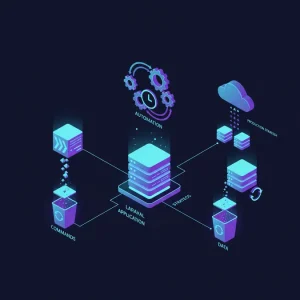
Imagine you are managing a massive, high-tech kitchen. You can either hire a pre-packaged, multi-purpose robotic chef designed to cook everything from soup to soufflé by following general instructions, or you can design a specialized, modular assembly line where every station is fine-tuned to handle specific ingredients with surgical precision. AutoGPT represents the former—a generalized, autonomous toolset designed to ‘solve’ problems by chaining LLM calls iteratively. A custom AI agent architecture represents the latter: a bespoke, deterministic framework engineered to interact with your specific data structures, business logic, and security constraints.
For startup founders and CTOs, the distinction between these two paths is not merely academic; it defines the reliability, scalability, and long-term maintainability of your product. While AutoGPT offers a rapid way to prototype autonomous goal-seeking behavior, it often introduces uncontrollable non-determinism into production environments. Conversely, building a custom architecture allows for granular control over tool execution, state management, and memory retrieval. This article dissects the architectural trade-offs, operational realities, and integration patterns required to decide which path aligns with your technical roadmap.
The Operational Mechanics of AutoGPT
AutoGPT operates on a recursive loop pattern. It receives a high-level goal, decomposes that goal into a series of sub-tasks, executes them via an LLM, evaluates the output, and iteratively refines its state to move closer to the target. At its core, it relies on a ‘think-act-observe’ loop. When the system performs an action—such as searching the web or writing a file—it logs the result back into its context window. The next iteration of the LLM receives the entire historical log, allowing the agent to ‘remember’ what it has previously attempted. This design is highly effective for exploratory research or unstructured tasks where the end goal is clear but the path is ambiguous.
However, from a software engineering perspective, AutoGPT introduces significant challenges regarding token consumption and context window management. Because the agent must ‘read’ its own history to function, the prompt size grows linearly with every step taken. In a production system, this leads to rapid degradation in performance and ballooning latency. Furthermore, the reliance on self-reflection—where the agent critiques its own work—is prone to circular logic loops. If the agent makes a mistake, it may attempt to ‘fix’ it by repeating the same faulty logic, leading to infinite loops that consume computational resources without yielding results. This is where handling AI agent failures in production becomes a critical engineering hurdle that vanilla AutoGPT frameworks often lack the depth to manage.
Designing Custom AI Agent Architectures
A custom architecture moves away from the ‘one-size-fits-all’ recursive loop toward a directed, graph-based execution flow. Instead of letting an LLM decide every step, you define the agent’s capabilities as a set of discrete, deterministic tools. This is often implemented using frameworks like LangChain or custom orchestrators built on top of the OpenAI API or Claude API. By defining a schema—typically via JSON-based function calling—you restrict the agent to a specific set of actions, such as ‘query_database’, ‘send_email’, or ‘generate_report’. This significantly reduces the hallucination surface area.
By implementing a finite state machine (FSM) or a directed acyclic graph (DAG) to govern the agent’s behavior, you remove the guesswork inherent in autonomous systems. Each node in your graph represents a specific task, and the transitions are governed by explicit logic rather than probabilistic interpretation. This structure ensures that your system remains predictable. When building this way, you must also consider the infrastructure layer, as complex workflows often benefit from choosing between serverless functions and container orchestration to ensure the agent’s execution environment is both scalable and isolated from your core application logic.
State Management and Memory Systems
In AutoGPT, memory is often handled by a simple file-based or vector-based buffer that the agent reads into its prompt. This is sufficient for short-lived tasks but fails in enterprise scenarios requiring long-term state persistence. A custom architecture allows for a tiered memory strategy. You can implement short-term memory via Redis for fast, session-specific context, and long-term memory via a vector database like Pinecone or Milvus. This allows your agents to perform Retrieval Augmented Generation (RAG) with high precision, ensuring that the model only accesses relevant, curated data rather than a noisy, bloated prompt history.
Furthermore, custom architectures allow for ‘human-in-the-loop’ checkpoints. In a production pipeline, you may require an agent to pause and await validation before executing a sensitive action, such as modifying a database record or deploying code. These manual gates are impossible to enforce in a standard AutoGPT setup without significant code modification. By decoupling the agent’s reasoning engine (the LLM) from its memory and execution layers, you create a robust system where components can be independently upgraded or tested.
Security and Risk Mitigation in Agent Systems
Security is the primary differentiator between experimental agents and production-grade software. AutoGPT, by design, is intended to have broad access to the file system and internet, which presents a massive security surface area. In a custom architecture, you implement the principle of least privilege at the tool level. Each tool provided to the LLM is wrapped in a dedicated service layer that enforces strict input validation and output sanitization. You are not just letting the agent ‘write a file’; you are providing a specific API endpoint that validates the content, checks user permissions, and logs the transaction for auditability.
When integrating these agents into larger systems, you must remain vigilant about prompt injection and data leakage. Analyzing vulnerabilities in AI-generated code is a standard practice in our design process, ensuring that the agent does not inadvertently execute malicious instructions hidden in the context window. Custom architectures allow you to implement middleware that inspects every request before it hits the LLM and every response before it triggers an action, effectively creating a firewall for your AI agents.
The Impact of Infrastructure on Agent Performance
The choice of infrastructure for your agent architecture directly impacts the latency and reliability of the user experience. While AutoGPT is often run locally or as a monolithic process, a custom architecture is best served by a microservices approach. By offloading resource-intensive tasks—such as vector search, image processing, or complex data transformation—to specialized services, you maintain the responsiveness of the main application. This modularity also allows for easier debugging. If an agent fails, you can isolate the failure to a specific service or tool rather than searching through a monolithic execution log.
We have observed that projects often struggle when they fail to account for the overhead of external API calls. Every call to an LLM adds latency; every retrieval from a vector database adds latency. A custom architecture forces you to optimize these interactions, perhaps by caching common responses or implementing asynchronous processing for non-critical tasks. This level of optimization is rarely found in off-the-shelf agent frameworks, which prioritize ease of use over system performance and efficiency.
Integration Patterns for Enterprise Workflows
Enterprise integration requires more than just calling an API; it requires mapping agent outputs to existing business processes. Whether you are connecting to an ERP system, a CRM, or a proprietary database, a custom architecture provides the necessary abstraction layer to transform raw LLM output into structured data that your legacy systems can understand. We use custom wrappers to enforce structural integrity, ensuring the agent returns a schema-compliant JSON object that can be immediately processed by downstream services.
If you choose to use an off-the-shelf framework without the necessary customization, you often find yourself fighting against the framework’s internal assumptions. This is a common pitfall; if you choose the wrong foundation, the cost of refactoring later can be catastrophic. Many teams have learned this the hard way, as seen in documented failures where the wrong technological foundation led to complete project abandonment. By building a custom interface layer, you ensure that your agents remain an asset to your business, not a maintenance burden.
Testing and Quality Assurance for Autonomous Systems
Testing an autonomous agent is fundamentally different from testing a traditional web application. You cannot rely on static unit tests alone because the output of the agent is probabilistic. Instead, you need a robust evaluation framework that benchmarks the agent’s performance against a set of ‘golden’ test cases. A custom architecture makes this possible by allowing you to swap out the underlying LLM (e.g., testing the agent with GPT-4o versus Claude 3.5 Sonnet) while keeping the tool definitions and business logic constant.
In our experience, the most effective testing strategy involves a combination of automated evaluation—using a secondary ‘judge’ LLM to score the agent’s performance—and human-in-the-loop review for high-stakes decisions. By building your architecture around these testing requirements, you create a system that can be continuously improved. AutoGPT, while fast to set up, provides no inherent framework for this kind of rigorous quality assurance, making it difficult to guarantee that the system will behave consistently in production.
Managing Latency and Token Costs
The economic and performance profile of an AI agent is largely dictated by how it uses its context window. AutoGPT’s tendency to dump entire histories into the prompt is an anti-pattern for cost-effective scaling. A custom architecture allows for intelligent context management. You can implement ‘sliding window’ approaches, where only the most relevant snippets of past interactions are passed to the agent, or ‘summarization’ patterns, where the agent periodically condenses its long-term memory into a concise state vector.
By controlling the prompt construction, you significantly reduce both the cost per request and the latency per turn. This is crucial for applications that require real-time interaction. Furthermore, a custom architecture allows you to dynamically choose the model based on the complexity of the task—using a smaller, faster model (like GPT-4o-mini) for simple routing, and reserving larger, more capable models for complex reasoning tasks. This tiered approach is the hallmark of a mature, production-ready AI integration strategy.
Scalability and Concurrency
Scaling an AI agent system involves more than just adding more servers; it involves managing the concurrency of agent sessions. If your application handles hundreds of simultaneous users, each with their own autonomous agent, you need a robust queuing system. A custom architecture allows you to decouple the agent’s ‘thinking’ from the user’s request, using message queues like RabbitMQ or AWS SQS to handle spikes in demand. This ensures that the system remains responsive even under heavy load.
Furthermore, you can implement ‘throttling’ and ‘rate limiting’ at the agent level, ensuring that no single user or autonomous process can exhaust your API quota or degrade the performance of the system for others. These are standard patterns in high-scale web development, yet they are often overlooked in the rush to deploy ‘autonomous’ agents. By leveraging standard architectural patterns, you ensure that your AI integration is as stable and reliable as any other part of your platform.
The Lifecycle of an AI Agent Project
The lifecycle of an AI project begins with exploration, moves to prototyping, and concludes with production hardening. AutoGPT is excellent for the exploration phase—it helps you understand what is possible and identifies the edge cases that your agent will encounter. However, as you move toward production, the focus must shift toward stability and control. This is the stage where a custom architecture becomes essential. You must replace the ‘black box’ logic of the agent with a ‘white box’ architecture that you can debug, monitor, and optimize.
The transition from prototype to production is where most projects fail. Without a clear plan for how to move from a flexible, autonomous agent to a constrained, reliable system, you will find yourself dealing with unpredictable behavior and rising operational costs. By planning for this transition from day one—by choosing a modular, extensible, and observable architecture—you ensure that your AI investment delivers long-term value to your business.
Technical Documentation and Developer Experience
A custom architecture is not just about the code; it is about the developer experience. By using well-defined interfaces and robust documentation, you ensure that your team can maintain and extend the agent system without fear of breaking core functionality. We emphasize the use of typed languages like TypeScript for our agent integrations, as this provides immediate feedback and reduces the likelihood of runtime errors. This rigor is essential when working with LLMs, where the input and output are inherently unstructured.
By treating your AI agents as first-class citizens in your codebase, you encourage best practices like version control for prompts, comprehensive logging for agent decisions, and automated deployment pipelines. This is the opposite of the ‘hacker’ approach often associated with AutoGPT, where the state is often lost or corrupted, and debugging involves manually re-running loops. A professional, engineering-first approach is what separates sustainable software from ephemeral experiments.
Building for the Future of AI Integration
As the field of AI advances, the capabilities of LLMs will continue to grow, but the fundamental requirements of software engineering—reliability, security, and scalability—will remain constant. Whether you are integrating AI into an existing platform or building a new product from the ground up, your choice of architecture will determine your ability to adapt to these changes. By choosing a custom, modular approach, you ensure that you can swap out components as better models or tools become available, without having to rebuild your entire system.
Explore our complete AI Integration — AI APIs & Tools directory for more guides.
Factors That Affect Development Cost
- Complexity of agent decision trees
- Number of integrated external APIs
- Volume of historical context processed
- Requirement for human-in-the-loop validation
- Infrastructure requirements for high-concurrency
Development effort varies significantly based on the depth of tool integration and the required level of deterministic control.
The debate between AutoGPT and a custom AI agent architecture is ultimately a question of control versus speed. While AutoGPT serves as a valuable tool for rapid exploration, it lacks the deterministic constraints and production-ready safeguards necessary for enterprise applications. A custom architecture, built on modular services and robust state management, provides the reliability and scalability that businesses require to turn AI potential into tangible results.
If you are ready to move beyond experimental prototyping and build a resilient, production-grade AI system, contact NR Studio to build your next project. We specialize in architecting custom AI integrations that prioritize reliability, security, and long-term maintainability.
Not Sure Which Direction to Take?
Book a 30-minute call with one of our engineers — we’ll help you decide without the sales pitch.