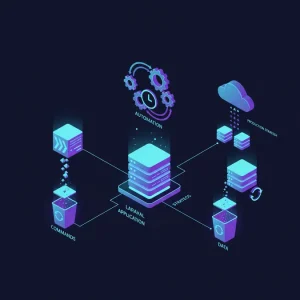
The Model Context Protocol (MCP) represents a fundamental shift in how developers connect Large Language Models (LLMs) to enterprise data sources and local tools. As software architecture evolves toward increasingly autonomous agentic systems, the industry has struggled with the ‘last mile’ problem: how to reliably expose heterogeneous data silos to AI models without building custom integration glue code for every new model provider. The maintainers of MCP are steering this protocol toward becoming the universal standard for AI-to-data connectivity, mirroring the impact that HTTP had on web service communication.
By establishing a standardized interface, MCP enables developers to decouple AI applications from specific data backends. This shift allows for the creation of reusable ‘servers’ that provide context, tools, and resources to any MCP-compliant client. For those focused on robust infrastructure, this means shifting from brittle, hard-coded API integrations toward a modular, protocol-driven architecture that facilitates horizontal scaling and simplifies complex system maintenance across distributed environments.
The Architectural Necessity for Standardized Context
In contemporary AI development, the primary bottleneck is rarely the model’s reasoning capability; it is the quality, timeliness, and format of the context provided during inference. Most RAG (Retrieval Augmented Generation) pipelines today rely on bespoke middleware that manually fetches data from SQL databases, vector stores, or internal APIs, processes that data, and injects it into the prompt. This approach creates significant technical debt. When you are busy building a comprehensive document processing AI pipeline, the complexity of managing unique data connectors for every LLM provider can stall development cycles.
MCP solves this by defining a clear, bidirectional communication layer. It acts as an abstraction over the data access layer, allowing the model to request resources or execute tools through a standardized set of JSON-RPC messages. From an infrastructure perspective, this promotes a ‘write once, run anywhere’ approach for data connectors. Whether you are using the Claude API, Gemini API, or an internally hosted model via an orchestration framework like LangChain, the connector logic remains identical. This modularity is essential for long-term maintainability, as it prevents the coupling of specific application logic to the internal APIs of third-party model providers. By implementing an MCP server, you effectively create an ‘AI-ready’ endpoint that can be queried by any compliant client without modification.
How MCP Operates Under the Hood
At its core, MCP is built on the JSON-RPC 2.0 specification, utilizing a client-host-server architecture. The ‘Host’ is typically an AI-powered application, such as an IDE or an agentic framework, which maintains the connection to the LLM. The ‘Server’ is the entity that exposes specific resources, prompts, and tools. When a user queries the host, the host inspects the available capabilities of the connected MCP servers. The communication is asynchronous and event-driven, allowing for real-time updates and low-latency interaction between the model and the data source.
The protocol defines three primary primitives: Resources, Prompts, and Tools. Resources are data-centric, providing read-only access to files, database rows, or memory snippets. Tools are executable functions that allow the model to interact with the environment, such as writing to a file or triggering a webhook. Prompts are predefined templates that streamline complex workflows. Because the protocol is transport-agnostic, it can operate over standard I/O (stdio) for local tools or via SSE (Server-Sent Events) for remote, distributed infrastructure. This flexibility is vital when deploying across cloud environments where network security and latency are primary concerns.
Infrastructure Considerations for Scalable Deployments
Deploying MCP servers in a production environment requires a departure from local development patterns. When you move beyond simple scripts, you must consider how to manage the lifecycle of these servers within your container orchestration platform, such as Kubernetes. Since MCP servers are essentially small, specialized microservices, they benefit from the same operational rigors as any other cloud-native component. You must ensure proper logging, observability, and health checking for each instance to prevent cascading failures in your AI-driven workflows.
Furthermore, managing these servers requires a robust approach to authentication and authorization. Because an MCP server can expose sensitive internal tools and data, you cannot rely on simple network-level security. You need to implement granular access controls that govern which LLM agents can invoke specific tools. This is a critical aspect when protecting your startup’s IP through infrastructure and code obfuscation, as exposing the wrong tool to an external agent could lead to data leakage or unintended system modifications. Using sidecar patterns in your deployments can help isolate the MCP server from your core application logic while providing a secure bridge to your backend services.
Integrating MCP with Existing RAG Architectures
Many organizations have already invested heavily in RAG architectures using vector databases and complex embedding pipelines. Integrating MCP into these setups does not mean replacing existing infrastructure; rather, it means augmenting it. You can wrap your existing vector search services as MCP resources, allowing your AI agents to query your internal knowledge base with the same ease as they might query a local file system. This allows for a unified interface across disparate data silos, whether they are stored in a distributed vector store or simple JSON files on S3.
The shift to MCP allows for a more dynamic retrieval process. Instead of static RAG where the context is fetched before the model starts reasoning, MCP allows for ‘agentic retrieval,’ where the model decides which tools or resources it needs in real-time. This reduces the need for massive, pre-computed context windows and allows for more efficient use of token limits. By offloading the retrieval logic to an MCP server, you can optimize your database schema and indexing strategies independently of the LLM client, leading to better performance and reduced operational overhead in high-traffic environments.
The Role of MCP in Agentic AI Longevity
One of the recurring challenges in the current AI landscape is the fragility of automated agents. As we explore why most agentic AI projects fail and how to build for longevity, it becomes clear that tight coupling between the agent’s logic and the environment is a primary culprit. MCP acts as a stabilizing force by providing a stable, versioned contract between the agent and its tools. When you upgrade your underlying model or swap out your backend data provider, the MCP interface remains constant, shielding the agent from upstream changes.
This stability is crucial for long-term projects that require continuous improvement. By standardizing the ‘language’ through which agents interact with the real world, MCP reduces the surface area for errors. It allows teams to build specialized agents that can be reused across different departments without needing to rewrite the integration logic. This modularity ensures that your AI investment is not tied to a single vendor or a specific model version, providing a hedge against the rapid pace of innovation in the AI space and reducing the risk of technical obsolescence.
Security and Data Governance in a Protocol-Driven World
Security is the most critical constraint when implementing any protocol that grants external AI models access to internal resources. MCP is designed with security in mind, but it requires careful implementation by the host application. The protocol supports various authentication mechanisms, and because it is based on JSON-RPC, you can implement fine-grained request validation at the server level. You should treat every request coming from an MCP client as untrusted input, applying strict schema validation to all tool arguments and resource queries.
Additionally, you need to consider the blast radius of any tool exposed via MCP. If an agent has the power to execute database queries or modify files, you must implement the principle of least privilege. This means creating scoped service accounts for your MCP servers that only have the permissions necessary to perform their specific tasks. Never run an MCP server with administrative or root-level privileges. By strictly defining the capabilities of each server, you can mitigate the risk of prompt injection or malicious agent behavior, ensuring that your AI integration remains secure even if the model itself is compromised.
Performance Benchmarks and Latency Optimization
Latency is an inherent concern in any networked protocol, and MCP is no exception. When an agent needs to retrieve data from an MCP server, the round-trip time of the JSON-RPC calls can impact the overall response time of the model. To optimize performance, you should aim to minimize the number of round trips between the host and the server. This can be achieved by batching tool calls or pre-fetching resources that are likely to be needed based on the current context.
For high-performance applications, consider the transport layer. While stdio is efficient for local communication, SSE over HTTP/2 is preferred for remote communication. HTTP/2 offers multiplexing capabilities that significantly reduce the overhead of multiple requests, allowing for a more responsive agent experience. Furthermore, caching strategies within the MCP server can help avoid redundant data fetches. By caching frequently accessed resources, you can drastically improve the perceived latency of your AI agents, leading to a smoother and more reliable user experience in your production systems.
Debugging and Observability in MCP Workflows
Debugging agentic workflows is notoriously difficult because the chain of reasoning is often opaque. MCP helps mitigate this by providing a standardized way to log and trace interactions between the client and the server. Because all communication happens via structured JSON-RPC messages, you can easily implement middleware that logs every request and response, including the tool arguments and the resulting output. This creates a clear audit trail that is invaluable for troubleshooting unexpected model behavior.
Advanced observability tools can be integrated into your MCP host to visualize the flow of data and the execution of tools in real-time. By monitoring the performance metrics of your MCP servers, you can identify bottlenecks, such as slow database queries or inefficient tool logic, and address them proactively. This level of transparency is essential for maintaining high availability in distributed AI systems. When something goes wrong, you want to be able to pinpoint whether the issue lies in the model’s reasoning, the tool’s execution, or the data source itself, and a well-instrumented MCP architecture makes this possible.
The Future Roadmap for Model Context Protocol
The maintainers of the Model Context Protocol are actively working to expand the specification to support more complex interactions and better cross-platform compatibility. Future iterations are expected to include better support for streaming large datasets, more advanced authentication flows, and enhanced capabilities for multi-agent coordination. As the protocol matures, we expect to see an ecosystem of standardized MCP servers emerge, similar to the library of plugins available for web servers like Nginx or Apache.
For architects and technical leaders, the key is to start experimenting with MCP now to understand its capabilities and limitations. By building your AI infrastructure around this protocol, you position your organization to take advantage of the growing ecosystem of tools and agents that are being designed with MCP compatibility in mind. This is not just a temporary trend; it is a fundamental shift toward a more modular and interoperable AI landscape that will define the next generation of enterprise software development.
Implementing MCP in Your Enterprise Stack
When transitioning to an MCP-based architecture, start by identifying the most frequently used data sources in your AI workflows. Instead of refactoring your entire backend, build a thin MCP wrapper around these sources. This allows you to test the protocol in a controlled manner without disrupting your existing operations. Once you have a working prototype, you can gradually expand the scope, migrating more tools and resources to the MCP standard as you gain confidence in the architecture.
It is also important to foster a culture of modularity within your engineering team. Encourage developers to think in terms of reusable tools and resources rather than monolithic integrations. By documenting your MCP servers and maintaining a registry of available capabilities, you can enable other teams to leverage your work, accelerating the development of new AI applications across your organization. This collaborative approach is what will ultimately lead to a more resilient and scalable AI infrastructure.
A Note on Ecosystem Compatibility
As you build with MCP, pay close attention to the compatibility between your chosen client (e.g., an LLM IDE or agent framework) and your server implementations. While the protocol defines the communication standard, different clients may have varying levels of support for specific features, such as streaming or complex resource discovery. Always test your servers against multiple clients to ensure broad compatibility and to avoid vendor lock-in. This diligence will pay off as the ecosystem continues to grow and diversify.
Explore our complete AI Integration — AI APIs & Tools directory for more guides. Explore our complete AI Integration — AI APIs & Tools directory for more guides.
Factors That Affect Development Cost
- Complexity of existing data silos
- Number of required agent tools
- Security and authentication requirements
- Integration with legacy RAG pipelines
Implementation effort varies based on the number of data sources and the depth of required agentic capabilities.
The Model Context Protocol is a transformative step forward for enterprise AI architecture, providing the necessary standardization to build scalable, secure, and maintainable agentic systems. By decoupling model logic from data access, MCP enables a more modular and interoperable approach that aligns with best practices in modern software engineering. While the protocol is still evolving, its potential to simplify the complex landscape of AI integration is immense, making it a critical area of focus for any architect building for the future.
Ready to architect your next AI-driven system with a focus on longevity and performance? Contact us to schedule a free 30-minute discovery call with our tech lead to discuss your specific infrastructure needs and how MCP can streamline your development process.
NR Studio builds custom web apps, mobile apps, SaaS platforms, and internal tools for growing businesses. If you’re working through a technical decision, feel free to reach out — no commitment required.