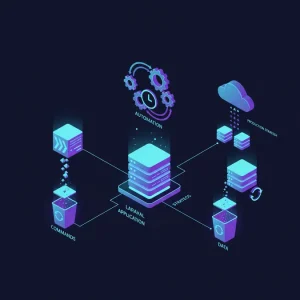
Abandoned cart recovery is not a silver bullet for declining conversion rates. It cannot magically fix underlying product-market fit issues, poor UI/UX, or systemic payment gateway failures. If your checkout flow is fundamentally broken or your backend architecture suffers from high latency, no amount of automated email or push notification logic will compensate for a hostile user experience. This guide treats recovery as a data-driven engineering challenge rather than a marketing task.
To build a performant recovery system, you must move beyond simple triggers. You need an event-driven architecture that tracks state changes with high fidelity, manages concurrency in your cart database, and handles communication delivery without overwhelming your primary services. When implementing this for Mobile App Development for E-commerce, the complexity multiplies due to push notification permissions and fragmented app states.
Architecting the State Machine for Cart Lifecycle
The foundation of any robust recovery system is the state machine governing your cart object. You cannot rely on a single ‘status’ column in your database. Instead, you must implement a granular state tracking mechanism that captures the nuances of user behavior. A standard cart lifecycle should include states like: active, pending_checkout, abandoned, recovered, and expired.
Using a Mobile App Backend Architecture Guide as a reference, you should decouple your cart service from the user session service. This allows for asynchronous processing of abandonment events. When a user adds an item and triggers a change in the cart_items table, your event bus—such as RabbitMQ or Apache Kafka—should capture this mutation. This is critical for Mobile App Development for Fintech Startups where transactional consistency is non-negotiable.
Consider the following schema for tracking state changes:
CREATE TABLE cart_state_history (id UUID PRIMARY KEY, cart_id UUID, from_state VARCHAR(50), to_state VARCHAR(50), timestamp TIMESTAMP DEFAULT CURRENT_TIMESTAMP, metadata JSONB);
By indexing the cart_id and timestamp, you enable efficient queries for your recovery workers. This architecture ensures that your application logic remains isolated from the persistence layer, which is a key principle in Mobile First Design Approach: A Technical Guide for Scalable Architecture.
Event-Driven Triggers and Concurrency Management
Triggering recovery flows requires careful handling of race conditions. A user might add an item to their cart, background the app, and re-open it on a desktop device within seconds. If your system triggers an abandonment notification immediately, you create a degraded user experience. You must implement a ‘debounce’ strategy at the service level.
When integrating these triggers, ensure your Mobile App Deep Linking Implementation Guide: A Technical Architecture Blueprint is fully utilized. The recovery link in your notification should deep-link directly into the checkout view, not the home screen. This reduces friction and increases conversion probability significantly.
To manage concurrency, utilize Redis-based locks when processing cart updates. This prevents multiple worker instances from triggering duplicate recovery emails for the same session. When scaling for high-traffic environments like those described in Strategic Guide to Social Media App Development: Engineering for Scale and Engagement, this level of synchronization is mandatory.
// Example of a debounced trigger logic in Node.js
async function handleAbandonment(cartId) {
const lock = await redis.set(`lock:${cartId}`, 'true', 'NX', 'EX', 300);
if (!lock) return;
// Proceed to trigger email/push notification
}
This pattern prevents the ‘thundering herd’ problem where thousands of concurrent events overwhelm your notification service.
Optimizing Database Queries for Abandoned Sessions
Querying for abandoned carts across millions of rows requires optimized indexing. If you perform a full table scan every time your cron job runs to identify abandoned sessions, you will hit I/O bottlenecks. Use a partitioned table strategy where partitions are based on the last_updated_at timestamp. This keeps your active index set small and performant.
For those building complex systems like Food Delivery App Development: A Comprehensive Technical Engineering Guide, real-time tracking is often required. Ensure your database indexes account for the user_id and status columns. A composite index is generally the most effective approach:
CREATE INDEX idx_cart_status_updated ON carts (status, last_updated_at DESC);
Furthermore, integrate Web Application Firewall (WAF) Architecture: A Technical Engineering Guide to protect these endpoints from scraping or automated cart-stuffing attacks that could spike your abandoned cart metrics artificially. Monitoring your database performance via metrics like slow query logs is essential to maintaining system health during peak promotional periods.
Handling Asynchronous Communication Delivery
Communication delivery should never be a blocking operation in your API request lifecycle. Use an asynchronous task queue like BullMQ or Celery to offload the responsibility of sending emails or push notifications. This prevents your main application thread from stalling if a third-party provider, such as SendGrid or Firebase Cloud Messaging (FCM), experiences latency.
When designing these systems, consider the retry logic. If a notification fails to deliver, your worker should implement an exponential backoff strategy. This is particularly important for Strategic Architecture for E-Learning App Development: Scaling Education Platforms where timely notifications are expected by users. You must also monitor delivery status through webhooks provided by your notification service.
Detailed logging is your best friend here. Always log the delivery attempt, the provider response, and any error codes returned by the notification gateway. Integrating this with Mobile App Crash Reporting Setup Guide: An Engineering Strategy allows you to correlate notification failures with application crashes or network issues effectively.
Infrastructure Considerations for High-Scale Deployments
If you are managing infrastructure, ensure that your services are deployed across multiple availability zones. When performing Mastering Azure App Service Deployment Slot Swaps: An Infrastructure Architect’s Guide, verify that your background workers are correctly drained so that no abandonment events are lost during the transition. This is crucial for maintaining state integrity during continuous deployment cycles.
Memory management is often overlooked in background tasks. When processing thousands of cart recovery events, ensure your workers do not leak memory. Use proper stream processing for large data exports to prevent heap exhaustion. In high-demand environments, like those discussed in Architecting Scalable Video Streaming App Development: A Cloud-Native Engineering Approach, you must scale your worker pool dynamically based on queue depth rather than CPU usage.
Consider the impact on your persistent storage layer. If your recovery system writes back to the main database frequently, you may need to implement a read-replica strategy to offload read-heavy reporting queries from the primary instance.
UI/UX Integration and Data Consistency
The user interface is the final link in the recovery chain. If the user clicks a notification and is met with an empty cart because the session data wasn’t synchronized, the recovery fails. You must ensure that the ‘Cart Sync’ operation is the first task executed upon app launch or deep-link redirect. Refer to UI UX Design for Mobile Apps: A Systems-Oriented Engineering Guide to understand the importance of optimistic UI updates during this synchronization process.
To maintain consistency, use a ‘source of truth’ pattern where the mobile app periodically pushes local cart state to the server if the user is offline, or fetches the server-side state if the app has been killed. This bidirectional sync logic is complex but necessary for a reliable user experience. Always handle edge cases like item stock depletion or price changes that might have occurred since the cart was abandoned.
Monitoring and Observability of Recovery Flows
Observability is not just about logging errors; it is about tracking the conversion funnel of your recovery system. You need to instrument your code to track metrics such as ‘notification_sent’, ‘notification_clicked’, and ‘checkout_completed’. These metrics should be stored in a time-series database like Prometheus or InfluxDB and visualized in Grafana.
If you observe a high volume of ‘sent’ but a low volume of ‘clicked’, investigate your notification content or timing. If you see high ‘clicked’ but low ‘checkout_completed’, look for issues in your checkout flow or payment integration. This data-first approach allows you to iterate on your recovery strategy based on empirical evidence rather than intuition.
Ensure your observability stack includes distributed tracing (e.g., OpenTelemetry) to visualize the path of a cart recovery request from the trigger event through the notification service and back into the checkout flow. This is the only way to debug intermittent failures in complex, microservices-based architectures.
Security and Data Privacy Considerations
Abandoned cart recovery involves handling PII (Personally Identifiable Information). You must ensure that your recovery system is compliant with GDPR, CCPA, and other relevant data protection regulations. Always encrypt data at rest and in transit. When sending links in emails or push notifications, use short-lived, signed tokens rather than raw URLs to prevent unauthorized access to user cart data.
Implement rate limiting on your notification endpoints to prevent abuse. If an attacker can trigger thousands of emails to random users, your domain reputation will suffer, leading to high bounce rates and potential blacklisting by email service providers. Always validate the authenticity of the request before processing any cart recovery event.
The Role of Machine Learning in Recovery
Advanced recovery systems move away from static timing (e.g., ‘send email after 1 hour’) toward predictive models. By analyzing historical data, you can predict the optimal time to send a notification to each individual user. For instance, if a user typically shops on Sunday evenings, sending a reminder then is more effective than an arbitrary one-hour delay.
Integrating a recommendation engine can also help. If a user abandoned a cart, suggest related items or items they have viewed previously to increase the total order value. While this adds significant complexity to your backend, the impact on conversion rates can be substantial. Start with a simple heuristic model and evolve it into a machine learning-based approach as your data volume grows.
Final Technical Checklist for Implementation
Before deploying your recovery system, verify the following checklist:
- Ensure all background workers are idempotent.
- Verify that your deep-linking implementation handles expired sessions correctly.
- Confirm that your database indexes are optimized for the recovery query patterns.
- Check that your notification service has sufficient rate limits and error handling.
- Confirm that your observability tools are capturing the necessary conversion metrics.
- Validate that all PII is handled in compliance with privacy regulations.
This checklist serves as a final quality gate to ensure your system is robust, secure, and performant. By adhering to these engineering standards, you can build a recovery system that delivers measurable impact without compromising the integrity of your core application.
Explore Our Resources
[Explore our complete Mobile App — Development Guide directory for more guides.](/topics/topics-mobile-app-development-guide/)
Factors That Affect Development Cost
- System complexity and microservices architecture
- Data volume and database scaling requirements
- Third-party notification service integration
- Engineering hours for custom state machine development
Implementation costs vary based on existing infrastructure and the level of custom personalization required for the recovery flows.
Frequently Asked Questions
How to recover abandoned carts?
You recover abandoned carts by implementing an event-driven system that monitors user sessions and triggers timely, personalized communication via push notifications or email. The key is to include direct deep links to the checkout flow to minimize user friction.
How many emails should be in an abandoned cart flow?
A standard, effective flow typically consists of three emails: an initial reminder within an hour, a second reminder after 24 hours including social proof, and a final offer or urgency-based nudge after 48 hours.
How to fix cart abandonment?
Fixing cart abandonment requires optimizing your checkout UI, reducing mandatory form fields, ensuring transparent shipping costs, and providing multiple, reliable payment options. Technical performance, such as reducing page load times, is also a critical factor.
What is a good cart abandonment rate?
While industry averages hover around 70%, a ‘good’ rate depends on your specific sector. However, aiming for anything below 60% is considered excellent and usually indicates a highly optimized checkout process.
Implementing an abandoned cart recovery system is a rigorous engineering exercise that demands a deep understanding of your data flow, system architecture, and user behavior. By focusing on reliable state management, asynchronous processing, and observability, you can convert lost opportunities into revenue while maintaining a performant and secure application.
If you are ready to build a scalable, high-performance recovery system for your e-commerce platform, our team at NR Studio is here to help. Contact us today for a free 30-minute discovery call with our tech lead to discuss your specific engineering requirements.
NR Studio builds custom web apps, mobile apps, SaaS platforms, and internal tools for growing businesses. If you’re working through a technical decision, feel free to reach out — no commitment required.