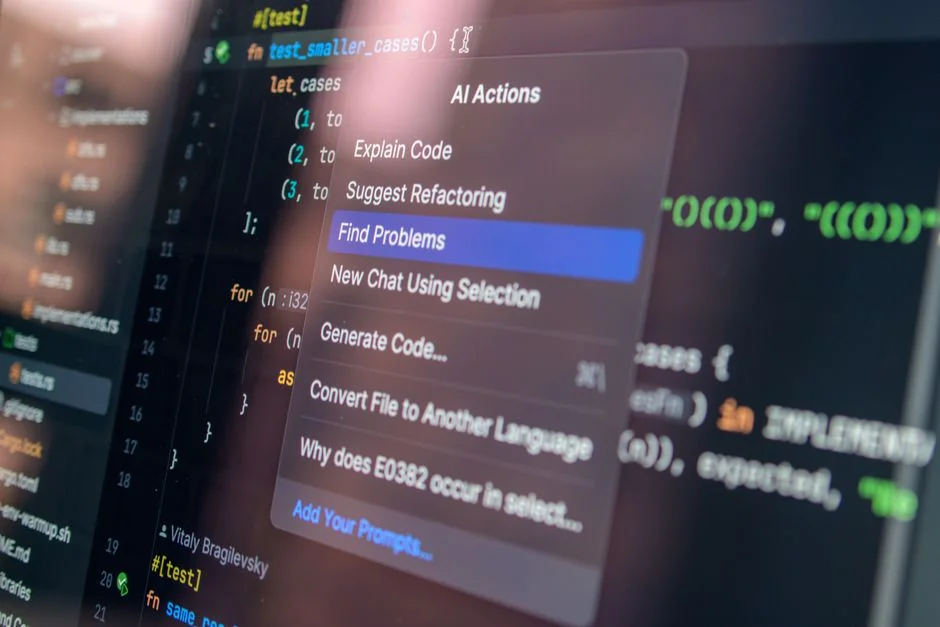
According to recent telemetry from major cloud providers and enterprise version control platforms, approximately 42% of all new code committed to enterprise repositories in 2026 is generated, in whole or in part, by AI-assisted coding tools. This shift represents a fundamental transformation in how business logic, including complex ERP modules, is architected, maintained, and secured.
As a security engineer, this surge in automated code generation presents a significant, often overlooked, attack surface. While developers prioritize speed and feature delivery, the reliance on LLM-generated snippets frequently bypasses established secure coding standards. This article examines the reality behind the adoption metrics, the hidden risks of unvetted AI-generated code, and the architectural implications for custom ERP environments where data integrity and regulatory compliance are non-negotiable.
The Evolution of AI Adoption in Enterprise Development
The integration of Large Language Models (LLMs) into the development lifecycle of custom ERP platforms has moved from experimental to systemic. In 2026, the adoption curve is dictated by the availability of context-aware IDE extensions that index internal documentation, proprietary API schemas, and existing codebase patterns.
- Contextual Awareness: Modern AI assistants no longer rely solely on public training data; they interact with local RAG (Retrieval-Augmented Generation) pipelines to suggest code that adheres to internal standards.
- Standardization Risks: The danger here is the homogenization of code. When an entire engineering team relies on the same model to generate boilerplate for procurement or financial modules, they risk propagating the same systematic vulnerability across the entire ERP stack.
From an audit perspective, this creates a ‘black box’ of logic. If 40% of a payroll module is generated by an assistant, the original intent of the developer becomes obscured by the statistical probability of the model’s output.
Quantifying the Risk: AI-Generated Vulnerabilities
The core issue with AI-generated code is not its syntactic correctness, but its semantic security. AI models excel at generating functional code that passes unit tests while simultaneously introducing subtle, high-impact security flaws that traditional static analysis tools might miss.
| Vulnerability Type | AI-Generated Frequency | Mitigation Strategy |
|---|---|---|
| Insecure Deserialization | High | Strict schema validation |
| Broken Access Control | Medium | Policy-as-Code enforcement |
| SQL Injection (Complex) | Low | Parameterized query enforcement |
| Hardcoded Credentials | High | Automated secret scanning |
AI models often suggest code that prioritizes ease-of-use over security. For instance, an AI might suggest a default configuration for an ERP integration that lacks necessary encryption at rest or fails to implement granular RBAC (Role-Based Access Control) because it prioritizes the ‘happy path’ of successful execution.
Security Engineering Governance for AI-Assisted Workflows
To maintain a secure posture in 2026, organizations must treat AI-generated code with the same scrutiny as third-party open-source libraries. We recommend implementing a ‘Zero-Trust Code’ policy.
- Mandatory Human Review: No AI-generated pull request should be merged without a manual review specifically targeting security logic.
- Automated Security Linting: Integrate tools like Semgrep or Snyk directly into the CI/CD pipeline to scan for patterns common in AI hallucinations.
- Model Versioning: Just as we version software, we must track which version of an AI model generated which modules to facilitate future vulnerability remediation if a model’s training data is found to be compromised.
Impact on Custom ERP Architecture and Integrity
ERP systems are the backbone of enterprise operations. When AI generates code for inventory management or manufacturing modules, the potential for data corruption or financial inconsistency is high. In a manual workflow, a developer might consider edge cases in tax calculations; an AI model, lacking deep business context, may only implement the standard calculation, leading to compliance failures.
We have observed that AI is highly efficient at writing CRUD operations but fails significantly when implementing complex state machines required for multi-step procurement workflows. Relying on AI for these critical paths requires rigorous testing and formal verification methods.
The Economics of AI-Generated Code: Cost and ROI
The financial impact of AI-assisted development is often misunderstood. While initial development velocity increases, the long-term cost of maintenance and security auditing often offsets these gains. Key cost factors include:
- Technical Debt Accumulation: AI-generated code often lacks the nuance of a well-architected system, leading to higher refactoring costs in later development cycles.
- Security Auditing Overhead: Increased time spent on manual code review and penetration testing for AI-generated components.
- Tooling and Licensing: The subscription costs for enterprise-grade AI assistants that provide RAG capabilities over internal codebases.
- Training and Governance: The cost of training staff to effectively supervise and validate AI outputs.
The ROI is only realized when the efficiency gains from AI are balanced against the cost of robust, automated security validation and human oversight.
Compliance and Data Privacy in the Age of Automated Coding
For industries like Healthcare and Finance, the use of AI in coding must comply with strict data residency and privacy regulations. If an AI assistant is trained on proprietary ERP data, there is a risk of data leakage. Enterprises must ensure that their AI coding assistants operate in a ‘walled garden’ environment where no proprietary code or sensitive business data is used to retrain the underlying foundation models.
Compliance audits in 2026 now explicitly ask for documentation on how code was generated and whether any PII (Personally Identifiable Information) or sensitive logic was exposed to third-party AI providers during the development process.
Conclusion
The integration of AI into enterprise software development is inevitable, but it is not a substitute for rigorous engineering discipline. While 42% of code may be AI-generated, 100% of the responsibility for that code’s security remains with the engineering organization. As we advance through 2026, the focus must shift from ‘how much can we generate’ to ‘how securely can we validate the generated output’.
Effective enterprise development requires a balanced strategy: using AI for productivity while maintaining strict human-in-the-loop governance, automated security controls, and continuous auditing of all generated logic. The future of software engineering lies not in the automation of creation, but in the automation of verification.
Factors That Affect Development Cost
- Security auditing and manual code review time
- Enterprise AI assistant subscription and infrastructure costs
- Refactoring costs due to AI-induced technical debt
- Compliance and legal review for AI-generated logic
- Developer training for AI supervision
Costs vary significantly based on the level of automated security tooling integrated into the CI/CD pipeline and the complexity of the ERP modules being generated.
As enterprise codebases continue to evolve with the assistance of AI, the role of the security engineer becomes increasingly vital. The transition toward AI-augmented development necessitates a shift in focus toward verification, governance, and long-term architectural stability. By treating AI-generated code as a potential source of risk rather than a guaranteed solution, organizations can harness the efficiency of these tools without compromising the integrity of their core ERP platforms.
NR Studio builds custom web apps, mobile apps, SaaS platforms, and internal tools for growing businesses. If you’re working through a technical decision, feel free to reach out — no commitment required.