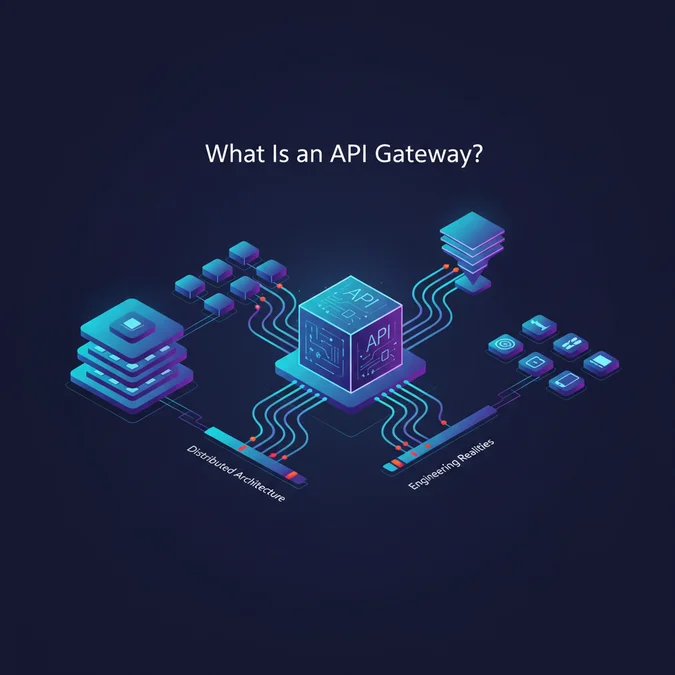

An API gateway is a specialized Layer 7 reverse proxy that acts as the single point of ingress for client applications, intercepting external network calls to route them to upstream services while enforcing cross-cutting concerns such as identity validation, traffic shaping, protocol translation, and observability. Rather than exposing internal service endpoints directly to the public internet, the gateway shields backends behind a unified, highly optimized control barrier.
In production microservice topologies, decentralized ingress breaks quickly. When mobile applications, web frontends, and external third-party integrations must independently discover, authenticate, and communicate with dozens of discrete backends, client complexity explodes. Frontends become tightly coupled to ephemeral network topologies, security surfaces widen across multiple service ports, and mobile devices suffer from high network chattiness over high-latency cellular networks.
Solving this architectural failure requires shifting network mediation and cross-cutting governance out of application codebases and into dedicated edge infrastructure. This guide breaks down the internal request life cycle of an API gateway, details the split between control planes and data planes, provides declarative deployment configurations, and evaluates the concrete latency, cost, and operational trade-offs between self-hosted software and managed cloud engines.
Understanding the Fundamentals: What Is an API Gateway and How Does It Work?
To understand what is api gateway infrastructure at a systems level, consider it an intelligent mediation layer positioned squarely at the perimeter of a private network. In microservice and distributed systems, individual services handle narrow domain logic: billing, user profile management, product cataloging, and inventory tracking. Without a gateway, clients must resolve separate DNS entries for every domain, authenticate against fragmented endpoints, and issue cascading network requests to construct a single screen view.
System Rule: An API gateway moves cross-cutting perimeter responsibilities (TLS termination, authentication, rate limiting, and request telemetry) away from heterogeneous backend codebases into a high-throughput proxy layer, converting public requests into secure, internal traffic flows.
So, how does an api gateway work during a production transaction? Rather than acting as a dumb socket forwarder, an API gateway runs incoming network packets through an extensible filter chain. What does api gateway do when a client issues an HTTP request? It executes a sequential pipeline:
- TLS Termination and Connection Ingestion: The gateway accepts the client TCP connection, completes the TLS 1.3 handshake, terminates encryption at the perimeter, and performs HTTP/2 or HTTP/3 stream multiplexing.
- Global Traffic Shaping: Before processing the payload, the gateway checks distributed state storage (such as a local Redis cluster) to confirm whether the incoming client IP or API token has exceeded its allocated token bucket rate limit.
- Authentication and Context Extraction: The gateway inspects the
Authorization: Bearerheader, cryptographically verifies the JSON Web Token (JWT) signature against a cached JSON Web Key Set (JWKS), asserts claims, extracts the subject identifier, and mutates the internal headers with clean user identity metadata. - Route Matching and Dynamic Resolution: The request URI path, HTTP verb, and client headers are evaluated against internal routing tables configured via control plane APIs. The target upstream service name is resolved using service discovery backends like Kubernetes CoreDNS or Consul.
- Request Transformation and Upstream Dispatch: The gateway alters the request, stripping public-facing cookies, injecting tracing headers (such as W3C
traceparent), switching protocols if necessary (e.g. HTTP/JSON to internal gRPC), and sending the packet across the internal VPC network via connection pools. - Response Interception and Telemetry: Upon receiving the upstream microservice response, the gateway captures latency metrics, writes access logs to an asynchronous buffer, strips internal error stack traces, compresses the response body with Brotli or Gzip, and returns the payload to the external caller.
Core Anatomy: The Distributed API Gateway Architecture Diagram
Modern api gateway architecture decouples the system into two distinct operational layers: the data plane and the control plane. This separation ensures that configuration changes, route updates, or centralized management outages never interrupt the fast path of packet routing.
+-----------------------------------------------------------------------------------+
| EXTERNAL CLIENTS |
| [ Mobile Apps ] [ Web SPAs ] [ Third-Party APIs ] |
+------------------------------------------+----------------------------------------+
 | HTTPS / WSS (Public Internet)
 v
+-----------------------------------------------------------------------------------+
| EDGE API GATEWAY CLUSTER |
| |
| +-----------------------------------------------------------------------------+ |
| | CONTROL PLANE (Envoy xDS / Kong Admin) | |
| | - Dynamic Route Definitions - Rate Limiting Rules Engine | |
| | - Service Discovery Watchers (K8s/Consul) - JWT Validation Policies | |
| +---------------------------------------+-------------------------------------+ |
| | In-Memory Cache Sync / gRPC xDS |
| +---------------------------------------v-------------------------------------+ |
| | DATA PLANE (Envoy / OpenResty / NGINX) | |
| | | |
| | [ TLS Termination ] -> [ IP / Token Rate Limit ] -> [ JWT Auth Filter ] | |
| | | | |
| | [ Metrics / Tracing Engine ] <- [ Protocol Translation (JSON -> gRPC) ] | |
| +---------------------------------------+-------------------------------------+ |
+------------------------------------------+----------------------------------------+
 | Internal VPC / mTLS
 +--------------------------+--------------------------+
 v v
+-------------------------------+ +-------------------------------+
| AUTH / USERS SERVICE | | ORDERS / CHECKOUT |
| +-------------------------+ | | +-------------------------+ |
| | Pod Instance 1 (gRPC) | | | | Pod Instance 1 (HTTP/2) | |
| +-------------------------+ | | +-------------------------+ |
| | Pod Instance 2 (gRPC) | | | | Pod Instance 2 (HTTP/2) | |
| +-------------------------+ | | +-------------------------+ |
+-------------------------------+ +-------------------------------+
As depicted in the api gateway architecture diagram, the data plane handles the execution path. Written in high-performance native runtimes like C++ (Envoy), C/Lua (Kong/OpenResty), or Go (Tyk, Traefik), the data plane runs non-blocking, event-driven loops that consume minimal memory per socket. In contrast, the control plane compiles declarative YAML or dynamic API requests into serialized configuration payloads pushed down to data plane workers via streaming gRPC APIs (such as Envoy’s Aggregated Discovery Service – ADS).
Architecture Note: Never allow the data plane to query the control plane synchronously during request processing. If the control plane or database fails, the data plane must continue serving cached routing tables and security rules without disruption.
Below is a production-ready declarative Envoy proxy configuration snippet demonstrating how an API gateway architecture defines an ingress listener with a dynamic JWT authentication filter and an upstream route cluster:
static_resources:
 listeners:
 - name: external_ingress_edge
 address:
 socket_address:
 address: 0.0.0.0
 port_value: 443
 filter_chains:
 - filters:
 - name: envoy.filters.network.http_connection_manager
 typed_config:
 "@type": type.googleapis.com/envoy.extensions.filters.network.http_connection_manager.v3.HttpConnectionManager
 stat_prefix: ingress_edge
 route_config:
 name: dynamic_api_routes
 virtual_hosts:
 - name: api_backend_services
 domains: ["api.production.internal", "api.company.com"]
 routes:
 - match:
 prefix: "/v1/orders"
 route:
 cluster: upstream_orders_service
 timeout: 3.500s
 retry_policy:
 retry_on: "5xx,connect-failure,reset"
 num_retries: 2
 http_filters:
 - name: envoy.filters.http.jwt_authn
 typed_config:
 "@type": type.googleapis.com/envoy.extensions.filters.http.jwt_authn.v3.JwtAuthentication
 providers:
 production_idp:
 issuer: https://auth.company.com/
 audiences: ["api.company.com"]
 remote_jwks:
 http_uri:
 uri: https://auth.company.com/.well-known/jwks.json
 cluster: upstream_idp_jwks
 timeout: 1.000s
 cache_duration: 300s
 rules:
 - match:
 prefix: "/v1/orders"
 requires:
 provider_name: production_idp
 - name: envoy.filters.http.router
 typed_config:
 "@type": type.googleapis.com/envoy.extensions.filters.http.router.v3.Router
 clusters:
 - name: upstream_orders_service
 connect_timeout: 0.250s
 type: STRICT_DNS
 lb_policy: ROUND_ROBIN
 load_assignment:
 cluster_name: upstream_orders_service
 endpoints:
 - lb_endpoints:
 - endpoint:
 address:
 socket_address:
 address: orders-service.backend.svc.cluster.local
 port_value: 8080
Why Modern Systems Depend on API Gateway Infrastructure in Microservices
When decomposing monoliths into a microservices architecture api gateway patterns become essential rather than optional. Teams often ask: what is the need of api gateway components if Kubernetes already provides basic Ingress controllers, or if microservices can expose HTTPS directly?
Exposing backends directly creates severe operational hazards. First, security sprawl: every development squad must independently implement authentication libraries, cryptographic key rotations, and OWASP top-ten threat protections. A single unpatched flaw in one service leaves the internal network open to exploitation. Second, protocol impedance: modern backends often communicate over high-performance binary protocols like gRPC, thrift, or raw TCP. Forcing client applications to natively support these protocols across web browsers and mobile platforms causes bloated client bundles and brittle network code.
Here is why teams encounter failure points when operating without an API gateway:
- Cascading Network Latency: A client interface rendering a user profile might require data from the User, Billing, Notification, and Permissions services. Direct querying requires 4 distinct public round-trips over high-latency cellular connections (4 x 150ms = 600ms). A gateway aggregates these calls into a single edge request, dispatching sub-requests within a low-latency VPC (4 x 2ms = 8ms).
- Contract Tight-Coupling: If internal teams reorganize services (such as splitting an Order service into an OrderSubmission and OrderHistory service), client applications break unless the edge gateway provides path rewriting and response aggregation to mask architectural shifts.
- Security Token Blast Radius: Forwarding long-lived user credentials or third-party OAuth access tokens deep into internal topologies increases data leakage risk. An API gateway validates public credentials at the border, swapping them for lightweight, short-lived internal identity claims (e.g. identity forwarding headers).
The table below summarizes the operational realities of choosing whether or not to adopt a dedicated gateway layer, highlighting why use an api gateway across critical engineering vectors:
| Architecture Vector | Direct Client-to-Microservice | API Gateway Pattern |
|---|---|---|
| Public Attack Surface | Broad: Dozens of public IPs, varying cipher suites, fragmented security patches. | Narrow: Centralized public ingress IP/domain, hardened TLS 1.3, unified WAF. |
| Cross-Cutting Concerns | Duplicated: Implemented repeatedly in Node.js, Go, Java, and Python codebases. | Centralized: Solved once in C++ or Go native proxies via filter chains. |
| Network Efficiency | Poor: Multiple round-trips over public cellular networks; high battery and data usage. | Optimized: Single aggregated client request; parallel internal VPC dispatch. |
| Protocol Flexibility | Restricted: Limited to HTTP/1.1 or basic HTTP/2 supported by standard browsers. | Flexible: Public HTTP/REST/WebSockets converted to internal gRPC or Kafka. |
| Observability Baseline | Fragmented: Inconsistent logging formats and variable trace ID propagations. | Unified: Standardized access logs, W3C trace generation, golden-signal metrics. |
Essential API Gateway Functions and Operational Mechanics
A high-performance gateway executes a suite of mission-critical api gateway functions within tight latency budgets (sub-5ms p99). These mechanics protect backend systems from resource starvation while maintaining high availability.
| Gateway Function | Mechanical Implementation | Production Trade-off |
|---|---|---|
| Token Bucket Rate Limiting | Maintains capacity tokens in shared Redis instances using atomic Lua scripts or local memory counters. | Redis round-trip adds 0.5 to 1.5ms overhead; local in-memory counters can permit slight traffic bursts across multi-pod gateways. |
| JWT Validation Offloading | Verifies signatures in the data plane using local JWKS public keys, asserting expiration, audience, and scopes. | Requires reliable cache synchronization for JWKS key rotation to avoid dropping valid requests. |
| Circuit Breaking | Tracks upstream error rates (5xx status or timeouts); temporarily trips to return an instant HTTP 503 fallback. | Aggressive triggers can cascade synthetic failures; requires precise configuration of consecutive error thresholds. |
| Request Transformation | Alters JSON paths, strips non-whitelisted query params, and adds internal routing headers. | Deep JSON payload mutation incurs CPU overhead and memory allocations, degrading throughput. |
| Dynamic Load Balancing | Distributes traffic via round-robin, least-request, or Maglev consistent hashing algorithms. | Consistent hashing guarantees cache affinity but can skew load if client request distribution is uneven. |
Rate limiting serves as the first line of defense against distributed denial-of-service (DDoS) attempts, runaway worker processes, and rogue automated scripts. Below is a production declarative configuration for Kong Gateway showing how to implement token bucket rate limiting alongside structured request transformation:
_format_version: "3.0"
services:
 - name: payments-processing-service
 url: http://payments-api.internal.svc:8080/v2/charge
 routes:
 - name: public-payments-route
 paths:
 - /api/v2/checkout
 strip_path: true
 methods:
 - POST
 plugins:
 - name: rate-limiting
 config:
 minute: 120
 policy: redis
 redis_host: redis-sentinel.storage.svc
 redis_port: 6379
 redis_timeout: 2000
 fault_tolerant: true
 hide_client_headers: false
 error_code: 429
 error_message: "Exceeded transaction rate limit. Please throttle your requests."
 - name: request-transformer
 config:
 add:
 headers:
 - "X-Ingress-Gateway: production-east-01"
 - "X-Forwarded-Proto: https"
 remove:
 headers:
 - "Cookie"
 - "X-Internal-Secret"
In this configuration, the gateway intercepts requests to /api/v2/checkout, checks the Redis cluster to ensure the client stays within 120 requests per minute, strips vulnerable client-side headers, appends infrastructure metadata, and dispatches the payload to the internal payments microservice.
Selecting Solutions: Open-Source API Gateway Software vs. Managed Cloud API Gateway Services
When selecting your infrastructure, the primary engineering fork lies between deploying open-source api gateway software directly on bare metal or Kubernetes versus consuming a managed cloud api gateway from a major hyperscaler. Each path introduces distinct architectural and financial implications.
Decision Principle: Managed cloud gateways minimize Day-1 operational maintenance but impose cold-start penalties and high invocation costs at scale. Self-hosted gateway software delivers sub-millisecond data plane routing and zero-cost scaling thresholds, but requires your engineering team to manage high availability, patching, and multi-region deployment.
The table below provides a concrete architectural comparison across key operational metrics:
| Evaluation Metric | Self-Hosted Software (Kong, Envoy, APISIX) | Cloud Managed Service (AWS API Gateway, Azure APIM) |
|---|---|---|
| P99 Latency Overhead | 0.5ms – 2.5ms (In-memory, native compiled code). | 15ms – 60ms (Shared edge routing, multi-tenant layers). |
| Cost Profile at Scale | Fixed/Compute: Pay for Kubernetes nodes/VMs. Extremely cost-effective for >10M reqs/day. | Variable/Metered: $1.00 to $3.50 per million requests, scaling linearly into high operational expenses. |
| Custom Extensibility | High: Write custom filters in WebAssembly (Wasm), Lua, or Go modules. | Low: Restricted to proprietary hooks, Lambda authorizers, or fixed policy sets. |
| Operational Overhead | High: Requires operating Kubernetes deployments, ingress controllers, HPA, and upgrades. | Zero: Fully serverless, automated scaling, zero host-level OS maintenance. |
| Ecosystem Lock-in | None: Declarative Kubernetes manifests run identically on AWS, GCP, or on-premises. | High: Deep integration with proprietary IAM, CloudWatch, and vendor services. |
For organizations operating standard microservices or streaming applications at scale, an open-source api gateway service engine such as Envoy or Kong running inside Kubernetes offers superior latency profiles and lower overall infrastructure costs. Conversely, for greenfield architectures running heavily on serverless functions (like AWS Lambda or Google Cloud Run), a managed cloud api gateway simplifies integration by binding HTTP endpoints directly to event handlers without persistent VM allocations.
Enterprise API Gateway Management: Security, Observability, and Resilient Implementation
Operating an enterprise api gateway fleet at scale requires strict safeguards against systemic failure modes. Because the gateway sits on the critical data path, misconfigurations, memory leaks, or unoptimized routing regexes can cause an infrastructure-wide outage. Effective api gateway management requires strict adherence to three operational rules.
First, never inject business logic into the gateway layer. It is tempting to write quick custom Lua scripts or Wasm filters that parse business payloads, execute customer lookups, or coordinate state transitions directly inside the gateway. This anti-pattern degrades gateway performance, complicates local developer testing, and turns your network ingress into an unmaintainable distributed monolith. Keep the gateway strictly focused on Layer 7 transport concerns.
Second, implement distributed tracing context propagation at the edge. The gateway must act as the initial distributed tracing span generator, creating standard W3C traceparent headers for untracked incoming requests and propagating them downstream to internal RPC calls.
Here is an operational checklist for production gateway readiness:
- Connection Pool Isolation: Maintain separate, isolated upstream HTTP connection pools per service to prevent a failing backend from exhausting gateway worker threads.
- Strict Upstream Timeouts: Enforce strict connection and read timeouts on all routes (e.g. connect: 250ms, read: 2000ms). Never inherit system-default infinite timeouts.
- Safe Regex Compilations: Avoid complex non-deterministic finite automaton (NFA) regular expressions in routing paths that invite ReDoS (Regular Expression Denial of Service) attacks.
- mTLS Perimeter-to-Backend: Terminate public TLS at the gateway, but maintain internal mutual TLS (mTLS) to upstream microservices using SPIFFE/SPIRE or service mesh sidecars for Zero-Trust environments.
Below is an enterprise NGINX reverse-proxy routing configuration demonstrating proper tracing header propagation, upstream connection pooling, and circuit-safe timeouts:
http {
 upstream backend_inventory_cluster {
 server inventory-pod-01.internal:8080 max_fails=3 fail_timeout=10s;
 server inventory-pod-02.internal:8080 max_fails=3 fail_timeout=10s;
 keepalive 64;
 }

 server {
 listen 443 ssl http2;
 server_name api.enterprise.internal;

 ssl_certificate /etc/ssl/certs/gateway.crt;
 ssl_certificate_key /etc/ssl/private/gateway.key;
 ssl_protocols TLSv1.2 TLSv1.3;

 # Edge tracing generation
 set $trace_id $http_traceparent;
 if ($trace_id = "") {
 set $trace_id "00-${request_id}000000000000-0000000000000001-01";
 }

 location /api/v1/inventory/ {
 proxy_pass http://backend_inventory_cluster/;
 proxy_http_version 1.1;

 # Upstream connection reuse
 proxy_set_header Connection "";
 proxy_set_header Host $host;
 proxy_set_header X-Real-IP $remote_addr;
 proxy_set_header X-Forwarded-For $proxy_add_x_forwarded_for;
 proxy_set_header traceparent $trace_id;

 # Fail-fast timeout defense
 proxy_connect_timeout 250ms;
 proxy_send_timeout 1500ms;
 proxy_read_timeout 2000ms;

 # Circuit buffer protection
 proxy_next_upstream error timeout http_502 http_503 http_504;
 proxy_next_upstream_tries 2;
 }
 }
}
Frequently Asked Questions
What is an API gateway in simple terms?
An API gateway is a reverse proxy server that sits between external client applications and internal backend services. It accepts incoming API calls, aggregates necessary data, enforces security policies like authentication and rate limiting, and routes requests to the correct microservice destination.
How does an API gateway differ from a standard load balancer?
A standard load balancer distributes traffic across identical instances at Layer 4 or Layer 7 without inspecting payload semantics. An API gateway operates at Layer 7 with advanced application logic, managing authentication, request modification, API versioning, telemetry, and protocol translation between clients and heterogeneous backends.
Why should teams use an API gateway in microservices architectures?
Teams use an API gateway to prevent client applications from directly coupling with dozens of individual internal microservices. The gateway centralizes cross-cutting concerns like TLS termination, authentication, token bucket rate limiting, and observability, preventing redundant code across autonomous service teams.
What are the common latency overheads introduced by an enterprise API gateway?
A well-optimized enterprise API gateway typically adds between 1 to 5 milliseconds of p95 latency. This overhead stems from TLS decryption, JSON schema validation, distributed cache lookups, external JWT token verification, and connection pool establishment to upstream microservices.
The API gateway pattern solves the organizational and operational friction of exposing distributed microservices to external clients. By centralizing security, dynamic routing, protocol translation, and distributed telemetry at the network perimeter, gateways free backend service teams to iterate rapidly without reinventing defensive edge logic in every repository.
However, an API gateway is a double-edged sword. Deployed without clear architectural boundaries, it can turn into a single point of failure or an unmanageable dumping ground for tangled business logic. Design your ingress pipelines around high-performance data planes, enforce configurations declaratively through version-controlled GitOps workflows, and maintain strict separation between transport-level orchestration and domain-level processing.