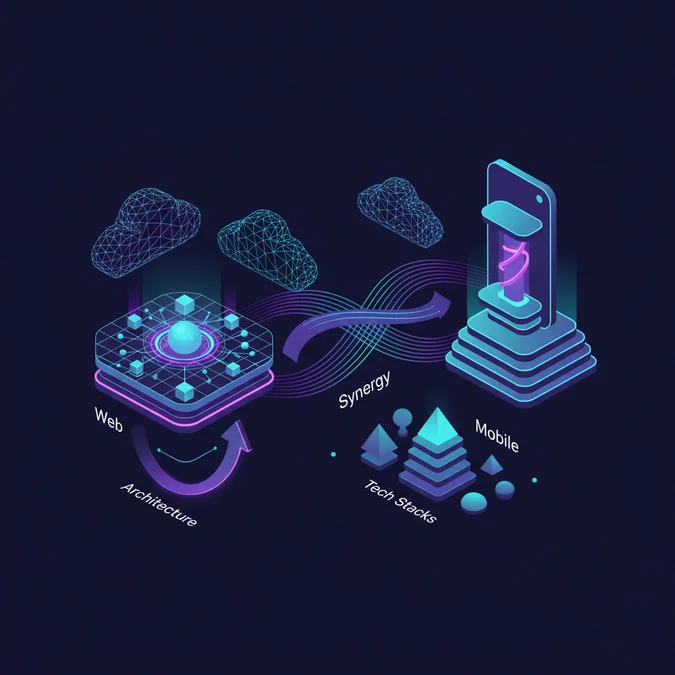

Web and mobile application development is the concurrent design, coding, and deployment of software optimized for web browsers and mobile platforms (iOS, Android). This unified approach leverages shared codebases and consistent user experiences, maximizing reach and operational efficiency across diverse digital touchpoints.
In today’s interconnected digital ecosystem, businesses must provide seamless user experiences across all devices. Fragmented development efforts for web and mobile applications lead to increased costs, inconsistent branding, and delayed market entry. This guide explores the strategic imperatives, technical architectures, and practical frameworks for achieving unified web and mobile application development, providing a practitioner-level roadmap for integrated software solutions.
Understanding Unified Web and Mobile Application Development
Unified web and mobile application development represents a strategic shift from siloed development tracks to an integrated, holistic approach. Instead of treating web and mobile platforms as distinct targets requiring entirely separate codebases and teams, this methodology emphasizes shared resources, design principles, and backend infrastructure. The goal is to build robust, scalable applications that deliver consistent functionality and user experience, regardless of whether the user accesses them via a web browser or a dedicated mobile application.
This approach fundamentally redefines how organizations conceptualize and execute their digital presence. It moves beyond merely making a website ‘mobile-friendly’ or creating a companion mobile app after web launch. Instead, the entire product lifecycle, from ideation to deployment and maintenance, considers both web and mobile channels in tandem. This ensures that core business logic, data models, and API endpoints serve both environments efficiently, minimizing redundancy and maximizing development velocity.
Key Takeaway: Unified web and mobile application development prioritizes a cohesive digital presence, leveraging shared assets and strategic technical choices to deliver consistent user experiences across browsers and native mobile platforms. It is a critical paradigm for modern digital product delivery.
The distinction between traditional web and mobile development is blurring, with technologies like Progressive Web Apps (PWAs) further bridging the gap. Effective web and mobile development today demands a clear strategy for how these platforms interact, share data, and present a unified brand identity.
The Strategic Imperative: Why Integrate Web and Mobile Development?
Integrating web and mobile development is no longer optional; it is a strategic imperative for businesses aiming for market leadership and operational efficiency. The benefits extend beyond mere technical convenience, impacting user acquisition, retention, and overall business agility. Developing both web and mobile applications in tandem addresses several critical challenges faced by organizations operating in a multi-device world.
Consider the following strategic advantages:
- Consistent User Experience: A unified approach ensures users encounter a familiar interface, brand identity, and interaction patterns across all touchpoints, fostering trust and reducing cognitive load.
- Reduced Development Costs: By leveraging shared codebases, APIs, and design systems, organizations can significantly reduce the resources required for separate web and mobile development efforts. Code reuse minimizes duplication of work.
- Faster Time-to-Market: A unified strategy streamlines the development pipeline. Features developed for one platform can often be quickly adapted or reused for the other, accelerating deployment cycles.
- Simplified Maintenance and Updates: Managing a single, coherent codebase or a highly integrated set of codebases simplifies debugging, security patching, and feature updates. This reduces technical debt and improves long-term maintainability.
- Broader Market Reach: Simultaneously targeting web browsers and native mobile platforms ensures maximum accessibility, capturing users regardless of their preferred device or access method.
- Optimized Resource Allocation: Development teams can collaborate more effectively, share knowledge, and specialize in cross-platform tools, leading to more efficient utilization of human capital for web and mobile development.
- Enhanced Brand Cohesion: A consistent digital presence reinforces brand messaging and identity across all user interactions, building stronger customer relationships.
These benefits collectively underscore why a proactive, integrated strategy for web and mobile development yields a significant competitive advantage. It moves businesses away from reactive, platform-specific fixes towards a holistic, forward-looking digital product strategy.
Architectural Blueprints & Tech Stacks for Unified Solutions
Achieving unified web and mobile application development requires a carefully considered architectural blueprint and a strategic choice of technology stacks. The core principle involves designing a robust backend that can serve both web and mobile clients efficiently, coupled with frontend technologies that facilitate code reuse or rapid adaptation. Modern architectures often lean towards API-first and microservices approaches.
Backend Architectures
- API-First Design: This ensures that all functionality is exposed via well-documented APIs (REST, GraphQL) consumed by both web and mobile frontends. This decoupling allows independent development and scaling of frontend and backend components.
- Microservices: Breaking down the backend into smaller, independent services allows for greater flexibility, scalability, and independent deployment. Each service can be developed using the most appropriate technology, provided it adheres to API contracts.
- Serverless Computing: For certain functionalities, serverless platforms (AWS Lambda, Azure Functions, Google Cloud Functions) can provide cost-effective, scalable backend services without managing infrastructure.
Unified Frontend Tech Stacks
The choice of frontend technologies is critical for enabling code reuse and maintaining consistency. Here’s a comparison of prominent approaches for web and mobile application development:
| Approach | Description | Pros | Cons | Primary Use Case |
|---|---|---|---|---|
| Cross-Platform Frameworks | Single codebase for iOS/Android native apps (e.g., React Native, Flutter). | Significant code reuse, native performance, faster development. | Platform-specific nuances, larger app size, dependency on framework. | Applications requiring native features with cost efficiency. |
| Progressive Web Apps (PWAs) | Web applications with app-like features (offline, push notifications, home screen icon). | Single codebase (web), no app store required, wide reach, low friction. | Limited access to native device features, performance can vary. | Content-heavy sites, e-commerce, internal tools. |
| Hybrid Apps | Web views wrapped in a native container (e.g., Ionic, Cordova). | Web tech stack (HTML, CSS, JS), faster initial development. | Performance limitations, less native feel, dependency on plugins. | Simple apps, rapid prototyping, limited budget. |
| Shared UI/Logic Libraries | Developing separate native apps but sharing business logic or UI components. | Optimal native performance, platform-specific UX. | Higher development cost, less code reuse than cross-platform. | High-performance apps where native UX is paramount. |
A common pattern involves a Node.js or Python backend serving a GraphQL API, with a React or Vue.js frontend for the web and React Native or Flutter for mobile. This allows maximum code sharing for business logic, while adapting UI for each platform.
For example, a shared API endpoint might look like this:
// Example GraphQL Query for User Data
query GetUserProfile($userId: ID!) {
  user(id: $userId) {
    id
    name
    email
    preferences {
      theme
      notifications
    }
  }
}
This single query can fetch user data for both a web dashboard and a mobile profile screen, ensuring data consistency and reducing backend complexity for web and mobile application development.
Cross-Platform & PWA: Accelerating Web and Mobile Development
Cross-platform frameworks and Progressive Web Apps (PWAs) are pivotal in accelerating web and mobile development by streamlining processes and maximizing code reuse. They represent modern, efficient approaches to delivering unified digital experiences, directly addressing the challenge of maintaining separate codebases for different platforms.
Cross-Platform Frameworks: React Native and Flutter
Frameworks like React Native (using JavaScript/TypeScript) and Flutter (using Dart) allow developers to write a single codebase that compiles into native iOS and Android applications. This significantly reduces development time and cost compared to building separate native apps.
| Feature | React Native | Flutter |
|---|---|---|
| Language | JavaScript/TypeScript | Dart |
| UI Rendering | Native UI components via JavaScript bridge | Own rendering engine (Skia) for custom widgets |
| Performance | Near-native, can be optimized | Near-native to native, often praised for smooth animations |
| Ecosystem | Mature, large community, many libraries | Growing rapidly, Google-backed, strong tooling |
| Learning Curve | Moderate for web developers (React knowledge helps) | Moderate, Dart is easy to learn for many developers |
Both frameworks are excellent choices for projects prioritizing speed, cost-effectiveness, and a largely native user experience without the overhead of maintaining two distinct native codebases. They are central to modern web and mobile development strategies.
Progressive Web Apps (PWAs)
PWAs are web applications that leverage modern browser capabilities to provide an app-like user experience. They are discoverable via URLs, work offline, can be installed to the home screen, and receive push notifications, blurring the lines between web and native mobile applications.
PWA Advantages for Unified Development:
- Single Codebase: A PWA is essentially a website, so the same codebase serves both web and ‘installed’ mobile experiences.
- No App Store: Bypasses app store approval processes and fees, offering direct distribution.
- Instant Updates: Updates are deployed instantly, just like a website, without requiring user action.
- Offline Capabilities: Service Workers enable caching and offline functionality.
- Cost-Effective: Lower development and maintenance costs compared to native apps.
While PWAs offer tremendous benefits in terms of reach and development efficiency, they do have limitations regarding deep device hardware access compared to fully native applications. However, for many business applications, content platforms, and e-commerce sites, PWAs offer an ideal balance, accelerating web and mobile development significantly.
Designing for Consistency: UX/UI Best Practices Across Web and Mobile
A unified web and mobile application development strategy is incomplete without a strong focus on consistent User Experience (UX) and User Interface (UI) design. Inconsistency across platforms can confuse users, erode trust, and diminish brand perception. The goal is to provide a cohesive and intuitive experience, adapting to platform specifics while maintaining a core identity.
Here are key UX/UI best practices for ensuring consistency across web and mobile:
- Establish a Unified Design System: Create a comprehensive design system that defines components, typography, color palettes, iconography, and interaction patterns. This system serves as the single source of truth for all design elements, ensuring consistent application across web and mobile.
- Prioritize Mobile-First Design: Start the design process with the mobile experience. Designing for constraints (smaller screens, touch input) often leads to simpler, more focused interfaces that can then be progressively enhanced for larger web screens.
- Responsive and Adaptive Design: For the web, implement responsive design principles to ensure layouts fluidly adjust to various screen sizes. For mobile, understand the differences between iOS Human Interface Guidelines and Android Material Design, adapting the UI to feel native while adhering to your brand’s core design system.
- Consistent Information Architecture: Ensure that the navigation structure, content organization, and terminology are consistent across both web and mobile applications. Users should instinctively know where to find information or perform actions regardless of the platform.
- Shared Interaction Patterns: While touch gestures differ from mouse clicks, strive for consistent interaction outcomes. For example, a ‘save’ action should behave predictably whether triggered by a button on a web form or a floating action button on a mobile app.
- Branding and Visual Identity: Maintain a consistent brand voice, visual style, and emotional tone. Use the same logos, brand colors, and imagery to reinforce brand recognition and trust across all touchpoints.
- User Journey Mapping: Map out critical user journeys across both platforms. Identify potential friction points and ensure a smooth, logical flow from web to mobile and vice-versa, especially for cross-device activities.
By diligently applying these principles, teams engaged in web and mobile application development can deliver a harmonious digital product suite that delights users and strengthens brand loyalty.
Real-World Success: Case Studies in Unified Web and Mobile Solutions
Examining real-world examples provides tangible evidence of the benefits derived from a unified web and mobile development strategy. These case studies highlight how organizations have successfully leveraged integrated approaches to achieve significant business outcomes, demonstrating the power of cohesive web and mobile development.
Case Study 1: E-commerce Platform with PWA & Native App Strategy
A mid-sized retail company faced challenges with high bounce rates on its mobile website and low conversion rates due to app download friction. They decided to implement a unified strategy:
- Solution: Developed a Progressive Web App (PWA) for their primary e-commerce site, offering offline browsing, push notifications for sales, and ‘add to home screen’ functionality. Simultaneously, they maintained a lightweight native app for premium features like augmented reality product previews and advanced loyalty programs.
- Outcome: The PWA significantly reduced mobile bounce rates by 35% and increased mobile conversions by 20% due to instant access and improved performance. The native app, targeting loyal customers, saw a 15% increase in engagement for its unique features. Their web and mobile development efforts were synchronized, sharing a common API gateway and product catalog service.
Case Study 2: Enterprise Productivity Suite with React Native and Web Portal
A B2B SaaS company needed to provide its project management and collaboration tools across desktop browsers and mobile devices for field teams. Maintaining separate codebases for their web portal and native iOS/Android apps was resource-intensive.
- Solution: They rebuilt their mobile applications using React Native, sharing much of the business logic and some UI components with their existing React-based web portal. A GraphQL API served as the unified data layer for both platforms.
- Outcome: Development time for new features was reduced by 40%. Consistency in UI/UX across web and mobile platforms improved user adoption by 25% among field teams. Maintenance overhead decreased, allowing developers to focus on innovation rather than platform-specific bug fixes. This integrated web and mobile development approach proved highly efficient.
Key Learning: Successful unified web and mobile development isn’t about forcing one technology onto all platforms, but strategically choosing the right blend (e.g., PWA for broad reach, native for specific features, cross-platform for efficiency) and ensuring a consistent backend and design language. Measurable outcomes often include improved user engagement, reduced costs, and faster time-to-market.
These examples illustrate that a well-executed unified strategy in web and mobile development can lead to tangible improvements in business performance and user satisfaction.
Frequently Asked Questions
What is the core difference between web and mobile application development?
Web application development creates software accessible via web browsers, while mobile application development builds native or cross-platform apps for smartphones and tablets. The key difference lies in platform-specific optimization, distribution channels, and access to device hardware features.
Why should businesses prioritize unified web and mobile development strategies?
Prioritizing unified strategies ensures a consistent user experience across all touchpoints, reduces development costs and time through code reuse, and broadens market reach. It streamlines maintenance, improves brand cohesion, and allows for more efficient resource allocation.
What are the best technologies for combined web and mobile application development?
For combined development, popular technologies include cross-platform frameworks like React Native and Flutter, which allow a single codebase for iOS and Android apps. Progressive Web Apps (PWAs) offer web-based solutions with app-like functionalities, bridging the gap between web and mobile experiences.
How do you ensure consistent UX/UI across web and mobile applications?
Ensuring consistent UX/UI involves establishing a unified design system, using responsive design principles for web, and adapting mobile-first approaches. Focus on shared branding, intuitive navigation patterns, and consistent interaction elements to create a seamless user journey across both platforms.
The landscape of web and mobile application development continues to evolve, demanding a unified, strategic approach from modern organizations. By embracing shared architectures, leveraging cross-platform frameworks and PWAs, and prioritizing consistent UX/UI, businesses can deliver cohesive digital experiences that meet user expectations and drive operational efficiency. This integrated methodology not only reduces development costs and accelerates time-to-market but also builds stronger brand loyalty and expands market reach.
Adopting a unified web and mobile development strategy is an investment in future-proofing your digital presence. It ensures your applications are scalable, maintainable, and capable of adapting to the ever-changing demands of a multi-device world. Prioritize integration, consistency, and strategic technology choices to unlock the full potential of your digital products.
NR Studio builds custom web apps, mobile apps, SaaS platforms, and internal tools for growing businesses. If you’re working through a technical decision, feel free to reach out — no commitment required.
References & Further Reading