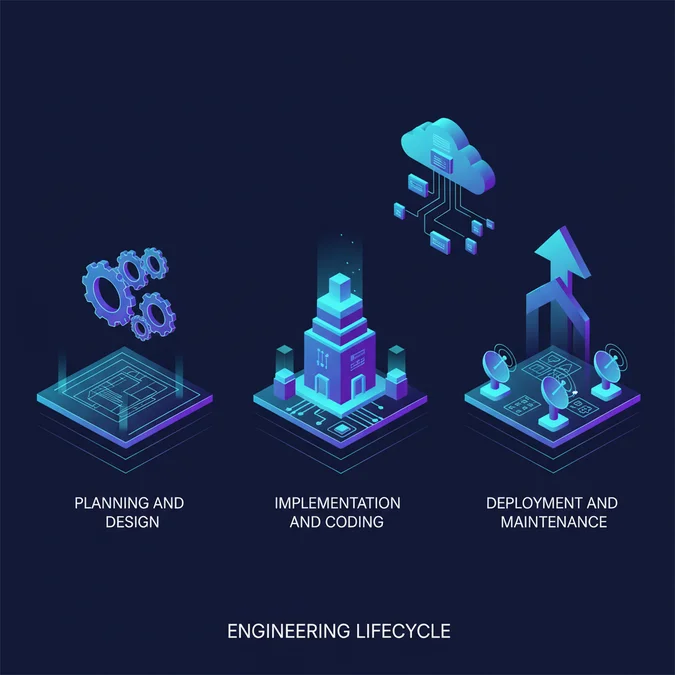

The stages of software development encompass requirements analysis, architectural system design, implementation, verification and testing, automated deployment, and production maintenance. These operational phases transform high-level domain constraints into deterministic, maintainable, and fault-tolerant software systems running across production infrastructure.
Engineering teams frequently suffer from severe structural breakdowns, uncontrolled architectural drift, runaway memory consumption, and cascading database bottlenecks. These failures rarely originate from syntax flaws. Instead, they stem from treating development stages as informal ceremonies rather than rigorous technical boundaries governed by automated contracts, schema migrations, and invariant enforcement.
Applying an engineering-first lens to each development phase resolves these failure modes. By standardizing transition gates, isolating business domains, enforcing strict continuous integration assertions, and profiling runtime resources early, engineering teams can eliminate systemic regression and build high-throughput systems that sustain real production loads.
Requirements Analysis and Technical Feasibility Modeling
Software systems fail when technical feasibility is evaluated after scope definition rather than during the initial requirements analysis. Requirements engineering requires translating product expectations into verifiable constraints: throughput targets (requests per second), input/output boundaries, state transitions, latency percentiles (p95 and p99), and data consistency guarantees under partition events.
Defining Non-Functional Invariants
Engineers must dissect business narratives to extract architectural non-negotiables. A requirement stating user registration must be fast translates technically into a hard constraint: HTTP p99 response times must remain below 120 milliseconds while executing zero blocking network round-trips off the critical path. Identifying these invariants prevents teams from introducing blocking third-party dependencies into synchronous request lifecycles.
- Throughput ceilings: Peak write load vs peak read load ratios.
- Data freshness tolerances: Absolute synchronous consistency (ACID) versus eventual consistency via transactional outbox patterns.
- Retention and scale vectors: Ingestion rates in gigabytes per month and partitioning strategies.
Analyzing requirements through foundational principles of scalable system design ensures non-functional requirements receive identical rigor to functional workflows.
System Architecture and Database Domain Modeling
The system architecture stage translates domain invariants into concrete structural boundaries. This phase defines component responsibilities, networking topology, persistence strategies, and state boundaries. Poor structural choices during this phase induce high coupling, making future refactoring mathematically expensive.
Database Normalization and Index Strategy
A relational schema must balance normalization (preventing update anomalies) with query access paths. Primary entity structures should prevent unbound joins across high-cardinality tables. Database models must define compound indexes that match precise query filters, sort orders, and partition keys from day one.
-- Example: Optimizing high-volume ledger queries
CREATE TABLE transaction_records (
 id BIGINT UNSIGNED AUTO_INCREMENT PRIMARY KEY,
 account_id BIGINT UNSIGNED NOT NULL,
 amount_cents BIGINT NOT NULL,
 currency_code VARCHAR(3) NOT NULL,
 status ENUM('pending', 'cleared', 'failed') NOT NULL,
 created_at TIMESTAMP NOT NULL DEFAULT CURRENT_TIMESTAMP,
 INDEX idx_account_status_created (account_id, status, created_at)
) ENGINE=InnoDB ROW_FORMAT=DYNAMIC;
The composite index above covers the exact lookup pattern for customer account balances, avoiding expensive filesorts and table scans during peak traffic.
Interface Contracts and Schema-Driven API Design
Decoupling interface definitions from backend implementation prevents integration deadlocks between distributed teams. Modern architecture mandates schema-first design using protocols like OpenAPI 3.1 or Protocol Buffers before writing consumer endpoints.
Schema-First Development Workflow
Drafting strict machine-readable specifications allows client developers, QA automation suites, and backend developers to execute their tasks concurrently against validated mocks. This eliminates the common anti-pattern where frontend teams stall while waiting for backend endpoints to land in staging environments.
- Specification authoring: Defining path parameters, request payloads, and typed response envelopes using JSON Schema.
- Contract testing: Validating that incoming API pull requests strictly adhere to the published OpenAPI contract using linters like Spectral.
- Mock generation: Deploying lightweight mock servers derived directly from schema specifications to unblock consumers immediately.
Implementation: Domain Logic and Architectural Separation
The implementation stage is where architecture becomes operational code. Production maintainability requires isolating pure business logic from framework infrastructure, HTTP routing, database queries, and external messaging systems. Embedding domain logic directly into controllers or active record models creates brittle codebases that resist unit testing.
Applying Domain-Driven Design in Modern Frameworks
Consider an implementation in an enterprise MVC ecosystem like Laravel. Placing invoice calculation rules within a controller directly couples payment logic to HTTP request lifecycles. Isolating the domain model into dedicated actions or services ensures consistent execution regardless of whether an event is triggered via an HTTP endpoint, a background job, or a CLI command.
<php

declare(strict_types=1);

namespace App\Domain\Billing\Actions;

use App\Domain\Billing\Models\Invoice;
use App\Domain\Billing\DataTransferObjects\ChargeRequest;
use App\Domain\Billing\Exceptions\InvalidAccountStateException;

final class SettleInvoiceAction
{
 public function execute(Invoice $invoice, ChargeRequest $request): void
 {
 if ($invoice->isSettled()) {
 return;
 }

 if (! $invoice->account->isActive()) {
 throw new InvalidAccountStateException('Account suspended.');
 }

 // Execute calculation using immutable domain rules
 $invoice->applyPayment(
 amount: $request->amountInCents,
 reference: $request->transactionRef
 );
 }
}
Clean architectural isolation ensures that changes to the external HTTP interface never mutate internal domain contracts, an approach demonstrated extensively when building custom Laravel real estate platforms featuring complex transactional multi-party billing systems.
Memory Management and Query Execution Optimization
A critical technical failure during implementation is ignoring runtime operational footprints. High-level frameworks provide powerful abstraction layers over the database, but naive usage leads directly to query magnification (N+1 query problems) and uncontrolled process memory growth.
Chunking and Lazy Processing
Loading ten thousand records into memory via an ORM will exhaust PHP or Node.js runtime process limits. Developers must implement stream-based or cursor-based chunking directly at the database engine level to keep application memory consumption bounded and flat.
| Query Strategy | Memory Complexity | Execution Latency | Database Impact |
|---|---|---|---|
Naive Fetch All (Model:all()) |
O(N) unbounded | High (large allocation pauses) | Memory spike on database cursor |
Offset Chunking (chunk(500)) |
O(1) constant | Degrades over large offsets | Heavy index scans on large offsets |
Cursor Streaming (cursor()) |
O(1) constant | Fast, consistent throughput | Maintains open single network cursor |
Using cursor iterations or indexed id-based windowing ensures that an application worker processing millions of records runs within a deterministic 32MB memory footprint rather than crashing out of memory.
Testing Phase: Unit, Integration, and Mutation Verification
Verification must confirm that system code preserves business invariants and handles failure states gracefully. Relying exclusively on end-to-end browser tests produces brittle test suites with excessive runtimes. A reliable test strategy employs a pyramid weighted heavily toward lightning-fast unit tests and isolated integration checks.
Mutation Testing to Verify Test Integrity
High code coverage numbers often mask inadequate assertion density. Mutation testing engines (such as Infection for PHP or Stryker for JavaScript) introduce synthetic bugs (mutators) into the codebase to verify whether the test suite actually catches them.
- Escaped mutants: Code changed, but tests still passed. Indicates useless assertions.
- Killed mutants: Tests immediately failed on modified logic. Indicates resilient assertions.
- Database isolation: Enforcing fast rollbacks via transaction wrapping rather than destructive database migrations between test runs.
Performance Profiling, Benchmarking, and Load Assertions
Verification is incomplete without subjecting code to synthetic load scenarios that mirror production concurrency. Developers must identify locks, thread contention, and connection pool exhaustion before releasing code to end users.
Identifying Contention Under Concurrency
When multiple worker processes attempt to update identical database rows, optimistic or pessimistic locking mechanics determine whether the system remains responsive or deadlocks completely.
// Example: Pessimistic locking prevents double-spending race conditions
$wallet = DB:transaction(function () use ($userId, $chargeAmount) {
 $record = Wallet:where('user_id', $userId)
 ->lockForUpdate()
 ->firstOrFail();

 if ($record->balance < $chargeAmount) {
 throw new InsufficientFundsException();
 }

 $record->balance -= $chargeAmount;
 $record->save();

 return $record;
});
Executing tools like Locust, k6, or wrk against staging environments enables teams to capture database deadlocks, connection leaks, and response latency degradation before deployments impact production traffic.
Continuous Integration Pipelines and Static Analysis Enforcement
Deploying software reliably requires converting verification rules into non-negotiable continuous integration (CI) automation. Code should never reach a production deployment pipeline if it violates static analysis thresholds, type bounds, or security guidelines.
Automated Quality Gates
Every pull request must clear a deterministic series of static assertions executed inside isolated container environments. The pipeline should halt on the first failed assertion:
- AST syntax checks: Syntax linting and code style normalization.
- Static type analysis: PHPStan or TypeScript running at maximum strictness levels to mathematically eliminate undefined property access and type mismatches.
- Dependency vulnerability scans: Running static analysis on installed packages to flag known vulnerabilities against the CVE database.
- Automated test matrices: Executing unit and integration suites across targeted language and database engine versions.
Deployment Strategies and Zero-Downtime Releases
The deployment phase bridges local artifacts to live production infrastructure. The objective is zero-downtime releases without dropping ongoing HTTP connections or corrupting active user sessions.
Blue-Green Deployments vs Rolling Updates
Traditional server reboots or in-place file modifications introduce transient 502 Bad Gateway errors while new processes boot up. Modern releases utilize either blue-green deployment switches or phased rolling updates across container orchestrators.
| Deployment Pattern | Infrastructure Cost | Rollback Speed | Schema Migration Complexity |
|---|---|---|---|
| Blue-Green Switch | Double during deployment | Instant (DNS/Router cutback) | Requires strict backwards-compatible schemas |
| Canary Rollout | Minimal increase | Fast (traffic weighting) | Telemetry must detect error thresholds |
| Symlink Release (Atomic) | Single host cost | Instant (symlink switch) | Application must decouple long-running jobs |
To support zero-downtime deployments, database migrations must adhere to expand-and-contract patterns. Columns must never be renamed or dropped in the same release where new code begins referencing updated database fields.
Telemetry, Distributed Tracing, and Observability
Software development does not conclude when code merges to the main branch. Once released, the operational stage relies on telemetry to maintain visibility into runtime application health. Systems require the three pillars of observability: structured logs, dimensional metrics, and distributed traces.
Contextual Logging and Correlation IDs
Unstructured plain-text logs are useless in high-concurrency distributed systems. Applications must assign a unique Correlation ID (UUIDv4) to every incoming HTTP request or queue job, propagating this identifier through every log line and downstream remote procedure call.
{
 "timestamp": "2026-03-31T14:22:18.041Z",
 "correlation_id": "b83ef32f-45b0-4f81-80a2-2d1bc71dae29",
 "event": "payment_gateway_dispatch",
 "context": {
 "account_id": 48192,
 "latency_ms": 142,
 "status_code": 200
 }
}
Injecting structured contextual logs enables search aggregators like OpenSearch or Grafana Loki to instantly trace complex user flows across multiple microservices or distributed workers.
Maintenance, Technical Debt Elimination, and Deprecation Lifecycles
The longest phase in the software development lifecycle is maintenance. Over time, frameworks release updates, security patches emerge, and domain assumptions evolve. Without deliberate engineering interventions, systems accumulate technical debt that degrades developer velocity and software stability.
Automated Dependency Updates and Deprecation Cycles
Engineering organizations must establish repeatable cadences for dependency updates and dead-code pruning rather than deferring maintenance until catastrophic failures occur:
- Scheduled dependency runs: Automating minor dependency upgrades weekly via tools like Renovate or Dependabot to minimize upgrade delta sizes.
- Formal deprecation paths: Marking internal APIs and interfaces with deprecation warnings alongside sunset timelines prior to outright removal.
- Dead path removal: Utilizing static analysis tools to locate uninvoked methods, unused classes, and orphaned database tables.
Treating maintenance as an ongoing engineering task preserves structural integrity and keeps systems adaptable to shifting organizational needs.
Framework Resource Hub and Advanced Topics
Executing each stage of the engineering lifecycle requires a firm grasp of underlying architectural patterns, routing mechanisms, database connection pools, and caching topologies. Developers can expand their understanding of structural foundations and core implementations through our organized guides.
Explore our complete Laravel, Basics directory for more guides.
The stages of software development form an interconnected engineering continuum rather than isolated administrative phases. Translating raw requirements into quantifiable invariants, modeling database schemas with deliberate index layouts, enforcing interface contracts, isolating pure domain logic, and instrumenting production environments with structured observability creates an architecture engineered for continuous stability.
By instituting automated quality gates at every transition, engineering teams eliminate regressions, reduce mean time to recovery, and deliver software that scales predictably under heavy production load.