
When a distributed application reaches tens of thousands of requests per second, subtle logic flaws and memory corruption vulnerabilities transform from rare anomalies into active production outages. High-throughput architectures amplify every unvalidated input, unhandled state machine transition, and unsafe type conversion, leading to security breaches and data corruption under high concurrent load.
Software verification provides the structured mathematical and programmatic assurance required to prevent these systemic collapses before deployment. By systematically proving that application components strictly satisfy formal functional specifications, engineering teams can eliminate zero-day risks, privilege escalation flaws, and state corruption across distributed backends.
Software Verification Defined: Theoretical Foundations and Production Scope
Software verification is the systematic engineering process of proving that an application correctly satisfies its specified technical requirements, constraints, and formal design contracts. Unlike validation, which asks whether the software meets human user intent, verification confirms the code adheres precisely to technical specifications, type safety rules, and functional state guarantees.
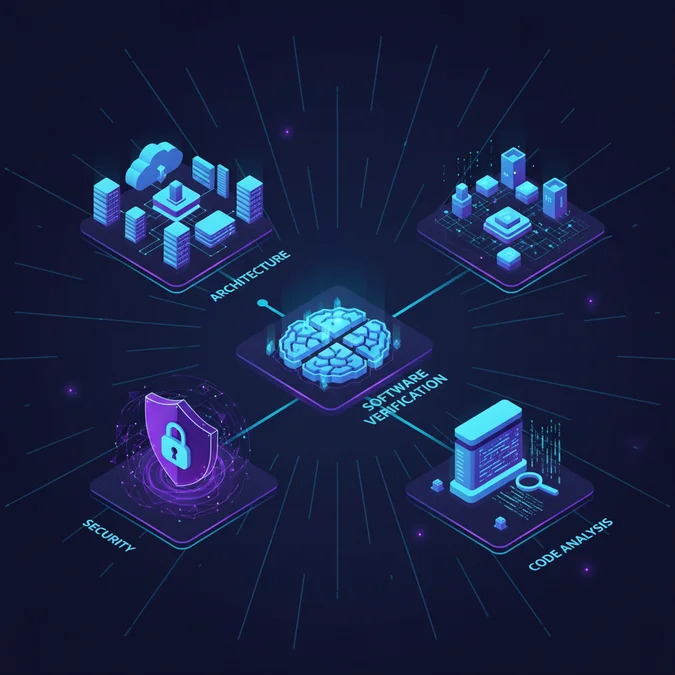
From a defensive security perspective, software verification establishes a deterministic envelope around system operations. It guarantees that memory allocations, network deserialization paths, and identity validation routines operate strictly within bounded, predictable invariants. Failure to verify these boundaries opens applications to memory safety bugs, remote code execution (RCE), and race conditions.
Verification operates across three primary planes of the software lifecycle:
- Static Analysis Plane: Inspecting Abstract Syntax Trees (AST) and type constraints prior to compilation or interpretation, ensuring illegal memory accesses and null pointer dereferences are mathematically impossible.
- Dynamic Specification Plane: Observing running processes under controlled state mutations using automated fuzzing, behavioral test runners, and memory sanitizers.
- Formal Mathematical Plane: Constructing machine-checkable mathematical proofs (via tools like TLA+ or Coq) verifying that distributed consensus algorithms and cryptographic handshakes cannot enter deadlock or invalid states.
Architects who overlook formal verification often encounter hidden security defects during rapid horizontal scaling. Reviewing how to scale a high-traffic Laravel architecture reveals that caching, replication, and thread synchronization quickly expose latent verification deficiencies that single-node unit tests fail to surface.
Verification versus Validation: Architectural Differences and Security Implications
In production security engineering, confusing software verification with software validation leads to critical architectural oversights. Verification is proof-oriented: it demonstrates compliance with the written specification (answering: “Are we building the product right?”). Validation is user-oriented: it demonstrates fitness for operational purpose (answering: “Are we building the right product?”).
An application can pass software validation completely while utterly failing software verification. For example, a monetary transaction endpoint may allow a user to transfer funds seamlessly (validating user intent), but fail to enforce atomic serialization, leaving it vulnerable to Time-of-Check to Time-of-Use (TOCTOU) race conditions during high-volume concurrency attacks.
| Dimension | Software Verification | Software Validation |
|---|---|---|
| Core Question | Are we building the product right? | Are we building the right product? |
| Primary Mechanism | Static analysis, formal proofs, invariant testing, automated linters | User acceptance testing (UAT), customer shadowing, usability testing |
| Execution Phase | Development loop, CI/CD pipeline, pre-merge checks | Staging environments, beta deployments, post-release observation |
| Failure Impact | Remote code execution, memory leaks, broken invariants, crashes | Feature churn, bad UX, misaligned business objectives |
| Specification Target | RFCs, architectural design records (ADRs), schemas, API contracts | Product requirements documents (PRDs), customer feedback loops |
To prevent malicious state manipulation, verification must remain distinct from feature delivery metrics. When verifying business logic against strict models, engineering teams often rely on defensive persistence patterns. Implementing comprehensive audit trails in backend applications provides the runtime evidentiary trail necessary to verify that database records accurately reflect the execution trace specified by security rules.
Static Analysis and Formal Verification: Enforcing Compile-Time Guarantees
Static program analysis forms the initial defense line in modern verification pipelines. By analyzing source code without executing it, static analysis tools traverse the control flow graph (CFG) and call graph to detect taint paths, improper data casts, and unhandled exception branches. Formal verification advances this paradigm further by applying symbolic logic to prove that program logic satisfies specified safety invariants across all execution paths.
In high-assurance contexts, static analyzers leverage Hoare logic, reasoning through preconditions, execution statements, and postconditions (the Hoare triple: {P} C {Q}). If a precondition is satisfied, running program C must terminate in state Q. Violating a postcondition indicates an unverified program branch.
Mathematical Proofs versus Symbolic Execution
Static verification tools typically utilize two primary methods:
- Theorem Proving: Using logical inference engines to check code properties against an axiomatic model. This prevents critical cryptographic failures and deadlock in distributed state machines.
- Symbolic Execution: Evaluating program paths with abstract symbols instead of concrete variables. When a symbolic path hits a failure condition (such as an integer overflow or null dereference), the engine outputs the exact input vector that triggers the flaw.
<php
declare(strict_types=1);

namespace App\Verification;

use InvalidArgumentException;

/**
 * Invariant-enforcing Money class verified via static type rules and assertion.
 */
final class VerifiedTransaction
{
 private int $amountInCents;
 private string $currencyCode;

 /**
 * Enforces formal preconditions on instantiation.
 */
 public function __construct(int $amountInCents, string $currencyCode)
 {
 // Precondition 1: Negative balances violate business invariants
 if ($amountInCents <= 0) {
 throw new InvalidArgumentException("Amount must be strictly positive.");
 }

 // Precondition 2: Strictly enforce ISO 4217 currency constraints
 if (strlen($currencyCode)!== 3 ||!ctype_upper($currencyCode)) {
 throw new InvalidArgumentException("Invalid ISO-4217 currency code.");
 }

 $this->amountInCents = $amountInCents;
 $this->currencyCode = $currencyCode;
 }

 /**
 * Safe addition with integer overflow protection (satisfies postconditions).
 */
 public function add(self $other): self
 {
 if ($this->currencyCode!== $other->currencyCode) {
 throw new InvalidArgumentException("Currency mismatch in financial addition.");
 }

 $result = $this->amountInCents + $other->amountInCents;

 // Explicit check against 64-bit integer overflow invariant
 if ($result < $this->amountInCents) {
 throw new InvalidArgumentException("Integer overflow detected during verification.");
 }

 return new self($result, $this->currencyCode);
 }
}
Writing software to conform to strict type checkers (such as PHPStan at Level 8 or Psalm at Level 1) eliminates dynamic coercion bugs before code merges to main branches.
Dynamic Verification: Fuzz Testing, Sanitizers, and Invariant Checks
While static analysis checks code without execution, dynamic verification validates properties during program runtime under rigorous, adversarial conditions. High-assurance systems cannot rely solely on deterministic unit tests because unit tests represent known paths scripted by developers. Dynamic verification deliberately attacks the edge conditions that human engineers forget to anticipate.
The cornerstone of dynamic verification is coverage-guided fuzz testing. Fuzzers mutate binary payloads, string encodings, and network serialization packets, tracking code coverage branches via instrumented binaries. If a random mutation hits a previously unreached code branch, the fuzzer preserves that input and mutates it further. This approach detects memory corruption, buffer overflows, and unhandled parser exceptions in native extensions and backend interpreters.
Runtime Memory and Thread Sanitization
When compiling native dependencies, cryptographic libraries, or high-performance network parsers, dynamic verification relies on dedicated memory sanitizers:
- AddressSanitizer (ASan): Detects out-of-bounds accesses, use-after-free bugs, and heap overflows by surrounding allocated memory buffers with poisoned redzones.
- ThreadSanitizer (TSan): Instruments memory read and write operations to detect data races between concurrent threads without explicit synchronization locks.
- UndefinedBehaviorSanitizer (UBSan): Instruments operations to catch integer overflows, misaligned pointers, and null dereferences during execution.
Integrating fuzzing engines like LibFuzzer or AFL++ into CI pipelines ensures API controllers and serialization mechanisms cannot be crashed by malformed Unicode strings or deeply nested JSON payloads.
OWASP Verification Frameworks: ASVS and Defensive Security Mechanics
Securing enterprise applications against the OWASP Top 10 requires formal verification against recognized standards rather than ad-hoc security scanning. The OWASP Application Security Verification Standard (ASVS) provides a granular, engineering-level framework for defining security controls and verifying compliance at every tier.
The ASVS defines three rigorous verification levels:
- Level 1 (Opportunistic): Baseline verification applicable to all software. Verifiable using automated scanners and basic manual penetration testing without source code access. Covers critical flaws like injection vectors and default credentials.
- Level 2 (Standard): Recommended for applications processing sensitive business data or handling authenticated transactions. Requires direct access to architecture documents, design specifications, and source code. Verifies defense-in-depth, RBAC enforcement, cryptographic storage, and session lifecycles.
- Level 3 (Advanced): Required for military, financial, critical infrastructure, and medical systems. Enforces modularity, hardware security modules (HSM) integration, formal transaction boundaries, and resistance against targeted physical or side-channel analysis.
| Verification Area | Threat Vector Target | Verification Method |
|---|---|---|
| Authentication | Credential stuffing, session hijacking | Verify password entropy, PBKDF2/Argon2id parameters, secure session invalidation |
| Access Control | Insecure Direct Object References (IDOR) | Automate static verification of authorization policies on every controller endpoint |
| Data Protection | Cleartext transmission, weak ciphers | Inspect TLS configurations, verify AES-GCM/ChaCha20-Poly1305 encryption keys |
| Input Sanitization | SQLi, XSS, Remote Code Execution (RCE) | Enforce parameterized queries, AST linting, and strict type casting schemas |
Incorporating ASVS criteria directly into an organization’s CI/CD pipeline establishes automated compliance gates, preventing non-compliant code from advancing toward production.
Contract-Driven Verification: Schemas, Type Systems, and API Boundaries
Distributed architectures fail when API services disagree on message formats or boundary constraints. When one service updates its JSON payload structure while an upstream consumer still expects legacy formats, the resulting deserialization failures can cascade into regional system outages. Contract-driven verification prevents these integration failures by making machine-readable schemas the single source of truth for runtime communication.
Using specifications like OpenAPI (v3.1), JSON Schema, or Protocol Buffers, teams can run consumer-driven contract tests using frameworks such as Pact. In this workflow, consumers publish contract specifications representing their expected input and output structures. Provider services run verified test suites against these contracts before committing code changes.
Strong contracts also serve as the foundation for database schema integrity. As systems scale horizontally, database tables must enforce accurate column definitions, foreign keys, and indexes. Poor indexing leads to slow table scans that cascade into request timeouts under load. Applying efficient database indexing strategies ensures that the queries executed across verified API contracts maintain low latency profiles in production.
{
 "$schema": "https://json-schema.org/draft/2020-12/schema",
 "title": "VerifiedTransferPayload",
 "type": "object",
 "required": ["transaction_id", "recipient_id", "amount_cents", "signature"],
 "properties": {
 "transaction_id": {
 "type": "string",
 "format": "uuid"
 },
 "recipient_id": {
 "type": "integer",
 "minimum": 1
 },
 "amount_cents": {
 "type": "integer",
 "minimum": 100,
 "maximum": 100000000
 },
 "signature": {
 "type": "string",
 "pattern": "^[a-f0-9]{64}$"
 }
 },
 "additionalProperties": false
}
By setting additionalProperties: false, verification engines reject unexpected payloads. This prevents parameter injection and object mass-assignment vulnerabilities directly at the network boundary.
Automating Verification in CI/CD: Static Analysis, Linter Gates, and Security Hooks
A verification strategy is ineffective if it relies on manual developer intervention. Human reviewers frequently miss subtle logic errors, missing authorization checks, and subtle memory safety flaws during peer code reviews. Software verification must be hardcoded into automated continuous integration and continuous deployment (CI/CD) pipelines as strict, non-bypassable status checks.
A production CI verification pipeline should enforce a zero-warning policy across several security and verification layers before granting merge permission:
- Layer 1 (Pre-commit Git Hooks): Run lightweight static linters and credential detectors (such as Gitleaks or TruffleHog) on local workstations to catch hardcoded API tokens and private keys before commits are recorded.
- Layer 2 (Compilation and Strict Type Checking): Enforce static typing with strict type checkers configured to maximum strictness, refusing dynamic type conversions that could conceal null pointer exceptions.
- Layer 3 (Security AST and Taint Analysis): Run tools such as Semgrep or SonarQube with custom rule configurations targeting authorization bypasses, SQL injections, and insecure deserialization patterns.
- Layer 4 (Software Composition Analysis – SCA): Check third-party dependencies against vulnerability databases (like CVE or GitHub Advisory Database) using automated vulnerability scanners.
- Layer 5 (Dynamic Invariant Tests): Execute end-to-end integration and property-based test suites in isolated containerized environments matching target production topologies.
Pipelines should fail immediately upon detecting any verification failure. Permitting warnings to accumulate undermines the security guarantees of the entire verification process.
Production Edge Cases: Race Conditions, Concurrency, and State Drift
Even systems with complete unit test coverage can suffer severe logic failures when deployed across multi-threaded or multi-instance production environments. Concurrency defects, race conditions, and distributed state drift represent complex verification challenges because these issues depend on non-deterministic network latency and thread scheduling that isolated development environments cannot replicate.
Consider an e-commerce stock checkout system that verifies user balance and product inventory through non-atomic database reads. When a sudden traffic spike occurs, multiple concurrent requests can interleave their read and write operations, resulting in double-spending or negative inventory levels.
<php
declare(strict_types=1);

namespace App\Verification;

use Illuminate\Support\Facades\DB;
use RuntimeException;

/**
 * Transaction handler verifying atomic balance updates under concurrent load.
 */
final class AccountBalanceService
{
 public function deductBalanceWithLock(int $accountId, int $centsToDeduct): void
 {
 // Verify execution occurs inside an atomic transaction with pessimistic locking
 DB:transaction(function () use ($accountId, $centsToDeduct) {
 // SELECT.. FOR UPDATE prevents concurrent reads on the same account record
 $account = DB:table('accounts')
 ->where('id', $accountId)
 ->lockForUpdate()
 ->first();

 if ($account === null) {
 throw new RuntimeException("Account not found for verification.");
 }

 if ($account->balance_cents < $centsToDeduct) {
 throw new RuntimeException("Insufficient verified balance for withdrawal.");
 }

 // Enforce atomic deduction preventing race conditions
 DB:table('accounts')
 ->where('id', $accountId)
 ->decrement('balance_cents', $centsToDeduct);
 }, 5); // Retry transaction up to 5 times if deadlock occurs
 }
}
Using explicit database locks (such as SELECT.. FOR UPDATE) or atomic conditional writes (such as UPDATE accounts SET balance = balance -:amount WHERE balance >=:amount) prevents concurrency races, ensuring invariants hold even under heavy system load.
Verification Resources and Framework Foundations
Building a resilient verification architecture requires a solid understanding of both low-level mechanics and core framework fundamentals. Teams must establish consistent coding conventions, robust lifecycle validation, and deterministic data handling from the earliest stages of application development.
For engineering teams working with modern web architectures, reviewing foundational principles helps ensure your systems remain scalable and secure over time.
Explore our complete Laravel, Basics directory for more guides.
Software verification provides the mathematical and programmatic discipline required to build resilient, attack-resistant applications. By combining static analysis, dynamic sanitizers, contract-driven testing, and strict CI/CD gate automation, engineering organizations can eliminate critical software vulnerabilities before they manifest as production incidents.
Rather than treating verification as an optional post-development task, systems architects must weave formal verification invariants into every tier of their development lifecycle. When specifications are machine-checkable and testing pipelines are automated, distributed systems achieve the deterministic safety needed to handle massive scale safely.