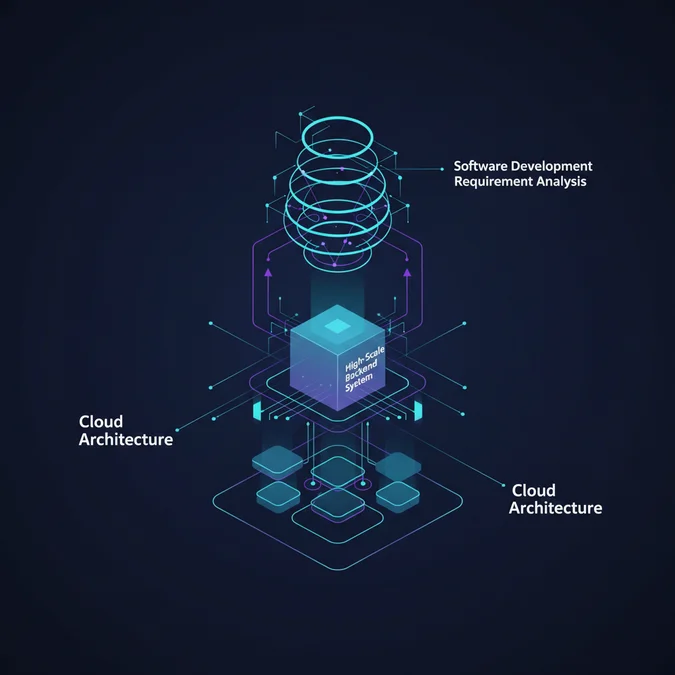

Software development requirement analysis is the engineering practice of discovering, decomposing, validating, and formalizing functional behaviors and non-functional runtime constraints before architectural commitment. Executed properly, it translates ambiguous user intents into strict mathematical boundaries, concrete relational schemas, bounded context contracts, and quantifiable service level objectives.
Why do engineering organizations continue to sink millions of dollars into database refactoring, cache invalidation panics, and distributed deadlocks when the root failures occurred weeks before a single pull request was merged? The industry frequently misdiagnoses architectural churn as an implementation defect when it is almost universally a failure of early-stage requirement analysis. Skipping the rigorous formalization of boundary conditions leaves senior engineers building elegant structures around invalid technical assumptions.
Bridging this gap requires treating requirement analysis as an empirical systems engineering discipline. By combining formal domain modeling, strict state boundary assertions, database cardinality sizing, and deterministic runtime projections, backend teams can systematically eliminate scope variance and construct software that sustains high-throughput operational realities.
Core Engineering Definition and Foundational Boundaries
Software development requirement analysis establishes the exact behavioral and operational contract between client requirements and software architecture. Rather than generating broad, subjective prose, the objective is to extract deterministic operational boundaries that directly dictate data structures, memory envelopes, execution thread limits, and database transactions.
A requirement only becomes technically actionable once its verification mechanism is mathematically or programmatically defined. When a requirement states that a system must process financial transactions quickly, it provides zero engineering value. It becomes an architectural constraint when rewritten: the transaction processing pipeline must achieve p99 latency below 120 milliseconds at 4,500 operations per second across a cluster of three stateless workers, utilizing a maximum of 512 megabytes of RAM per worker instance.
The Classification Matrix
Every incoming operational demand falls into three orthogonal spaces that dictate the overall software topology:
- Functional Requirements: The discrete computational state transitions, calculations, input transformations, and relational mappings required by business workflows.
- Non-Functional Operational Constraints: The quantitative physical performance attributes including response latency, throughput volume, concurrent socket limits, database read/write ratios, and disaster recovery recovery point objectives.
- System and Domain Constraints: Immutable environmental parameters such as compliance standards (HIPAA, PCI-DSS, SOC2), upstream API rate limits, persistent storage engine limitations, and runtime execution environments.
Transforming business vernacular into these three spaces eliminates hand-waving and immediately exposes conflicting expectations between stakeholders and hardware capabilities.
Functional Requirement Decomposition and Domain State Modeling
Functional requirement decomposition moves beyond narrative user stories to construct deterministic state machines. In modern application frameworks like Laravel, unvetted requirements often produce bloated Active Record models where database rows double as state containers without lifecycle enforcement. Deconstructing requirements requires mapping every state change to an isolated finite state machine.
Consider an order fulfillment pipeline. Business analysts frequently define the process as a sequence of steps: pending, paid, shipped, delivered. An engineering decomposition examines transition guards, failure domains, idempotency windows, and concurrent mutation locks.
<php
declare(strict_types=1);

namespace App\Domain\Fulfillment\Enums;

enum OrderState: string
{
 case PENDING = 'pending';
 case PAYMENT_PROCESSING = 'payment_processing';
 case ESCROW_HOLD = 'escrow_hold';
 case COMPLETED = 'completed';
 case FAILED = 'failed';

 /**
 * Returns the valid transitions from the current state.
 * Prevents invalid state jumps directly inside domain analysis.
 */
 public function allowedTransitions(): array
 {
 return match ($this) {
 self:PENDING => [self:PAYMENT_PROCESSING, self:FAILED],
 self:PAYMENT_PROCESSING => [self:ESCROW_HOLD, self:COMPLETED, self:FAILED],
 self:ESCROW_HOLD => [self:COMPLETED, self:FAILED],
 self:COMPLETED, self:FAILED => [],
 };
 }
}
By enforcing transition logic within domain models, software engineers prevent race conditions that lead to inconsistent records. Every functional requirement must cleanly map to a transition method that asserts pre-conditions, mutates domain state, and emits events for downstream persistence, eliminating hidden paths through business processes.
Non-Functional Requirements as Concrete Database and Memory Sizing
Non-functional requirements dictate the actual infrastructure footprint and runtime configuration. Rather than accepting nebulous performance targets, backend developers must reverse-engineer load specifications into storage, memory, and database indexes. Unvetted throughput assumptions lead to catastrophic resource exhaustion in production.
To calculate database row growth and memory requirements, engineers use a structural sizing formula based on byte allocations per column, index overhead, and transactional frequency. When evaluating an application handling order events, calculating storage envelopes during the requirement phase prevents unexpected operational crises months after deployment.
| Metric Parameter | Small Scale (100 req/sec) | Mid Scale (1,500 req/sec) | Enterprise Scale (10,000 req/sec) |
|---|---|---|---|
| Daily Row Accumulation | 8.64 Million Rows | 129.6 Million Rows | 864.0 Million Rows |
| Raw Storage Growth / Day (500b/row) | 4.32 GB | 64.8 GB | 432.0 GB |
| B-Tree Index Overhead (approx 35%) | 1.51 GB | 22.68 GB | 151.2 GB |
| Required Buffer Pool Memory | 8 GB (InnoDB / RAM) | 64 GB Dedicated | 512 GB Clustered |
| Network Throughput Required | 4.1 MB/s | 61.5 MB/s | 410.0 MB/s |
Translating business goals into these physical measurements immediately informs architectural requirements. A relational MySQL or PostgreSQL schema may comfortably service the small or mid-scale thresholds with simple composite indexes. However, hitting enterprise requirements instantly highlights the necessity of timeseries partitioning, storage tiering, read replicas, and caching layers before drafting any application code.
Technical Requirement Elicitation and Discovery Methodologies
Eliciting software requirements is an adversarial discovery process. Product stakeholders naturally visualize the happy path of an application while ignoring edge boundaries, network latency, asynchronous eventual consistency, and transient downstream failures. Backend engineers must systematically probe for failure conditions using technical discovery frameworks.
An effective discovery methodology relies on structural workshops such as Event Storming and Domain-Driven Discovery. Instead of listening to vague feature wishlists, the technical team forces stakeholders to reconstruct the entire business lifecycle using domain events in past-tense verbs (for example, PaymentCaptured, InventoryReserved, InvoiceDispatched).
- Event Mapping: Identify every atomic business event that changes persistent state across the enterprise domain.
- Trigger and Actor Identification: Determine what triggers the event, whether it is an authenticated user action, a cron scheduler, an incoming webhook, or an internal domain observer.
- Failure Mode Interrogation: Systematically question what happens when dependent entities fail. If the payment gateway returns an HTTP 504 gateway timeout, does the order cancel, initiate an exponential backoff retry, or move into an administrative triage queue?
- Boundary Realignment: Group events into bounded contexts to prevent monolithic domain leakage. Adopting a structured software model in software engineering helps teams establish these boundaries cleanly, isolating transaction scopes and preventing domain cross-contamination across database schemas.
Executing these discovery steps uncovers hidden constraints long before developers draft relational migrations, exposing business ambiguities when they cost almost nothing to resolve.
Translating Business Logic into Testable Constraints and Specifications
Requirements expressed in informal prose invite dangerous assumptions. Modern engineering teams enforce testable specifications by capturing business workflows using specification-by-example frameworks. Translating business logic into deterministic domain assertions bridges the gap between requirements discovery and continuous integration.
By integrating technical practices such as BBD software development, engineering teams turn acceptance criteria directly into executable integration tests. This approach guarantees that functional requirements become self-validating, code-level contracts.
<php
declare(strict_types=1);

namespace Tests\Feature\Requirements;

use Tests\TestCase;
use App\Models\Account;
use App\Domain\Ledger\LedgerTransferService;
use App\Domain\Ledger\Exceptions\InsufficientFundsException;

class LedgerTransferRequirementTest extends TestCase
{
 /**
 * Requirement: Ledger must never record a negative balance on debit
 * accounts unless an explicit overdraft protection contract exists.
 */
 public function test_debit_fails_and_rolls_back_when_balance_insufficient(): void
 {
 $source = Account:factory()->create(['balance_cents' => 5000]);
 $destination = Account:factory()->create(['balance_cents' => 1000]);
 $service = app(LedgerTransferService:class);

 $this->expectException(InsufficientFundsException:class);

 try {
 // Attempting to withdraw 6000 cents from an account with only 5000
 $service->transfer($source, $destination, 6000);
 } finally {
 // Ensure database transaction safety and complete rollback
 $this->assertDatabaseHas('accounts', [
 'id' => $source->id,
 'balance_cents' => 5000,
 ]);
 $this->assertDatabaseHas('accounts', [
 'id' => $destination->id,
 'balance_cents' => 1000,
 ]);
 }
 }
}
Writing tests that mirror analytical requirements transforms functional constraints into continuous integration guardrails, preventing logic regressions during system refactoring cycles.
Architecture Deep Dive: Mapping Requirements to System Topology
Once requirements pass discovery and validation, they must be converted directly into architectural topology. Every architecture decision represents a set of trade-offs directly dictated by non-functional constraints. A requirement for strict ACID compliance mandates single-leader database clustering and synchronous replication, while a requirement for 99.999% global write uptime mandates multi-region event-driven eventual consistency with conflict resolution mechanisms.
Understanding how requirements drive backend architectural patterns prevents catastrophic over-engineering or premature optimization:
- High Write Throughput, Relaxed Read Consistency: When requirements prioritize raw logging or sensor ingestion, the architecture shifts away from relational primary-key auto-increment engines toward log-structured merge-tree (LSM) architectures like Apache Cassandra or ClickHouse, fronted by an event buffer such as Apache Kafka.
- Complex State Invariants, Moderate Scale: When requirements demand complex financial constraints where invalid state sequences carry severe fiscal risk, a centralized relational model (PostgreSQL) using strong foreign keys, row-level locks, and strict transaction isolation (Serializable) is optimal.
- Low Latency Distributed Reads: When requirements mandate sub-10ms global edge delivery, caching topologies involving Redis clusters, read-through write-around cache policies, and CDN edge computing logic become mandatory system components.
Architectural topology must never be chosen based on industry trends or developer preferences. Every server, cache, queue, and database worker exists solely to satisfy a specific functional or non-functional operational requirement.
Managing Requirement Drift, Scope Creep, and Architectural Debt
Requirement drift represents one of the most destructive operational risks in software delivery. It occurs when small, seemingly trivial scope changes are accepted during implementation without systematically updating the underlying technical constraints, index boundaries, or capacity sizing projections.
When an engineering team accepts continuous feature additions without re-evaluating baseline operational constraints, architectural debt compounds exponentially. For example, adding an innocuous filter query to an analytics dashboard can transform an index-optimized single-table scan into an unindexed full-table join across tens of millions of rows, degrading overall cluster throughput.
The Technical Change Control Process
Engineers must institute a strict technical change control protocol whenever requirement modifications surface mid-development:
- Schema Impact Assessment: Evaluate whether new fields invalidate existing composite indexes, require table restructuring, or introduce lock contention on high-traffic database tables.
- Throughput Re-calibration: Re-calculate expected requests per second and peak read/write operational ratios against existing worker pool configurations.
- SLA Impact Modeling: Confirm whether added domain logic can execute within the existing p99 latency SLA window or if processing must be offloaded to asynchronous background jobs.
Treating scope changes as fundamental architectural events prevents gradual performance degradation and maintains structural system stability throughout the development lifecycle.
Requirement Documentation: Architecture Decision Records (ADRs) and OpenAPI
Lengthy, unstructured requirement documents stored in static wikis quickly become outdated and detached from production reality. Modern software architecture demands documentation-as-code: dynamic, version-controlled artifacts that evolve within the code repository alongside unit tests and application logic.
Architecture Decision Records (ADRs) capture the architectural context, requirements, evaluated alternatives, and trade-offs of significant technical decisions. Stored as plain Markdown in the source control tree, they preserve the contextual justification for complex architectural designs.
OpenAPI Specification as a Requirement Contract
For API design and cross-service communication, the OpenAPI specification acts as the definitive contract between teams. Rather than treating documentation as an afterthought, requirement analysis finishes with a formal schema definition that enforces request payloads, validation rules, and error codes.
openapi: 3.0.3
info:
 title: Account Transfer Service API
 version: 1.0.0
paths:
 /api/v1/transfers:
 post:
 summary: Execute atomic funds transfer between accounts
 operationId: executeTransfer
 requestBody:
 required: true
 content:
 application/json:
 schema:
 type: object
 required:
 - source_account_id
 - destination_account_id
 - amount_cents
 - idempotency_key
 properties:
 source_account_id:
 type: string
 format: uuid
 destination_account_id:
 type: string
 format: uuid
 amount_cents:
 type: integer
 minimum: 1
 idempotency_key:
 type: string
 format: uuid
 responses:
 '201':
 description: Transfer executed successfully
 '422':
 description: Unprocessable entity, validation or business rule violation
Formally capturing API contracts in version control eliminates runtime integration mismatches, simplifies mocking for client applications, and acts as an automated validation layer across engineering teams.
Security Implications: Threat Modeling During Requirement Analysis
Security requirements must be embedded into the analysis phase rather than patched on after system construction. Threat modeling during technical discovery exposes attack vectors, privilege escalation risks, and data boundary violations before writing the first line of code.
Employing formal threat modeling frameworks such as STRIDE (Spoofing, Tampering, Repudiation, Information Disclosure, Denial of Service, Elevation of Privilege) during requirement decomposition allows backend developers to design defensive mechanisms directly into data structures and authorization workflows.
- Tampering & Data Integrity: When financial or auditing requirements emerge, standard database mutation patterns must be replaced with immutable event ledgers and cryptographic hashing chains.
- Information Disclosure: Data privacy requirements (GDPR, CCPA) mandate column-level encryption keys, dedicated field-level masking policies, and strict tenant isolation rules embedded into the Object-Relational Mapper (ORM).
- Denial of Service: Publicly exposed operational endpoints must have rate-limiting boundaries, maximum payload sizing constraints, and query complexity analysis defined directly within their functional specifications.
Integrating security assertions into the initial requirement definition dramatically reduces vulnerability remediation overhead and prevents architectural rewrites driven by late-stage penetration testing failures.
Pricing, Resource Planning, and Cost Modeling for Requirements Engineering
Engaging in thorough software requirement analysis carries explicit financial and organizational costs. However, the cost of discovering invalid assumptions during analysis is orders of magnitude lower than discovering them in production. Industry data consistently demonstrates that correcting a defect during the requirements phase costs a fraction of refactoring a live, distributed system under load.
Engineering organizations deploy various cost models when executing requirement analysis, architectural discovery, and proof-of-concept validation. The table below illustrates standard industry cost structures and rate allocations for senior systems architects and engineering consultants:
| Engagement Cost Model | Standard Rate Range (USD) | Duration / Scope | Best Fit Application |
|---|---|---|---|
| Hourly Specialist Consulting | $150 to $320 per hour | 20 to 80 hours | Targeted architecture reviews, bottleneck analysis, and specific API contract validation. |
| Weekly Discovery Sprint | $6,500 to $14,000 per week | 2 to 4 weeks | Greenfield domain modeling, event storming, database sizing, and ADR development. |
| Fixed-Scope Technical Blueprint | $12,000 to $45,000 flat fee | Full discovery phase | Complete requirements decomposition, OpenAPI schema drafting, and threat modeling for new platforms. |
| Retainer Advisory Support | $4,000 to $10,000 per month | 3 to 12 months ongoing | Continuous change control, architecture oversight, and SLA monitoring across scaling phases. |
Investing between 10% and 15% of total project capital in structured requirement analysis reliably compresses implementation schedules, minimizes emergency mid-sprint architectural refactoring, and ensures hardware infrastructure budgets match long-term usage trajectories.
Framework Architecture Exploration and Resource Directory
Establishing rigorous technical specifications provides the baseline required to build resilient, maintainable backend services. Whether designing distributed event-driven systems or monolithic web applications, disciplined discovery remains the primary driver of software quality and infrastructure reliability.
To see how these architectural boundaries, lifecycle controls, and domain patterns are implemented within concrete modern application ecosystems, continue expanding your backend design knowledge base.
Explore our complete Laravel, Basics directory for more guides.
Factors That Affect Development Cost
- Domain model complexity and business invariant depth
- Non-functional performance, throughput, and clustering targets
- Regulatory compliance standards (PCI-DSS, HIPAA, SOC2)
- Cross-system integration points and API contract surface area
Requirement analysis investments typically scale from short targeted architectural reviews to multi-week formal discovery blueprints based on system criticality.
Rigorous software development requirement analysis transforms unpredictable development cycles into a deterministic systems engineering process. By replacing subjective product narratives with formal domain models, explicit state machine transitions, quantified database sizing calculations, and automated acceptance tests, engineering teams establish an architectural foundation capable of sustaining scale.
As you plan your next production service, prioritize these analytical safeguards: establish strict non-functional constraints before selecting database engines, capture API contracts in version-controlled specifications, integrate threat modeling directly into discovery, and measure infrastructure limits against empirical data models. Grounding system architecture in deep requirements analysis is the most dependable investment an engineering organization can make to eliminate architectural drift and deliver resilient software.