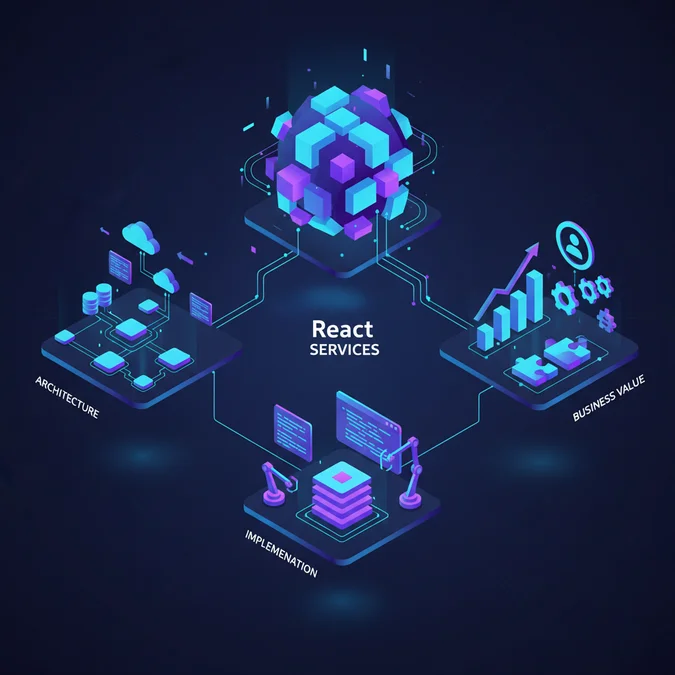

React services encompass a comprehensive suite of professional offerings from specialized agencies, providing custom development, migration, optimization, and consulting to build and enhance high-performance, scalable web applications. These services leverage the React.js library to deliver robust, interactive user interfaces, ensuring modern digital experiences and strategic business advantages.
As the digital landscape evolves, businesses require agile, performant, and maintainable web solutions. ReactJS, with its component-based architecture and efficient rendering, has become a cornerstone for developing such applications. Engaging with expert React service providers allows organizations to harness this powerful technology effectively, translating technical capabilities into tangible business outcomes like improved user engagement, faster time-to-market, and reduced operational costs.
This guide explores the foundational concepts, architectural nuances, and practical implementation strategies behind professional React services. We will delve into how these offerings are structured, the best practices that govern their delivery, and the strategic value they bring to modern web application development, ensuring a clear understanding for technical leaders and business stakeholders alike.
What are React Services? Defining Core Offerings
React services refer to the specialized offerings provided by development agencies and consultancies to design, develop, deploy, and maintain applications built using the React.js library. These services extend beyond mere coding, encompassing a full lifecycle approach to delivering robust and scalable web solutions. Understanding the breadth of these offerings is crucial for businesses seeking to leverage React’s capabilities effectively.
Typically, professional react services include, but are not limited to, the following core areas:
Callout: Holistic React Service Engagement
A holistic React service engagement covers the entire project lifecycle, from initial concept and strategic planning to post-launch support and continuous optimization. This ensures not only the technical excellence of the application but also its alignment with overarching business objectives and user needs.
- Custom React Web Application Development: Building bespoke web applications from the ground up, tailored to specific business requirements, industry standards, and user experiences. This includes single-page applications (SPAs), progressive web applications (PWAs), and complex enterprise solutions.
- UI/UX Design and Implementation: Crafting intuitive and engaging user interfaces and experiences, leveraging React’s declarative nature to bring designs to life with high fidelity and responsiveness.
- React Migration Services: Assisting businesses in migrating existing legacy applications or frameworks to React.js, modernizing their tech stack to improve performance, maintainability, and scalability.
- API Integration and Backend Development: Connecting React frontends with various backend services and APIs (REST, GraphQL) to ensure seamless data flow and functionality. Often, this involves full-stack expertise.
- Performance Optimization: Analyzing and enhancing the speed, responsiveness, and efficiency of existing React applications through code splitting, lazy loading, memoization, and other advanced techniques.
- React Consulting and Strategy: Providing expert guidance on technology stack choices, architectural decisions, best practices, and project roadmapping for React-based projects.
- Maintenance and Support: Offering ongoing support, bug fixing, feature enhancements, security updates, and performance monitoring to ensure applications remain stable and up-to-date post-deployment.
- Team Augmentation: Integrating skilled React developers into existing in-house teams to bolster development capacity and expertise.
Each of these service categories addresses distinct business needs, contributing to a comprehensive strategy for modern web presence.
The Architecture of React Services: Components, State, and Data Flow
Effective react services are fundamentally built upon a clear understanding of React’s architectural paradigms. The library promotes a component-based structure, which is critical for developing maintainable, scalable, and reusable user interfaces. This section explores the core architectural elements that underpin robust React applications.
Component-Based Design
React applications are constructed from isolated, reusable components. These components can be functional or class-based, each encapsulating its own logic and rendering. A well-architected React application organizes components hierarchically, from atomic elements like buttons to complex page layouts. This modularity facilitates parallel development and simplifies debugging.
// Example of a functional component

function WelcomeMessage({ userName }) {

  return <h1>Welcome, {userName}!</h1>;

}
// Example of usage
<WelcomeMessage userName=”Developer” />
State Management Strategies
State management is a critical aspect of any interactive application. React applications manage two primary types of state: component local state and global application state. Choosing the right strategy impacts performance, maintainability, and developer experience.
- Local State (
useState,useReducer): Ideal for managing component-specific data that does not need to be shared across disparate parts of the application. - Context API: A built-in React feature for sharing state across a component tree without prop-drilling. Suitable for medium-scale applications or specific feature domains.
- Redux/Zustand/Jotai: External libraries providing centralized state management for complex, large-scale applications. They offer predictable state containers, middleware capabilities, and powerful dev tools. For enterprise-grade react services, a robust global state management solution is often indispensable.
Unidirectional Data Flow
React enforces a unidirectional data flow, where data primarily moves down the component tree from parent to child. This predictability simplifies understanding how data changes affect the UI and makes debugging more straightforward. Actions initiated by user interactions or API responses trigger state updates, which then re-render affected components.
Architectural Trade-offs for Scalability and Maintainability
When architecting react services, several trade-offs must be considered:
- Bundle Size vs. Features: Balancing the inclusion of libraries and features against the overall application bundle size to ensure fast loading times. Techniques like code splitting and lazy loading are essential.
- Performance vs. Development Speed: Optimizing for maximum performance can sometimes involve more complex patterns (e.g., manual memoization), potentially increasing development time.
- State Management Complexity: While Redux offers powerful features, its boilerplate can be overkill for smaller applications. Choosing a simpler solution like Context API or Zustand can accelerate development.
- Server-Side Rendering (SSR) vs. Client-Side Rendering (CSR): SSR (e.g., Next.js) improves initial load performance and SEO but adds server complexity. CSR is simpler to deploy but can have slower initial loads.
A well-designed React architecture prioritizes modularity, clear state management, and an efficient data flow, laying the groundwork for applications that are both performant and easily extendable.
Implementing ReactJS Services: Best Practices and Development Workflow
Implementing high-quality reactjs services requires adherence to established best practices and a streamlined development workflow. This ensures not only functional applications but also maintainable, scalable, and secure codebases. Adopting these practices is critical for delivering projects on time and within budget, with a focus on long-term value.
Development Workflow
A typical development workflow for reactjs services leverages agile methodologies, promoting iterative development and continuous feedback:
- Discovery & Planning: Thorough requirements gathering, user story creation, and technical architecture planning.
- Design & Prototyping: UI/UX design, wireframing, and interactive prototyping to visualize the application.
- Iterative Development (Sprints): Breaking down features into smaller, manageable tasks completed in short sprints (e.g., 1-2 weeks).
- Continuous Integration/Continuous Deployment (CI/CD): Automating code integration, testing, and deployment to ensure rapid and reliable releases.
- Testing & Quality Assurance: Implementing various testing strategies to identify and resolve bugs early.
- Deployment & Monitoring: Deploying the application to production environments and setting up monitoring for performance and errors.
- Maintenance & Optimization: Ongoing support, feature enhancements, and performance tuning post-launch.
Key Best Practices Checklist
- Component Structure: Organize components logically (e.g., by feature or type) and keep them small, focused, and reusable.
- Prop Types or TypeScript: Use
PropTypesor TypeScript for type checking to ensure predictable component behavior and reduce runtime errors. - State Management: Choose the appropriate state management solution (Context API, Redux, Zustand) based on application complexity and scale. Avoid excessive global state.
- Performance Optimization: Employ
React.memo,useCallback,useMemo, lazy loading, and code splitting to minimize re-renders and reduce bundle size. - Error Boundaries: Implement error boundaries to gracefully handle runtime errors within components and prevent application crashes.
- Accessibility (A11y): Design and develop with accessibility in mind, using semantic HTML, ARIA attributes, and keyboard navigation.
- Testing: Write comprehensive tests (unit, integration, end-to-end) using tools like Jest, React Testing Library, and Cypress. Aim for high test coverage.
- Code Style & Linting: Enforce consistent code style with tools like ESLint and Prettier to improve readability and maintainability.
- Folder Structure: Adopt a consistent and scalable folder structure (e.g., feature-based or domain-based) to organize components, styles, and utilities.
- API Integration: Use modern data fetching libraries like React Query or SWR for efficient caching, revalidation, and error handling.
Code Example: Basic Component Testing with React Testing Library
This example demonstrates a simple unit test for a React component using Jest and React Testing Library, a common practice in professional reactjs services.
// MyComponent.js

import React from 'react';
function MyComponent({ name }) {
return <div>Hello, {name}</div>;
}
export default MyComponent;
// MyComponent.test.js
import { render, screen } from ‘@testing-library/react’;
import MyComponent from ‘./MyComponent’;
describe(‘MyComponent’, () => {
it(‘renders the correct name’, () => {
render(<MyComponent name=”World” />);
expect(screen.getByText(/Hello, World/i)).toBeInTheDocument();
});
it(‘renders a different name’, () => {
render(<MyComponent name=”React” />);
expect(screen.getByText(/Hello, React/i)).toBeInTheDocument();
});
});
By following these best practices and adopting a structured workflow, development teams can deliver high-quality React applications that meet both technical and business objectives.
Strategic Value of React Services for Modern Web Applications
Beyond technical implementation, engaging in professional react services offers significant strategic advantages for businesses aiming to thrive in the modern digital ecosystem. React’s inherent characteristics translate directly into business value, impacting everything from user satisfaction to operational efficiency and competitive differentiation.
Enhanced User Experience (UX)
React’s virtual DOM and efficient reconciliation algorithm ensure fast, responsive user interfaces. This leads to smoother interactions, quicker page loads, and an overall superior user experience, which is paramount for retaining users and driving engagement. Applications built with React feel snappy and modern, directly improving user satisfaction metrics.
Accelerated Development and Faster Time-to-Market
The component-based architecture of React promotes code reusability. Developers can build a library of UI components that can be used across different parts of an application or even across multiple projects. This modularity significantly reduces development time, allowing businesses to bring new features and products to market faster than competitors. For companies investing in react services, this means quicker iteration cycles and a more responsive product roadmap.
Scalability and Maintainability
React applications are designed for scalability. As an application grows in complexity and features, its component structure and predictable data flow make it easier to manage and extend. This maintainability reduces long-term operational costs and allows for easier onboarding of new development talent. Strategic investments in React ensure that applications can evolve with changing business needs without requiring costly rewrites.
Strong Community and Ecosystem
React boasts one of the largest and most active developer communities globally. This translates into a rich ecosystem of tools, libraries, and resources, including state management solutions (Redux, Zustand), routing libraries (React Router), UI frameworks (Material-UI, Ant Design), and testing utilities. Access to this vast ecosystem means faster problem-solving, readily available talent, and continuous innovation, providing a stable foundation for long-term projects.
Performance and SEO Benefits
While React is primarily a client-side library, modern approaches like Server-Side Rendering (SSR) with frameworks like Next.js allow React applications to deliver excellent initial load performance and improved search engine optimization (SEO). This ensures that web applications are not only fast for users but also discoverable by search engines, crucial for online visibility and customer acquisition.
Comparison of React’s Strategic Benefits
The table below highlights how React’s core features deliver strategic value compared to traditional web development approaches or alternative frameworks:
| Feature | React’s Strategic Benefit | Impact on Business |
|---|---|---|
| Component Reusability | Modular, self-contained UI elements | Faster development, reduced costs, consistent UI |
| Virtual DOM | Efficient UI updates, minimal DOM manipulation | Superior performance, smoother user experience |
| Unidirectional Data Flow | Predictable state management | Easier debugging, higher code stability |
| Large Ecosystem | Abundant tools, libraries, community support | Accelerated development, access to talent, continuous innovation |
| Flexibility | Integrates easily with various tech stacks | Future-proof architecture, adaptability to evolving needs |
| Server-Side Rendering (SSR) | Improved initial load, SEO-friendly | Better user engagement, higher search ranking |
By leveraging these strategic advantages through expert react services, businesses can build modern web applications that are not just technically sound but also powerful drivers of growth, efficiency, and competitive advantage.
Choosing a React Services Partner: Key Considerations and Vetting
Selecting the right react services partner is a critical decision that can significantly impact the success of your web application project. It requires careful consideration beyond just technical prowess, encompassing factors like communication, process transparency, and long-term support. A thorough vetting process ensures alignment with your business goals and expectations.
Essential Criteria for Partner Selection
- Proven Expertise and Experience:
- Demonstrable track record of successful React projects, ideally within your industry or a similar domain.
- Portfolio showcasing diverse React applications, including complex features, integrations, and optimizations.
- Team composition with senior React developers, architects, and UI/UX specialists.
- Technical Proficiency:
- Deep understanding of core React concepts, hooks, and ecosystem tools (Redux, Next.js, GraphQL, etc.).
- Proficiency in modern JavaScript (ES6+), TypeScript, and related frontend technologies.
- Experience with testing frameworks (Jest, React Testing Library, Cypress) and CI/CD pipelines.
- Transparent Communication:
- Clear and consistent communication channels (e.g., daily stand-ups, weekly reports, dedicated project manager).
- Responsiveness to inquiries and proactive updates on project status.
- Ability to articulate technical concepts in understandable terms for non-technical stakeholders.
- Defined Development Process:
- Adherence to agile methodologies (Scrum, Kanban) with iterative development cycles.
- Clear project management tools and practices for task tracking, issue resolution, and sprint planning.
- Emphasis on code reviews, quality assurance, and automated testing throughout the development lifecycle.
- Scalability and Maintainability Focus:
- Approach to building scalable architectures that can accommodate future growth and feature additions.
- Commitment to writing clean, well-documented, and maintainable code.
- Strategies for performance optimization and ongoing technical debt management.
- Post-Launch Support and Maintenance:
- Offerings for ongoing maintenance, bug fixes, security updates, and performance monitoring.
- Clear service level agreements (SLAs) for support and issue resolution.
- Availability for future enhancements and feature development.
- Cost-Effectiveness and Value:
- Transparent pricing models (fixed-price, time & material) with detailed cost breakdowns.
- Focus on delivering tangible business value and ROI, not just technical solutions.
- Avoidance of hidden fees and clear contractual terms.
Vetting Checklist for React Services Providers
- Initial Consultation: Schedule a discovery call to discuss your project in detail. Assess their understanding of your needs.
- Portfolio Review: Examine their past React projects. Look for complexity, design quality, and performance.
- Case Studies/Testimonials: Request case studies or client testimonials that highlight their expertise and client satisfaction.
- Team Introduction: Meet the actual team members who will be working on your project. Assess their experience and communication style.
- Technical Assessment: Ask about their technical stack, development practices, and quality assurance processes. Inquire about their approach to challenging technical scenarios.
- Process Walkthrough: Have them walk you through their typical project lifecycle, from discovery to deployment and support.
- Reference Checks: Contact previous clients to inquire about their experience with the agency’s delivery, communication, and post-project support.
- Contract Review: Carefully review the proposed contract, ensuring clarity on deliverables, timelines, payment terms, intellectual property, and support.
By diligently evaluating these criteria and following a structured vetting process, businesses can confidently choose a react services partner capable of transforming their digital vision into a successful, high-performing web application.
Frequently Asked Questions
What types of React services are commonly offered by development agencies?
Common React services include custom web application development, UI/UX design, existing application migration to React, performance optimization, API integration, and ongoing maintenance and support. Agencies also provide React consulting and team augmentation.
How do ReactJS services benefit businesses in terms of performance and user experience?
ReactJS services enhance business performance through faster rendering, improved responsiveness, and a smoother user experience. Its component-based architecture facilitates efficient updates, leading to highly interactive and engaging web applications that retain users.
What is the typical development process when engaging for React services?
The typical process for React services involves discovery and requirements gathering, UI/UX design, agile development sprints, rigorous testing, deployment, and post-launch support. This iterative approach ensures alignment with business goals and high-quality delivery.
What factors primarily influence the cost of React services for a project?
The cost of React services is primarily influenced by project complexity, scope, required features, team size, timeline, and the expertise level of the developers. Ongoing maintenance, support, and third-party integrations also contribute to the overall investment.
React services are indispensable for businesses seeking to build modern, high-performance, and scalable web applications. From custom development and strategic consulting to meticulous implementation and ongoing support, these offerings leverage React’s robust architecture to deliver superior user experiences and significant strategic advantages. Understanding the various facets of React services, coupled with a diligent approach to selecting a development partner, ensures that investments translate into tangible business growth and competitive differentiation.
The journey from concept to a successful React application is complex, requiring deep technical expertise, a clear architectural vision, and a commitment to best practices. By focusing on component-based design, efficient state management, and an agile development workflow, businesses can unlock the full potential of React. Ultimately, choosing an experienced React services provider is about securing a partner who can navigate these complexities, delivering not just code, but a strategic asset that propels your digital future.
NR Studio builds custom web apps, mobile apps, SaaS platforms, and internal tools for growing businesses. If you’re working through a technical decision, feel free to reach out — no commitment required.