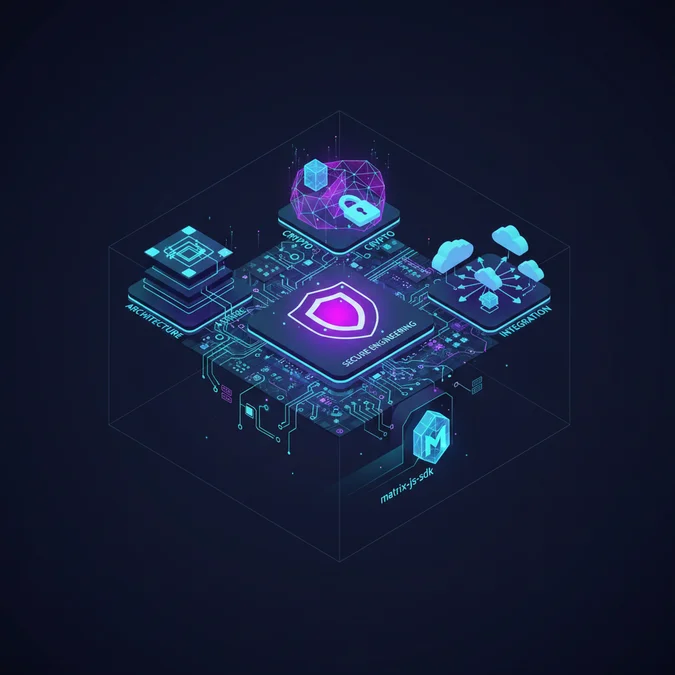

matrix-js-sdk is the official JavaScript and TypeScript client library for building decentralized, federated communication applications on the open Matrix protocol. It provides comprehensive primitives for room management, event synchronization, end-to-end encryption using Olm and Megolm, and real-time state synchronization across distributed homeservers.
Why do engineering teams still deploy fragmented proprietary messaging systems when zero-trust, federated communication architectures are readily available? Implementing decentralized identity, multi-device cryptography, and real-time synchronization introduces severe security failure modes if client storage, state machines, and cryptographic session ratchets are not implemented with extreme paranoia. A single vulnerability in cross-signing validation or token storage can compromise the integrity of an entire communication mesh.
This architectural guide examines the mechanics of the matrix-js-sdk client library through the lens of strict security engineering. We break down the synchronization engine, multi-device state management, cryptographic lifecycle primitives, token authorization workflows, and defensive integration strategies within modern enterprise backends.
Core Architecture and the Client Synchronization Loop
The core runtime of matrix-js-sdk is built around the MatrixClient class, which operates an persistent, long-polling HTTP loop against the Matrix client-server API (specification versions r0.6.1 through v1.11). This sync engine abstracts homeserver federation, processing incremental state deltas, ephemeral typing notifications, read receipts, and encrypted timeline payloads. From a systems perspective, the library acts as an event-driven state container where homeserver state is mirrored into local memory or persistent cache layers.
At the center of client stability and memory management is the synchronization token, commonly referred to as the since parameter. The client issues a long-poll request to the /_matrix/client/v3/sync endpoint. When transactions occur across the federated network, the homeserver resolves room Directed Acyclic Graphs (DAGs) and emits a consolidated JSON delta. If the client fails to persist or ratchets backwards this sync token, duplicate event processing or critical state desynchronization occurs.
import * as sdk from "matrix-js-sdk";

// Minimal defensive client configuration
const client = sdk.createClient({
 baseUrl: "https://matrix.internal.domain",
 accessToken: "syt_aHR0cHM..", // Must be stored strictly in memory or hardened keystores
 userId: "@sec_auditor:internal.domain",
 deviceId: "DEVICE_SEC_NODE_01",
 timelineSupport: true,
});

// Register core state event emitter listeners
client.on(sdk.ClientEvent.Sync, (state, prevState, data) => {
 if (state === "PREPARED") {
 console.info("Sync state machine prepared. Initial snapshot acquired.");
 } else if (state === "SYNCING") {
 // Continuous operation state
 } else if (state === "ERROR") {
 console.error("Sync stream encountered transport or auth failure", data?error);
 }
});

await client.startClient({ initialSyncLimit: 20 });
The sync loop operates under three distinct operational states: PREPARED, SYNCING, and CATCHUP. In defensive architectures, client instances running in memory-constrained environments must carefully configure sync filters. Failure to apply restrictive Filter definitions causes the homeserver to send massive backlogs of state events, leading to high heap allocations and potential client crash scenarios.
Cryptographic Foundations: Olm and Megolm Protocols
Matrix achieves end-to-end encryption (E2EE) through two layered cryptographic protocols: Olm and Megolm. Olm implements a cryptographic ratchet modeled on the Double Ratchet Algorithm pioneered by Signal, establishing pairwise mutual authentication and forward secrecy between distinct device pairs. Olm handles 1-to-1 key exchange, device verification handshakes, and ephemeral payload delivery.
Megolm is an encrypted group messaging protocol engineered to balance cryptographic overhead across expansive communication rooms. Rather than encrypting a single room message N times for N recipients using Olm, a sending device establishes a Megolm outbound session. This session ratchets forward with every emitted message using symmetric Advanced Encryption Standard in Galois/Counter Mode (AES-256-GCM) combined with HMAC-SHA-256 for message authentication. The outbound session key is subsequently encrypted individually for each authorized room member’s device using their established Olm sessions.
| Metric / Attribute | Olm Protocol | Megolm Protocol |
|---|---|---|
| Cryptographic Design | Double Ratchet (Diffie-Hellman + KDF) | Symmetric Ratchet (AES-256-GCM + HMAC) |
| Target Environment | Direct 1-to-1 sessions / Key distribution | Multi-user group rooms and channels |
| Forward Secrecy | Continuous per-message ratchet | Ratchet forward only (Historical secrecy preserved) |
| Break-in Recovery | Yes (via asymmetric DH ratchet updates) | No (compromise of current key leaks subsequent events) |
| Key Distribution Overhead | O(N) pairwise handshakes | O(1) message encryption, O(N) one-time key share |
To implement this in production, matrix-js-sdk relies on the Rust-based Matrix SDK Crypto WebAssembly binding (or historical legacy libolm). The crypto state engine requires absolute isolation. If an outbound Megolm session key is backed up without explicit passphrase encryption or shared across unsecured domestic storage layers, historical forward secrecy properties collapse completely across all linked rooms.
Storage Subsystems and Zero-Trust Session Persistence
State persistence in client-side applications represents the most exploited attack vector in decentralized communication systems. matrix-js-sdk abstracts storage through two primary driver classes: the client state store (MemoryStore or IndexedDBStore) and the cryptographic store (IndexedDBCryptoStore or memory-based crypto stores). Choosing the wrong storage abstraction directly undermines identity verification and key confidentiality.
Storing unencrypted session access tokens or Megolm inbound keys inside standard browser localStorage is an architectural violation of basic security fundamentals. Web applications vulnerable to Cross-Site Scripting (XSS) allow arbitrary JavaScript runtimes to scrape keys directly from the window context. When configuring the SDK for modern browser environments, engineers must deploy encrypted IndexedDBStore instances backed by WebCrypto-derived storage keys.
import { IndexedDBStore, IndexedDBCryptoStore } from "matrix-js-sdk";

// Construct secure persistent client and crypto stores
const clientStore = new IndexedDBStore({
 indexedDB: window.indexedDB,
 localStorage: window.localStorage,
 dbName: "matrix_secure_state_cache",
});

const cryptoStore = new IndexedDBCryptoStore(
 window.indexedDB,
 "matrix_megolm_crypto_cache"
);

// Mandatory state initialization prior to starting client
await clientStore.startup();

const client = sdk.createClient({
 baseUrl: "https://matrix.internal.domain",
 idStore: clientStore,
 store: clientStore,
 cryptoStore: cryptoStore,
 userId: "@auditor:internal.domain",
 deviceId: "AUDIT_DESKTOP_1",
});
In high-assurance security models, even encrypted IndexedDB mechanisms on disk may present unacceptable residual risk. In such environments, ephemeral in-memory stores are enforced. This architectural choice necessitates that keys are discarded immediately upon session termination, requiring cryptographic verification rituals upon every cold initialization cycle.
Device Verification and Cross-Signing Mechanics
In federated architectures, identity assertion cannot rely exclusively on a homeserver’s authentication database. Homeservers operate untrusted with respect to message content and device identity. A compromised homeserver could quietly introduce a rogue virtual device into a user’s account, injecting public keys into rooms to intercept Megolm session distribution. To defeat this threat model, matrix-js-sdk implements Cross-Signing and interactive verification via SAS (Short Authentication String).
Cross-signing relies on a hierarchical three-key trust framework rooted in a user-controlled Master Key:
- Master Key (MSK): The root cryptographic authority for a user’s identity. Signs both user-signing and self-signing subordinate keys.
- Self-Signing Key (SSK): Signs the user’s own auxiliary devices, validating that a given client instance belongs to the authenticated account owner.
- User-Signing Key (USK): Signs the Master Keys of other external users, establishing a cryptographic Web of Trust that bypasses centralized directory reliance.
Interactive device verification is completed through the SAS emoji or decimal verification ritual. Two devices derive a shared secret using Diffie-Hellman ephemeral keys over an established encrypted Olm channel, passing the resulting entropy through HKDF (HMAC-based Extract-and-Expand Key Derivation Function) to render identical visual sequences to human operators.
// Listening for inbound verification requests from new devices
client.on(sdk.CryptoEvent.VerificationRequestReceived, async (request) => {
 // Verify caller public identity against authorization policies
 if (request.fromUserId!== client.getUserId()) {
 console.warn("External user verification initiated:", request.fromUserId);
 }

 const verifier = request.beginKeyVerification("m.sas.v1");
 verifier.on("show_sas", (sasData) => {
 // SAS data renders emojis or decimal blocks to user interface
 const visualEmojis = sasData.sas.emoji;
 renderSasVerificationDialog(visualEmojis, async (userConfirmed) => {
 if (userConfirmed) {
 await sasData.confirm();
 } else {
 sasData.mismatch();
 }
 });
 });
 await verifier.verify();
});
If a developer bypasses cross-signing checks and configures client instances to silently auto-trust unverified devices, they render the entire Megolm encryption architecture completely ineffective against malicious homeserver administrators or Man-in-the-Middle (MitM) key injection.
Room State Resolution and Directed Acyclic Graph Processing
A Matrix room is not a static database table; it is a distributed, cryptographically signed Directed Acyclic Graph (DAG) of state and message events replicated across all participating homeservers. When concurrent network partitions occur across federated domains, divergent branches emerge within the room DAG. Resolving these partitions without centralized arbitration requires State Resolution Version 2 (State Res v2).
State Res v2 relies on event authentication authorization rules, cryptographic signing chains, and an iterative topological sort that resolves conflicting room permissions and membership states. While the heavy computational burden of DAG sorting is carried by homeserver processes, matrix-js-sdk continuously tracks, validates, and renders local state changes emitted down the /sync pipeline.
Developers using the client SDK must handle race conditions inherent to eventually consistent DAG models. When emitting room state modifications, such as updating room power levels or membership status, optimistic UI updates must be avoided until the homeserver returns a signed event identifier. For applications built with real-time UI stacks like modern full-stack web platforms, balancing local client cache responsiveness with definitive DAG consensus requires defensive event ordering handlers.
Threat Modeling and the OWASP Top 10 Context
Integrating matrix-js-sdk into web, desktop (Electron), or server environments exposes unique interfaces to traditional and decentralized vulnerabilities. Mitigating these risks requires applying the OWASP Top 10 framework directly to Matrix client interactions.
- A01: Broken Access Control: In Matrix, authorization is defined via Room Power Levels. An event modifying
m.room.power_levelscan strip administrative rights. Clients must never rely on local state assumption; every privileged action must verify authorization directly against current room state snapshots before UI exposure. - A02: Cryptographic Failures: Failing to securely generate random device keys or mishandling Megolm inbound session decryption failures. Catching decryption errors silently without alerting the user enables stealth ciphertext-dropping attacks.
- A03: Injection (Event Payload Spoofing): Matrix event contents are arbitrary JSON structures. If custom client components inject raw
content.bodyvalues into DOM structures without strict sanitization, Cross-Site Scripting (XSS) is virtually guaranteed. - A07: Identification and Authentication Failures: Storing raw access tokens in non-HTTP-only locations or failing to invalidate stale device registrations upon logout leads to chronic session hijacking vulnerabilities.
When orchestrating complex full-stack web architectures, rendering untrusted rich text emitted from federated Matrix rooms demands strict contextual encoding. Using tools like DOMPurify with rigorous allowlists is mandatory before rendering any serialized Matrix event body.
Defensive Code Implementation: Hardened Room Client
The following production-grade implementation demonstrates the initialization of a defensive Matrix room client. This snippet establishes strict sync filtering, cryptographic verification requirements, sanitized event decoding, and fault-tolerant error boundaries.
import * as sdk from "matrix-js-sdk";
import DOMPurify from "dompurify";

interface ClientSecureConfig {
 homeserverUrl: string;
 accessToken: string;
 userId: string;
 deviceId: string;
}

export class DefensiveMatrixNode {
 private client: sdk.MatrixClient;

 constructor(private config: ClientSecureConfig) {
 this.client = sdk.createClient({
 baseUrl: config.homeserverUrl,
 accessToken: config.accessToken,
 userId: config.userId,
 deviceId: config.deviceId,
 timelineSupport: true,
 // Enforce secure crypto callbacks
 cryptoCallbacks: {
 getSecretStorageKey: async ({ keys }, name) => {
 throw new Error("Raw key extraction forbidden in strict mode");
 },
 },
 });
 }

 public async initialize(): Promise {
 // Configure strict event synchronization filter
 const secureFilter = new sdk.Filter(this.config.userId);
 secureFilter.setTimelineLimit(25);
 secureFilter.setUnreadThreadNotifications(false);

 // Bind room message listener with strict DOM sanitization
 this.client.on(sdk.RoomEvent.Timeline, (event, room, toStartOfTimeline) => {
 if (toStartOfTimeline || event.getType()!== "m.room.message") {
 return;
 }

 // Enforce device trust boundary validation
 const senderId = event.getSender();
 const isEncrypted = event.isEncrypted();

 if (!isEncrypted) {
 console.warn(`Unencrypted event rejected in zero-trust channel: ${event.getId()}`);
 return;
 }

 const rawBody = event.getContent().body || "";
 // Strictly sanitize output to mitigate OWASP A03 / XSS
 const cleanContent = DOMPurify.sanitize(rawBody, {
 ALLOWED_TAGS: ["b", "i", "em", "strong", "code", "pre"],
 ALLOWED_ATTR: [],
 });

 this.dispatchToSecurePipeline(room.roomId, senderId, cleanContent);
 });

 // Initialize local crypto verification engine
 await this.client.initCrypto();
 await this.client.startClient({ filter: secureFilter });
 }

 private dispatchToSecurePipeline(roomId: string, sender: string, content: string): void {
 // Process validated, sanitized data down the enterprise bus
 }
}
In enterprise installations, client event ingestion routines should integrate cleanly with centralized backend queue architectures. For systems passing Matrix event notifications through queue topologies, maintaining transactional event boundaries ensures that transient worker drops do not cause event loss across audit records.
Backend Integration Patterns with Laravel and Distributed Services
While matrix-js-sdk runs natively in browser runtimes and Node.js environments, enterprise backends frequently integrate Matrix events into broader application workflows. In modern distributed systems, PHP application tiers like Laravel do not handle real-time WebSockets or long-polling sync loops directly within request cycles. Instead, a Node.js microservice running matrix-js-sdk acts as an edge cryptographic gateway, proxying sanitized, decrypted payloads internally to backend workers.
This decoupled pattern protects the primary enterprise application from the high memory overhead of persistent client sync loops and local Olm session caches. For teams building administrative dashboards, reactive components built on modern reactive interfaces can poll verified application state updates cleanly without maintaining raw Matrix cryptographic identities in user sessions.
Similarly, single-page application shells driven by unified state managers often bridge Matrix communication events using hybrid routing approaches. Reviewing hybrid architecture patterns provides valuable architectural clarity on keeping client-side state models aligned with enterprise backend controllers.
When handling massive Matrix event streams across federated rooms, the Node.js ingress layer must push events into persistent message brokers. Relying on dedicated worker topologies like robust background processing systems ensures high-throughput message consumption, decoupling real-time synchronization rates from database write constraints.
Network Resilience, Federation Delays, and Reconnection
Federated networks introduce unique network failure modes. A network split between homeserver domains, latency spikes in state signing, or sudden homeserver rate-limiting (HTTP 429 Too Many Requests) can disrupt client synchronization loops. The matrix-js-sdk provides resilient connection management, but default behaviors must be reinforced to prevent catastrophic cascading failures.
When a homeserver rate-limits a client, the response contains a retry_after_ms payload in the JSON error body. Naive client implementations loop immediately on network errors, triggering harsh IP bans from homeserver reverse proxies like Synapse or Dendrite. The client configuration must enforce exponential backoff with jitter to smooth recovery profiles across fleet deployments.
// Hardening network transport retry rules
const client = sdk.createClient({
 baseUrl: "https://matrix.internal.domain",
 accessToken: token,
 requestConfig: {
 retry: {
 maxRetries: 5,
 retryCondition: (error) => {
 // Retry on transient network drops and rate limits
 return sdk.isMatrixError(error) && (
 error.httpStatus === 429 ||
 error.httpStatus >= 500
 );
 },
 },
 },
});
During extended network disconnections, Megolm session keys may rotate on the homeserver while the client is offline. Upon reconnecting, the client may receive events it cannot decrypt, resulting in the UISI (Unable to Decrypt: Unknown Inbound Session ID) state. The client architecture must handle these events gracefully, queuing room positions and issuing targeted key-forwarding requests using verified Olm channels.
Performance Bottlenecks and Memory Optimization
Running matrix-js-sdk inside high-volume enterprise environments or low-powered mobile wrapper runtimes quickly exposes memory bottlenecks. Because the library preserves event timelines, user profiles, room memberships, and cryptographic session states in client memory, unoptimized long-running sessions can leak hundreds of megabytes within hours.
Three architectural settings dictate the memory profile of the client runtime:
- Timeline Windowing: Setting
timelineSupport: truewith strict limits prevents infinite growth of the in-memory room timeline array. Discarding old timeline nodes outside the active viewport stabilizes DOM and JavaScript memory footprints. - User Profile Caching: In federated rooms with tens of thousands of members, storing the profile data of every inactive user creates massive heap bloat. Enabling lazy-loading of room members (
lazyLoadMembers: truein the sync filter) ensures profile data is fetched only when a member actively emits a message. - Crypto Key Pruning: Inbound Megolm sessions accumulate indefinitely unless explicitly managed. Expired or unreferenced session keys must be archived to disk-backed stores (like IndexedDB) rather than held permanently in V8 heap allocations.
Implementing these three mitigations reduces baseline heap consumption by up to 75% in enterprise communication portals containing dense room rosters.
Security Auditing, Key Backup, and Secret Storage
Secure Secret Storage (SSSS) and Server-Side Key Backup are core security layers of the Matrix ecosystem. When an operator migrates between hardware devices, historical Megolm messages cannot be decrypted without the private key material distributed exclusively to previous endpoints. To preserve message history securely without granting the homeserver plaintext access, the SDK coordinates SSSS workflows.
The client derives a Key Backup Key from a user recovery passphrase using PBKDF2 (or Argon2id in advanced configurations) coupled with high work factors (minimum 500,000 iterations). Megolm session keys are encrypted locally with this recovery key and pushed to the homeserver via the /_matrix/client/v3/room_keys/keys endpoint. The homeserver stores solely the encrypted ciphertext blob, maintaining complete zero-knowledge isolation.
Auditing these operational workflows requires strict verification of cryptographic primitives during runtime. Teams must enforce static analysis rules prohibiting unencrypted key recovery fallbacks, run periodic fuzzing against event parser layers, and ensure all backup exchanges are tied to verified cross-signing master identities.
Total Cost of Ownership and Infrastructure Economics
Engineering, deploying, and maintaining high-assurance Matrix communications infrastructure involves substantial financial and operational commitments. Whether an organization chooses to operate self-hosted Matrix infrastructure or contract external engineering services, the total cost model diverges significantly across scale, security posture, and compliance demands.
The table below breaks down realistic industry cost ranges for deploying and maintaining production-grade Matrix systems integrated via matrix-js-sdk.
| Deployment & Support Tier | Monthly Retainer / Cloud Cost | Hourly Specialist Rate | Upfront Implementation Budget |
|---|---|---|---|
| Standard Enterprise Gateway (1,000 Users) | $2,500 to $4,500 / month | $150 to $200 / hour | $25,000 to $45,000 |
| High-Compliance Federated Node (10,000 Users) | $6,500 to $12,000 / month | $200 to $275 / hour | $60,000 to $110,000 |
| Zero-Trust Dedicated Security Mesh (50,000+ Users) | $15,000 to $32,000 / month | $275 to $375 / hour | $150,000 to $300,000 |
Key drivers behind operational expenditures include:
- Cryptographic and State Storage Overhead: High-throughput federation requires dedicated high-IOPS NVMe PostgreSQL clusters to handle DAG state resolution without degrading sync latency.
- Security Maintenance and Audits: Independent third-party cryptographic reviews for WebAssembly bindings, client token storage, and protocol implementations typically require $30,000 to $70,000 per review cycle.
- Developer Integration Complexity: Structuring resilient, leak-free TypeScript and Node.js microservices requires specialized systems expertise compared to traditional centralized REST APIs.
Cluster Knowledge Hub Integration
Decentralized messaging and real-time state synchronization represent only one layer of modern enterprise software architecture. Robust applications require a solid foundation of backend service management, dependable background processing, and rock-solid architectural fundamentals.
Explore our complete Laravel, Basics directory for more guides.
Building secure decentralized communications with matrix-js-sdk demands an uncompromising, zero-trust mindset. Homeservers must be treated as untrusted transport brokers, and client-side runtimes must enforce rigorous local state validation, isolated cryptographic key stores, and disciplined memory management. By implementing cross-signing verification, sanitizing dynamic event payloads against injection vulnerabilities, and decoupling edge cryptographic synchronization from core backend services, engineering teams can build resilient communication platforms that protect user privacy without sacrificing operational scale.
Prioritize these key decision factors before moving to production: enforce strict IndexedDB crypto storage, enable lazy loading of room rosters to protect client memory, implement automated SAS cross-signing workflows, and sanitize every timeline event at the application boundary.