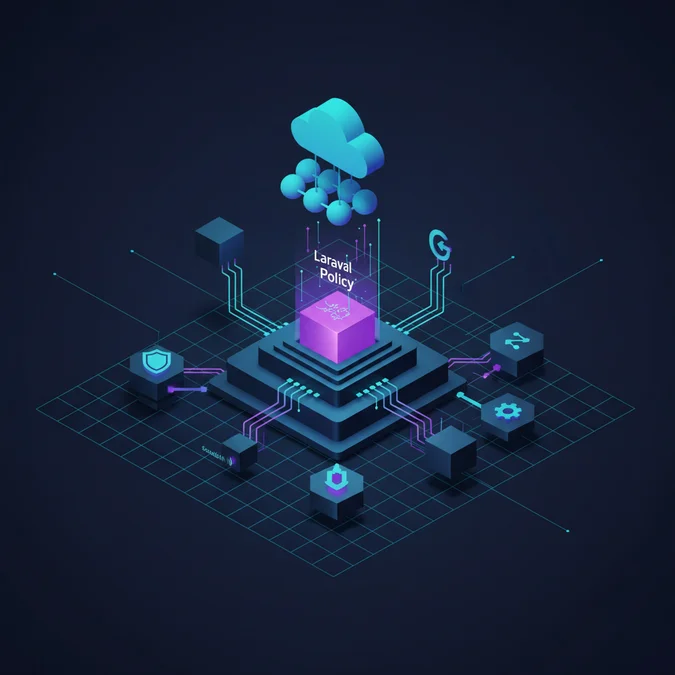

A Laravel policy is an authorization class that organizes granular access control logic around a specific Eloquent model or business domain resource. Policies evaluate whether an authenticated user possesses the operational privileges to view, create, update, or delete records, isolating authorization checks entirely from HTTP controllers and domain services.
Historically, early PHP frameworks encouraged developers to interleave authorization checks directly into database queries or controller action methods. As codebases scaled, this distributed logic produced silent privilege escalations, audit gaps, and severe code duplication across API endpoints and web routes. The introduction of standardized policy classes in Laravel decoupled authorization from transport mechanisms, establishing an explicit, object-oriented security barrier that engineering teams can unit test, audit, and refactor independently of the presentation layer.
From an architectural standpoint, adopting policies stabilizes application growth. By replacing ad-hoc condition checks with dedicated access contracts, organizations lower the ongoing engineering overhead of access management, eliminate recurring privilege leakage bugs, and maintain predictable delivery velocity even as resource relationships expand across microservices and enterprise domain models.
Core Mechanics of Laravel Authorization and Policy Discovery
At its core, Laravel coordinates authorization through the Illuminate\Auth\Access\Gate service, which sits inside the foundational service container. When an application queries whether a user can perform an action on a model instance, the Gate inspects registered policies before falling back to ad-hoc closures or inline gates. The engine extracts the fully qualified class name of the target resource, searches the policy map, and delegates execution to the matching method.
Modern Laravel versions employ automated policy discovery by standard reflection conventions. If an Eloquent model resides in App\Models\Invoice, the framework dynamically searches for an authorization counterpart in App\Policies\InvoicePolicy. This automated binding eliminates manual registration boilerplate, though high-throughput systems often explicitly cache or register policy maps within the AuthServiceProvider to bypass runtime class-existence checks under heavy traffic.
<php

namespace App\Providers;

use App\Models\Invoice;
use App\Policies\InvoicePolicy;
use Illuminate\Foundation\Support\Providers\AuthServiceProvider as ServiceProvider;

class AuthServiceProvider extends ServiceProvider
{
 /**
 * Explicitly map models to avoid reflection lookups in hot paths.
 */
 protected $policies = [
 Invoice:class => InvoicePolicy:class,
 ];

 public function boot(): void
 {
 $this->registerPolicies();
 }
}
During execution, the Gate matches incoming parameters against the target policy method signature. The authenticated user context is injected automatically as the first parameter. If an unauthenticated guest requests access, the framework halts evaluation immediately unless the target policy method explicitly declares the user argument as nullable or types it with an optional contract.
Anatomy of a Production-Grade Policy Class
A production-ready policy mirrors RESTful and domain-level actions. Methods typically conform to standard names such as viewAny, view, create, update, delete, restore, and forceDelete. However, complex enterprise architectures routinely introduce explicit business operations like approve, void, or exportComplianceData directly onto the policy.
Writing durable policies requires isolating security rules from deep persistence queries. Policies should execute pure contextual logic on already-loaded entity states rather than triggering surprise database queries inside an authorization loop. Below is a resilient policy implementation containing standard access logic alongside role hierarchies and status checks:
<php

namespace App\Policies;

use App\Models\Invoice;
use App\Models\User;
use Illuminate\Auth\Access\Response;

class InvoicePolicy
{
 /**
 * Grant access to view any invoices within tenant scope.
 */
 public function viewAny(User $user): bool
 {
 return $user->tokenCan(\'invoices:read\') || $user->hasRole(\'finance_auditor\');
 }

 /**
 * Determine if the user can modify the given invoice record.
 */
 public function update(User $user, Invoice $invoice): Response
 {
 // Prevent mutations on finalized accounting documents
 if ($invoice->is_locked) {
 return Response:deny(\'Locked invoices cannot be altered. Void or credit instead.\');
 }

 // Multi-tenant boundary verification
 if ($user->organization_id!== $invoice->organization_id) {
 return Response:denyAsNotFound();
 }

 return $user->id === $invoice->created_by || $user->hasRole(\'finance_manager\')? Response:allow(): Response:deny(\'Insufficient permissions to modify this invoice.\');
 }
}
Using Response:denyAsNotFound() is an essential defense-in-depth practice. When unauthorized actors attempt to probe resources across organizations, throwing standard HTTP 403 Forbidden statuses verifies that the targeted identifier exists. Returning a 404 response eliminates record enumeration vectors completely.
Gates Versus Policies: Technical Decision Matrix
Software architects frequently encounter confusion regarding when to employ ad-hoc Gates versus structured Policies. While both share the underlying Gate infrastructure, they serve diverging operational complexities. Ad-hoc gates excel at ambient or action-based permissions not tied to any individual database model, such as accessing a system diagnostics dashboard or triggering maintenance mode.
In contrast, Policies represent resource-centric authorization boundaries. When authorization decisions depend on the properties, relationships, or state lifecycle of a discrete model instance, routing logic through a policy is non-negotiable. Failing to maintain this distinction results in unmanageable service providers filled with hundreds of unstructured closure bindings.
| Evaluation Metric | Ad-Hoc Gates | Resource Policies |
|---|---|---|
| Primary Domain Scope | Global, action-based, operational | Entity-based, resource lifecycle |
| Target Subject | No entity or arbitrary payload | Concrete Model instance or Class |
| Discoverability | Manual registration in providers | Automated naming-convention discovery |
| Test Isolation | Requires binding mock Gate instances | Simple unit-testable plain PHP classes |
| Maintainability at Scale | Low (causes bloated config providers) | High (one modular file per resource) |
As applications expand, standardizing on policies for every business model creates a self-documenting security boundary. Junior engineers immediately recognize where authorization rules live, reducing cognitive fatigue and preventing accidental security omissions.
Invoking Policies Across Controllers, Form Requests, and Blade
Laravel exposes multiple clean surfaces to execute policy evaluations across the HTTP lifecycle. The most common entry point is within resource controllers using the standard authorize helper method inherited from the base controller. If evaluation fails, Laravel instantly throws an AuthorizationException, rendering an HTTP 403 or 404 depending on the policy response.
<php

namespace App\Http\Controllers;

use App\Models\Invoice;
use Illuminate\Http\Request;
use Illuminate\Http\JsonResponse;

class InvoiceController extends Controller
{
 public function update(Request $request, Invoice $invoice): JsonResponse
 {
 // Automatically triggers InvoicePolicy:update
 $this->authorize(\'update\', $invoice);

 $invoice->update($request->validated());

 return response()->json($invoice);
 }
}
For architectural cleanliness, authorization can also occur upstream inside Form Requests. Evaluating authorization before running input validation rules protects database resources from unnecessary parsing and sanitization when the client lacks foundational privileges.
<php

namespace App\Http\Requests;

use App\Models\Invoice;
use Illuminate\Foundation\Http\FormRequest;

class UpdateInvoiceRequest extends FormRequest
{
 public function authorize(): bool
 {
 $invoice = $this->route(\'invoice\');
 return $invoice && $this->user()->can(\'update\', $invoice);
 }

 public function rules(): array
 {
 return [
 \'amount\' => [\'required\', \'numeric\', \'min:0\'],
 \'notes\' => [\'nullable\', \'string\', \'max:1000\'],
 ];
 }
}
In presentation layers such as Blade templates, developers can conditionally render actionable interface controls using directives like @can and @cannot. This ensures users only see interface actions they are actively permitted to run, reducing user error and mismatched state states.
Handling Global Overrides and Interception with the Before Hook
High-tier administrative access often demands universal bypass rules. Rather than scattering conditionals like if ($user->is_super_admin) inside every individual policy method, Laravel provides the before method. When declared on a policy, the Gate executes before prior to any other evaluation check.
Returning a boolean true from before grants unconditional permission for the incoming request, while returning a boolean false denies it immediately, halting downstream method execution. Returning null instructs the authorization runner to fall through directly to the requested specific policy method.
<php

namespace App\Policies;

use App\Models\User;

class InvoicePolicy
{
 /**
 * Perform pre-authorization checks.
 */
 public function before(User $user, string $ability):bool
 {
 // Unconditional bypass for system administrators
 if ($user->hasRole(\'super_admin\')) {
 return true;
 }

 // Revoked or suspended accounts are universally barred
 if ($user->is_suspended) {
 return false;
 }

 // Fall through to specific policy methods
 return null;
 }
}
Architects must exercise discipline when applying before hooks. Overusing permissive returns creates blind spots during audit trails and can unintentionally allow administrators to mutate immutable compliance records, such as finalized financial ledgers or signed contracts.
Architectural Anti-Patterns: Solving the N+1 Authorization Bottleneck
The single greatest operational hazard associated with policies in growing applications is the N+1 authorization bottleneck. This anti-pattern manifests when developers attempt to filter collections or database queries by looping through models and invoking $user->can(\'view\', $model). Evaluating hundreds of models sequentially destroys system throughput.
Consider an administrative dashboard displaying 100 projects. If the project policy checks whether the user belongs to the project via an unloaded relationship, invoking the policy inside a loop triggers 100 secondary SQL queries. Even if relationships are eagerly loaded, cycling through thousands of records in memory exhausts PHP process memory limits.
<php

// ANTI-PATTERN: In-memory collection filtering via policy
$visibleInvoices = Invoice:all()->filter(function ($invoice) use ($user) {
 return $user->can(\'view\', $invoice);
}); // Triggers extreme latency and memory bloat on large tables
The correct architectural resolution shifts authorization boundaries down into the persistence engine using scope queries. Policies must govern access to specific records or commands, while query scopes or view repositories restrict data retrieval at the database level.
<php

// SCALABLE PATTERN: Database-level scope projection
$visibleInvoices = Invoice:query()
 ->accessibleBy($user)
 ->paginate(25);
By unifying query scopes with policy criteria, database indexes absorb the filtering workload. This keeps page generation speeds under 50 milliseconds regardless of total table volume.
Writing Isolated Unit Tests for Authorization Policies
A major benefit of organizing authorization into standalone policies is test velocity. Because policies are plain PHP classes containing deterministic condition logic, engineers can execute lightning-fast unit tests without booting complete HTTP request kernels or dispatching controller routing pipelines.
Testing policies independently isolates security failure points. You can pass mock users and hydrated, unpersisted Eloquent models directly into methods, verifying complex matrix permissions in sub-millisecond execution windows.
<php

namespace Tests\Unit\Policies;

use App\Models\Invoice;
use App\Models\User;
use App\Policies\InvoicePolicy;
use PHPUnit\Framework\TestCase;

class InvoicePolicyTest extends TestCase
{
 private InvoicePolicy $policy;

 protected function setUp(): void
 {
 parent:setUp();
 $this->policy = new InvoicePolicy();
 }

 public function test_user_cannot_update_locked_invoice(): void
 {
 $user = new User([\'id\' => 1, \'organization_id\' => 10]);
 $invoice = new Invoice([
 \'organization_id\' => 10,
 \'created_by\' => 1,
 \'is_locked\' => true,
 ]);

 $response = $this->policy->update($user, $invoice);

 $this->assertFalse($response->allowed());
 $this->assertSame(\'Locked invoices cannot be altered. Void or credit instead.\', $response->message());
 }
}
Maintaining an aggressive unit testing suite for policies ensures authorization refactoring carries zero risk. Teams reviewing changes through code collaboration systems like hardened Git development environments can confirm authorization integrity prior to deployment pipelines.
Multi-Tenant Authorization and Boundary Enforcement
In multi-tenant software architectures, horizontal privilege escalation represents an existential operational risk. A horizontal privilege escalation occurs when Tenant A crafts requests targeting identifiers belonging to Tenant B. Implementing robust policies provides an infallible line of defense against cross-tenant data leakage.
Rather than relying solely on global database scopes, policies should validate tenant tenancy identifiers explicitly on every state-altering action. When policy methods verify that the entity organization matches the request user organization, cross-tenant leakage becomes structurally impossible even if an engineer forgets a query constraint elsewhere in the stack.
<php

namespace App\Policies;

use App\Models\CustomerRecord;
use App\Models\User;
use Illuminate\Auth\Access\Response;

class CustomerRecordPolicy
{
 public function delete(User $user, CustomerRecord $record): Response
 {
 // Strict organization boundary validation
 if ($user->tenant_id!== $record->tenant_id) {
 // Return 404 to prevent resource existence leaking
 return Response:denyAsNotFound();
 }

 return $user->hasRole(\'tenant_admin\')? Response:allow(): Response:deny(\'Only tenant administrators may purge customer records.\');
 }
}
This defense-in-depth approach is vital when integrating external corporate systems or identity providers via complex enterprise web service integrations, where API keys and customer records map directly to enterprise client boundaries.
Auditing, Logging, and Security Compliance Integration
Regulatory compliance frameworks such as SOC 2, HIPAA, and ISO 27001 demand auditable trails for authorization denials and sensitive operational invocations. Leaving authorization decisions silent impedes forensic investigations following security incidents.
Laravel allows teams to attach listeners directly to the Gate evaluation cycle. By subscribing to authorization events, systems can automatically dispatch structured audit logs whenever critical permissions are denied or whenever high-clearance administrative policies are triggered.
<php

namespace App\Providers;

use Illuminate\Support\Facades\Gate;
use Illuminate\Support\Facades\Log;
use Illuminate\Support\ServiceProvider;

class SecurityAuditServiceProvider extends ServiceProvider
{
 public function boot(): void
 {
 Gate:after(function ($user, $ability, $result, $arguments) {
 // Log security-sensitive authorization failures
 if (!$result) {
 Log:warning(\'Authorization failed\', [
 \'user_id\' => $user?->id,
 \'ability\' => $ability,
 \'target\' => is_object($arguments[0]? null)? get_class($arguments[0]): null,
 \'ip\' => request()->ip(),
 ]);
 }
 });
 }
}
Structured authorization logging surfaces malicious automated scanning, identifies misconfigured frontend interfaces, and gives compliance officers indisputable evidence of consistent perimeter enforcement.
Exploring the Complete Laravel Foundation
Mastering authorization mechanisms is merely one component of designing maintainable, secure software. For additional architectural breakdowns covering routing, validation, queuing pipelines, and core service container internals, check out our expansive library.
Explore our complete Laravel, Basics directory for more guides.
Laravel policies provide a scalable, deterministic foundation for managing authorization across enterprise applications. By strictly decoupling entity permission logic from presentation controllers and HTTP inputs, engineering teams lower code duplication, eliminate dangerous horizontal escalation bugs, and safeguard multi-tenant data boundaries.
To maintain clean long-term architecture, always pair policies with database-level query scopes to avoid N+1 evaluation traps, test your policies in lightweight unit suites without HTTP overhead, and use explicit response denials to protect resource existence from unauthorized actors.