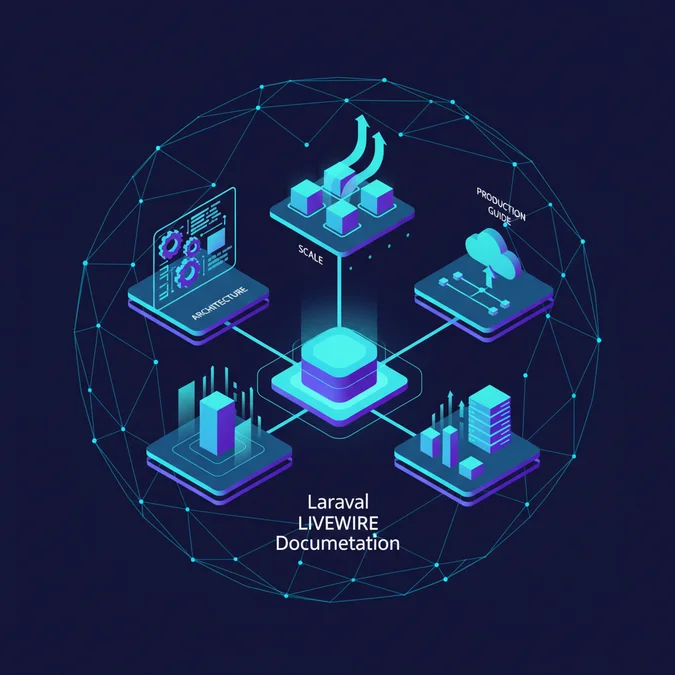

Laravel Livewire is a full-stack framework for Laravel that makes building dynamic interfaces simple, without leaving the comfort of standard PHP. Official documentation specifies that Livewire components run exclusively on the server, synchronizing state with the browser DOM through recurring AJAX requests or WebSockets without requiring a dedicated JavaScript single-page application framework.
Livewire cannot replace dedicated client-side computation engines for graphics-intensive interfaces, offline-first mobile applications, or high-frequency input canvas rendering. Because every mutating user interaction triggers a round-trip network request back to a PHP execution environment, trying to build real-time audio processors, 60 FPS animation loops, or network-disconnected mobile frontends directly within Livewire components creates untenable latency bottlenecks.
For enterprise systems and SaaS architectures, Livewire bridges the gap between traditional server-side rendering and client-heavy reactive frameworks. Operating Livewire reliably under massive concurrent load requires cloud engineers and systems architects to understand its internal network protocol, component lifecycle hooks, state snapshot hydration mechanisms, and horizontal scaling dependencies across distributed infrastructure.
Laravel Livewire Architecture and the Wire Protocol
Laravel Livewire operates on a client-server synchronization pattern known as the Wire Protocol. When a client requests a page containing a Livewire component, the Laravel application processes an initial GET request through the standard HTTP kernel, rendering the Blade view alongside a serialized JSON snapshot of the component public state.
This initial snapshot includes the component cryptographic checksum, data payload, and metadata required for subsequent hydration. Once the browser paints the HTML, the client-side Livewire JavaScript driver attaches event listeners to DOM nodes flagged with wire: attributes. When a user interacts with a tracked element, such as typing into an input field or clicking a submission button, the client driver catches the event and dispatches an asynchronous HTTP POST request to the application endpoint, typically registered at /livewire/update.
Deconstruction of the Livewire Request-Response Payload
The update request contains the raw serialized state snapshot alongside an array of updates or method calls requested by the client. The server receives this payload and executes a distinct operational cycle:
- Signature Verification: Validates the message authentication code (HMAC) generated using the application
APP_KEYto confirm that the client has not tampered with protected or internal properties. - State Hydration: Instantiates the component class on the server, populating its public properties with values extracted from the verified payload snapshot.
- Hook and Action Execution: Executes lifecycle hooks (such as
hydrate()andupdating()) and executes the requested public method with incoming arguments. - Re-rendering: Evaluates the component
render()method to produce a freshly executed Blade template string. - DOM Morphing: The server computes an optimized response containing the newly updated snapshot and the rendered HTML. Livewire client-side morph engine (built on top of Morphdom in v2 and a custom Alpine morph engine in v3) applies minimal DOM transformations in place, preserving cursor positions and unmanaged client state.
{
 "fingerprint": {
 "id": "c4ca4238a0b923820dcc509a6f75849b",
 "name": "user-profile-editor",
 "locale": "en",
 "path": "users/settings",
 "method": "GET"
 },
 "serverMemo": {
 "data": {
 "email": "ops@modern.com",
 "planTier": "enterprise"
 },
 "checksum": "a6c1e3458bfa92305a2cd0829871bbcd5402"
 },
 "updates": [
 {
 "type": "callMethod",
 "payload": {
 "method": "recalculateQuotas",
 "params": []
 }
 }
 ]
}
Understanding this JSON exchange is necessary for systems architects because every interactive Livewire element behaves as an API endpoint, generating dynamic CPU and memory consumption profiles on the web server tier for what traditionally occurred purely on client memory.
Component Lifecycle and State Serialization Mechanics
Every component in Laravel Livewire follows a strict lifecycle model designed to reconcile stateless HTTP execution with stateful user interface interaction. The PHP class lifecycle hooks govern precisely when data is bound, validated, rendered, and stored.
The Execution Order of Hooks
Livewire triggers lifecycle hooks predictably across two distinct phases: initial mount and subsequent interaction updates. Architectural decisions regarding database queries and caching must align with these hooks to prevent query amplification and unneeded latency.
mount(): Executes once when the component is initially requested via HTTP GET. This is where dependency injection and parameter assignment take place. It never runs on subsequent update requests.hydrate(): Runs on every single update request immediately after the component instance is reconstructed from the snapshot, before any actions or updates are processed.updating()andupdated(): Fire before and after a public property is modified by the incoming request. Useful for triggering inline calculations or dynamic schema validation.render(): Executes at the conclusion of both initial page rendering and subsequent updates. It must return a valid Blade view or HTML string.dehydrate(): Executes right before the server serializes the public properties back into the response snapshot sent to the browser.
<php

namespace App\Livewire;

use Livewire\Component;
use App\Models\User;
use Illuminate\Support\Facades\Auth;

class ProfileSettings extends Component
{
 public string $username = '';
 public string $statusMessage = '';

 // Runs once during initial page load
 public function mount(): void
 {
 $user = Auth:user();
 $this->username = $user->name;
 }

 // Runs on every subsequent hydration cycle before actions trigger
 public function hydrate(): void
 {
 // Verify tenant context or reconstruct unpersisted transient models
 }

 // Hook executing specifically when $username changes
 public function updatingUsername(string $value): void
 {
 $this->validateOnly('username', [
 'username' => 'required|string|min:3|max:50'
 ]);
 }

 public function save(): void
 {
 User:where('id', Auth:id())->update([
 'name' => $this->username
 ]);

 $this->statusMessage = 'Profile synchronized successfully.';
 }

 public function render()
 {
 return view('livewire.profile-settings');
 }
}
Livewire only serializes public properties into the wire payload. Private and protected properties are stripped during dehydration. If an engineer holds a large Eloquent collection in a public property, Livewire serializes the entire collection into the encrypted wire state. This inflates request payload sizes from negligible payloads into multi-megabyte transfers, elevating memory usage on every browser update.
Horizontal Scaling and Infrastructure Requirements
Because Livewire offloads client state updates onto the server via continuous HTTP POST requests, application traffic patterns shift from low-frequency, document-style requests to high-frequency, event-driven state mutations. This shift significantly impacts web server pool capacity, CPU core utilization, and caching strategies across cloud networks.
Stateless Routing Across Load Balancers
Livewire does not require stateful sticky sessions on the load balancer (such as AWS Application Load Balancer or GCP Cloud Load Balancing). Because the complete state snapshot, checksum, and component identification are transmitted within each individual client payload, any healthy application container behind a load balancer can hydrate the component and generate the diff response.
However, the rapid succession of requests generated by features like wire:model.live creates significant connection volume. To prevent traffic saturation on standard PHP-FPM architectures, systems architects frequently integrate modern application application servers. For organizations processing heavy Livewire interaction loops, adopting high performance Laravel Octane runtimes substantially mitigates the bootstrap overhead inherent to traditional worker lifecycles by keeping the framework resident in memory across sequential requests.
| Infrastructure Metric | Traditional Blade App | Livewire Interactive App | Architectural Remedy |
|---|---|---|---|
| Requests per User Session | 1 to 3 req / min | 15 to 45 req / min | Add horizontal auto-scaling triggers based on ALB active connections. |
| CPU Load per Interaction | Negligible (handled by JS) | Moderate (PHP hydration + Blade render) | Implement aggressive server-side caching and debounced updates. |
| Session Storage Contention | Standard session locks | High write-lock collisions | Switch to atomic Redis drivers; disable blocking session locks where feasible. |
| Edge Network Caching | Full Page Cache (Varnish/Cloudflare) | Dynamic POST requests bypass edge | Employ partial rendering, micro-caching, or hybrid client hydration. |
To prevent race conditions when multiple Livewire updates fire concurrently from a single browser window, Laravel handles session serialization carefully. If using the default file-based session handler, PHP locks the session file during each request, forcing concurrent Livewire calls into a sequential queue that inflates Time to First Byte (TTFB). Production infrastructure running Livewire must utilize an in-memory cache layer like Redis, configured with non-blocking concurrency controls or optimized connection pooling via Redis Sentinel or AWS ElastiCache.
Real-Time Updates, Event Broadcasting, and WebSockets
While Livewire uses standard HTTP requests for simple interactions, scaling dynamic user interfaces often demands push-based communication from the backend. The framework implements an event system that operates locally on the client DOM, across server-side components, and over WebSockets via Laravel Echo.
Bridging Livewire with WebSockets
Triggering updates solely through polling with wire:poll introduces immense baseline strain on server infrastructure. A dashboard with 5,000 active concurrent users polling every 2 seconds generates 2,500 incoming PHP requests per second, which can quickly saturate server compute capacity.
The scalable alternative is event-driven updates. Rather than polling, Livewire components listen for events broadcast over WebSocket channels. When an external process completes, such as a background queue finishing a heavy computation or receiving an asynchronous webhook payment, the application broadcasts an event over Redis to a WebSocket gateway. Engineers working on revenue workflows can see this pattern in action when reviewing a production Laravel Stripe implementation guide, where asynchronous webhooks update order status components without page refreshes.
<php

namespace App\Livewire;

use Livewire\Component;
use Livewire\Attributes\On;

class SystemHealthMonitor extends Component
{
 public array $nodeMetrics = [];

 public function mount(): void
 {
 $this->refreshMetrics();
 }

 // Listens to frontend events or private broadcast channels
 #[On('echo-private:infrastructure.nodes,NodeMetricUpdated')]
 public function handleMetricBroadcast(array $payload): void
 {
 // Update public state dynamically when the WebSocket pushes an event
 $this->nodeMetrics[$payload['node_id']] = $payload['metrics'];
 }

 public function refreshMetrics(): void
 {
 $this->nodeMetrics = cache()->get('cloud:nodes:summary', []);
 }

 public function render()
 {
 return view('livewire.system-health-monitor');
 }
}
For teams scaling real-time collaboration or live administrative interfaces, pairing this reactive component setup with dedicated infrastructure is essential. Integrating native push workflows using an event driven Laravel WebSockets tutorial architecture decouples interface updates from recurring HTTP polling, preserving web worker headroom for actual user input processing.
Security Implications: Snapshot Tampering and Authorization Checks
Deploying Livewire components requires a thorough understanding of the unique security surface created by client-side hydration. Because public properties reside in the browser DOM within base64-encoded JSON blobs, those properties are fully visible to and modifiable by end users via developer tooling.
Defending Against Tampering
Livewire automatically signs the state snapshot using an HMAC SHA-256 hash. If an attacker modifies a public property directly inside the browser DOM and submits the request, the server detects a checksum mismatch and raises an CorruptComponentPayloadException, aborting execution immediately.
However, checksum validation does not replace domain-level access control. A frequent vulnerability arises when engineers rely solely on public component properties for business logic routing without re-verifying permissions during subsequent action invocations.
<php

namespace App\Livewire;

use Livewire\Component;
use App\Models\Project;
use Illuminate\Support\Facades\Gate;

class ProjectManager extends Component
{
 // Vulnerable pattern: Exposing sensitive models without guards
 public Project $project;

 public function mount(Project $project): void
 {
 // mount() executes once on initial load
 Gate:authorize('view', $project);
 $this->project = $project;
 }

 public function deleteProject(): void
 {
 // CRITICAL: Authorization must be re-evaluated inside action methods.
 // If an attacker invokes this method via devtools on an unauthorized component instance,
 // missing authorization checks here would permit catastrophic privilege escalation.
 Gate:authorize('delete', $this->project);

 $this->project->delete();
 $this->redirect('/projects');
 }

 public function render()
 {
 return view('livewire.project-manager');
 }
}
Protective Mechanisms
- Property Locking: Use the
#[Locked]attribute on properties that must not be manipulated from the frontend. While the HMAC already secures properties, the Locked attribute guarantees that if a client payload contains a modified value for that property, an exception terminates the request. - Strict Typing: Declare explicit PHP scalar types on all component properties. Strict types force the hydration engine to fail early if arbitrary payloads, such as nested arrays or malformed strings, are injected into primitive variables.
- Rate Limiting Actions: Expose critical actions only through throttle wrappers. Livewire components accept standard Laravel rate-limiting middleware configured at the router or executed programmatically via the
RateLimiterfacade inside component methods.
Performance Tuning and Production Optimization
When an application scales to thousands of concurrent users, unoptimized Livewire components can introduce heavy processing overhead. Optimizing performance requires minimizing payload weights, reducing unnecessary database round-trips, and refining how the browser communicates with the server.
Optimizing Network and Memory Footprints
By default, updating an input field with wire:model sends an HTTP request on every change event. Without deliberate debouncing or lazy binding, users fill server access logs with premature network requests that waste CPU cycles.
- Lazy Binding: Apply
wire:model.blurorwire:model.lazyon text inputs. This delays state transmission until the user clicks away or tabs out of the input, condensing dozens of intermediate requests into a single network exchange. - Debouncing High-Frequency Events: For live filtering or autocomplete, apply explicit throttling using
wire:model.live.debounce.300ms. This ensures the client waits for a 300-millisecond pause in typing before firing an update to the backend. - Model Hydration Control: Instead of serializing full Eloquent models into public properties, store only the model ID (e.g.
public int $userId). Hydrate the record inside computed properties cached with the#[Computed]attribute, which memoizes the database query for the duration of a single request lifecycle.
<php

namespace App\Livewire;

use Livewire\Component;
use Livewire\Attributes\Computed;
use App\Models\Order;

class OrderInspector extends Component
{
 // Best practice: Store primitives, avoid storing complex Eloquent instances in public state
 public int $orderId;

 #[Computed(persist: true, seconds: 300)]
 public function order(): Order
 {
 // Memoized across requests and cached to prevent query amplification
 return Order:with(['items.product', 'customer'])->findOrFail($this->orderId);
 }

 public function render()
 {
 return view('livewire.order-inspector');
 }
}
Using the #[Computed] attribute with the persist: true flag offloads state generation onto centralized memory stores like Redis. This prevents the application from executing repetitive database queries across recurring interactive loops.
Enterprise Deployment Costs and Resourcing Models
Implementing and maintaining Laravel Livewire across high-traffic enterprise architectures requires careful budgeting across infrastructure, development velocity, and long-term maintenance. While Livewire significantly reduces upfront frontend engineering costs by consolidating the team tech stack into modern PHP, it introduces specific cloud hosting expenses tied to server-side computation.
Development and Maintenance Cost Comparison
Building an application interface with a decoupled single-page application (SPA) architecture such as React or Vue requires distinct backend API engineers and dedicated frontend developers. Livewire consolidates this work into a unified full-stack engineering team, altering both operational and labor expenditure.
| Engagement / Resource Model | Average Hourly Rate | Monthly Retainer Range | Project-Based Cost (MVP to Enterprise) |
|---|---|---|---|
| Junior/Mid Laravel Livewire Developer | $45 – $75 / hr | $6,500 – $11,000 / mo | $15,000 – $35,000 |
| Senior Cloud / Full-Stack Architect | $110 – $180 / hr | $16,000 – $26,000 / mo | $45,000 – $120,000 |
| Specialized System Integration Agency | $150 – $250 / hr | $22,000 – $45,000 / mo | $75,000 – $250,000+ |
| Cloud Infrastructure & Scaling Audit | $175 – $300 / hr | $8,000 – $18,000 / mo | $12,000 – $30,000 (Fixed Scope) |
Cloud Infrastructure Cost Implications
A typical enterprise application operating on decoupled React and an API backend handles frontend rendering entirely on the user hardware, keeping API server instances modest. Migrating that user interface to Livewire shifts hydration, diff rendering, and component template evaluation back onto the cloud fleet.
- Compute Instances (AWS EC2 / ECS): An API-first architecture serving 10,000 concurrent active users typically requires 4 to 6
c6i.xlargecompute instances (approx. $0.17 per hour each, totaling ~$500 to $750 monthly). Running an equivalent, dynamic Livewire implementation under the same load pattern routinely expands the required fleet to 8 to 12c6i.xlargeinstances, increasing monthly compute costs to approximately $1,000 to $1,500. - In-Memory Caching (AWS ElastiCache Redis): Managing high-frequency session locks and computed property caches requires robust Redis deployments. A production clustered setup (e.g.
cache.r6g.largemulti-AZ) runs roughly $280 to $350 monthly to prevent state bottlenecks. - Development Savings Offset: Despite an estimated 30% to 50% increase in baseline cloud compute expenses, organizations typically see substantial labor savings. Consolidating separate frontend and backend tasks into unified Livewire pull requests saves an estimated $40,000 to $90,000 annually in cross-functional coordination and duplicate validation engineering.
Troubleshooting Common Livewire Pitfalls in Production
Running Livewire in high-throughput environments inevitably surfaces edge cases related to DOM morphing, session timeouts, and asset mismatches after continuous deployments. Recognizing and diagnosing these behaviors quickly prevents production outages.
1. DOM Morphing Collisions and Missing Keys
When rendering dynamic loops or conditionally swapping blocks of markup, the client morph engine can lose track of element identity. This manifests as input values jumping between fields, inputs dropping focus, or animations stalling.
Resolution: Always assign unique, deterministic wire:key attributes to looping elements and wrapping control containers.
<-- Incorrect: Livewire morph engine may mix up rows during deletion -->
@foreach ($servers as $server)
 <div>
 <span>{{ $server->hostname }}</span>
 <button wire:click="terminate({{ $server->id }})">Terminate</button>
 </div>
@endforeach

<-- Production-Ready: Deterministic keys anchor the morphing engine -->
@foreach ($servers as $server)
 <div wire:key="server-node-{{ $server->id }}">
 <span>{{ $server->hostname }}</span>
 <button wire:click="terminate({{ $server->id }})">Terminate</button>
 </div>
@endforeach
2. The 419 Page Expired Error on Stale Tabs
Because Livewire requests are standard CSRF-protected POST requests, a user who leaves an application open overnight will experience an expired CSRF token on their next interaction. By default, Livewire presents a modal indicating the page has expired, disrupting the user experience.
Resolution: Configure Livewire custom request error handlers to silently refresh tokens, or implement proactive client keep-alives using Alpine.js to periodically update the CSRF meta tag before interactions fail.
3. Post-Deployment Component Mismatch
During zero-downtime rolling deployments, web servers execute new code versions while existing client browser tabs hold older component state snapshots. If a newly deployed component class renames or deletes a public property that exists in an active user snapshot, Livewire fails during hydration with a PropertyNotFoundException.
Resolution: Treat component public properties like a public API. Deprecate variables gradually across releases, or leverage asset versioning alongside an automatic page-reload interceptor when a version mismatch is detected in the wire headers.
Factors That Affect Development Cost
- Target concurrent user interaction frequency
- Choice of compute runtime (traditional PHP-FPM vs Laravel Octane)
- In-memory caching and session clustering infrastructure (Redis/ElastiCache)
- Engineering team composition (consolidated full-stack vs specialized teams)
Cloud compute costs generally scale 30% to 50% higher than pure static SPAs, while team engineering velocity and maintenance overhead decrease substantially.
Operating Laravel Livewire successfully at scale requires viewing it not merely as a convenient templating utility, but as a full client-server distributed system. By mastering the Wire Protocol, protecting public properties through explicit authorization, debouncing network traffic, and provisioning scalable Redis caching layers, systems architects can achieve the development velocity of a single monolith without sacrificing responsiveness or security.
Before moving complex reactive components to production, review your architecture against these core operational criteria: confirm that Eloquent models are hydrated via cached computed properties rather than public fields, ensure all dynamic Blade loops feature deterministic wire keys, and verify that rate limiters guard high-frequency action endpoints across your container fleet.
Explore our complete Laravel, Basics directory for more guides.