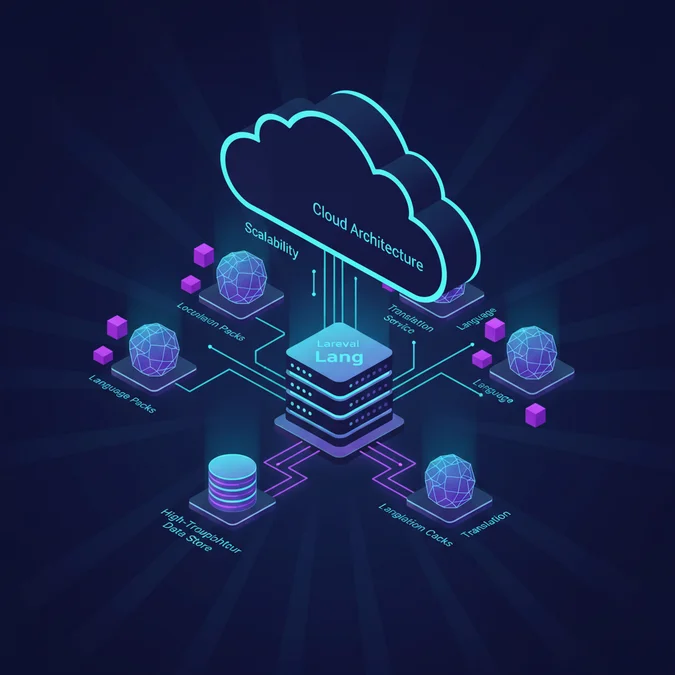

In Laravel, laravel lang refers to the framework’s native localization subsystem, which retrieves translated strings from filesystem dictionaries stored in lang/ or resources/lang/ using PHP arrays or JSON key-value files. It dynamically swaps UI strings, error responses, and system messages according to the application’s active locale configuration.
When scaling web applications horizontally across AWS or Google Cloud clusters, filesystem-driven internationalization rapidly evolves from a routine utility into a critical input-output bottleneck. Operating dozens of autoscaling container tasks handling thousands of requests per second exposes systemic lock contention, inode churn, and CPU thrashing if localization assets are parsed synchronously from distributed or ephemeral storage layers on every single request lifecycle.
High-throughput enterprise deployments demand an architectural evaluation of how language catalogs are compiled, distributed, cached, and synchronized. Moving beyond primitive file reading requires structured middleware, pre-warmed opcache mechanisms, distributed memory stores, and streamlined CI/CD translation pipelines designed for failure tolerance and minimum latency.
Understanding the Laravel Lang Core Architecture and Directory Structure
Laravel organizes translation strings into two distinct directory paradigms depending on framework version and project conventions. In modern Laravel applications, the root-level lang/ directory serves as the primary location for localization catalogs, while legacy architectures place these files within resources/lang/. Regardless of path positioning, the core framework translator, implemented via Illuminate\Translation\Translator, relies on a file loader contract (Illuminate\Translation\FileLoader) to parse localized resources on demand.
The localization layer bifurcates language data into structured PHP array definitions and flat JSON key-value mappings. Array-based definitions support nested domain separation such as validation, authentication, and pagination, while JSON dictionaries accommodate full-string keys commonly rendered in front-end templates:
lang/ en/ auth.php pagination.php passwords.php validation.php es/ auth.php pagination.php passwords.php validation.php fr/ auth.php pagination.php passwords.php validation.php en.json es.json fr.jsonWhen an application invokes the translation helper __('auth.failed'), the translator extracts the namespace or file identifier, checks internal execution memory for an existing copy, and falls back to invoking the file loader if the dictionary is unparsed. For high-throughput services, understanding this path resolution order prevents unnecessary directory lookups across networked filesystems.
PHP Arrays vs. JSON Translation Dictionaries: Technical Trade-offs
Choosing between nested PHP arrays and single JSON translation files introduces concrete trade-offs between OPcache performance, execution memory, and editorial ergonomics. PHP translation files return native array hashes, allowing the PHP Zend engine to compile and retain them directly in OPcache shared memory across worker lifecycles. JSON catalogs, by contrast, must be read from disk and decoded via json_decode() during request execution unless explicitly wrapped in an application-level caching layer.
| Metric / Criterion | PHP Array Catalogs | JSON Catalogs |
|---|---|---|
| OPcache Resident Memory | Yes (Pre-compiled into memory) | No (Decoded into runtime memory) |
| Parse Cost per Cold Request | Sub-millisecond bytecode execution | IO disk read plus JSON parsing overhead |
| Nested Key Support | Native multidimensional structures | Flat keys only (requires strict key hashing) |
| Frontend Reusability | Requires extraction step for JavaScript | Directly consumable by single-page apps |
| Translation Vendor Support | Requires custom parsers or extractors | Universally accepted standard format |
For high-performance API architectures processing tens of thousands of requests per minute, native PHP files offer superior compute efficiency. While JSON dictionaries provide developer convenience for long-form user interface text, relying on dozens of multi-megabyte JSON localization files introduces continuous CPU overhead during parsing under heavy traffic spikes.
Resolving Translation Strings, Placeholders, and Pluralization Rules
String resolution in Laravel provides robust substitution mechanics, fallback routines, and locale-specific pluralization patterns governed by the ISO standard via the Symfony Translation component. Developers interact with localization through the trans() or __() helper functions, as well as the Lang facade.
Dynamic parameter substitution utilizes replacement tokens prefixed with a colon. Laravel replaces these tokens safely without executing unescaped variable evaluations:
// lang/en/billing.php
return [
 'invoice_paid' => 'Payment of:amount received for account:account_id.',
];

// String resolution
$message = __('billing.invoice_paid', [
 'amount' => '$1,450.00',
 'account_id' => 'ACC-9921',
]);
Pluralization introduces complexity due to linguistic variation across world languages. English utilizes simple singular versus plural distinctions, whereas languages such as Polish, Russian, or Arabic implement multi-tier inflection rules. Laravel addresses this through the pipe delimiter syntax using trans_choice():
// lang/en/cluster.php
return [
 'nodes_online' => '{0} No worker nodes active|{1} Exactly one worker node active|[2,*]:count worker nodes active',
];

// Evaluation
$status = trans_choice('cluster.nodes_online', $activeNodeCount, ['count' => $activeNodeCount]);
Under the hood, the translator queries Symfony’s MessageSelector to match integer values against interval declarations, ensuring predictable runtime results without manual branching logic in controller classes.
Dynamic Locale Switching and Multi-Tenant Isolation Middleware
In stateless cloud backends, user locales must be resolved on every incoming HTTP cycle without creating cross-request state contamination across asynchronous workers like Octane, Swoole, or RoadRunner. Maintaining active locales in static properties can leak session state between requests if not correctly reset.
A production middleware inspects HTTP headers, authentication claims, or route parameters to establish the active context dynamically, falling back securely to system defaults when an unsupported locale is requested:
<php

namespace App\Http\Middleware;

use Closure;
use Illuminate\Http\Request;
use Illuminate\Support\Facades\App;
use Illuminate\Support\Facades\Config;
use Symfony\Component\HttpFoundation\Response;

class LocaleIsolationMiddleware
{
 protected array $supportedLocales = ['en', 'es', 'de', 'ja'];

 public function handle(Request $request, Closure $next): Response
 {
 // Check user preferences, headers, or domain routing
 $requestedLocale = $request->user()?->preferred_locale? $request->header('X-App-Locale')? $request->getPreferredLanguage($this->supportedLocales);

 $locale = in_array($requestedLocale, $this->supportedLocales, true)? $requestedLocale: Config:get('app.fallback_locale', 'en');

 App:setLocale($locale);

 $response = $next($request);

 // Set Content-Language response header for client transparency
 $response->headers->set('Content-Language', $locale);

 return $response;
 }
}
When managing multi-tenant SaaS environments, locale resolution can be layered directly into tenant discovery pipelines, ensuring customer catalogs remain isolated while dynamic front-ends render using synchronized components, such as those found when building a Laravel Livewire dynamic event calendar for multi-lingual international booking systems.
Filesystem Latency in Containerized Infrastructure and Kubernetes
Deploying Laravel containers across AWS Elastic Container Service (ECS) or Google Kubernetes Engine (GKE) introduces nuanced filesystem constraints. When multiple worker pods share an AWS Elastic File System (EFS) mount for codebases or asset directories, the translation loader triggers network file system calls for every unique language catalog accessed during bootstrapping.
Under standard Linux operations, executing file_exists() and include across network-attached mounts yields noticeable I/O wait times due to attribute metadata fetching over the network wire. If an application supports 20 locales across 15 domain files, a sudden cold burst of international traffic can saturate network storage input-output operations per second (IOPS), inflating P99 API latency from 25 milliseconds to several seconds.
| Storage Mount Strategy | Average Latency (I/O Read) | IOPS Scaling Limit | Network Saturation Risk |
|---|---|---|---|
| AWS EFS (Network NFS Mount) | 1.5ms to 8.0ms | Constrained by burst credits | High during burst scale-out |
| Container Local OverlayFS | 0.02ms to 0.08ms | Local instance NVMe bound | Zero (Isolated to container) |
| Shared EBS Block Volume | 0.5ms to 2.0ms | Configured provisioned IOPS | Medium (Single AZ bound) |
| Memory-Baked Docker Image | Sub-microsecond | Host RAM speed bound | None |
To eliminate distributed filesystem latency, language catalogs must be baked directly into the immutable container image during the CI/CD build phase. Translation assets should reside on the local OverlayFS layer of the container host rather than external shared volumes.
Optimizing Laravel Lang Performance with OPcache Preloading and In-Memory Caching
While Laravel provides native caching utilities for routes and configuration via php artisan route:cache and php artisan config:cache, the framework does not provide a native php artisan lang:cache command out of the box. Consequently, language files are evaluated on each request cycle unless advanced caching mechanisms are deployed.
By leveraging PHP 8.2+ OPcache Preloading, all array-based translation files can be compiled into persistent server memory during PHP-FPM or Octane startup. The preload script scans the lang/ directory and compiles the scripts permanently:
<php
// preload-translations.php

$langPath = __DIR__. '/lang';
$files = new RecursiveIteratorIterator(
 new RecursiveDirectoryIterator($langPath, RecursiveDirectoryIterator:SKIP_DOTS)
);

foreach ($files as $file) {
 if ($file->getExtension() === 'php') {
 opcache_compile_file($file->getRealPath());
 }
}
For massive JSON translation sets, writing a dedicated application-level caching decorator around Illuminate\Translation\Translator ensures that unparsed files are read once from storage, deserialized, and preserved within distributed memory backends such as Redis, totally bypassing disk I/O.
High Availability Translation Architecture: Redis-Backed Distributed Localization
In distributed enterprise environments where translation catalogs are frequently updated by localization agencies without triggering full container deployment pipelines, relying on filesystem files introduces deployment coordination challenges. Modifying a file inside one container requires rolling updates across the entire autoscaling group.
A resilient pattern integrates a fallback-capable Redis translation repository. The custom loader inspects a Redis cluster for dynamic keys before falling back to static container assets:
<php

namespace App\Services\Localization;

use Illuminate\Contracts\Translation\Loader;
use Illuminate\Support\Facades\Redis;

class RedisFallbackTranslationLoader implements Loader
{
 public function __construct(
 protected Loader $fileLoader,
 protected string $connection = 'cache'
 ) {}

 public function load($locale, $group, $namespace = null): array
 {
 // Check Redis primary cache
 $cacheKey = "translations:{$locale}:{$group}";
 $cached = Redis:connection($this->connection)->get($cacheKey);

 if ($cached) {
 return json_decode($cached, true)? [];
 }

 // Fall back to immutable disk files
 $lines = $this->fileLoader->load($locale, $group, $namespace);

 // Store back in Redis with a 24-hour TTL for fast lookups
 Redis:connection($this->connection)->setex($cacheKey, 86400, json_encode($lines));

 return $lines;
 }

 public function addNamespace($namespace, $hint): void
 {
 $this->fileLoader->addNamespace($namespace, $hint);
 }

 public function addJsonPath($path): void
 {
 $this->fileLoader->addJsonPath($path);
 }

 public function namespaces(): array
 {
 return $this->fileLoader->namespaces();
 }
}
This distributed setup guarantees sub-millisecond translation lookups while allowing remote translation teams to invalidate keys globally with single Redis publish events.
Automating Community Translations with laravel-lang Packages and CI/CD
Maintaining complete language coverage across dozens of regions manually requires extensive localization resources. The open-source laravel-lang organization maintains standard dictionaries for over 100 languages, covering native validation messages, authentication notices, and baseline attributes.
Rather than manually importing files, engineering teams integrate these packages using Composer and automated synchronization tools within continuous delivery pipelines:
# Install the official publisher utility
composer require laravel-lang/publisher laravel-lang/lang --dev

# Add specific locale catalogs to your repository
php artisan lang:add es
php artisan lang:add de
php artisan lang:add ja

# Update existing translation catalogs with upstream improvements
php artisan lang:update
Within modern automation workflows, translation verification should run as an automated quality gate. Integrating workflows like an n8n open-source integration pipeline enables development teams to intercept translation file pull requests, run static schema validation, and dispatch changed translation keys directly to localization APIs without developer intervention.
Front-End Integration Strategies for Inertia.js, Vue, and React Single-Page Apps
When operating decoupled single-page applications (SPAs) or hybrid Inertia.js architectures, sharing translation logic between Laravel and the client runtime presents data serialization hurdles. Transferring entire translation catalogs over the wire on every route visit bloats JSON payloads and degrades client Core Web Vitals.
The optimal cloud pattern extracts only the necessary language keys per component or namespace, injecting them selectively via Inertia shared props:
<php

namespace App\Http\Middleware;

use Illuminate\Http\Request;
use Inertia\Middleware;

class HandleInertiaRequests extends Middleware
{
 public function share(Request $request): array
 {
 $locale = app()->getLocale();

 return array_merge(parent:share($request), [
 'locale' => $locale,
 'translations' => [
 // Only load critical UI domains instead of whole dictionaries
 'auth' => trans('auth'),
 'validation' => trans('validation'),
 'navigation' => trans('navigation'),
 ],
 ]);
 }
}
On the front end, a lightweight utility function mirrors the Laravel translator signature:
// resources/js/helpers/lang.js
export function __(key, replace = {}) {
 const parts = key.split('.');
 let translation = window.translations;

 for (const part of parts) {
 if (!translation ||!translation[part]) {
 return key;
 }
 translation = translation[part];
 }

 Object.keys(replace).forEach((placeholder) => {
 translation = translation.replace(`:${placeholder}`, replace[placeholder]);
 });

 return translation;
}
This reduces front-end bundle footprints and prevents memory bloat in low-powered mobile browsers.
Common Anti-Patterns and Operational Pitfalls in Enterprise Localization
Enterprise applications frequently fall victim to architectural anti-patterns that induce subtle bugs, concurrency errors, or memory leaks across server clusters. Identifying and mitigating these traps is vital for high-reliability systems.
- Unbounded JSON Memory Bloat: Consolidating all system translations into a single monolithic
en.jsonfile spanning several megabytes causes excessive memory usage during deserialization under high-concurrency runtimes. - State Leakage in Octane/Swoole: Modifying the application locale via
App:setLocale()inside an asynchronous service worker without clearing state via lifecycle hooks results in downstream requests executing under the preceding user’s locale. - Unescaped Database Translations: Injecting user-supplied content directly into
__()replacement tokens can open cross-site scripting (XSS) vectors if rendered unescaped in front-end templates. - Missing Fallback Dictionaries: Failing to maintain a strictly completed
fallback_localecatalog causes missing translation keys to return raw array path strings (such asfinance.invoices.tax_id) directly to end users.
Adhering to strict coding standards, similar to the precision maintained by an enterprise custom software development architecture team, prevents operational degradation and preserves code reliability across large engineering divisions.
Enterprise Financial Analysis: Localization Engineering Cost Models
Implementing and maintaining an internationalized Laravel ecosystem incurs measurable compute, infrastructure, and human operational costs. Organizations must evaluate ongoing maintenance expenditure across internal engineering salaries, professional translation services, and distributed hosting resources.
| Operational Expense Category | Hourly / Freelance Model | Monthly Dedicated Retainer | Fixed Enterprise Contract |
|---|---|---|---|
| Infrastructure (Redis/AWS ECS/CDN) | $150 to $350 per month | $500 to $1,500 per month | $2,500 to $6,000 per month |
| Localization Integration Engineers | $85 to $160 per hour | $8,000 to $15,000 per month | $20,000 to $45,000 per project |
| Professional Translation Services | $0.08 to $0.22 per word | $1,200 to $3,500 per month | $10,000 to $30,000 annually |
| Translation Management Tooling (TMS) | $50 to $150 per month | $300 to $800 per month | $1,500 to $4,000 per month |
| Estimated Annual Total | $15,000 to $35,000 | $115,000 to $235,000 | $300,000 to $600,000+ |
Engineering managers must choose between building manual translation pipelines or adopting dedicated Translation Management Systems (TMS) such as Crowdin, Phrase, or Lokalise. For a system operating 15 languages across 2,000 translation keys, automating updates via API integrations lowers overall operational expenditure by reducing engineering intervention hours by up to 70 percent over a three-year lifecycle.
Migration Path: Upgrading Legacy Localization to Modern Framework Standards
Applications migrating from older Laravel versions (such as Laravel 8 or earlier) must update their translation structure to align with the root-level lang/ directory standard introduced in Laravel 9 and continued through modern versions. While legacy systems continue to read from resources/lang/, standardizing paths simplifies deployment scripts and tooling integration.
A resilient migration script automates directory relocation while maintaining backward compatibility through symlinks or configuration updates:
#!/usr/bin/env bash
set -euo pipefail

# Ensure clean git working directory
if [ -n "$(git status --porcelain)" ]; then
 echo "Working tree dirty. Commit or stash changes before running migration."
 exit 1
fi

# Move directory if legacy path exists
if [ -d "resources/lang" ] && [! -d "lang" ]; then
 echo "Migrating resources/lang to root lang directory.."
 git mv resources/lang lang

 # Clear compiled framework files
 php artisan view:clear
 php artisan cache:clear

 echo "Directory successfully relocated."
else
 echo "Root lang directory already exists or legacy path missing."
fi
Following relocation, verification tests should run across CI pipelines to ensure that every localized route and JSON dictionary returns the expected string hashes under automated regression test runs.
Curated Educational Directory and Architecture References
Establishing a dependable localization pipeline requires deep familiarity with the broader Laravel ecosystem and foundational design patterns. Navigating foundational architectural decisions early protects growing applications from painful refactoring cycles as traffic expands.
Explore our complete Laravel, Basics directory for more guides.
Leverage the architectural materials in our basics directory to ensure your service infrastructure, service providers, and dependency injection practices align with modern high-scale engineering benchmarks.
Factors That Affect Development Cost
- Volume of target languages and translation key counts
- Frequency of copy updates and dynamic TMS integration needs
- Storage architecture choice (Local Container Image vs Distributed EFS vs Redis Cluster)
- Dedicated localization engineers and external language agency translation rates
Production localization architectures range from minimal open-source configurations costing under $300 monthly to enterprise multi-region deployments exceeding $15,000 per month.
Operating high-throughput localized applications in Laravel requires treating translation dictionaries as critical production data rather than static filesystem files. When running across distributed, horizontally auto-scaled container clusters, the differences between uncompiled JSON files and memory-resident PHP arrays have direct consequences for latency, IOPS consumption, and container compute costs.
For enterprise-scale reliability, bake language catalogs directly into local container images during CI/CD steps, employ PHP OPcache preloading to maintain translation hashes in memory, and implement distributed Redis caching layers if translations must update independently of code releases. By isolating request locale state within dedicated middleware and enforcing automated linting across pull requests, engineering teams can maintain lightning-fast international services that scale effortlessly across global markets.