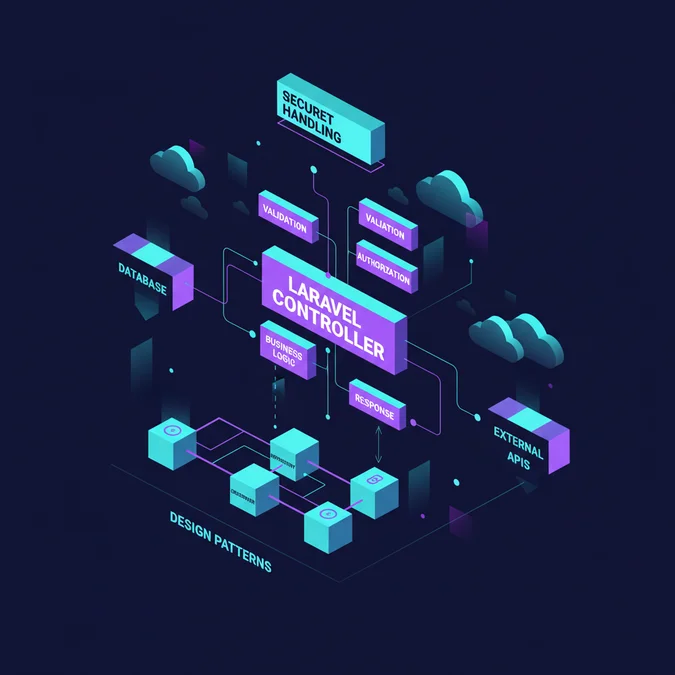

A Laravel controller is a PHP class that groups HTTP request handling logic, acting as the traffic director between incoming routing definitions, domain business models, and downstream responses. Instead of defining procedural closures across route files, controllers encapsulate application execution flow, input validation, dependency injection, and authorization barriers.
The PHP community has experienced a notable shift toward defensive backend architectures as microservice boundaries blur and public APIs face relentless automated scans. Development teams increasingly abandon bloated procedural controllers in favor of single-action invokable classes, strict Form Requests, and zero-trust perimeter checks. Modern controller design treats every incoming payload as hostile, requiring explicit contracts and deterministic boundaries before executing domain logic.
Writing controllers without strict security controls exposes production applications to Mass Assignment, Broken Object Level Authorization (BOLA), and Cross-Site Request Forgery (CSRF). This deep architectural guide deconstructs Laravel controllers through an offensive and defensive security lens, establishing practical patterns to prevent systemic OWASP Top 10 vulnerabilities while maintaining clean, maintainable code.
Anatomy of an HTTP Controller and Request Lifecycle
When an incoming HTTP request strikes a Laravel application via the public web server, it traverses the global middleware stack, passes through route-specific middleware, and resolves inside the target controller method. The controller acts as the coordinating orchestrator, responsible for unpacking input data, evaluating authorization policies, dispatching state changes to domain services, and returning an HTTP response.
At its fundamental baseline, a basic controller extends the base Illuminate\Routing\Controller class, granting convenient access to helper methods like middleware(), authorize(), and validate(). Modern implementations, however, favor decoupled construction where controllers operate as lightweight, framework-agnostic invokable classes.
<php

declare(strict_types=1);

namespace App\Http\Controllers;

use App\Http\Requests\StoreTenantRequest;
use App\Services\TenantProvisioningService;
use Illuminate\Http\JsonResponse;
use Symfony\Component\HttpFoundation\Response;

final class RegisterTenantController extends Controller
{
 public function __construct(
 private readonly TenantProvisioningService $provisioner
 ) {}

 public function __invoke(StoreTenantRequest $request): JsonResponse
 {
 // Validation and authorization are already resolved by StoreTenantRequest
 $tenant = $this->provisioner->provision(
 $request->validatedTenantDTO()
 );

 return response()->json([
 'status' => 'provisioned',
 'tenant_id' => $tenant->id,
 ], Response:HTTP_CREATED);
 }
}
In this architecture, the controller contains zero direct SQL queries, zero raw validation rules, and zero unvalidated input processing. By offloading validation to dedicated request classes and business logic to isolated domain services, the controller maintains a single, verifiable responsibility: translating an HTTP request into a domain command and converting the domain result into an HTTP response.
Routing to Controllers: Resource, ApiResource, and Invokable Patterns
Laravel provides multiple routing patterns to map HTTP verbs and URIs to controller execution points. Choosing the incorrect routing pattern can expose unintended HTTP verbs to the public internet, dramatically expanding your application attack surface.
Comparing Controller Routing Archetypes
| Pattern | Generated Routes | Typical Use Case | Security Risk Profile |
|---|---|---|---|
| Standard Controller | Manual / Ad-hoc | Complex multi-step workflows | Moderate: route verb misconfigurations are common |
| Resource Controller | 7 actions (index, create, store, show, edit, update, destroy) | Full-stack blade web forms | High: exposes edit/create endpoints even on pure APIs |
| API Resource Controller | 5 actions (excludes create, edit) | RESTful JSON APIs | Low to Moderate: explicit HTTP methods mapped to standard CRUD |
| Invokable Controller | 1 action (__invoke) |
Single-purpose domain actions | Very Low: strictly minimal attack surface per endpoint |
To register an API resource that excludes unnecessary HTML view routes, enforce the apiResource directive in your routes/api.php:
<php

use App\Http\Controllers\UserSecurityProfileController;
use App\Http\Controllers\RotateApiKeyController;
use Illuminate\Support\Facades\Route;

// Explicit RESTful endpoint limiting attack surface
Route:apiResource('users.security-profiles', UserSecurityProfileController:class)
 ->only(['show', 'update'])
 ->middleware(['auth:sanctum', 'throttle:60,1']);

// Single action invokable controller for high-risk actions
Route:post('keys/{key}/rotate', RotateApiKeyController:class)
 ->middleware(['auth:sanctum', 'can:rotate,key', 'throttle:5,1']);
Never register blanket resource routes without verifying that every generated endpoint has corresponding validation rules and authorization gates. An unhandled destroy or update route exposed unintentionally provides an instant vector for data tampering.
Hardening Input Data: Form Requests and Mass Assignment Defenses
The most pervasive vulnerability in poorly architected controllers is Mass Assignment (OWASP A03:2021 – Injection and A04:2021 – Insecure Design). This vulnerability occurs when an unvetted payload from $request->all() is passed straight into an Eloquent write operation like User:create($request->all()).
An attacker can inject arbitrary fields into the JSON or form payload, including is_admin, role, account_balance, or foreign key tenant identifiers. Using strict Form Request classes eliminates this threat by isolating the authorization and field validation contracts before the controller method executes.
<php

declare(strict_types=1);

namespace App\Http\Requests;

use Illuminate\Foundation\Http\FormRequest;
use Illuminate\Validation\Rule;

final class UpdateUserProfileRequest extends FormRequest
{
 public function authorize(): bool
 {
 // Verify the authenticated entity has permission to mutate this specific target
 return $this->user()->can('update', $this->route('user'));
 }

 /**
 * @return array<string, array<int, mixed>>
 */
 public function rules(): array
 {
 return [
 'display_name' => ['required', 'string', 'max:50'],
 'phone' => ['nullable', 'string', 'regex:/^\+[1-9]\d{1,14}$/'],
 'preferences.locale' => ['required', Rule:in(['en', 'es', 'de', 'fr'])],
 'preferences.dark_mode' => ['required', 'boolean'],
 ];
 }
}
Within the controller, extract strictly the validated data via $request->validated() or $request->safe(). Never access raw input keys via the generic $request->input() or dynamic properties like $request->display_name for mutations.
<php

public function update(UpdateUserProfileRequest $request, User $user): JsonResponse
{
 // Safely mutated via validated keys only
 $user->update($request->safe()->only([
 'display_name',
 'phone',
 'preferences',
 ]));

 return response()->json(['status' => 'updated']);
}
For projects requiring unified compliance tracking, integrating structural audits via a comprehensive audit logging pipeline ensures that every state mutation leaving the controller layer generates an immutable historical record.
Broken Object Level Authorization (BOLA) and Implicit Route Model Binding
Broken Object Level Authorization (BOLA), formerly categorized as Insecure Direct Object Reference (IDOR), consistently ranks as the primary vulnerability in modern API architectures. BOLA occurs when an application receives an entity ID in the URL, instantiates the model, but fails to check if the active user possesses permission to view or manipulate that exact record.
Laravel provides Implicit Route Model Binding, automatically resolving model instances matching the route parameter:
Route:get('/invoices/{invoice}', [InvoiceController:class, 'show']);If the controller method accepts Invoice $invoice without authorization, any authenticated user can increment the invoice ID parameter to inspect invoices belonging to competitors, leaking critical business intelligence and personally identifiable information (PII).
Enforcing Authorization Gates
Every controller action consuming a model must explicitly challenge the caller against an Eloquent Policy:
<php

declare(strict_types=1);

namespace App\Http\Controllers;

use App\Models\Invoice;
use Illuminate\Http\JsonResponse;
use Illuminate\Foundation\Auth\Access\AuthorizesRequests;

final class InvoiceController extends Controller
{
 use AuthorizesRequests;

 public function show(Invoice $invoice): JsonResponse
 {
 // Throws AuthorizationException (HTTP 403) if check fails
 $this->authorize('view', $invoice);

 return response()->json([
 'id' => $invoice->id,
 'amount_cents' => $invoice->amount_cents,
 'currency' => $invoice->currency,
 'status' => $invoice->status,
 ]);
 }
}
Alternatively, enforce scoped bindings directly in the route declaration to guarantee that child resources belong strictly to the authenticated parent entity:
// Enforces that the invoice belongs strictly to the authenticated tenant context
Route:get('/tenants/{tenant}/invoices/{invoice:id}', [InvoiceController:class, 'show'])
 ->scopeBindings()
 ->middleware('auth:sanctum');
When scopeBindings() is activated, Laravel executes a query requiring where('tenant_id', $tenant->id) automatically, returning an immediate 404 response if the invoice does not belong to the identified tenant.
Constructor vs Method Dependency Injection Mechanics
Controllers in Laravel participate completely in the framework Service Container. Dependencies can be resolved automatically through two primary injection points: constructor injection and method injection. Understanding the operational distinction between both is critical for memory management and testability.
Constructor Injection
Constructor injection is suitable for shared services, state managers, and communication clients needed across multiple actions within the controller:
<php

namespace App\Http\Controllers;

use App\Contracts\PaymentGatewayInterface;
use Psr\Log\LoggerInterface;

final class SubscriptionController extends Controller
{
 public function __construct(
 private readonly PaymentGatewayInterface $gateway,
 private readonly LoggerInterface $logger
 ) {}
}
Method Injection
Method injection resolves dependencies unique to a specific HTTP endpoint, preventing unnecessary object construction when executing sibling routes. Laravel resolves route parameters alongside type-hinted service objects transparently:
<php

namespace App\Http\Controllers;

use App\Models\Subscription;
use App\Services\FraudDetectionEngine;
use Illuminate\Http\JsonResponse;

final class SubscriptionController extends Controller
{
 public function cancel(
 Subscription $subscription,
 FraudDetectionEngine $fraudEngine
 ): JsonResponse {
 $this->authorize('cancel', $subscription);

 $riskScore = $fraudEngine->evaluateCancellationContext($subscription);
 if ($riskScore->isFlagged()) {
 return response()->json(['error' => 'Review required'], 422);
 }

 $subscription->markCanceled();

 return response()->json(['status' => 'canceled']);
 }
}
When coordinating distributed pipelines or scaling development via remote engineering delivery architectures, keeping controllers thin through targeted dependency injection ensures testing boundaries remain clean and unit tests execute without booting heavy web infrastructure.
Middleware Pipeline Binding and Scope Isolation
Controllers must not function in isolation; they depend on the HTTP middleware pipeline to perform boundary filtering, rate limiting, token parsing, and header validation. Laravel provides two distinct ways to attach middleware to controllers: within route declarations or inside the controller constructor.
While registering middleware inside a controller constructor was common in older versions, modern Laravel architecture strongly advocates registering middleware exclusively inside route definition files (routes/web.php or routes/api.php). Defining middleware at the route level makes access controls immediately auditable without parsing PHP class internals.
<php

use App\Http\Controllers\Admin\SystemConfigController;
use Illuminate\Support\Facades\Route;

Route:prefix('admin/system')
 ->name('admin.system.')
 ->middleware([
 'auth:sanctum',
 'verified',
 'role:security-admin',
 'throttle:10,1',
 'require-mfa'
 ])
 ->group(function () {
 Route:get('/audit', [SystemConfigController:class, 'index'])->name('audit');
 Route:post('/freeze', [SystemConfigController:class, 'freezePlatform'])->name('freeze');
 });
Grouping middleware at the route level guarantees defense-in-depth: requests attempting to trigger high-privilege controller operations like platform freezes are terminated at the routing edge before any controller code, reflection, or database queries are loaded into server memory.
Data Sanitization, Output Masking, and Preventing Information Disclosure
A controller must guard against both malicious inbound payloads and accidental outbound data leakage (OWASP A01:2021 – Broken Access Control). Returning raw Eloquent models directly from a controller action serializes internal database columns, including salt hashes, API secrets, deleted_at timestamps, and internal foreign keys.
Direct model serialization creates critical information disclosure flaws:
// DANGEROUS: Leaks hidden model attributes if model casts change
public function show(User $user): User
{
 return $user;
}
API Resources as Defensive Security Boundaries
Always route outgoing controller data through dedicated JsonResource transformations to define an explicit allowlist of attributes permitted to leave the application memory space:
<php

declare(strict_types=1);

namespace App\Http\Resources;

use Illuminate\Http\Request;
use Illuminate\Http\Resources\Json\JsonResource;

/**
 * @mixin \App\Models\User
 */
final class UserPublicResource extends JsonResource
{
 /**
 * @return array<string, mixed>
 */
 public function toArray(Request $request): array
 {
 return [
 'id' => $this->public_uuid, // Use external UUIDs, never incrementing IDs
 'display_name' => e($this->display_name), // HTML entity encoding
 'avatar_url' => $this->avatar_url,
 'registered_at' => $this->created_at?->toIso8601String(),
 ];
 }
}
Coupling your controller output to isolated resource classes ensures that even if a developer adds a sensitive credential or cleartext column to the underlying database migration, it will not be broadcast over the wire.
Handling Authentication, Tokens, and Controller Gateways
Authentication must establish identity with absolute certainty before a controller evaluates business commands. Within an API context, Laravel Sanctum or Passport handles bearer token translation, instantiating the authenticated principal accessible via $request->user().
When provisioning automated worker systems or external integrations, token capabilities must be scrutinized directly inside the controller or through dedicated token ability middleware. Managing API keys securely mirrors enterprise patterns like configuring personal access tokens securely, where token scope must strictly limit endpoint reach.
<php

declare(strict_types=1);

namespace App\Http\Controllers;

use App\Http\Requests\DeployInfrastructureRequest;
use Illuminate\Http\JsonResponse;
use Symfony\Component\HttpFoundation\Response;

final class CloudDeploymentController extends Controller
{
 public function __invoke(DeployInfrastructureRequest $request): JsonResponse
 {
 // Verify the token specifically possesses deployment privileges
 if (! $request->user()->tokenCan('infrastructure:deploy')) {
 return response()->json([
 'error' => 'Access denied. Token missing required scope.'
 ], Response:HTTP_FORBIDDEN);
 }

 // Execute protected deployment sequence
 return response()->json(['status' => 'initiated'], Response:HTTP_ACCEPTED);
 }
}
Controllers must reject requests if token lifespans have lapsed, revocation records exist, or the authenticated caller state does not meet tenant verification criteria.
Common Controller Mistakes and Anti-Patterns
Architectural decay in Laravel applications frequently begins within the controller layer. Identifying and eliminating these patterns early prevents technical debt and critical security flaws.
- The God Controller: A single controller class exceeding 1,000 lines of code handling dozens of disparate actions. This violates the Single Responsibility Principle and causes merge conflicts and audit blind spots.
- Bypassing Policies: Executing database updates or deletions directly without checking authorization policies via
$this->authorize()or Form Requestauthorize(). - Direct File Operations: Writing raw user uploads to the public storage disk without parsing mime types, checking file extension spoofs, or randomizing storage file names.
- Trusting Client Identifiers: Reading client-provided user IDs from the request body (such as
$request->input('user_id')) instead of resolving the verified identity via$request->user()->id. - Uncaught Database Exceptions: Allowing raw PDO driver errors to bubble up to the HTTP response, which can expose database table names, SQL syntax, and internal hostnames to potential attackers.
Adhering to strict linting rules and static analysis tools like PHPStan (level 8 or 9) prevents the majority of these programmatic mistakes before code reaches your review pipelines.
Exception Handling and Defensive Controller Responses
Controllers must handle operational errors deterministically without leaking execution traces. When an unhandled exception occurs in a production environment with APP_DEBUG=true accidentally set, full environment variables, database passwords, and cryptographic keys are printed directly to the public browser.
Controllers should catch domain-specific exceptions and transform them into standardized RFC 7807 problem details or clean JSON error structures:
<php

declare(strict_types=1);

namespace App\Http\Controllers;

use App\Exceptions\PaymentDeclinedException;
use App\Exceptions\RateLimitExceededException;
use App\Http\Requests\ProcessPaymentRequest;
use App\Services\BillingService;
use Illuminate\Http\JsonResponse;
use Psr\Log\LoggerInterface;
use Symfony\Component\HttpFoundation\Response;

final class PaymentExecutionController extends Controller
{
 public function __invoke(
 ProcessPaymentRequest $request,
 BillingService $billingService,
 LoggerInterface $logger
 ): JsonResponse {
 try {
 $result = $billingService->charge($request->toCommand());

 return response()->json(['charge_id' => $result->id]);
 } catch (PaymentDeclinedException $e) {
 $logger->warning('Card transaction rejected by upstream issuer', [
 'user_id' => $request->user()->id,
 'code' => $e->getErrorCode(),
 ]);

 return response()->json([
 'title' => 'Payment Failed',
 'detail' => 'Your card issuer declined the transaction.',
 ], Response:HTTP_UNPROCESSABLE_ENTITY);
 } catch (RateLimitExceededException $e) {
 return response()->json([
 'title' => 'Too Many Requests',
 'detail' => 'Downstream payment provider throttle reached.',
 ], Response:HTTP_TOO_MANY_REQUESTS);
 }
 }
}
Centralized exception handling inside bootstrap/app.php (in Laravel 11) or app/Exceptions/Handler.php (in earlier versions) can also intercept exceptions globally, keeping individual controller actions free of repetitive try-catch blocks.
Integration Testing Controllers for Security and Integrity
A controller cannot be considered production-ready without automated HTTP integration tests verifying that security middleware, authentication barriers, and authorization policies reject unauthorized probes. Testing controllers purely via unit tests with mocked containers fails to evaluate the actual middleware stack.
Laravel provides robust HTTP testing methods to simulate complete network requests against controller endpoints:
<php

declare(strict_types=1);

namespace Tests\Feature\Http\Controllers;

use App\Models\User;
use App\Models\Tenant;
use App\Models\Document;
use Illuminate\Foundation\Testing\RefreshDatabase;
use Tests\TestCase;

final class DocumentControllerTest extends TestCase
{
 use RefreshDatabase;

 public function test_unauthenticated_request_is_rejected(): void
 {
 $response = $this->getJson('/api/documents');

 $response->assertStatus(401);
 }

 public function test_user_cannot_access_cross_tenant_document(): void
 {
 $tenantA = Tenant:factory()->create();
 $tenantB = Tenant:factory()->create();

 $authorizedUser = User:factory()->create(['tenant_id' => $tenantA->id]);
 $unauthorizedUser = User:factory()->create(['tenant_id' => $tenantB->id]);

 $document = Document:factory()->create(['tenant_id' => $tenantA->id]);

 // The intruder attempts to view a document belonging to Tenant A
 $response = $this->actingAs($unauthorizedUser, 'sanctum')
 ->getJson("/api/documents/{$document->id}");

 // Assert that BOLA protection rejects access via HTTP 403 Forbidden
 $response->assertStatus(403);
 }

 public function test_validation_rejects_malicious_mass_assignment_keys(): void
 {
 $user = User:factory()->create();

 $payload = [
 'display_name' => 'Legitimate Name',
 'is_admin' => true, // Malicious injection attempt
 ];

 $response = $this->actingAs($user, 'sanctum')
 ->putJson('/api/profile', $payload);

 $response->assertOk();
 $this->assertFalse($user->fresh()->is_admin);
 }
}
These integration tests run inside continuous integration (CI) environments, halting pull requests if any modification inadvertently weakens controller security configurations.
Cluster Reference and Foundational Architecture
Building secure, resilient enterprise systems in Laravel requires an understanding of how foundational components interlock. Controllers depend directly on route providers, service containers, and validation middleware to form an integrated defensive perimeter.
Explore our complete Laravel, Basics directory for more guides.
A Laravel controller should never serve as a repository for raw business rules, direct database queries, or unsecured input manipulation. Treating the controller as a strict, defensive traffic manager ensures that every incoming payload is authenticated, authorized, and validated before touching application domain models.
By leveraging single-action invokable controllers, dedicated Form Requests, scoped model binding, and strict Eloquent API Resources, you eliminate entire classes of OWASP Top 10 vulnerabilities while creating a clean, thoroughly testable codebase. Apply these patterns systematically across all endpoints to maintain a predictable, secure engineering foundation.