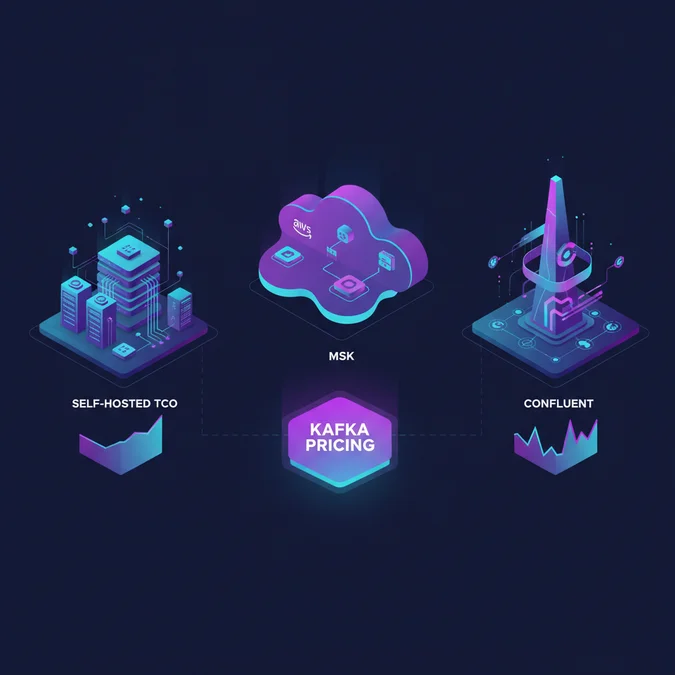

A production Apache Kafka deployment capable of ingesting 100 MB/s sustained throughput will cost between $3,200 and $11,800 monthly depending on whether you self-host on cloud compute or purchase managed capacity through AWS MSK or Confluent Cloud. The software binary itself requires zero license fees under the Apache 2.0 license, but compute, enterprise NVMe storage, and inter-availability-zone network transfer create substantial operational overhead.
Engineering leadership teams often budget exclusively for broker compute instances while overlooking the catastrophic compounding effect of cloud networking. In typical multi-availability-zone architectures with a replication factor of three, cross-AZ synchronization and client egress charges routinely exceed the raw cost of the virtual machines hosting the brokers. When engineering labor for cluster maintenance, OS patch cycles, and rebalancing is added, self-hosting frequently flips from a perceived discount into an expensive operational liability.
This procurement and architectural guide details Kafka pricing across raw compute, storage tiers, networking traps, and managed platform overhead. By dissecting concrete throughput tiers from 10 MB/s to 1 GB/s, this analysis equips systems architects and procurement directors with the exact mathematical models needed to optimize streaming infrastructure spend in 2026.
Open Source vs Managed Platforms: Apache Kafka Licensing and Base Economics
When evaluating the baseline kafka license cost, the financial equation starts at zero. Apache Kafka is distributed under the Apache License 2.0, granting organizations unconstrained rights to download, modify, run, and scale the software across private data centers or public cloud instances without per-core or per-broker licensing royalties. However, equating zero software licensing fees with a zero-dollar apache kafka cost represents a critical misunderstanding of distributed systems engineering.
Operating Apache Kafka at enterprise scale demands a fleet of dedicated compute instances, high-throughput IOPS provisioned block storage, resilient networking topologies, and specialized site reliability engineering (SRE) talent. Fully managed platforms like Confluent Cloud, AWS Managed Streaming for Apache Kafka (MSK), and Google Cloud Managed Service for Apache Kafka trade infrastructure margins for automated lifecycle management, guaranteed service level agreements (SLAs), and abstracted infrastructure provisioning.
The Software Fallacy: Open-source streaming software carries zero software acquisition fees, but infrastructure, cross-zone data transfer, and specialized engineering labor form the actual baseline of your total cost of ownership (TCO).
The operational spectrum spans three distinct operational paradigms: bare-metal or self-hosted virtual machines, infrastructure-level managed services (such as AWS MSK Provisioned), and fully abstracted, serverless streaming fabrics (such as Confluent Cloud or AWS MSK Serverless). Each tier rebalances the ratio between direct cloud provider invoices and internal human capital expenditures.
| Operational Dimension | Self-Hosted (EC2 / EKS / Bare Metal) | AWS MSK (Provisioned) | Confluent Cloud (Enterprise / Dedicated) |
|---|---|---|---|
| Software License | $0 (Apache 2.0) | $0 (Included in broker hourly rate) | Commercial proprietary tier included in usage |
| Control Plane Overhead | Manual KRaft controller management, node tuning | Automated KRaft controllers (free of charge) | Fully abstracted multi-tenant or dedicated control plane |
| OS and Security Patching | Internal SRE responsibility | Automated / Semi-automated maintenance windows | 100% managed by vendor, zero operator downtime |
| Broker Rebalancing | Manual partition reassignment scripts or Cruise Control | Manual Cruise Control integration or AWS APIs | Automated rebalancing, dynamic self-healing partitions |
| SRE Allocation (FTE) | 0.75 to 2.0 Senior Distributed Systems Engineers | 0.25 to 0.5 Platform Engineer | 0.1 Platform Engineer (configuration only) |
For organizations deploying small topologies beneath 20 MB/s, internal operational labor easily outweighs compute spending. A single senior platform engineer earning an industry-standard fully loaded compensation of $240,000 annually costs $20,000 per month. If that engineer dedicates 30 percent of their working hours maintaining Kafka broker health, rebalancing topics, debugging consumer lag, and performing rolling upgrades, the organization incurs an unbilled operational cost of $6,000 monthly, dwarfing the direct cloud bill.
2026 Kafka Cost Drivers: Infrastructure, Compute, and Storage Economics
A realistic evaluation of baseline kafka cost requires decomposing the cluster into three physical primitives: broker memory and CPU allocation, persistent storage throughput, and retention capacity. Because Kafka delegates disk caching to the operating system page cache, memory sizing directly dictates whether consumers read hot segments from RAM or force expensive, high-latency disk reads that degrade broker throughput.
To construct an accurate kafka pricing framework for production infrastructure, organizations must evaluate compute and storage across four distinct operational steps:
- Broker Compute and Memory Sizing: Production brokers require sustained network throughput and adequate RAM for the OS page cache. For an ingest workload of 100 MB/s with three-way replication, your cluster must absorb 300 MB/s of total write traffic alongside read traffic from downstream consumer groups. A typical cluster requires at least three to five storage-optimized or network-optimized instances (such as AWS
m6i.2xlargeori3en.2xlarge) running around the clock. - Direct Storage Provisioning: AWS EBS gp3 or io2 volumes must be provisioned for both peak gigabyte storage and minimum IOPS. A high-throughput cluster ingesting 100 MB/s generates 8.64 TB of raw data per day. With a replication factor of three, this equates to 25.9 TB of local disk writes daily. Provisioning 7 days of raw retention on local NVMe or high-speed block storage requires roughly 181 TB of raw disk space, incurring thousands of dollars in monthly disk volume allocations alone.
- Partition Density and File Descriptors: Each active partition creates multiple physical files on disk (index, log, timeindex). High partition counts demand elevated CPU overhead for metadata handling and memory allocation for open file descriptors. Oversizing partitions without sufficient compute leads to severe garbage collection pauses and uncoordinated leader elections.
- Controller Quorum Infrastructure: Modern clusters running KRaft (Kafka Raft Metadata mode) eliminate external ZooKeeper clusters. While this removes three to five dedicated ZooKeeper instances from the monthly bill, KRaft controllers still require dedicated compute nodes in large enterprise topologies to isolate metadata transactions from heavy broker IOPS.
Below is a concrete, dollar-for-dollar monthly infrastructure baseline comparing self-hosted AWS EC2 deployments against AWS MSK and Confluent Cloud across three realistic operational throughput profiles. All scenarios assume a 7-day retention window, a replication factor of three, and standard payload compression.
| Throughput Profile | Workload Specifications | Self-Hosted (AWS EC2 + EBS) | AWS MSK Provisioned | Confluent Cloud (Dedicated/Standard) |
|---|---|---|---|---|
| Small Scale | 10 MB/s Ingest, 20 MB/s Egress, 30-day retention (~26 TB) | $1,420 / month | $1,890 / month | $2,450 / month |
| Medium Scale | 100 MB/s Ingest, 300 MB/s Egress, 7-day retention (~181 TB) | $7,150 / month | $9,420 / month | $11,800 / month |
| Enterprise Scale | 1 GB/s Ingest, 3 GB/s Egress, 3-day retention (~777 TB) | $48,900 / month | $62,400 / month | $78,200 / month |
While self-hosted infrastructure presents lower monthly cloud invoices, it exposes teams to unforecasted expenses when broker storage fills up unexpectedly, forcing emergency volume expansions, data rebalances, and manual volume re-striping.
Managed Kafka Price Breakdown: AWS MSK vs Confluent Cloud vs GCP
Procuring managed streaming capacity requires navigating vastly divergent billing mechanisms. Finding the optimal kafka price requires contrasting capacity-unit pricing, broker-hour models, and partition fees across the major public cloud vendors and enterprise platforms.
Understanding each vendor-specific apache kafka pricing model determines whether your organization can cost-effectively scale. Below are the three dominant managed platform pricing structures in production today:
- AWS MSK (Provisioned): Billed based on hourly broker instance rates (e.g.
kafka.m5.2xlargeat approximately $0.484/hour) plus attached EBS gp3 storage ($0.10/GB/month) and provisioned IOPS. Controller nodes in KRaft mode are managed by AWS at no additional instance fee. - AWS MSK Serverless: Charges on pure throughput and cluster storage. You pay $0.75 per cluster-hour, $0.10 per GB of data ingested, $0.05 per GB of data read, and $0.10 per GB-month of storage, alongside $0.0015 per partition-hour. This model provides high savings for spiky, unpredictable workloads but becomes cost-prohibitive under steady, high-throughput loads.
- Confluent Cloud: Utilizes Confluent Capacity Units (CKUs). A single Standard CKU provides 10 MB/s ingress and 30 MB/s egress, billed at a flat hourly rate (approximately $1.50 to $2.00 per CKU-hour depending on multi-zone configuration). Confluent decouples storage entirely through automated Tiered Storage, billing long-term retention at cheap object storage rates ($0.021 to $0.025 per GB-month).
- Google Cloud Managed Service for Apache Kafka: GCP charges for vCPU and memory allocated per broker-hour, provisioned Persistent Disk capacity, and network egress bandwidth. Google isolates compute units while allowing linear scaling of regional SSD disks.
| Pricing Dimension | AWS MSK (Provisioned) | AWS MSK Serverless | Confluent Cloud (Enterprise) | Google Cloud Managed Kafka |
|---|---|---|---|---|
| Billing Metric | Broker instances + EBS storage volumes | Cluster hours + data processed + partitions | Confluent Capacity Units (CKUs) + storage | vCPU-hours + RAM-hours + disk volume |
| Partition Limits | Up to 1,000 per broker (scales with instance size) | Strict cluster partition cap (max 2,000) | Up to 4,000 partitions per CKU | Dynamic based on allocated broker vCPUs |
| Storage Architecture | Direct EBS (Optional Tiered Storage to S3) | Automated multi-tenant managed storage | Automated, built-in Tiered Storage to S3/GCS | Google Persistent Disk (Regional/Zonal) |
| High Availability SLA | 99.95% multi-AZ availability | 99.9% availability | 99.95% to 99.99% multi-AZ availability | 99.95% availability |
| Built-in Ecosystem | Basic schema registry options, custom connectors | Standard cloud native metrics | Integrated Schema Registry, 120+ managed connectors | Google Cloud Pub/Sub connectors, standard monitoring |
Workload Architecture Guidance: For spiky workloads with variable traffic under 20 MB/s, serverless utility pricing saves capital by scaling to zero during idle periods. For sustained enterprise traffic exceeding 100 MB/s, provisioned infrastructure or dedicated capacity units avoid the severe data processing unit premiums enforced by serverless tiers.
The Hidden Costs: Cross-AZ Replication, NAT Gateways, and Egress Traps
The single most underestimated variable in Kafka financial engineering is network transfer. A broker cluster does not operate in a vacuum; it constantly synchronizes state across distinct availability zones to survive physical data center failure. Cloud service providers charge an average of $0.01 per GB for data traversing availability zone boundaries, both when leaving one zone and entering another.
Because production Kafka requires a minimum replication factor of three (replication.factor=3), every megabyte of data written by a producer is transmitted across availability zone boundaries multiple times. Furthermore, consumer applications deployed in a different availability zone than the topic partition leader incur cross-AZ transit penalties on every read operation.
Vendor Vetting Checklist and Critical Architectural Red Flags
Before committing to a managed Kafka vendor contract or authorizing a dedicated internal platform engineering team, technical leads must audit operational capabilities against a strict rubric. Managed service providers often disguise limitations behind attractive baseline compute discounts, while self-hosted proposals routinely understate operational drag.
Review this practitioner vetting checklist during commercial evaluations:
- Audit Multi-AZ Replication Pricing: Does the vendor contract include cross-availability-zone data transit fees within the capacity unit or broker hourly rate, or are network egress bills billed separately via your underlying cloud provider account?
- Verify Partition Scaling Ceilings: What is the hard ceiling on total partition count per cluster? Does exceeding 2,000 partitions force an unneeded compute tier upgrade even if network and CPU throughput remain under 30 percent utilization?
- Evaluate Native Tiered Storage Support: Can the platform transparently offload cold segment files to S3, GCS, or Azure Blob Storage via KIP-405 or proprietary engines, reducing reliance on expensive provisioned SSDs?
- Examine Producer Lag and Quota Throttling: Does the vendor transparently apply client byte-rate quotas when noisy neighbor consumers saturate network interfaces, or does the cluster experience unannounced TCP backpressure?
- Review Contractual Availability SLAs: Does the service level agreement define availability by end-to-end publish/consume latency (e.g. P99 latency under 50ms), or merely by TCP socket response on the broker ports?
- Inspect Upgrade and Maintenance Automation: Are minor patch releases and major version upgrades executed without broker disconnection, partition leadership flapping, or consumer group rebalance storms?
Contractual Red Flag: Be cautious of managed SLAs that guarantee 99.99% availability but exclude client-side rebalance disruptions, maintenance window restarts, and ZooKeeper or KRaft metadata synchronization failures from their definition of cluster downtime.
Cost Optimization Roadmap: Slashing Spend with KRaft and Tiered Storage
Lowering overall streaming TCO does not require sacrificing cluster throughput or data retention guarantees. By modernizing metadata architecture, deploying tiered object storage, and tuning producer network pipelines, engineering teams can cut their monthly Kafka spend by 40 to 65 percent.
Execute this four-step technical roadmap to eliminate architectural waste across your cluster fleet:
- Retire ZooKeeper and Migrate to Modern KRaft: Migrating legacy clusters to KRaft metadata quorum eliminates three to five dedicated ZooKeeper compute nodes per cluster, immediately cutting compute and local storage costs. Furthermore, KRaft streamlines partition recovery times by orders of magnitude, minimizing expensive cross-AZ metadata polling loops.
- Implement Tiered Storage (KIP-405 Offloading): Decouple compute from long-term storage retention. By writing active data to high-speed NVMe or EBS block storage for immediate consumption (hot data, 2 to 4 hours retention) and asynchronously migrating inactive segments to cloud object storage like Amazon S3 or Google Cloud Storage (cold data, days to months), storage bills drop from $0.10/GB-month to approximately $0.021/GB-month. This step eliminates up to 70 percent of local broker disk allocation requirements.
- Configure Rack-Aware Consumer Fetching: Enforce
client.rack routing on all downstream consumers. Enabling consumers to read directly from the in-sync replica (ISR) located within their matching availability zone entirely avoids cross-AZ data transit penalties on reads. - Enforce Modern Payload Compression: Mandate Zstandard (
zstd) compression at the producer tier. Zstandard provides an exceptional balance of CPU throughput and compression density, routinely reducing raw JSON or Avro payload sizes by 40 to 60 percent compared to uncompressed or Snappy-compressed streams. Lower byte volume directly reduces network egress, block storage writes, and long-term object retention costs simultaneously.
Optimization Payoff: Transitioning a 100 MB/s cluster from raw EBS storage and cross-AZ consumer reads to a combination of Zstandard compression, rack-aware fetching, and S3 Tiered Storage routinely reduces monthly cloud spend from $9,400 to less than $3,900.
Factors That Affect Development Cost
- Broker compute instance types and memory allocation
- Provisioned SSD storage IOPS and capacity
- Cross-availability-zone replication network transfer
- Public NAT gateway processing fees
- Dedicated SRE labor for operations and patching
- Object storage offloading volume via Tiered Storage
Production Kafka deployments range widely from small multi-zone clusters up to massive enterprise installations processing hundreds of megabytes per second.
Frequently Asked Questions
What is the baseline Apache Kafka license cost?
Apache Kafka is open-source under the Apache 2.0 license, meaning the software itself carries zero licensing fees. However, production deployments require infrastructure, networking, and dedicated engineering labor, which form the true foundation of your cluster expenses.
How does self-hosted Kafka pricing compare to AWS MSK?
Self-hosted Kafka on EC2 saves around 20 to 30 percent on raw compute compared to AWS MSK broker hourly rates. However, MSK significantly offsets this margin by eliminating manual cluster maintenance, OS patching, automated ZooKeeper or KRaft management, and version upgrades.
What primary factors determine monthly Apache Kafka cost?
Monthly Kafka costs are driven by broker compute sizing, SSD storage volume, network egress, and cross-AZ replication. In high-throughput architectures, inter-availability-zone data transfer and cloud NAT gateways frequently account for over 35 percent of the total infrastructure bill.
How do Confluent Cloud and Apache Kafka pricing structures differ?
Confluent Cloud charges for throughput capacity units (CKUs), ingress, egress, and tiered storage, while Apache Kafka pricing on bare cloud VMs is billed directly on raw compute instances, attached block storage volumes, and standard cloud provider network transfer.
Deciding between self-hosted Apache Kafka and commercial managed solutions is an architectural trade-off between infrastructure margins and operational velocity. Self-hosting saves money on raw compute for teams running high-throughput, predictable workloads that already employ dedicated distributed systems infrastructure engineers. However, for organizations lacking in-house Kafka expertise, the hidden costs of cross-AZ network transfer, unoptimized EBS block storage, and SRE triage rapidly eradicate any theoretical compute savings.
By auditing your exact throughput profiles, enabling modern levers like KRaft metadata management and Tiered Storage, and enforcing rack-aware consumer routing, you can minimize unnecessary infrastructure overhead. Evaluate managed options like AWS MSK and Confluent Cloud not simply on baseline hourly rates, but on their ability to eliminate operational toil and free your core engineering teams to build revenue-generating product features.
Need Engineering Guidance for Your Production Stack?
Evaluate architecture trade-offs, scalability limits, and implementation feasibility with experienced systems engineers.
Schedule an Engineering Review
References & Further Reading