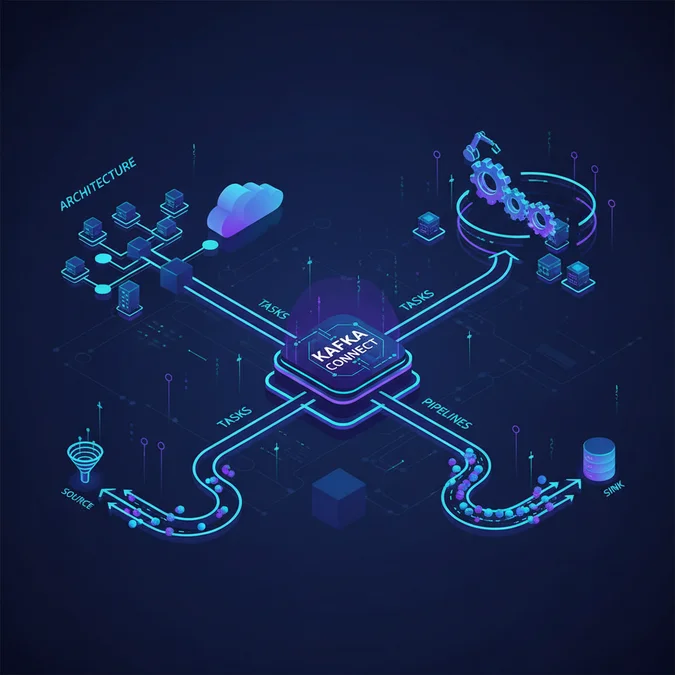

Building bespoke consumer and producer applications to bridge operational databases, stream processing engines, and analytical datastores inevitably leads to fragile distributed systems. Engineering teams routinely battle offset desynchronization, silent schema drift, unhandled serialization failures, and worker failure cascades. Moving high-throughput change streams across infrastructure boundaries requires a hardened execution runtime rather than ad-hoc microservices.
Apache Kafka Connect resolves these integration bottlenecks by providing an enterprise-grade, distributed integration framework that runs as a dedicated cluster alongside Apache Kafka. It abstracts the low-level complexities of consumer group rebalancing, stateful offset tracking, dynamic worker discovery, and record transformation into a declarative configuration model.
This operational guide details the internal mechanics of Kafka Connect: distributed worker topology, source and sink task execution, custom converter performance characteristics, automated failure recovery, and production cluster orchestration in modern enterprise environments.
Core Architecture: Workers, Tasks, and Distributed Execution
At the center of apache kafka connect is an execution framework separating task orchestration from connector logic. Rather than embedding connector code directly within source or destination systems, Kafka Connect deploys as an independent cluster of JVM worker processes. Understanding the fundamental kafka connect architecture requires dissecting how workers, connector configurations, and executable tasks interact under the hood.
+---------------------------------------------------------------------------------+ | Kafka Connect Distributed Cluster | | | | +-----------------------------+ +-----------------------------+ | | | Worker 1 (Leader) | | Worker 2 | | | | - REST Administrative API | | - Task Execution Pool | | | | - Rebalance Coordinator | | - Group Member | | | | +-----------------------+ | | +-----------------------+ | | | | | Task: PostgresSource-0 | | | | Task: PostgresSource-1 | | | | | +-----------------------+ | | +-----------------------+ | | | | +-----------------------+ | | +-----------------------+ | | | | | Task: S3Sink-0 | | | | Task: S3Sink-1 | | | | | +-----------------------+ | | +-----------------------+ | | | +--------------+--------------+ +--------------+--------------+ | +---------------|----------------------------------------------|-----------------+ | | +----------------------+-----------------------+ | v +-----------------------------------------------------------------------+ | Apache Kafka Cluster | | | | Internal Compacted Topics: | | - connect-configs (1 partition, cleanup.policy=compact) | | - connect-offsets (25-50 partitions, cleanup.policy=compact) | | - connect-status (5 partitions, cleanup.policy=compact) | +-----------------------------------------------------------------------+Workers, Connectors, and Tasks
The cluster hierarchy separates control state from data processing pipelines:
- Workers: The running JVM instances that form the kafka connect cluster. Workers join a group identified by
group.idusing Kafka internal consumer group coordination protocols. One worker is elected cluster leader to manage work assignment and monitor member heartbeats. - Connectors: Declarative definitions that define data source or sink topology, schema conventions, converter parameters, and task concurrency limits via
tasks.max. The connector instance itself does not process records; it inspects external infrastructure (such as querying database table shard counts) and splits work into discrete configurations. - Tasks: The stateless, parallel execution units spawned by the worker runtime. Each task pulls assigned partitions from external systems (source) or Kafka topics (sink). Tasks run inside managed thread pools and interact directly with Kafka broker partitions.
Operational Rule: Tasks are decoupled from worker instances. If a worker process abruptly terminates due to node hardware failure or out-of-memory errors, the remaining workers trigger an automated rebalance, reassigning stranded tasks across the surviving nodes within seconds.
Internal Storage Topics and Offset Coordination
Distributed Kafka Connect maintains state without an external consensus datastore like ZooKeeper or etcd. Instead, state is coordinated across three internal Kafka topics configured with log compaction:
| Internal Topic Name | Recommended Partitions | Replication Factor | Compaction Policy | Operational Purpose |
|---|---|---|---|---|
connect-configs |
1 | 3 | compact |
Stores connector and task JSON configurations. Must strictly remain at 1 partition to guarantee total ordering of topology modifications. |
connect-offsets |
25 to 50 | 3 | compact |
Maintains external source offsets (e.g. database binlog LSN, JDBC timestamps) or committed consumer offsets. Heavily read and written. |
connect-status |
5 | 3 | compact |
Tracks the operational state of connectors and assigned tasks (RUNNING, PAUSED, FAILED), surfaced through the REST API. |
Incremental Cooperative Rebalancing
Historically, task rebalances in distributed Kafka Connect relied on the eager consumer rebalance protocol, which suspended all running tasks across the entire cluster while reassignment computed. In enterprise deployments running hundreds of tasks, this created severe pipeline latency spikes.
Modern Kafka Connect utilizes the Incremental Cooperative Rebalancing Protocol. When a connector is added or a worker joins the cluster, only the affected tasks are paused and migrated. Unaffected tasks continue streaming records without interruption, eliminating stop-the-world rebalance storms and reducing end-to-end ingestion latency.
Source Connectors: Ingesting Data into Kafka Topics
A kafka source connector pulls real-time changes or batch extracts from external systems and publishes them as structured messages to Kafka topics. Unlike simple polling scripts, production source connectors preserve message order, reliably track source position offsets, and extract rich schema definitions.
Poll Semantics and Ingestion Lifecycle
Source tasks implement an ingestion loop governed by the poll() lifecycle:
- Polling Cycle Execution: The worker invokes
task.poll()on a dedicated thread. The task retrieves records from the external system up tomax.poll.interval.msor a defined batch size. - Record Transformation: Retrieved payloads are wrapped into
SourceRecordobjects containing target topic names, partition keys, values, and schema metadata. - Internal Conversion: The worker executes configured Single Message Transforms (SMTs) and runs the selected converter (such as Avro or Protobuf) to serialize keys and values into raw byte arrays.
- Broker Dispatch and Offset Staging: Records are passed to an internal, shared
KafkaProducer. Once the producer receives broker acknowledgments (acks=all), the worker commits source offsets to the internalconnect-offsetstopic.
CDC vs JDBC Polling
Selecting the optimal kafka database connector pattern dictates whether the pipeline delivers high-fidelity event streams or causes database performance degradation. Traditional JDBC polling relies on executing periodic queries like SELECT * FROM table WHERE updated_at >. This introduces operational friction: deleted records are missed without soft-delete columns, polling intervals introduce latency, and query execution stresses the primary database index.
In contrast, Change Data Capture (CDC) connectors, such as Debezium, operate directly on database transaction logs (PostgreSQL WAL, MySQL binary log, or Oracle Redo log). CDC extracts row-level insert, update, and delete events with sub-second latency, zero database query overhead, and complete transaction boundaries.
Production Source Configuration: PostgreSQL Debezium CDC
The following kafka source connector configuration establishes a battle-tested Debezium CDC ingestion stream from PostgreSQL to Kafka, leveraging the Confluent Avro converter for enterprise schema governance:
{ "name": "postgres-orders-cdc-source", "config": { "connector.class": "io.debezium.connector.postgresql.PostgresConnector", "tasks.max": "1", "plugin.name": "pgoutput", "database.hostname": "postgres-cluster.internal.net", "database.port": "5432", "database.user": "cdc_worker", "database.password": "${file:/secrets/connect-secrets.properties:pg_password}", "database.dbname": "commerce_db", "database.server.name": "prod_db", "table.include.list": "public.orders,public.line_items", "tombstones.on.delete": "true", "decimal.handling.mode": "double", "key.converter": "io.confluent.connect.avro.AvroConverter", "key.converter.schema.registry.url": "http://schema-registry.internal.net:8081", "value.converter": "io.confluent.connect.avro.AvroConverter", "value.converter.schema.registry.url": "http://schema-registry.internal.net:8081", "transforms": "unwrap,reroute", "transforms.unwrap.type": "io.debezium.transforms.ExtractNewRecordState", "transforms.unwrap.drop.tombstones": "false", "transforms.reroute.type": "org.apache.kafka.connect.transforms.RegexRouter", "transforms.reroute.regex": "prod_db\\.public\\.(.*)", "transforms.reroute.replacement": "events.cdc.commerce.$1", "producer.override.compression.type": "zstd", "producer.override.acks": "all", "producer.override.max.in.flight.requests.per.connection": "1" }}Sink Connectors: Exporting Kafka Events to Downstream Datastores
A kafka sink connector consumes messages from Kafka topics, transforms raw binary payloads into structured datatypes, and writes batches into external datastores such as Amazon S3, Snowflake, OpenSearch, or relational databases. Sinks function as specialized consumer groups managed by the Connect worker runtime.
Consumer Offset Management and Batch Commit Lifecycle
Unlike standard Kafka consumer applications where offset commits dictate consumer position, a kafka sink ties consumer offsets directly to downstream persistence success. The execution flow follows strict boundaries:
- The sink task polls records using its internal consumer via
task.put(Collection<SinkRecord> records). - Records pass through configured converters and SMTs, deserializing raw bytes into internal Connect data structures.
- The task buffers records internally until reaching batch size thresholds or
consumer.max.poll.interval.msconstraints. - The worker invokes
task.preCommit(). The sink flushes buffered records to the target system. - Only after the external datastore acknowledges the write does the task return committed offset positions to Kafka. If an external write fails, offsets are not committed, allowing retry loops to prevent data loss.
Dead-Letter Queues and Poison-Pill Routing
A frequent failure mode in stream processing occurs when a malformed record (a poison pill) arrives in a topic. Standard consumers either crash or fail continuously. Kafka Connect provides an integrated Dead-Letter Queue (DLQ) framework that intercepts invalid records, appends diagnostics to Kafka record headers, and forwards the offending message to an isolation topic without stopping the task.
{ "name": "opensearch-order-analytics-sink", "config": { "connector.class": "io.aiven.kafka.connect.opensearch.OpensearchSinkConnector", "tasks.max": "4", "topics": "events.cdc.commerce.orders", "connection.url": "https://opensearch.internal.net:9200", "type.name": "_doc", "key.ignore": "false", "schema.ignore": "false", "key.converter": "org.apache.kafka.connect.storage.StringConverter", "value.converter": "io.confluent.connect.avro.AvroConverter", "value.converter.schema.registry.url": "http://schema-registry.internal.net:8081", "errors.tolerance": "all", "errors.log.enable": "true", "errors.log.include.messages": "true", "errors.deadletterqueue.topic.name": "dlq.events.cdc.commerce.orders", "errors.deadletterqueue.topic.replication.factor": "3", "errors.deadletterqueue.context.headers.enable": "true" }}Production Sink Deployment Checklist
Before launching sink connectors in critical production environments, verify the operational criteria outlined below:
- Delivery Semantics: Confirm whether your external sink datastore supports idempotent writes or two-phase commit (2PC). If the sink only supports append operations without deduplication keys, duplicate records can occur during task restarts.
- Dead-Letter Queue Configuration: Ensure
errors.deadletterqueue.context.headers.enable=trueis set so operators can inspect the source exception, class name, and originating partition directly in Kafka headers. - Schema Evolution Compatibility: Verify that sink schemas automatically adjust to backward and forward schema upgrades managed by Schema Registry.
- Buffer Flush Sizing: Calibrate
flush.sizeandrotate.interval.msto balance write latency against file fragmentation when targeting object storage sinks.
Kafka Connect REST API and Administrative Operations
Every worker in a distributed Kafka Connect cluster exposes an HTTP REST interface on port 8083. The kafka connect api provides full administrative control to register connector configurations, evaluate operational health, pause data streams during maintenance windows, and trigger rolling task restarts.
Primary REST API Endpoints
The following table provides an operational kafka connect documentation overview for key cluster management endpoints:
| HTTP Verb | Path | Payload / Parameters | Administrative Operation |
|---|---|---|---|
GET |
/connectors |
None | Returns a JSON array of all active connector names deployed in the cluster. |
POST |
/connectors |
JSON Config Manifest | Registers and starts a new connector instance across cluster workers. |
GET |
/connectors/{name}/status |
None | Retrieves the runtime status of the connector and each assigned task (RUNNING, PAUSED, FAILED). |
PUT |
/connectors/{name}/pause |
None | Temporarily pauses record polling and processing without releasing partition assignments. |
PUT |
/connectors/{name}/resume |
None | Resumes task execution for a previously paused connector. |
POST |
/connectors/{name}/restart?includeTasks=true&onlyFailed=true |
Query Parameters | Restarts failed tasks without interrupting healthy running tasks. |
PUT |
/admin/loggers/{package} |
{"level": "DEBUG"} |
Dynamically modifies runtime log levels (DEBUG, INFO, WARN, ERROR) without restarting workers. |
Automated Health Monitoring and Task Recovery Script
In high-throughput environments, external network partitions or transient database timeouts can cause individual tasks to fail while the overall connector remains marked as active. Production orchestration requires automated monitoring and task restarts. Below is a bash script engineered for automated task recovery via health checks:
#!/usr/bin/env bashset -euo pipefailCONNECT_URL="http://connect-cluster.internal.net:8083"echo "[$(date --utc -Iseconds)] Inspecting Kafka Connect cluster at ${CONNECT_URL}.."CONNECTORS=$(curl -s -f "${CONNECT_URL}/connectors")for connector in $(echo "${CONNECTORS}" | tr -d '[]"' | tr ',' ' '); do STATUS_JSON=$(curl -s -f "${CONNECT_URL}/connectors/${connector}/status") STATE=$(echo "${STATUS_JSON}" | grep -o '"state":"[^"]*' | head -1 | cut -d'"' -f4) echo "Connector: ${connector} | State: ${STATE}" # Extract and parse failed tasks FAILED_TASKS=$(echo "${STATUS_JSON}" | grep -o '"state":"FAILED"' || true) if [ -n "${FAILED_TASKS}" ]; then echo "[WARNING] Detected failed tasks in connector '${connector}'. Triggering selective restart.." curl -s -X POST "${CONNECT_URL}/connectors/${connector}/restart?includeTasks=true&onlyFailed=true" \ -H "Content-Type: application/json" echo "[SUCCESS] Restart signal sent for failed tasks in '${connector}'." fidoneConnector Ecosystem Taxonomy and Enterprise Selection Guide
Navigating the ecosystem of verified kafka connectors requires evaluating community open-source plugins, commercial enterprise solutions, and custom development approaches. Deploying the wrong plugin can introduce unmanageable memory overhead, lock contention, or unexpected licensing liabilities.
Enterprise Architecture Decision Matrix
Before selecting a prebuilt connector or building custom integration pipelines, assess how Kafka Connect compares against standalone streaming frameworks and custom microservices:
| Evaluation Dimension | Distributed Kafka Connect | Custom Producer/Consumer Apps | Apache Flink / Spark Streaming |
|---|---|---|---|
| Implementation Cost | Minimal: Declarative JSON configuration without writing pipeline code. | High: Requires writing producer/consumer loops, retry handling, and thread safety. | Medium to High: Requires maintaining distributed streaming jobs and Java/Scala code. |
| State and Offset Management | Automated via internal Kafka compacted storage topics. | Manual: Requires manual offset commits and state persistence stores. | Automated: Managed via native distributed checkpoints and savepoints. |
| Scalability & Parallelism | Task-level parallelism driven by tasks.max and partition distribution. |
Consumer group scaling limited by partition count and container sizing. | High: Fine-grained task slot parallelism with dynamic autoscaling. |
| Complex Event Transformations | Basic: Single Message Transforms (SMTs) for structural renaming, masking, routing. | Full: Complete programming freedom in business logic layers. | Advanced: Stateful windowing, multi-stream joins, pattern matching (CEP). |
| Infrastructure Footprint | Moderate: Runs on standalone JVM worker pools alongside brokers. | Variable: Independent containerized services or serverless functions. | Substantial: Requires dedicated JobManagers, TaskManagers, and storage backends. |
Verified Kafka Connectors List
The global kafka connectors list spans several primary operational categories. When architecting your data fabric, consult these verified options:
- Database CDC Connectors: Debezium (PostgreSQL, MySQL, SQL Server, MongoDB, Oracle), Confluent JDBC Connector.
- Cloud Object Storage Connectors: Confluent Amazon S3 Sink, Google Cloud Storage Sink, Azure Blob Storage Sink.
- Modern Analytical Warehouses: Snowflake Kafka Connector (supporting Snowpipe Streaming for sub-second ingestion), ClickHouse Sink, BigQuery Sink.
- Search and Observability: OpenSearch Sink, Elasticsearch Sink, Splunk Sink Connector.
- Message Queues and Event Buses: IBM MQ Source/Sink, RabbitMQ Source, JMS Source Connector.
Plugin Isolation Best Practice: Always configure
plugin.pathinside worker properties with isolated subdirectories for each connector artifact. Placing different connector JARs in a flat classpath leads to classloading conflicts when libraries depend on incompatible third-party dependencies.
By standardizing on verified kafka connect connectors, infrastructure teams maintain declarative audit trails, reduce operational maintenance, and maximize message ingestion efficiency across the distributed data landscape.
Frequently Asked Questions
What is the difference between standalone and distributed Kafka Connect?
Standalone mode runs all connectors and tasks in a single JVM process, ideal for local testing. Distributed mode runs across clustered worker nodes, automatically balancing tasks, handling node failures, and scaling throughput dynamically through consumer group coordinator protocols.
How do you configure a Kafka database connector for CDC?
To configure a CDC database connector, deploy a Debezium connector via the REST API with connection credentials, server ID, and table whitelists. The connector reads the database transaction log and publishes raw row mutations as structured Kafka events.
How does a Kafka sink connector handle dead-letter queues?
A Kafka sink connector routes unparseable or rejected records to a configured dead-letter queue topic instead of crashing the task. Administrators configure errors.tolerance to all and specify errors.deadletterqueue.topic.name to capture poisoned messages with contextual error headers.
Where can developers find an official Kafka connectors list?
Engineers can browse verified plugins via Confluent Hub, open-source repositories, and the Apache Kafka documentation overview. These registries curate source and sink connectors for relational databases, object storage, Snowflake, Elasticsearch, and external cloud services.
Kafka Connect serves as the foundational data backbone for modern event-driven architectures. By replacing ad-hoc polling services with a distributed worker cluster, organizations eliminate the operational pain of schema drift, unhandled offset gaps, and silent consumer failures. Mastering the nuances of task distribution, dead-letter queue routing, and incremental cooperative rebalancing unlocks scalable, fault-tolerant integration across all transactional and analytical systems.
As you scale data infrastructure into 2026, ensure your Connect workers run with isolated plugin paths, declarative CI/CD configuration pipelines, and continuous REST health monitoring to maintain clean, uninterrupted data pipelines across your enterprise.