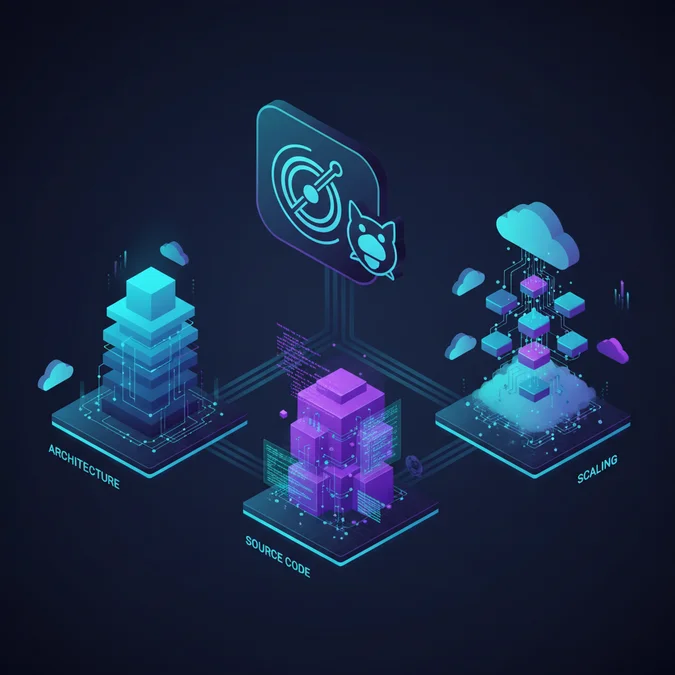

The Filament GitHub repository (hosted at filamentphp/filament) is not merely an admin dashboard generator; it is a modular, full-stack application framework built on top of Laravel, Livewire, Alpine.js, and Tailwind CSS. The repository provides a unified suite of decoupled packages including a standalone Form Builder, Table Builder, Notification manager, Actions library, and an extensible Panel Builder engine.
A common misconception across engineering teams is that Filament is simply a wrapper around database tables that introduces heavy technical debt through rigid abstraction layers. In reality, inspecting the core repository reveals a clean, inversion-of-control architecture that shifts dynamic UI workloads directly into standard Laravel classes, eliminating the overhead of managing disjointed frontend single-page application (SPA) codebases for internal operations.
For technology executives and senior architects, evaluating the source repository on GitHub is the most effective way to quantify Total Cost of Ownership (TCO), audit maintenance velocity, assess security posture, and understand how the package manages Livewire lifecycle state before introducing it into enterprise production pipelines.
Understanding the Filament GitHub Architecture and Monorepo Structure
Filament is organized as a Git monorepo containing multiple decoupled PHP packages maintained under the packages/ directory. Rather than forcing teams into an all-or-nothing administrative framework, the source architecture adheres to strict modularity principles. Each component can be isolated and incorporated into custom customer-facing applications or composed together within the flagship Panel package.
Core Packages inside the Monorepo
Navigating the GitHub repository reveals several key architectural sub-packages that drive the ecosystem:
- filament/filament: The central Panel Builder that binds the sub-packages into a cohesive multi-tenant, role-aware dashboard runtime.
- filament/forms: A declarative schema-driven form generation engine supporting dynamic validation, conditional field rendering, and Livewire state binding.
- filament/tables: A datatable component layer handling high-performance database querying, column projection, server-side filtering, and bulk operations.
- filament/actions: A unified modal and action-triggering system that standardizes operations such as resource deletion, exports, and status transitions across tables and forms.
- filament/notifications: An event-driven flash and database notification system capable of sending immediate alerts or queueing broad user updates.
- filament/support: Shared low-level utilities, asset managers, and blade components reused across the entire suite.
This monorepo layout utilizes Composer path repositories and centralized GitHub Actions workflows to guarantee that changes to core action primitives or support traits do not break downstream consumer packages.
Repository Health, Commit Cadence, and Open Source Maintenance Signals
Before standardizing on an open-source framework, an engineering organization must verify that the underlying repository exhibits strong maintainability metrics. Abandoned dependencies and stale pull requests pose direct risks to security compliance and framework upgrade paths.
The filamentphp/filament repository demonstrates an exceptional level of continuous integration and maintenance cadence. Pull requests undergo automated static analysis via PHPStan at level 8 or 9, format enforcement using Laravel Pint, and complete regression test suites run across multiple PHP and Laravel versions.
| Metric | Filament GitHub Standard | Enterprise Risk Assessment |
|---|---|---|
| Release Frequency | Weekly minor/patch releases | Low: Bugs and vulnerabilities patched rapidly |
| Issue Resolution Time | Median under 72 hours | Low: Active core team and community triaging |
| PHPStan Coverage | Max Level / Level 8+ | Low: Type-safety minimizes runtime crashes |
| Dependency Footprint | Minimal (Laravel, Livewire, Alpine) | Medium: Bound to Livewire lifecycle releases |
| Breaking Changes | Strict SemVer within major tags | Low: Predictable long-term upgrade cadence |
These verifiable signals in the repository assure engineering leaders that technical debt remains contained within versioned upgrades rather than accruing unchecked in unmaintained dependencies.
Total Cost of Ownership: Filament Monorepo vs Custom React or Vue Dashboards
The core business justification for leveraging Filament directly stems from developer velocity and total cost of ownership. Building an administrative interface or an internal operations console using custom React or Vue frontends requires maintaining dual API layers, syncing client-side form schemas with backend validation, and managing authentication state across separate repos.
Filament unifies the presentation and domain layers within PHP. Changes to database schemas, policies, and authorization rules are mapped directly into single-class Resource files. As a result, engineering velocity for internal tools typically accelerates by a factor of three to four compared to standalone SPA workflows.
Maintenance Debt Reduction
When UI definitions reside inside server-side code, your engineering team avoids:
- Managing complex JSON:API or GraphQL boilerplate purely for internal CRUD actions.
- Updating multiple Node.js build pipelines and npm dependencies across distinct repositories.
- Re-implementing authorization logic twice (once in frontend route guards and once in backend middleware).
By tracking the Filament repository directly on GitHub, teams capture upstream improvements in accessibility, UI performance, and UI component standards without spending internal developer hours rebuilding foundational interface widgets.
Cloning, Contributing, and Local Repository Environment Setup
When enterprise projects require customized behaviors or bug fixes upstream, developers must clone the repository and run the local development suite. Filament provides an established local testing scaffold directly in the repository to make verification straightforward.
Local Monorepo Bootstrapping
To clone and prepare the Filament repository locally, run the following commands in your shell:
# Clone the core monorepo from GitHub
git clone https://github.com/filamentphp/filament.git
cd filament

# Install PHP dependencies across all monorepo packages
composer install

# Run static analysis across the entire codebase./vendor/bin/phpstan analyse

# Execute the automated test suite./vendor/bin/pest
The repository ships with Pest PHP test suites across all packages. When modifying table queries, custom field components, or action lifecycles, run ./vendor/bin/pest packages/tables to execute package-isolated test suites instantly without running the entire repository test suite.
Livewire Integration Mechanics and Reactive Execution Flow
Filament derives its interface reactivity by compiling schema configurations into standard Livewire components. Understanding this execution model is vital when scaling your application or diagnosing hydration bottlenecks.
When a user navigates to a Filament Resource page, the server renders the initial HTML markup via Blade and mounts an internal Livewire component (such as ListRecords or EditRecord). Form inputs and table filters register Livewire property models. When state changes, Livewire sends an asynchronous AJAX payload containing the altered state to the Laravel backend.
Modern Laravel applications combining micro-interactions often integrate complementary tools like declarative functional Livewire Volt components to handle isolated front-of-house UI modules alongside Filament back-office screens.
<php

namespace App\Filament\Resources\CustomerResource\Pages;

use App\Filament\Resources\CustomerResource;
use Filament\Resources\Pages\ListRecords;
use Illuminate\Database\Eloquent\Builder;

class ListCustomers extends ListRecords
{
 protected static string $resource = CustomerResource:class;

 // Overriding the query lifecycle to enforce strict tenant boundary
 protected function getTableQuery(): Builder
 {
 return parent:getTableQuery()
 ->where('team_id', auth()->user()->current_team_id)
 ->with(['subscription', 'invoices']); // Prevents N+1 hydration loops
 }
}
By inspecting the underlying classes in the Filament GitHub repo, architects can observe that all table queries run through standard Eloquent builders, ensuring database queries remain transparent and fully optimizable.
Security Posture, CVE Management, and Authentication Layers
Administrative dashboards are primary targets for injection attacks, cross-site scripting (XSS), and privilege escalation. Auditing the security mechanisms in the Filament repository is essential for enterprise deployments.
Authorization and Gate Checks
Filament does not implement a proprietary, opaque permission framework. Instead, it delegates authorization directly to standard Laravel Eloquent Policies. For any registered Resource (for example, OrderResource), Filament checks viewAny, view, create, update, delete, and restore methods on the corresponding model policy.
Attack Surface Defenses
- XSS Prevention: Filament treats all column outputs and form helpers as raw text by default, passing them through Laravel’s Blade
{{ }}escape filter. Displaying raw HTML requires explicit invocation of thehtml()method. - SQL Injection Shielding: Search inputs, column sorting, and table filter classes build queries using parameterized Eloquent calls, eliminating raw string interpolation in WHERE and ORDER BY clauses.
- CSRF and State Validation: Because all mutations flow through Livewire’s encrypted payload protocol, requests are cryptographically tied to the active user session and verified against CSRF tokens.
Security vulnerabilities reported to the Filament GitHub repository are managed under coordinated GitHub Security Advisories (GHSA), with automated Dependabot alerts dispatched across the ecosystem upon patch publication.
Database Query Optimization and N+1 Mitigation in Core Tables
A common operational challenge in large Filament deployments is unoptimized database I/O. When listing thousands of records with relational tags, users, or status indicators, uncalibrated table configurations can inadvertently trigger dozens of redundant database queries per page load.
The source code of filament/tables exposes several hooks specifically designed to eliminate N+1 queries and restrict eager-loading memory overhead.
<php

namespace App\Filament\Resources;

use App\Models\Order;
use Filament\Resources\Resource;
use Filament\Tables;
use Filament\Tables\Table;
use Filament\Tables\Columns\TextColumn;

class OrderResource extends Resource
{
 protected static?string $model = Order:class;

 public static function table(Table $table): Table
 {
 return $table
 ->columns([
 TextColumn:make('reference')->searchable(),
 TextColumn:make('customer.email')->sortable(),
 TextColumn:make('billingAddress.country_code'),
 TextColumn:make('total_amount')->money('usd'),
 ])
 // Force eager loading directly within the table definition
 ->modifyQueryUsing(fn ($query) => $query->with(['customer', 'billingAddress']))
 ->defaultPaginationPageOption(25);
 }
}
Leveraging modifyQueryUsing ensures that related relations are retrieved in a single batch query, reducing database roundtrips and keeping server latency predictable even under high concurrent staff access.
Extending Filament: Plugins, Custom Form Components, and Core Overrides
Enterprise platforms often hit boundaries where off-the-shelf admin builders fall short. One of the strongest assets of the Filament repository is its modular extension contract. The repository provides dedicated service provider interfaces allowing teams to publish custom plugins or encapsulate bespoke Alpine.js form components.
Creating an Isolated Custom Component
When an existing field component (like TextInput or Select) does not meet specialized operational requirements, developers can extend the core Field class:
<php

namespace App\Filament\Forms\Components;

use Filament\Forms\Components\Field;

class GeoCoordinatePicker extends Field
{
 // Define the custom Blade view backing this component
 protected string $view = 'filament.forms.components.geo-coordinate-picker';

 protected function setUp(): void
 {
 parent:setUp();

 // Set initial state bindings and reactive defaults
 $this->default(['lat' => 0.0, 'lng' => 0.0]);
 }
}
In the corresponding Blade template, teams combine Tailwind markup with lightweight Alpine.js dispatchers. Changes emit standardized Livewire events that update backend record state cleanly, avoiding non-standard DOM hacks.
Enterprise Implementation Strategy: Staged Rollouts and Migration
Transitioning existing internal software to Filament requires a phased migration approach rather than a high-risk cutover. The recommended strategy isolates high-volume read operations first before moving complex transaction forms.
Three-Stage Migration Blueprint
- Phase 1: Read-Only Dashboards and Operational Auditing: Register read-only resources to replace legacy internal monitoring screens. This validates database connectivity, policy mapping, and role permissions without risk of data corruption.
- Phase 2: Standard CRUD Modules: Shift secondary support resources (such as product categories, coupon codes, and system configurations) into the Filament Panel. This allows internal operators to adapt to the new UI paradigm while technical teams observe memory metrics.
- Phase 3: High-Concurrency Transaction Flows: Migrate critical operational workflows (such as order management and identity verification). Couple these actions with asynchronous worker queues to ensure long-running jobs do not lock the web process.
For operations requiring instant updates to desk operators, Filament can broadcast real-time feedback using WebSockets or secure push notification infrastructure to signal order processing status directly within the panel interface.
Monitoring, Observability, and Telemetry in Production
Running Filament at enterprise scale requires visibility into Livewire component lifecycles, memory consumption, and database execution profiles. Standard HTTP request monitoring often fails to accurately represent user experience because Livewire operations present as uniform POST requests to internal endpoints.
Observability Instrumentation
To accurately monitor Filament runtime health, configure standard application performance management (APM) tools like OpenTelemetry, Datadog, or Laravel Pulse with explicit metric tracking:
- Component Hydration Memory: Track memory spikes during the rehydration of complex forms containing extensive schema state.
- Livewire Action Execution Time: Set alerts for actions taking longer than 250 milliseconds, which usually indicates unindexed database queries or slow external API integrations.
- Payload Footprint: Monitor the size of serialized state payloads transferred across client network connections, ensuring tables with thousands of selected IDs do not overwhelm browser memory.
Instrumenting these metrics early ensures that scaling bottlenecks are identified before internal operational delays impact customer service teams.
Commercial Investment and Cost Models for Enterprise Filament Delivery
Budgeting for an enterprise administration platform built on Filament involves analyzing software licensing, developer ramp-up time, custom component engineering, and long-term infrastructure overhead. While the core Filament repository is completely open-source under the MIT license, delivering an enterprise-ready operations portal involves tangible resource investments.
Comparative Cost Models for Implementation
Engineering departments generally source implementation through one of three commercial models. Below is an objective analysis of real market cost ranges and deliverable schedules for an administrative platform encompassing 25 to 50 complex resources:
| Engagement Model | Typical Cost Range | Delivery Timeframe | Maintenance & Scaling Trade-offs |
|---|---|---|---|
| Hourly Contract Specialists | $90 to $175 per hour ($45,000 to $85,000 total) | 8 to 16 weeks | High flexibility; variable quality control; documentation often requires rigorous internal auditing. |
| Dedicated Monthly Retainers | $12,000 to $22,000 per month (3 to 6-month contracts) | 12 to 24 weeks | Consistent velocity; predictable budget burn; requires strong product management to avoid scope creep. |
| Fixed-Scope Enterprise Delivery | $35,000 to $95,000 fixed fee | 6 to 12 weeks | Defined scope and guaranteed deliverables; alterations outside initial RFC require formal change orders. |
| Internal Engineering (In-House) | $110,000 to $160,000 (Base salary allocation) | 16 to 30 weeks | Maximum domain alignment; highest initial cost; potential opportunity cost on customer-facing product features. |
Compared to constructing a bespoke React or Angular administrative console (which routinely exceeds $150,000 to $250,000 in upfront engineering capital), standardizing on Filament typically slashes capital expenditure by 50% to 65% while consolidating maintenance inside standard Laravel skillsets.
Decision Matrix: When to Adopt Filament vs Alternatives
While the Filament repository provides an outstanding developer experience, it is not an ideal fit for every operational architecture. Engineering leaders must evaluate organizational skill sets and performance constraints before committing to the framework.
| Evaluation Criterion | Filament Monorepo | Custom SPA (Vue/React) | Laravel Nova |
|---|---|---|---|
| Source Code License | MIT (Completely Free) | Proprietary / Open Source | Commercial ($99 – $299 / app) |
| Frontend Independence | Tightly coupled to Blade/Livewire | Complete decoupling (REST/GraphQL) | Coupled to Vue.js runtime |
| Development Velocity | Very High (Schema in PHP) | Moderate (Dual-stack maintenance) | High (Resource-driven PHP) |
| Ecosystem Extensibility | High (Thriving GitHub community) | Unlimited | Moderate (Smaller third-party plugin market) |
| Optimal Operational Fit | Internal tools, CRM, ERP, SaaS Backends | Public marketplaces, micro-frontends | Standard administrative CRUD |
Adopt Filament if your engineering team is proficient in PHP and Laravel, values rapid iteration on internal software, and prefers keeping operational business logic within server-side classes. Consider custom decoupled SPAs only if your operational interface has strict offline-first requirements or mandates a dedicated non-web client layer.
Explore the Complete Laravel Basics Directory
Mastering modern enterprise application design requires building a strong foundation across core framework architecture, queue management, database structuring, and reactive UI runtimes.
Explore our complete Laravel, Basics directory for more guides.
Factors That Affect Development Cost
- Total number of operational resources and database models
- Custom Alpine.js and third-party UI component development
- Legacy data migration complexity and ETL requirements
- Multi-tenant database tenancy and RBAC granularity
- Third-party REST/SOAP API synchronizations
Total operational portal delivery projects typically range between $35,000 for standard CRUD implementations to over $95,000 for complex multi-tenant enterprise platforms.
The Filament GitHub repository represents a major structural advancement in the Laravel ecosystem. By turning server-side PHP classes into dynamic, reactive interfaces, it eliminates the architectural friction and maintenance overhead of decoupled admin dashboards. Teams that adopt Filament spend fewer engineering hours building repetitive forms and more time advancing proprietary domain logic.
For technology executives, standardizing on Filament offers a clear win: it lowers initial software development costs, reduces the operational burden of managing duplicate API layers, and ensures long-term framework maintainability backed by an active, battle-tested open-source codebase.