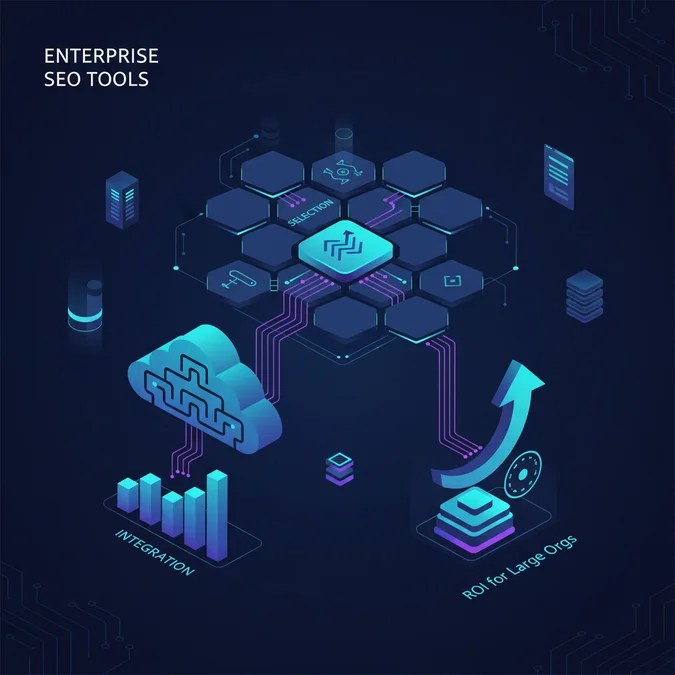

Enterprise SEO tools are specialized software solutions designed to manage the immense scale, complexity, and data requirements of large organizations’ digital presence. They provide advanced capabilities for site auditing, keyword research, content optimization, and performance tracking across millions of URLs and diverse global markets, enabling strategic decision-making and measurable organic growth.
For large enterprises, the digital landscape is a complex ecosystem where traditional SEO tactics fall short. Managing vast content inventories, intricate technical architectures, and diverse stakeholder needs demands a robust, integrated approach. This guide provides a practitioner’s perspective on selecting, integrating, and optimizing enterprise SEO tools to drive significant return on investment.
We will explore the core functionalities that define enterprise-grade solutions, offer a strategic framework for tool selection, detail architectural blueprints for seamless integration, and address advanced challenges with AI-driven solutions. Our goal is to equip technical leaders and SEO professionals with the knowledge to make informed decisions that align with organizational objectives and deliver sustainable search performance.
Understanding Enterprise SEO: Beyond Traditional Search Marketing
Enterprise SEO is a distinct discipline, fundamentally different from the SEO practiced by small to medium-sized businesses. It involves managing the organic search performance of websites with hundreds of thousands, or even millions, of pages, often across multiple domains, subdomains, and international markets. The sheer scale necessitates automation, sophisticated data analysis, and cross-functional collaboration that traditional SEO approaches cannot accommodate.
While traditional SEO might focus on individual keyword rankings or content pieces, enterprise SEO encompasses a holistic strategy for a vast digital footprint. This includes:
- Technical Complexity: Dealing with intricate site architectures, legacy systems, JavaScript rendering challenges, and large-scale migrations.
- Content Volume: Managing thousands of content assets, ensuring their discoverability, relevance, and performance at scale.
- Data Integration: Unifying data from multiple sources, including analytics platforms, CRM systems, and internal databases, to derive actionable insights.
- Stakeholder Alignment: Coordinating efforts across marketing, product, engineering, and legal departments to execute SEO initiatives.
- Global Reach: Optimizing for multiple languages, regions, and search engines, requiring advanced international SEO capabilities.
The objective of what is enterprise search engine marketing extends beyond mere organic rankings. It’s about securing a dominant, sustainable presence across all search touchpoints, including paid search, local search, and app store optimization, all while contributing directly to enterprise-level revenue and market share goals. This strategic imperative makes the selection of appropriate enterprise SEO tools crucial.
Key Differentiator: Scalability and Integration
The defining characteristic of enterprise SEO is its non-linear scalability requirement. Solutions must handle massive data volumes, complex site structures, and integrate seamlessly into existing enterprise tech stacks, providing a unified view of performance metrics across diverse digital assets.
Core Capabilities: What Defines an Enterprise SEO Platform and Software?
Distinguishing between an enterprise SEO platform and specialized enterprise SEO software is critical for strategic procurement. A platform typically offers a comprehensive, integrated suite of tools covering multiple facets of SEO, often with shared data infrastructure and unified reporting. Standalone software, conversely, provides deep functionality for a specific task, such as log file analysis or content optimization, which can then be integrated into a broader ecosystem.
An effective enterprise SEO platform provides a holistic view, automating routine tasks and enabling strategic analysis. Key capabilities include:
- Comprehensive Site Auditing: Ability to crawl millions of URLs, identify technical issues (crawl errors, broken links, duplicate content, indexing problems), and provide actionable recommendations at scale.
- Advanced Keyword Research and Gap Analysis: Tools to uncover high-volume, high-intent keywords across diverse markets, identify content gaps, and monitor competitive keyword strategies.
- Performance Monitoring and Reporting: Granular rank tracking, visibility metrics, traffic analysis, and customizable dashboards to report on KPIs relevant to different stakeholders.
- Content Optimization and Strategy: Features for content brief generation, on-page optimization suggestions, and content decay analysis across vast content libraries.
- Competitor Intelligence: Deep insights into competitor strategies, including keyword targeting, backlink profiles, and content performance.
- Integration APIs: Robust APIs to connect with analytics platforms (e.g., Google Analytics, Adobe Analytics), CMS, BI tools, and data warehouses.
- Workflow Management: Tools for task assignment, progress tracking, and collaboration across large, distributed teams.
The table below outlines typical features differentiating a comprehensive platform from specialized software components:
| Feature Category | Enterprise SEO Platform | Enterprise SEO Software (Specialized) |
|---|---|---|
| Site Crawling & Auditing | Comprehensive, scalable, continuous crawls, multi-region support | Deep-dive into specific technical aspects (e.g., JavaScript rendering, log file analysis) |
| Keyword Management | Integrated research, tracking, competitive analysis, content mapping | Focused on specific tasks like long-tail keyword generation or semantic clustering |
| Content Optimization | Content briefs, on-page analysis, content performance tracking | AI-powered content generation, plagiarism checks, readability scores |
| Reporting & Dashboards | Customizable, role-based dashboards, executive summaries, API access | Detailed reports for specific functions (e.g., backlink audit reports) |
| Integration | Native connectors, extensive APIs for ecosystem integration | APIs for data export, often requiring custom integration effort |
| Workflow & Collaboration | Built-in task management, user roles, commenting, notifications | Typically standalone, may export data for external workflow tools |
| Scalability | Designed for millions of URLs, petabytes of data, high concurrency | Optimized for specific, often heavy, computational tasks |
Choosing the Best Enterprise SEO Tools: A Strategic Selection Framework
Selecting the best enterprise SEO tools requires a structured approach that aligns technology capabilities with specific business objectives and organizational constraints. It’s not about finding a single ‘best’ tool, but rather the optimal suite that fits your unique enterprise context. Our strategic selection framework involves a multi-stage evaluation process:
- Needs Assessment: Clearly define your enterprise’s current SEO challenges, technical infrastructure, team structure, and desired outcomes. What specific pain points must the tool address?
- Feature-to-Requirement Mapping: Evaluate potential solutions against a detailed list of mandatory and desired features. Prioritize scalability, integration capabilities, and reporting flexibility.
- Vendor Evaluation: Assess vendor stability, support, training resources, and their roadmap for future development.
- Proof of Concept (POC): For shortlisted tools, conduct a limited-scope POC to test real-world performance, integration ease, and user adoption within your environment.
- Total Cost of Ownership (TCO): Beyond licensing fees, consider implementation costs, training, maintenance, and potential resource allocation.
Enterprise SEO Readiness Assessment Checklist
Before evaluating tools, assess your internal readiness:
- Have we documented our current technical SEO challenges (e.g., JavaScript rendering, site speed)?
- Is our data infrastructure capable of integrating with external APIs?
- Do we have dedicated resources for tool implementation and ongoing management?
- Are key stakeholders (marketing, engineering, product) aligned on SEO objectives?
- What are our measurable KPIs for success over the next 12-24 months?
When evaluating tools, consider the following comparison points:
| Criteria | Tool A (e.g., BrightEdge) | Tool B (e.g., Searchmetrics) | Tool C (e.g., Conductor) |
|---|---|---|---|
| Core Strengths | ContentIQ, Data Cube, AI-powered insights | Research Cloud, Content Experience, Technical SEO | Content Intelligence, Organic Visibility, Workflow |
| Technical SEO Capabilities | Strong crawling, log file analysis, site health monitoring | Deep technical audits, site speed analysis, hreflang validation | On-page analysis, schema validation, crawl budget insights |
| Content Optimization | Content creation workflows, topic clustering, competitive content analysis | Content scoring, semantic relevance, content brief generation | Audience insights, content gaps, personalization recommendations |
| Integration Ecosystem | Broad API access, connectors for analytics & CMS | Extensive API, integrations with BI tools & Google Search Console | Integrates with Google Analytics, Adobe Analytics, custom data sources |
| Reporting & Analytics | Customizable dashboards, executive reports, predictive analytics | Advanced reporting, competitive benchmarks, market share analysis | Performance dashboards, ROI tracking, trend analysis |
| Pricing Model | Tiered, based on URLs, keywords, users; typically high-end enterprise | Modular pricing, tailored to specific needs; enterprise-grade | Subscription-based, scales with usage; enterprise focus |
| Ideal Use Case | Large content-driven sites, agencies managing multiple brands | Global enterprises, competitive markets, data-driven teams | Complex organizations needing content strategy & cross-functional alignment |
An agency vetting checklist should include:
- Proven track record with similar enterprise clients.
- Expertise in integrating and customizing selected tools.
- Clear communication protocols and reporting structures.
- Access to certified platform experts and technical support.
- Alignment with your internal team’s methodologies and goals.
Architectural Blueprint: Integrating Enterprise SEO Tools into Your Tech Stack
Effective integration of enterprise SEO tools is paramount for maximizing their value and achieving a unified data ecosystem. This requires a well-defined architectural blueprint that ensures seamless data flow, automates workflows, and provides a single source of truth for performance metrics. Ignoring this can lead to data silos, manual inefficiencies, and inaccurate reporting.
A typical integration architecture might involve several key components:
- SEO Platform as Central Hub: The primary enterprise SEO platform often acts as the central data orchestrator, pulling data from various sources and pushing insights to other systems.
- Data Connectors (APIs): Leverage robust APIs provided by SEO platforms to connect with existing systems. This ensures automated data exchange without manual intervention.
- CMS Integration: Direct integration with your Content Management System (e.g., Adobe Experience Manager, Sitecore, WordPress VIP) allows for direct implementation of on-page SEO recommendations, content updates, and schema markup deployments.
- Analytics & Business Intelligence (BI) Tools: Connecting with Google Analytics, Adobe Analytics, or internal BI dashboards (e.g., Tableau, Power BI) enriches SEO data with user behavior, conversion metrics, and business impact. This enables comprehensive ROI attribution.
- Developer Workflows: Integrate technical SEO audit findings into project management tools (e.g., Jira, Asana) used by engineering teams. This streamlines the remediation of critical technical issues.
- CRM Systems: While less direct, integrating SEO insights with CRM data can help understand how organic search influences customer journeys and sales pipelines.
Consider the following architectural integration points and potential engineering trade-offs:
| Integration Point | Purpose | Engineering Trade-offs |
|---|---|---|
| SEO Platform & CMS | Automated content optimization, meta data updates, schema deployment | API rate limits, data mapping complexity, potential for content conflicts |
| SEO Platform & Analytics (GA/Adobe) | Holistic performance view, user behavior correlation, conversion tracking | Data sampling, discrepancy reconciliation, PII compliance |
| SEO Platform & BI Tools | Custom dashboards, cross-channel reporting, executive summaries | Data warehousing costs, ETL process development, data governance |
| SEO Platform & Dev Tools (Jira) | Streamlined technical SEO issue tracking & resolution | API authentication, webhook configuration, workflow automation scripting |
| Log File Analysis Software & SEO Platform | Crawl budget optimization, bot activity monitoring | Storage costs for log data, processing power, data privacy |
| Internal Data Lakes/Warehouses | Enriched data for advanced modeling, predictive analytics | Data ingestion pipelines, schema design, data quality management |
Integration Best Practice: API-First Strategy
Prioritize enterprise SEO tools with well-documented, flexible APIs. An API-first integration strategy reduces manual effort, enhances data accuracy, and future-proofs your tech stack against evolving requirements, enabling custom workflows and deeper data analysis.
Engineering teams must evaluate the robustness of APIs, data synchronization methods (batch vs. real-time), security protocols, and the potential impact on system performance. Investing in robust integration architecture upfront saves significant operational overhead and unlocks deeper insights for strategic decision-making.
Advanced Enterprise SEO Challenges and AI-Driven Solutions
Large enterprises face a distinct set of advanced technical SEO challenges that demand sophisticated solutions. These go beyond basic on-page optimization and delve into the intricacies of how search engines crawl, render, and index vast, dynamic websites. Addressing these requires a deep understanding of search engine mechanics and often, the leveraging of artificial intelligence.
- Internationalization at Scale: Managing Hreflang tags, geo-targeting, multi-language content, and local search performance across dozens of countries can quickly become unmanageable manually. AI can automate Hreflang audits, identify geo-targeting conflicts, and even suggest localized content variations based on linguistic and cultural nuances.
- Managing Millions of URLs: Crawl budget optimization becomes critical for sites with millions of pages. AI-powered log file analysis can identify inefficient crawl patterns, prioritize critical pages for indexing, and detect orphaned or low-value content that drains crawl resources.
- JavaScript-Heavy Sites: Modern web applications often rely heavily on JavaScript for rendering content, posing significant challenges for search engine crawlers. Enterprise SEO tools with advanced rendering capabilities can simulate browser behavior, identify render-blocking resources, and ensure all critical content is discoverable. AI can further analyze rendering performance and suggest optimizations to improve crawlability and indexing.
- Content Duplication and Cannibalization: Vast content libraries often lead to unintentional content duplication or keyword cannibalization. AI algorithms can detect semantic similarities across thousands of pages, identify potential cannibalization issues, and recommend consolidation or optimization strategies.
- Dynamic Content and Personalization: Websites that deliver personalized content based on user profiles or location can present indexing challenges if not managed carefully. AI can help map personalized content variations to indexing strategies, ensuring relevant versions are discoverable without creating duplicate content issues.
- Predictive Analytics: Leveraging machine learning, enterprise SEO platforms can analyze historical data to predict future ranking fluctuations, traffic trends, and the potential impact of algorithmic updates, allowing proactive strategy adjustments.
AI-Driven Technical SEO Audit: Beyond the Surface
AI goes beyond traditional audit tools by identifying complex, non-obvious patterns in vast datasets. For example, AI can correlate server log data with Google Search Console data to pinpoint specific server response time spikes impacting crawl rates for critical page segments, a level of detail manual analysis cannot achieve efficiently.
The strategic application of AI in enterprise SEO shifts the focus from reactive problem-solving to proactive optimization. It enables teams to manage complexity, gain predictive insights, and automate highly repetitive or data-intensive tasks, freeing up human experts for higher-level strategic work.
Maximizing ROI: Building a Winning Enterprise SEO Strategy and Team Alignment
Achieving significant ROI from enterprise SEO initiatives extends beyond tool implementation; it requires a robust strategy, meticulous execution, and, critically, cross-departmental alignment. For large organizations, siloed operations can severely impede SEO progress and dilute the impact of even the most sophisticated enterprise SEO tools. Maximizing ROI hinges on integrating SEO into the core business strategy and fostering a culture of collaboration.
Key elements for a winning strategy and team alignment:
- Clear KPI Definition: Establish measurable Key Performance Indicators (KPIs) that directly tie SEO efforts to business outcomes, such as organic revenue, lead generation, customer acquisition cost, or market share. Move beyond vanity metrics.
- Cross-Functional Collaboration Framework: Implement a structured approach for collaboration between marketing, product, engineering, content, and legal teams. This includes regular sync meetings, shared project management tools, and clear communication channels.
- Stakeholder Education and Buy-in: Educate executive leadership and other department heads on the value of SEO, its long-term impact, and how their teams contribute to its success. Present ROI in terms of business metrics they understand.
- Dedicated Resources and Expertise: Ensure adequate staffing with specialized SEO talent, both in-house and potentially through agency partnerships, to manage the complexity and scale of enterprise SEO.
- Continuous Optimization and Iteration: SEO is not a one-time project. Establish processes for ongoing monitoring, A/B testing of SEO changes, and iterative improvements based on performance data.
- Integrated Reporting: Develop comprehensive reports that consolidate data from SEO tools, analytics platforms, and sales data to provide a holistic view of performance and ROI to all stakeholders.
Here’s a checklist for fostering team alignment and maximizing ROI:
- Define clear, measurable SEO objectives aligned with business goals.
- Identify and engage all relevant internal stakeholders early in the process.
- Establish a regular communication cadence for SEO updates and performance.
- Provide training and resources for non-SEO teams to understand their role.
- Integrate SEO tasks directly into existing product and development sprints.
- Create a centralized knowledge base for SEO best practices and guidelines.
- Celebrate SEO successes internally to build momentum and recognition.
- Regularly review and adjust the SEO strategy based on market shifts and data.
By treating enterprise SEO as a strategic business function, rather than a tactical marketing activity, organizations can unlock its full potential, transforming organic search into a primary driver of sustained growth and competitive advantage.
Frequently Asked Questions
What are the primary differences between enterprise SEO and traditional SEO?
Enterprise SEO focuses on the unique complexities of large organizations, including vast websites, multiple stakeholders, global markets, and intricate technical infrastructures. Unlike traditional SEO, it requires scalable solutions, advanced data integration, and cross-departmental collaboration to manage its scope and impact effectively.
What key features should an enterprise SEO platform offer for large-scale operations?
An effective enterprise SEO platform should offer robust site auditing for millions of URLs, advanced keyword research at scale, comprehensive competitor analysis, sophisticated rank tracking, and seamless integration with other marketing and development tools. It must also provide detailed reporting and workflow management capabilities for large teams.
How can enterprise SEO software help manage international SEO challenges?
Enterprise SEO software aids international SEO by supporting multi-language and multi-region site structures, Hreflang tag management, localized keyword research, and global rank tracking. It helps identify geo-targeting issues, manage international content strategies, and ensure compliance with regional search engine guidelines, crucial for global brands.
What are the critical considerations when evaluating the best enterprise SEO tools for ROI?
When evaluating enterprise SEO tools for ROI, consider their scalability, integration capabilities with your existing tech stack, depth of data insights, and automation features. Assess vendor support, training, and total cost of ownership. Prioritize tools that align with your specific business goals and offer clear pathways to measurable performance improvements.
The journey of selecting, integrating, and optimizing enterprise SEO tools is a strategic imperative for any large organization aiming for sustained digital dominance. It demands a sophisticated understanding of both technology and business objectives, moving far beyond the scope of traditional search marketing. By investing in the right platforms, building robust integration architectures, and fostering cross-functional alignment, enterprises can transform their organic search presence into a powerful, measurable engine for growth.
The insights and frameworks presented here provide a roadmap for navigating this complex landscape. Remember, the true value of enterprise SEO tools lies not just in their features, but in their ability to drive actionable intelligence and enable a collaborative, data-driven approach to organic performance. Embrace these principles to ensure your enterprise SEO strategy delivers exceptional ROI and maintains a competitive edge in an ever-evolving digital world.
NR Studio builds custom web apps, mobile apps, SaaS platforms, and internal tools for growing businesses. If you’re working through a technical decision, feel free to reach out — no commitment required.