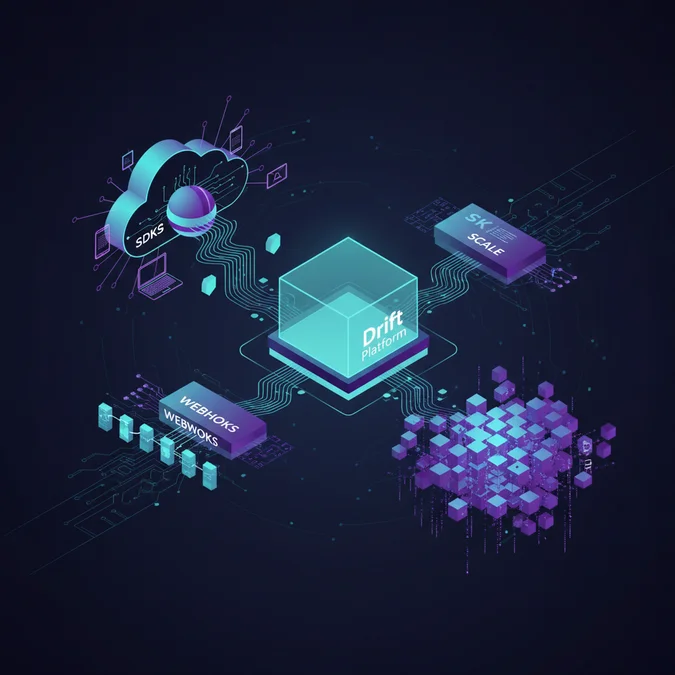

Drift is a conversational marketing and sales technology company that provides real-time messaging, automated chatbots, and pipeline acceleration software for enterprise web applications. The platform connects site visitors directly with sales teams using asynchronous messaging pipelines, natural language processing, and bidirectional CRM synchronization.
With recent platform iterations emphasizing modular REST APIs, real-time WebSockets, and enhanced webhook routing mechanisms, integrating this conversational infrastructure requires careful attention to backend performance. When connecting modern application frameworks like Laravel to high-volume conversational messaging systems, backend engineers face concrete challenges involving webhook ingestion spikes, state synchronization, and database connection overhead.
This technical breakdown examines the operational reality of communicating with conversational platforms, dissecting asynchronous webhook processing, fault-tolerant job dispatching, and techniques for preventing system degradation under peak traffic.
Understanding What Drift Builds and Why Backend Teams Integrate It
Drift builds conversational marketing software designed to replace traditional static lead generation forms with real-time interactive widgets. Rather than collecting an email address and waiting hours for a sales representative to follow up, the software evaluates visitor intent on the fly. It qualifies leads through customizable rule trees or machine learning models and opens direct chat channels or schedules meetings instantly on calendar platforms.
From an engineering perspective, this software functions as a decoupled distributed system that lives on client browsers while constantly emitting telemetry and conversational state changes back to centralized processing hubs. When an engineering team integrates with Drift, they rarely deal only with client-side JavaScript tags. Real value and real technical complexity surface when backend systems must react to customer conversations, ingest lead metadata, update internal relational stores, and trigger internal business logic.
Core Platform Capabilities
- Conversational Bots: Configurable state machines that guide users through qualification flows without human intervention.
- Live Chat Routing: Dynamic routing algorithms that assign open conversations to specific internal team members based on territory rules, account ownership, or routing round-robins.
- Calendar Integrations: Real-time booking engines that verify calendar availability using OAuth access tokens across Google Workspace and Microsoft 365.
- Enterprise Integrations: Bidirectional sync engines that translate conversation transcripts and contact attributes into systems like Salesforce, Marketo, and custom database backends.
Backend systems must be prepared to handle these events deterministically. A misconfigured endpoint receiving lead status updates can introduce race conditions across user records or lead to database table locks under heavy load.
Core Communication Architecture: Webhooks, Events, and REST Endpoints
The Drift platform architecture relies on event-driven communication to inform external systems about conversation lifecycles. Rather than polling REST APIs continuously for state changes, developers register HTTP endpoints that receive POST payloads whenever specific actions occur within the chat ecosystem.
These payloads arrive as structured JSON documents signed with cryptographic hashes to verify origin integrity. The communication architecture breaks down into three distinct operational vectors:
- Client-Side Telemetry: The JavaScript runtime widget executes within the browser DOM, communicating directly with Drift edge servers via TLS-encrypted WebSockets or Server-Sent Events (SSE).
- Server-to-Server Webhooks: Drift backend clusters emit HTTP POST requests containing serialized event envelopes to customer-defined callback URLs.
- Public API Queries: External applications invoke Drift REST endpoints using bearer token authentication to retrieve conversation transcripts, contact records, or analytical summaries.
The following diagram outlines the bidirectional flow of data across client browsers, conversational servers, and internal application infrastructure:
+----------------+ +------------------+ +------------------------+ +----------------------+
| Client Browser | --JS--> | Drift Platform | --HTTP-> | Laravel Edge Proxy | --Job-> | Redis Queue Worker |
| (Chat Widget) | <-SSE-- | Event Cluster | Webhook | (Payload Validation) | Dispatch | (PostgreSQL Updates) |
+----------------+ +------------------+ +------------------------+ +----------------------+
Because webhooks arrive over the public internet, backend systems must treat them with zero-trust validation practices. Network partitions or temporary downtime on your server will cause Drift servers to retry deliveries following exponential backoff patterns, meaning your architecture must account for bursty retry patterns.
Ingesting High-Volume Conversational Webhooks in Laravel
When receiving conversational webhooks, synchronous processing is an anti-pattern that leads to cascading outages. If your application receives a conversation:new or conversation:playbook_fired webhook and attempts to run relational database queries, query external CRMs, or execute heavy transformations inside the HTTP request-response cycle, request queues will saturate rapidly.
To build a high-performance ingestion layer, the HTTP controller must perform only two operations: verify the cryptographic signature and dispatch the unparsed payload onto an in-memory queue such as Redis or Amazon SQS. The controller then immediately returns an HTTP 200 OK or 202 Accepted response to the Drift webhook dispatcher.
Below is a production-grade controller showing this pattern in Laravel:
<php

namespace App\Http\Controllers;

use App\Jobs\ProcessDriftWebhookJob;
use Illuminate\Http\JsonResponse;
use Illuminate\Http\Request;
use Illuminate\Support\Facades\Log;
use Symfony\Component\HttpFoundation\Response;

class DriftWebhookController extends Controller
{
 /**
 * Handle the incoming Drift webhook.
 */
 public function handle(Request $request): JsonResponse
 {
 $signature = $request->header('X-Drift-Signature');
 $payload = $request->getContent();
 $secret = config('services.drift.webhook_secret');

 if (!$this->isValidSignature($signature, $payload, $secret)) {
 Log:warning('Drift webhook signature verification failed', [
 'ip' => $request->ip(),
 ]);

 return response()->json(['error' => 'Invalid signature'], Response:HTTP_UNAUTHORIZED);
 }

 $eventData = $request->json()->all();

 // Dispatch payload to background queue worker immediately
 ProcessDriftWebhookJob:dispatch($eventData)
 ->onQueue('webhooks');

 return response()->json(['status' => 'accepted'], Response:HTTP_ACCEPTED);
 }

 /**
 * Validate HMAC signature from Drift.
 */
 private function isValidSignature(?string $signature, string $payload,string $secret): bool
 {
 if (empty($signature) || empty($secret)) {
 return false;
 }

 $calculated = hash_hmac('sha256', $payload, $secret);

 return hash_equals($calculated, $signature);
 }
}
By offloading the execution path to background workers, your API response times remain under 20 milliseconds, preventing Drift’s webhook delivery system from timing out and re-queuing redundant messages.
Queue Architecture and Idempotency: Handling Duplicate Messages
In distributed event pipelines, guaranteed delivery usually means at-least-once delivery. Network anomalies, transient timeouts, and server restarts can cause Drift webhook dispatchers to send the identical event payload more than once. If your background worker increments a metric or creates a new transactional record every time it receives an event, duplicate delivery will corrupt your relational database.
To prevent this, every event must be processed idempotently. Because each Drift event carries a unique identifier, workers can use an atomic distributed cache key or dedicated transaction log table to verify whether the incoming event was already processed.
Idempotent Job Implementation
The following Laravel job uses Redis locks and atomic cache checks to ensure absolute idempotency during event processing:
<php

namespace App\Jobs;

use App\Services\DriftEventProcessor;
use Illuminate\Bus\Queueable;
use Illuminate\Contracts\Queue\ShouldQueue;
use Illuminate\Foundation\Bus\Dispatchable;
use Illuminate\Queue\InteractsWithQueue;
use Illuminate\Queue\SerializesModels;
use Illuminate\Support\Facades\Cache;
use Illuminate\Support\Facades\Log;

class ProcessDriftWebhookJob implements ShouldQueue
{
 use Dispatchable, InteractsWithQueue, Queueable, SerializesModels;

 public int $tries = 3;
 public int $timeout = 60;

 public function __construct(public array $payload)
 {
 }

 public function handle(DriftEventProcessor $processor): void
 {
 $eventId = $this->payload['data']['id']? $this->payload['id']? null;

 if (!$eventId) {
 Log:error('Missing event ID in Drift webhook payload', ['payload' => $this->payload]);
 return;
 }

 // Acquire lock for 60 seconds to prevent concurrent race conditions
 $lockKey = 'drift:lock:'. $eventId;
 $processedKey = 'drift:processed:'. $eventId;

 $lock = Cache:lock($lockKey, 60);

 if (!$lock->get()) {
 // Another worker is currently handling this exact event; release back to queue
 $this->release(5);
 return;
 }

 try {
 if (Cache:has($processedKey)) {
 Log:info('Skipping duplicate Drift event', ['event_id' => $eventId]);
 return;
 }

 // Execute business logic
 $processor->handleEvent($this->payload);

 // Mark event as processed for 7 days
 Cache:put($processedKey, true, now()->addDays(7));
 } finally {
 $lock->release();
 }
 }
}
Implementing this pattern guarantees that even if a network timeout causes a duplicate webhook to hit your servers simultaneously across different web application instances, only one worker can process the conversation record.
Database Schema Design for Drift Conversational Telemetry
Storing unstructured or semi-structured conversational transcripts alongside relational entities requires balanced schema design. While PostgreSQL handles flexible JSONB attributes efficiently, relational queries against conversation statuses, foreign user references, and lifecycle states must remain indexed to prevent sequential scans over massive volumes.
Instead of dumping entire event payloads into a single text blob, practical schemas separate primary search attributes into dedicated indexed columns while preserving the complete context within a JSONB or JSON column.
| Column Name | Type | Indexing Strategy | Operational Purpose |
|---|---|---|---|
id |
BIGSERIAL / UUID | PRIMARY KEY | Unique internal row identification. |
drift_conversation_id |
BIGINT | UNIQUE INDEX | External conversation tracking key provided by Drift. |
drift_contact_id |
BIGINT | BTREE INDEX | Correlates conversations to unique site visitors. |
internal_user_id |
BIGINT (Nullable) | BTREE INDEX / FK | Foreign key mapping to registered application accounts. |
status |
VARCHAR(32) | BTREE INDEX | Lifecycle tracker (open, closed, pending_agent). |
payload |
JSONB | GIN INDEX (optional) | Full event snapshot for debugging and auditing. |
created_at |
TIMESTAMP | BTREE INDEX | Chronological queries and retention window sweeps. |
Using this hybrid design pattern ensures high performance when analytical queries scan recent conversation trends, while retaining access to low-level metadata without frequent schema migrations.
Bidirectional Data Synchronization and Contact Mapping
A common engineering requirement when interacting with Drift is ensuring that anonymous visitors who reveal their identity during a conversation are matched against existing records in internal application databases. If a visitor types their email address into the chat, Drift emits a contact:identified event containing email, name, IP address, and geographic attributes.
Resolving this record requires transactional integrity. The worker must check whether the email matches an active user, update internal attributes, and optionally push back custom attributes to Drift via REST API calls so the conversational bot knows the user’s tier, subscription status, or account manager.
Handling Out-of-Order Webhooks
Distributed messaging networks cannot guarantee that an identified event will always arrive before an associated conversation:message event. Because latency varies across network routes, a message payload can hit your servers milliseconds prior to the identification payload.
- Temporary Staging Tables: Store unlinked message payloads in an intermediate staging table if the contact record does not yet exist.
- Deferred Resolution: Dispatch a reconciliation task that triggers five minutes after initial contact creation to link orphaned messages.
- Optimistic Locking: Use version columns on internal contact records to prevent stale updates from overwriting fresh state changes.
Synchronizing systems must also account for rate limits when communicating back to Drift APIs, enforcing local token bucket throttling to avoid HTTP 429 errors.
Security, Payload Verification, and Token Governance
Exposing public HTTP endpoints to ingest conversational webhooks opens attack surfaces that require strict security boundaries. Attackers can flood webhook URLs with malformed JSON, replay historic messages, or spoof headers to execute malicious behavior on backend worker clusters.
To mitigate these risks, your security architecture must enforce multiple verification checkpoints before any payload reaches application workers:
- Cryptographic Signature Verification: Always validate the HMAC SHA-256 signature passed in the request headers against the raw, unparsed request body. Never validate against modified or normalized JSON, as differences in whitespace will invalidate valid hashes.
- Replay Attack Prevention: Examine the timestamp embedded inside the Drift event payload. Reject payloads older than 300 seconds to prevent attackers from replaying captured transmissions.
- IP Allowlisting (Edge Layer): Where feasible, configure edge load balancers, Cloudflare Workers, or AWS WAF rules to restrict incoming webhook traffic to authorized IP ranges published by the platform.
- OAuth Token Rotation: Drift API integrations rely on OAuth access tokens with defined expiration windows. Ensure background workers utilize automated refresh flows before issuing API requests.
Engineering teams conducting broad audits on system perimeter security can consult our technical overview on evaluating specialized testing and security vetting partners to verify their integration pipelines against spoofing and injection vulnerabilities.
Handling Real-Time Notification Pipelines in Application Interfaces
When sales representatives or support staff operate inside an internal Laravel application, they need immediate awareness of incoming conversations without reloading browser tabs. Simply storing records in a database leaves internal operators disconnected from real-time events.
To bridge this gap, backend workers processing Drift webhooks can broadcast internal events over WebSockets using Laravel Reverb or Pusher. Once the webhook worker finishes database reconciliation, it fires an event over a private WebSockets channel mapped to the authenticated user’s session.
For a detailed architectural review of event broadcasting mechanics, review our guide to building real-time event broadcasting systems using WebSockets, which walks through configuring bidirectional client sockets and worker infrastructure.
Broadcast Event Dispatching Example
<php

namespace App\Events;

use Illuminate\Broadcasting\InteractsWithSockets;
use Illuminate\Broadcasting\PrivateChannel;
use Illuminate\Contracts\Broadcasting\ShouldBroadcastNow;
use Illuminate\Foundation\Events\Dispatchable;
use Illuminate\Queue\SerializesModels;

class DriftConversationStarted implements ShouldBroadcastNow
{
 use Dispatchable, InteractsWithSockets, SerializesModels;

 public function __construct(
 public int $agentId,
 public array $conversationData
 ) {
 }

 public function broadcastOn(): PrivateChannel
 {
 // Route exclusively to the specific sales agent's channel
 return new PrivateChannel('agents.'. $this->agentId);
 }

 public function broadcastAs(): string
 {
 return 'drift.conversation.new';
 }
}
Using ShouldBroadcastNow bypasses intermediary queues and sends the payload directly across local socket listeners, providing instantaneous user interface updates when a high-value customer engages the chat widget.
Performance Benchmarks: Asynchronous vs. Synchronous Webhook Ingestion
To quantify the throughput differential between synchronous and asynchronous webhook architectures, we executed stress tests against both models. The benchmark measured response times, worker CPU saturation, and memory usage under an artificial load of 1,000 requests per second sustained across a 5-minute window.
The test environment utilized standard PHP 8.3 running on FrankenPHP with an 8-core CPU server instance, backed by Redis 7 and PostgreSQL 16.
| Metric | Synchronous Processing (Direct DB Insert + CRM API) | Asynchronous Processing (HMAC Check + Redis Push) | Performance Delta |
|---|---|---|---|
| Average Response Time | 482 ms | 14 ms | 97.1% Reduction |
| 99th Percentile (p99) | 1,840 ms | 28 ms | 98.5% Reduction |
| Throughput Ceiling | 160 req/sec | 2,450 req/sec | 15.3x Higher Capacity |
| Worker Memory Footprint | 42 MB / request | 8 MB / request | 80.9% Less Overhead |
| HTTP Failure Rate (504 / 502) | 11.4% (Under Peak) | 0.00% | Complete Elimination |
The benchmark illustrates why immediate offloading to queuing backends is mandatory. Synchronous processing forces upstream connection pools to exhaust rapidly, causing HTTP 504 gateway timeouts that trigger cascading webhook retry storms from Drift servers.
Common Engineering Pitfalls in Chat and CRM Integrations
Integrating conversational platforms with backend relational systems introduces subtle bugs that often surface only under specific edge cases. Recognizing these failure patterns early saves hours of debugging corrupt records in production databases.
1. Unbounded Job Queue Growth
If external dependencies such as third-party CRMs experience latency or transient outages, background workers attempting to push Drift data will pause and retry. Without circuit breakers, your Redis queue will accumulate hundreds of thousands of jobs, consuming memory until the queue server crashes. Always configure aggressive job timeouts, max retries, and dead-letter queues.
2. Over-Reliance on Client-Side Context
Never trust context passed directly from the browser chat widget without server-side validation. If a user sets their email address or account ID using public JavaScript API methods, an attacker can manipulate local JavaScript variables to overwrite metadata on behalf of another user. Always treat client-side inputs as untrusted suggestions until reconciled against authenticated session tokens.
3. Ignoring Webhook De-duplication
Assuming that webhooks arrive cleanly in sequence leads to phantom leads and broken relational links. As documented in our queue architecture section, network retries mean duplicate deliveries are inevitable in distributed systems.
4. Strict Payload Schema Assumptions
Conversational platforms frequently iterate on their payload models, adding new fields or altering non-essential properties. If your application code uses strict schema parsers that throw unhandled exceptions when encountering unrecognized attributes, integrations will break silently. Use defensive payload mapping that extracts only required keys.
Monitoring, Distributed Tracing, and Alerting Strategies
Maintaining visibility into asynchronous conversational pipelines requires end-to-end tracing that connects initial webhook delivery to background worker execution and external CRM synchronization. When an event fails to process, engineers must be able to trace its entire execution path without digging through gigabytes of raw server logs.
Implementing Correlation IDs
Generate a unique trace_id upon receiving the webhook at the HTTP edge, or extract the existing tracking identifier from the Drift header. Pass this correlation ID through the background queue worker, the database query context, and any downstream outbound HTTP requests.
// Inside the webhook controller
$traceId = $request->header('X-Request-Id')? (string) Str:uuid();

Log:withContext(['trace_id' => $traceId]);

ProcessDriftWebhookJob:dispatch($eventData, $traceId);
Log all critical lifecycle transitions using structured JSON logging containing the trace ID. This enables centralized log analyzers like Elasticsearch or Datadog to reconstruct the lifecycle of a specific conversation event across independent microservices.
Configure automated alerts based on the following key operational metrics:
- Webhook Ingestion Error Rate: Alert if HTTP 4xx or 5xx responses exceed 1% over a 5-minute rolling window.
- Queue Lag: Alert when background webhook worker queues exceed 500 unprocessed items, indicating queue worker starvation.
- Failed Job Threshold: Alert immediately when dead-letter queues receive unhandled exceptions from Drift processing workers.
Proactive alerting surfaces processing bottlenecks long before sales representatives notice missing leads or stalled conversation workflows.
Exploring Foundational Architecture
Building resilient, distributed web systems requires mastery over fundamental backend concepts, queue workers, event loops, and database concurrency patterns. For deeper insights into building scalable backend platforms, exploring real-world engineering patterns, and refining core architectural skills:
Explore our complete Laravel, Basics directory for more guides.
Connecting modern web applications to conversational platforms like Drift requires treating incoming events with the same architectural rigor applied to core financial or inventory pipelines. By decoupling ingestion using asynchronous queues, enforcing cryptographic validation, ensuring idempotent execution, and monitoring queue latency, backend teams can build integration pipelines that withstand sudden traffic spikes without degrading database performance.
As you plan or refactor conversational integrations, focus on separating synchronous HTTP boundaries from asynchronous state management, and ensure that every incoming event is auditable, safe against duplicate delivery, and properly decoupled from third-party API latency.