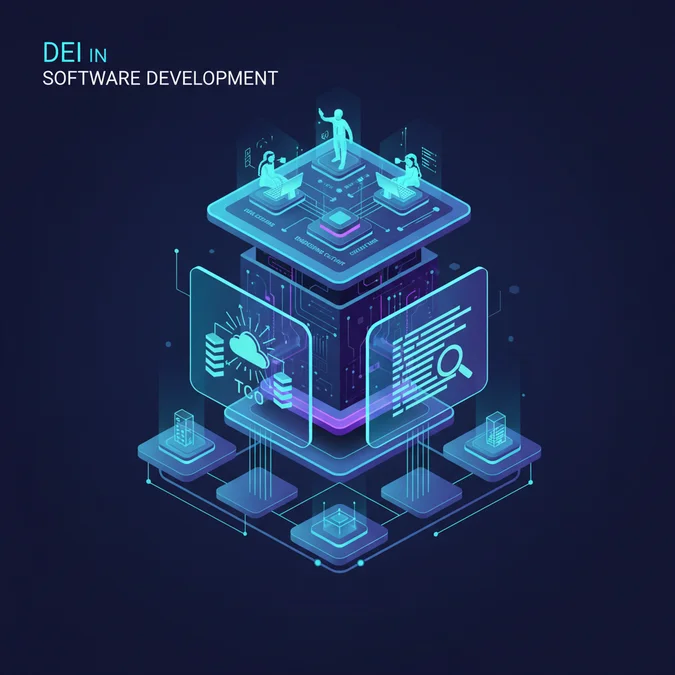

Diversity, equity, and inclusion (DEI) in software development is the deliberate practice of assembling engineering teams with varied backgrounds and designing systems, architectures, and automated pipelines that eliminate systemic bias, reduce blind spots, and expand platform accessibility. Far from a purely human-resources initiative, DEI directly determines software reliability, algorithmic fairness, and product viability across diverse global user bases.
Engineering organizations often run into severe operational bottlenecks when scaling consumer-facing or enterprise distributed systems. A high-throughput API gateway processing millions of multi-regional transactions will often experience catastrophic production failures not because the infrastructure cluster runs out of memory, but because the software was built under narrow cultural and contextual assumptions. Systems collapse under internationalization edge cases, accessibility validation defects, regional network variations, and misconfigured demographic validations. Homogeneous engineering teams consistently design systems with critical domain blind spots that generate technical debt, bloat bug queues, and skyrocket the Total Cost of Ownership (TCO).
Treating diversity, equity, and inclusion as core architectural attributes mitigates these production vulnerabilities. By aligning team composition, algorithmic reviews, code linters, and pull request workflows with inclusive engineering standards, technology leaders insulate their architectures against cost overruns while driving higher development velocity across modern cloud platforms.
The Direct Answer: Defining DEI within Software Engineering Systems
DEI in software development represents the integration of cognitive diversity, equal technical opportunity, and programmatic inclusion across both human engineering teams and the technical artifacts they build. It spans engineering hiring, code review dynamics, pipeline architecture, algorithmic dataset curation, and digital accessibility compliance to build resilient software systems with minimal technical debt.
When engineering leaders treat DEI as an engineering requirement rather than an administrative policy, it surfaces as tangible specifications in software architectures:
- Cognitive Diversity: Assembling development squads with varied socioeconomic, educational, cognitive, and regional backgrounds to anticipate real-world edge cases before code touches production.
- Systemic Equity: Providing equal distribution of high-leverage architectural ownership, clear engineering ladders, and objective telemetry-based code contribution models to prevent burnout and turnover.
- Algorithmic and Architectural Inclusion: Designing data schemas, machine learning models, and user interfaces that accommodate global locales, diverse physiological interactions, and non-Western identity structures.
Without an engineering-centric approach to DEI, systems accumulate structural flaws that require expensive refactoring. Engineering teams that embed these principles early prevent recurring defects, preserve development velocity, and expand total addressable market reach without architectural rework.
The Architecture Challenge: System Bottlenecks Caused by Monocultural Teams
Monocultural software teams routinely design systems with hidden edge-case liabilities. When software architects share identical demographic and socio-technical profiles, their implicit assumptions become hardcoded into database schemas, third-party authentication handshakes, and identity management systems. These assumptions frequently fail under global load, causing outages, customer attrition, and costly emergency rewrites.
Consider an international fintech platform experiencing explosive adoption. The core database schema, designed by a team accustomed only to Western naming conventions, utilizes restrictive tables that force every user to provide a single alphanumeric first name and last name. As traffic spikes across East Asia, the Middle East, and Latin America, registration services throw millions of unhandled exceptions at the persistence layer:
-- Fragile, monocultural schema design causing production failures
CREATE TABLE app_users (
 id BIGINT UNSIGNED AUTO_INCREMENT PRIMARY KEY,
 first_name VARCHAR(50) NOT NULL,
 last_name VARCHAR(50) NOT NULL,
 middle_initial CHAR(1) NULL,
 phone_e164 VARCHAR(15) NOT NULL,
 created_at TIMESTAMP DEFAULT CURRENT_TIMESTAMP
);

-- Inclusive schema supporting global naming models and flexible identities
CREATE TABLE app_users (
 id BIGINT UNSIGNED AUTO_INCREMENT PRIMARY KEY,
 display_name VARCHAR(255) NOT NULL,
 legal_name VARCHAR(255) NULL,
 family_name VARCHAR(100) NULL,
 given_name VARCHAR(100) NULL,
 preferred_pronouns VARCHAR(50) NULL,
 phone_e164 VARCHAR(20) NOT NULL,
 locale VARCHAR(10) DEFAULT 'en-US',
 created_at TIMESTAMP DEFAULT CURRENT_TIMESTAMP
);
Resolving this schema defect after reaching scale requires running risky, long-running database migrations on high-traffic tables, re-indexing millions of records, and patching every downstream microservice reading from those columns. Incorporating diverse team perspectives during the design phase avoids this rework entirely, building resilience into systems right from their inception in the software life cycle.
Total Cost of Ownership and Technical Debt: The Financial Impact of Ignoring DEI
Ignoring DEI generates quantifiable technical and financial debt. Software architectures built without diverse inputs suffer from higher defect density in validation layers, poor accessibility scores that risk regulatory fines, and elevated customer acquisition costs due to localized drop-offs.
When software defects reach production, the remediation cost scales exponentially compared to catching them during the design or pull request phase. The table below details how DEI-related defects impact software maintenance costs across common architectural components:
| Architectural Component | Monocultural Engineering Risk | Remediation Phase Cost | Annualized TCO Impact |
|---|---|---|---|
| Identity & Access Management (IAM) | Rigid schema constraints (names, genders, scripts) | Database refactor during peak traffic | $140,000 – $350,000 in migration overhead |
| Frontend Presentation Layer | Zero keyboard navigation, poor ARIA contracts | Post-audit retrofitting or ADA lawsuits | $85,000 – $220,000 in legal and re-work costs |
| Machine Learning Classifiers | Biased training data, narrow validation groups | Model retraining, public brand rollback | $300,000 – $1,200,000 in compute and churn |
| Automated Test Suites | Missing internationalization test coverage | Persistent flaky releases, microservice rollbacks | $60,000 – $180,000 in lost engineering sprint time |
Engineering leaders can actively prevent these budget drains by holding systems accountable to strict internationalization and accessibility criteria during design reviews. In complex enterprise platforms, such as those implementing event sourcing in Laravel, tracking historical user attributes without a flexible, inclusive domain model creates irreversible read-model projections that require complete event-stream replays to resolve.
Algorithmic Bias and Machine Learning: Engineering Fair Data Pipelines
Automated decision-making systems and machine learning models are fundamentally sensitive to biases in training data and validation metrics. When an engineering team lacks demographic diversity, developers often select historical datasets without auditing them for socioeconomic skew, historical prejudice, or demographic imbalances.
Data Pipeline Auditing Mechanics
Production data pipelines must feature automated fairness assertions alongside standard schema validators. This involves checking feature distribution parity before feeding tensors into training loops:
import numpy as np
import pandas as pd

def validate_feature_fairness(df: pd.DataFrame, protected_col: str, outcome_col: str, threshold: float = 0.8) -> bool:
 """
 Evaluates disparate impact ratio between demographic subgroups.
 Enforces the four-fifths rule programmatically within CI/CD pipelines.
 """
 groups = df[protected_col].unique()
 if len(groups) < 2:
 return True

 rates = {}
 for group in groups:
 subset = df[df[protected_col] == group]
 positive_rate = subset[outcome_col].mean()
 rates[group] = positive_rate

 base_rate = max(rates.values())
 min_rate = min(rates.values())

 if base_rate == 0:
 return True

 disparate_impact_ratio = min_rate / base_rate

 # Assert model pipeline fails if disparate impact exceeds allowed threshold
 if disparate_impact_ratio < threshold:
 raise ValueError(
 f"Fairness Pipeline Failure: Disparate impact ratio {disparate_impact_ratio:3f} "
 f"violates safety threshold {threshold}."
 )
 return True
Integrating these automated checks directly into CI/CD pipelines ensures that biased models fail pre-flight tests before deployment, mitigating compliance and security risks down the line.
Accessibility as Code: Automated Linters and CI/CD Quality Gates
Inclusion within modern software requires web and mobile products to function reliably for people with visual, motor, auditory, or cognitive impairments. Relying on manual accessibility audits right before product launches introduces massive release delays. Engineering organizations must instead treat Accessibility as Code (AaC).
Automated Static Accessibility Linting
Development teams should enforce WCAG 2.2 AA compliance natively using static analysis tools and automated headless browser assertions inside the continuous integration pipeline:
- AST Static Linters: Run
eslint-plugin-jsx-a11yor framework-specific blade/template linters on every pull request to catch missing labels, unassociated form inputs, and invalid ARIA attributes. - Automated Headless Checks: Execute automated headless browser passes (such as axe-core integrated into Cypress or Playwright) that fail deployment builds if contrast ratios or DOM structures violate accessibility specifications.
- Screen Reader Semantic Contracts: Treat semantic HTML elements (such as
<main>,<nav>,<button>) as strict API contracts, banning arbitrary<div onClick=..>patterns that isolate assistive technologies.
By automating accessibility compliance inside the deployment pipeline, teams systematically protect the application from regressions while reducing the labor-intensive code review cycles needed to maintain accessible interfaces.
Team Velocity and Psychological Safety: Architectural Decision Making
Engineering velocity is not simply a function of CPU cycles or compiler optimizations. It depends heavily on team communication clarity and psychological safety. In environments where code review feedback is hostile or architectural discussions are monopolized by a single demographic archetype, underrepresented developers withhold innovative solutions, hesitate to point out edge-case security vulnerabilities, and experience accelerated burnout.
Objective, Async-First RFC Workflows
High-velocity engineering cultures eliminate friction by replacing informal, conversational consensus-building with structured, asynchronous Request for Comments (RFC) frameworks. An asynchronous RFC model levels the playing field for team members who are non-native English speakers, neurodivergent engineers, or distributed across different time zones.
- Structured RFC Templates: Mandate templates that document background contexts, alternatives considered, security implications, and trade-offs before evaluating any architectural change.
- Blameless Code Reviews: Decouple code review discussions from personal developer seniority by utilizing automated linters for styling and adopting standardized comment conventions (such as Conventional Comments) to clarify severity levels (e.g.
suggestion:vsblocking:). - Explicit Contribution Metrics: Track engineering impact via clear, observable outcomes (such as system uptime, resolved tickets, automated test coverage, and documentation contributions) rather than subjective assessments of presence or charisma.
Instituting transparent, written decision processes transforms team dynamics, reduces onboarding friction, and leads to measurably higher deployment frequencies.
Inclusive Hiring Pipelines: Metrics, Sourcing, and Technical Screening
Hiring pipelines for engineering roles frequently suffer from flawed vetting processes that filter out diverse talent while failing to test for real-world engineering capability. Traditional whiteboard interviews that focus on algorithmic puzzles disproportionately reward candidates with the leisure time to memorize dynamic programming patterns, rather than assessing an engineer’s ability to navigate distributed architectures, balance trade-offs, and maintain legacy codebases.
Auditing the Technical Screening Process
Engineering leaders can rebuild their hiring pipelines to assess competence objectively across diverse candidate pools:
- Practical Take-Home Audits with Bounded Scope: Provide candidates with realistic codebases containing broken automated tests or missing endpoints, giving them a strictly bounded 2-to-3-hour window to submit a pull request. Compensate candidates for their time to eliminate socioeconomic gatekeeping.
- Blind Resume Vetting: Strip demographic markers, names, locations, and university affiliations from candidate applications prior to internal technical evaluations.
- Structured Rubric Grading: Evaluate candidates against strict, unambiguous grading rubrics that score architecture choices, code clarity, unit test isolation, and documentation precision independently.
Standardizing technical vetting minimizes unconscious bias, improves candidate pass-through rates, and ensures newly hired engineers possess the exact skills required to maintain your tech stack.
Pricing Models and Investment Realities: The Cost of DEI Engineering Implementation
Building inclusive engineering organizations and resilient software architectures requires targeted financial investment. Engineering leaders must budget for third-party accessibility tooling, specialized consulting, compensation adjustments, and internal training. These expenditures must be planned with precision to justify their operational ROI to the executive board.
The table below provides typical market rates, deployment models, and budgetary requirements for building an inclusive engineering organization across varying business scales:
| Engagement / Tooling Category | Pricing Structure | Typical Cost Range (USD) | Expected Deliverables & Impact |
|---|---|---|---|
| Comprehensive Accessibility & DEI Code Audit | Project-based flat fee | $15,000 – $45,000 per application | Full AST linter setup, WCAG 2.2 audit, and architectural remediation roadmap |
| Enterprise Inclusive Recruiting Retainer | Monthly retainer (3-month min) | $8,000 – $18,000 per month | Pre-screened, diverse senior candidates and audited technical screening rubrics |
| Algorithmic Bias Testing Infrastructure | Annual SaaS / Platform license | $12,000 – $60,000 per year | Automated fairness pipelines, dataset parity assertions, and model drift telemetry |
| Fractional Chief Diversity & Systems Advisor | Hourly advisory rate | $250 – $600 per hour | RFC workflow audits, internal ladder reviews, and executive strategy guidance |
| Engineering Team Training Workshops | Fixed workshop rate | $5,000 – $15,000 per cohort | Inclusive code review workflows, blameless postmortems, and accessible UI patterns |
While an initial organizational investment of $50,000 to $150,000 may appear substantial for mid-market engineering teams, it pales in comparison to the typical $400,000 to $1,500,000 cost of an emergency platform migration, an accessibility settlement, or the enterprise churn caused by unhandled localization failures.
Decision Matrix: Evaluating Inclusive Engineering Trade-Offs
Implementing DEI initiatives across an engineering organization involves technical and operational trade-offs. CTOs and VP-level leaders must decide where to focus their capital and engineering effort to maximize stability and velocity.
| Strategy | Velocity Trade-off | TCO Trade-off | Implementation Complexity | Ideal Context |
|---|---|---|---|---|
| Automated CI Accessibility Gates | Slight increase in PR validation runtime (1-3 min) | Significantly lowers post-launch remediation costs | Low (drop-in linter plugins and automated headless checks) | Any consumer-facing web or mobile product |
| Anonymous Take-Home Technical Interviews | Requires internal engineers to maintain a sample sandbox repo | Reduces bad hires and high-turnover churn | Medium (requires grading rubrics and candidate compensation structures) | Mid-sized to enterprise teams scaling engineering headcount |
| Dataset Disparate Impact Validation | Adds 5-10% overhead to scheduled training workflows | Prevents regulatory fines, model rewrites, and brand damage | High (requires specialized data engineering telemetry) | Organizations running production machine learning models |
| Fully Asynchronous RFC Workflows | Slightly extends initial architectural alignment phases | Prevents expensive rewrites caused by overlooked edge cases | Medium (requires executive buy-in and documentation discipline) | Distributed, remote-first, or multi-regional engineering organizations |
Balancing these investments requires evaluating current platform risks against immediate sprint priorities. In fast-paced growth phases, deploying automated linters and accessible design tokens yields immediate risk reduction with minimal velocity impact.
Architectural Decision Summary: Building Resilient Systems
Diversity, equity, and inclusion are core drivers of software reliability, system resilience, and operational efficiency. Treating DEI as an optional administrative exercise leaves systems vulnerable to architectural blind spots, algorithmic bias, and ballooning technical debt.
Technology leaders must approach these challenges with the same rigor applied to distributed systems, performance tuning, and cybersecurity:
- Treat human interfaces as strict accessibility contracts validated continuously within CI/CD pipelines.
- Audit database schemas and third-party APIs for rigid, monocultural assumptions that restrict international expansion.
- Structure engineering communication through blameless, asynchronous RFC frameworks that tap into the insights of your entire team.
- Invest methodically in tooling, fair pipelines, and structured vetting processes to build a sustainable, resilient software organization.
By transforming inclusive principles into automated pipelines and clear architectural standards, engineering teams build platforms that scale globally while keeping long-term maintenance costs under control.
Explore our complete Laravel, Basics directory for more guides.
Factors That Affect Development Cost
- Application interface complexity and WCAG compliance target level
- Scale and demographic variance of machine learning training datasets
- Scope of technical hiring pipeline audits and interview sandbox creation
- Size of the software development organization requiring workflow realignment
Implementation budgets range from $15,000 for targeted static analysis and accessibility audits up to $150,000 or more for comprehensive enterprise-wide dataset pipeline restructuring and organizational advisory engagements.
Modern software systems succeed or fail based on their ability to handle real-world complexity at scale. When engineering leaders integrate diversity, equity, and inclusion directly into their architecture, hiring frameworks, and continuous delivery pipelines, they build organizations capable of shipping resilient, high-velocity software.
Review your existing pipelines, audit your data models for rigid cultural assumptions, and implement automated quality gates that guarantee accessibility and systemic fairness across every service you deploy.