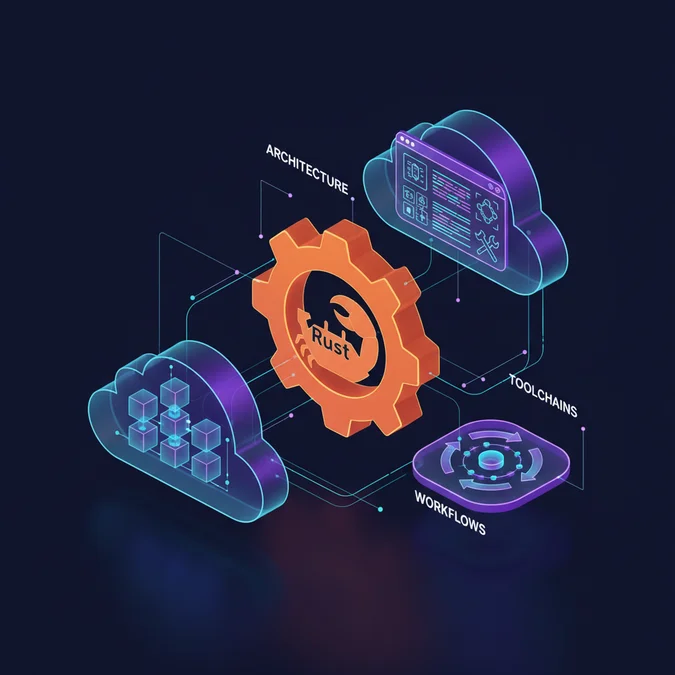

Engineering teams in 2026 are increasingly shifting away from manual memory management to minimize the catastrophic costs of buffer overflows and data races. Comprehensive Rust provides the technical framework necessary to transition from legacy C++ environments into a memory-safe, high-concurrency paradigm.
This guide serves as a practitioner-level manual for implementing these patterns in production. We analyze the core primitives that make the language a standard for systems-level infrastructure, moving beyond syntax to architectural decision-making.
Foundations of Comprehensive Rust Architecture
The core philosophy of comprehensive rust centers on the elimination of undefined behavior at compile time. Unlike garbage-collected languages, Rust enforces strict ownership rules that prevent data races without requiring a runtime overhead.
Architectural Callout: The borrow checker is not an obstacle, but a static analysis tool that guarantees memory safety by validating the lifetime of every reference during compilation.
- Memory Safety: No null pointers or dangling references.
- Concurrency: Send and Sync traits prevent data races.
- Abstraction: Zero-cost abstractions that compile to efficient machine code.
Checklist for System Adoption:
- Verify target platforms support LLVM-based toolchains.
- Audit dependencies for unsafe code blocks using cargo-audit.
- Establish a CI pipeline that enforces strict clippy lints.
The Google Rust Training Model: A Technical Evaluation
The google rust initiative has significantly accelerated industry-wide adoption by providing an open-source, battle-tested pedagogical path. It emphasizes practical coding patterns over theoretical academic exercises, making it the gold standard for internal engineering onboarding.
| Metric | Google Rust Approach | Standard Docs |
|---|---|---|
| Primary Focus | Industrial Application | Syntax Reference |
| Learning Curve | Steep but Structured | Modular/Fragmented |
| Safety Emphasis | Strict Enforcement | Language Features |
Core Mechanics: Ownership, Borrowing, and Lifetimes
Ownership is the fundamental pillar of Rust. Every value has a single owner, and when that owner goes out of scope, the memory is reclaimed.
[Scope Start] -> {Owner Created} -> [Borrowing] -> {End Scope} -> [Drop/Free]Implementation Steps:
- Define Ownership: Assign a variable to a heap-allocated resource.
- Borrowing: Use references (&T or &mut T) to allow access without transferring ownership.
- Lifetime Annotation: Use explicit lifetime markers (‘a) to satisfy the compiler when references are returned from functions.
fn longest<'a>(x: &'a str, y: &'a str) -> &'a str { if x.len() > y.len() { x } else { y } }
Production Selection Criteria and Architectural Trade-offs
Deciding when to pivot from C++ to Rust requires a clear understanding of the operational trade-offs. While Rust provides superior safety, it requires a significant cultural shift in how teams manage dependencies and build pipelines.
| Feature | Rust | C++ |
|---|---|---|
| Safety | Memory Safe by Default | Manual Oversight |
| Compile Time | Slow (Monomorphization) | Fast (Incremental) |
| Ecosystem | Cargo-driven | Fragmented (CMake) |
Callout: For performance-critical hot paths, Rust matches C++ speed. However, initial development velocity may decrease until the team matures in ownership patterns.
Troubleshooting Common Compiler Errors
Compiler friction is the primary bottleneck for new developers. Understanding the borrow checker’s logic is essential for resolving common errors.
Resolution Checklist:
- E0502: You are trying to borrow as mutable while an immutable borrow exists. Reorder your logic to ensure immutable references drop before the mutable one is created.
- E0597: A variable is dropped before the reference to it. Extend the lifetime of the owner.
- E0382: Use of moved value. Implement the Copy trait or pass by reference.
Frequently Asked Questions
What is the primary goal of the comprehensive rust course?
Comprehensive Rust is an intensive technical curriculum designed to teach engineers how to build memory-safe, high-performance systems. It covers fundamental language syntax, advanced concurrency patterns, and production-grade architectural strategies necessary for modern software development in 2026.
How does the google rust curriculum differ from standard documentation?
The Google Rust curriculum focuses on practical, industrial-scale application rather than theoretical abstraction. It provides a structured path for developers to transition from other languages while emphasizing the specific safety requirements and error-handling paradigms used in large-scale production environments.
Mastering comprehensive rust requires persistent practice and a deep understanding of memory layout. By internalizing the ownership model and leveraging the tools provided by the google rust ecosystem, engineering teams can build resilient systems that are both performant and secure.
Start your transition by auditing your current build pipeline and integrating static analysis tools. Technical excellence in 2026 demands nothing less than absolute memory safety.