
Software engineering is increasingly defined by the ability to abstract away repetitive implementation details without sacrificing system integrity. As complexity in distributed architectures grows, manual boilerplate management has become a primary bottleneck for velocity. Modern teams are moving beyond simple script-based automation toward sophisticated pipelines that treat code as a dynamic output of architectural intent.
This article examines the current state of automated synthesis in 2026. We move past the hype to analyze the technical trade-offs between static schema-driven generation and probabilistic LLM synthesis, providing a framework for integrating these tools into robust, production-ready CI/CD workflows.
Defining the Codegen Meaning and Scope
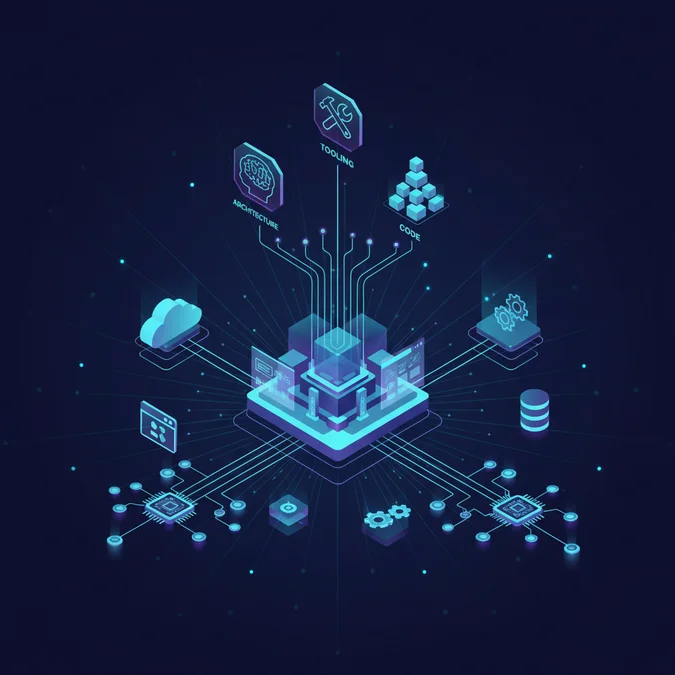
At its core, the codegen meaning describes the systematic transformation of a high-level representation, such as an API schema, a database model, or a natural language requirement, into executable source code. This process acts as a bridge between abstract design specifications and the concrete implementation layer.
Technical Insight: Codegen is not merely about writing code; it is about enforcing a single source of truth across a distributed system. When the definition changes, the generated artifacts update automatically, ensuring architectural alignment.
Engineers must distinguish between internal generation, which creates support code like serialization logic, and external generation, which produces client-side SDKs or type definitions for external consumers. Understanding this distinction is critical for managing the scope of your build pipeline.
Foundational Concepts: What is Codegen in Modern Stacks?
When asking what is codegen in the context of a modern web or cloud stack, we are referring to the integration of automated synthesis into the build lifecycle. Modern development relies on this to maintain type safety and interface consistency across heterogeneous services.
Use the following checklist to evaluate if your current stack is effectively leveraging automation:
- Schema-First Contracts: Do you define your API contracts in Protobuf, OpenAPI, or GraphQL SDL before writing implementation logic?
- Type Safety Propagation: Are your frontend type definitions automatically derived from backend schemas to prevent runtime contract mismatch?
- Build-time Injection: Is your code generation triggered by the CI/CD pipeline, or does it rely on local developer execution?
- Artifact Versioning: Are generated files treated as ephemeral build artifacts or committed to source control?
The Code Gen Spectrum: Static Schemas vs Dynamic Synthesis
The industry is currently bifurcated between deterministic static generation and probabilistic dynamic synthesis. Choosing the right approach depends on the volatility of your requirements.
| Feature | Static Schema Gen | Dynamic LLM Synthesis |
|---|---|---|
| Determinism | High | Low |
| Maintenance | Low (Schema-driven) | High (Prompt-driven) |
| Use Case | API Clients, ORMs | UI Components, Boilerplate |
| Error Rate | Near Zero | Requires Human Review |
Static generation excels at repetitive, structured tasks. For example, generating a TypeScript client from an OpenAPI definition:
# Example: Static generation command
npx openapi-typescript./schema.yaml -o./src/types/api.d.ts
Dynamic synthesis, conversely, is best suited for scaffolding complex features where the structure is non-repeating but follows established team patterns.
Technical Trade-offs and Maintenance Overhead
Integrating code generation introduces a non-trivial maintenance burden. If not managed correctly, generated code becomes ‘Ghost Code’, unmaintained, opaque logic that developers fear modifying.
- Define Ownership: Clearly mark generated files with headers indicating they should not be manually edited.
- Validate Outputs: Integrate linting and static analysis into your pipeline to ensure generated code conforms to project standards.
- Manage Drift: Implement ‘dirty check’ steps in CI to fail builds if the generated artifacts are out of sync with their source schemas.
- Auditability: Treat generated code as a build artifact, not a source of truth, to ensure developers focus on the underlying schema during reviews.
Future Directions for Automated Synthesis
As we move through 2026, the convergence of static and dynamic tools is accelerating. We are seeing the rise of ‘Hybrid Synthesis,’ where LLM agents are constrained by static schemas to produce code that is both creative and syntactically guaranteed to compile.
The next frontier is the automated refactoring of legacy codebases, where generation tools will analyze existing patterns to propose updates that maintain stylistic and architectural consistency. Success in this environment will require engineers to transition from writing code to managing the models and schemas that produce it.
Frequently Asked Questions
What is the primary codegen meaning in software engineering?
In software engineering, the codegen meaning refers to the automated process of creating source code from predefined models, schemas, or natural language prompts. It serves to reduce manual boilerplate, enforce consistency across distributed systems, and accelerate the transformation of design specifications into functional, production-ready application logic.
What is codegen, and how does it differ from manual coding?
Codegen is the programmatic generation of code using templates or AI models, whereas manual coding involves human-authored syntax. While manual coding provides total control over logic, codegen offers speed and error reduction, particularly when handling repetitive tasks like API client generation or database entity mapping.
Why is code gen considered a critical part of modern CI/CD?
Code gen is critical to CI/CD because it ensures that generated interfaces, types, and database schemas remain perfectly synchronized with source definitions. By automating these updates during the build phase, teams eliminate human error and prevent drift between architectural specifications and the final runtime environment.
Effective code generation strategy is a balancing act between the reliability of static schemas and the velocity of dynamic synthesis. By treating generated code as a first-class citizen in your CI/CD pipeline, you reduce human error and force architectural discipline across your engineering organization.
Focus on maintaining a clean separation between the source definition and the generated artifact. When you automate the repetitive, you allow your team to dedicate their cognitive bandwidth to solving unique business logic problems rather than boilerplate maintenance.