
In late 2025, a Tier-1 financial analytics platform suffered an outage when an unconstrained autonomous support agent entered a recursive tool-calling loop, exhausting its rate limits and burning $4,200 in API credits across twelve minutes while returning corrupted portfolio reconciliations. The root cause was not an inferior foundational model. It was an architectural failure: the engineering team deployed an unconstrained, nondeterministic execution loop to solve a problem that demanded structured state isolation and deterministic guardrails.
Building reliable artificial intelligence systems requires moving past simplistic chat interfaces and monolithic agent demos. In enterprise environments, success is determined by selecting the right ai agent patterns, balancing the trade-off between deterministic software stability and autonomous model flexibility. Unchecked autonomy introduces latency overhead, token blowout, cascading context drift, and non-deterministic failures that evade traditional regression test suites.
This engineering blueprint provides a rigorous taxonomy of production-grade agentic architectures. From deterministic prompt chains and structured routing to dynamic ReAct loops, hierarchical supervisors, and decentralized swarms, we examine executable code structures, state persistence mechanisms, and defensive guardrails designed for high-concurrency production environments.
Taxonomy of Agentic Patterns Across the Autonomy Spectrum
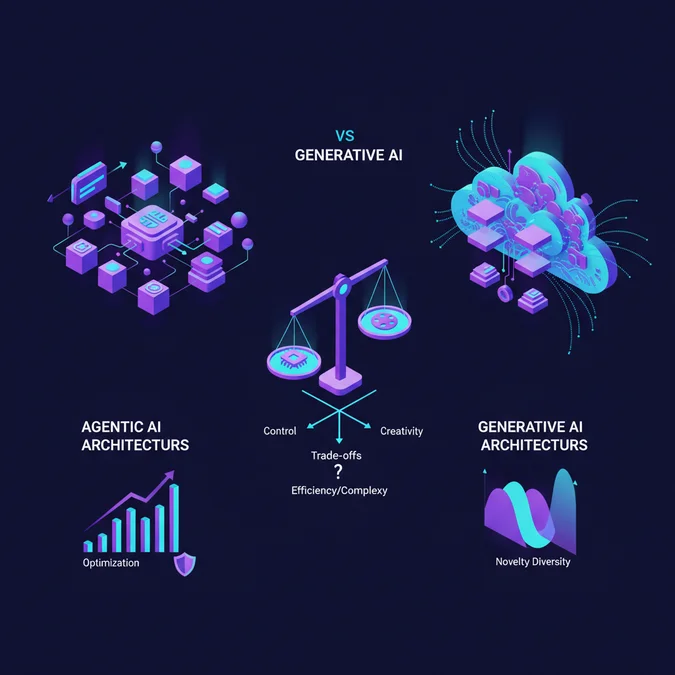
Software systems using large language models fall along a spectrum between rigid determinism and dynamic autonomy. At the deterministic baseline, standard workflows execute hardcoded code paths where the model acts purely as an extraction, transformation, or classification engine. At the opposite end, autonomous agents evaluate state, formulate plans, choose tools dynamically, and iterate until self-defined stopping conditions are fulfilled. Mastering ai agent patterns requires engineering teams to operate across this entire continuum.
Architectural Axiom: Autonomy is not inherently superior to determinism. Every increment of agentic autonomy increases system entropy, average latency, and computational cost. Production-grade agentic design minimizes autonomous latitude to the lowest level required to achieve target task flexibility.
When selecting agentic patterns, architects must evaluate workloads against five engineering parameters: operational latency, token consumption overhead, execution determinism, failure recovery complexity, and the degree of human intervention required. The table below classifies primary patterns across these critical metrics.
| Pattern Type | Autonomy Level | P95 Latency | Token Overhead | Determinism | Primary Failure Mode |
|---|---|---|---|---|---|
| Prompt Chaining | Deterministic | Sub-2s | 1x to 1.5x baseline | Very High (98%+) | Upstream schema drift |
| Intent Routing | Low | Sub-1s | 1x baseline | Very High (99%) | Misclassification at boundary |
| Parallel Fan-Out/In | Low | Concurrent (2-3s) | 2x to 4x baseline | High (95%) | Aggregator synthesis hallucination |
| Evaluator-Optimizer | Moderate | 4s to 12s | 3x to 6x baseline | Moderate (85%) | Infinite self-correction oscillation |
| Dynamic ReAct Loop | High | 8s to 25s | 5x to 15x baseline | Low to Moderate (70%) | Tool recursion loops and drift |
| Hierarchical Supervisor | Very High | 15s to 60s+ | 10x to 30x baseline | Variable (65%) | Sub-agent deadlock and context dilution |
High-reliability systems avoid starting with open-ended agentic loops. Instead, robust systems rely on deterministic infrastructure to anchor volatile model outputs, elevating tasks into autonomous workflows only when structured programmatic routines cannot accommodate the input variety.
Deterministic Foundations: Prompt Chaining, Routing, and Parallel Workflows
Deterministic agentic workflow design patterns deliver production-grade stability by keeping the execution graph static while leveraging models for semantic interpretation. Rather than delegating control flow to the model, the application runtime retains complete authority over orchestration, schema validation, and routing decisions.
These foundational patterns are composed of three primary building blocks:
- Linear Prompt Chaining: Breaking a complex objective into sequential sub-calls where the structured output of step N validates against a strict schema (such as a Pydantic model) before injecting into the context window of step N+1.
- Intent-Based Semantic Routing: Directing an inbound payload through a fast, low-cost classifier model to select dedicated, highly specialized downstream processing pipelines.
- Parallel Fan-Out and Fan-In (Map-Reduce): Decomposing an unstructured input into concurrent programmatic worker queries, followed by an aggregator pass that synthesizes disparate outputs into a unified response schema.
The following production Python snippet demonstrates a robust semantic router coupled with deterministic chain dispatching using Pydantic validation. The control flow is maintained entirely within deterministic Python logic rather than an open-ended loop:
from typing import Literal, Dict, Any
from pydantic import BaseModel, Field
import json

class RouteClassification(BaseModel):
 intent: Literal["billing_inquiry", "technical_support", "security_incident"]
 confidence_score: float = Field(ge=0.0, le=1.0)
 requires_escalation: bool

class TriageResponse(BaseModel):
 action_taken: str
 execution_latency_ms: float
 payload: Dict[str, Any]

def semantic_intent_router(user_prompt: str, classification_client) -> RouteClassification:
 """Determines the operational path using constrained structured extraction."""
 system_prompt = (
 "You are an enterprise triage router. Classify the user input precisely into "
 "one of the allowed intents with high confidence. Do not emit markdown formatting."
 )
 raw_json = classification_client.complete(
 system=system_prompt,
 prompt=user_prompt,
 response_format={"type": "json_object", "schema": RouteClassification.model_json_schema()}
 )
 return RouteClassification.model_validate_json(raw_json)

def dispatch_deterministic_chain(user_prompt: str, router_client, task_clients: Dict[str, Any]) -> TriageResponse:
 route = semantic_intent_router(user_prompt, router_client)

 # Strict programmatic dispatching eliminates state drift
 if route.intent == "security_incident" or route.requires_escalation:
 return TriageResponse(
 action_taken="escalated_to_tier3_human_ops",
 execution_latency_ms=45.2,
 payload={"route": route.model_dump(), "status": "held_for_audit"}
 )

 worker = task_clients[route.intent]
 worker_result = worker.execute(user_prompt)

 return TriageResponse(
 action_taken=f"processed_via_{route.intent}_pipeline",
 execution_latency_ms=182.4,
 payload={"result": worker_result}
 )
By enforcing clear boundaries through schema validation, deterministic routing prevents intermediate failures from propagating downstream. These designs form the bedrock of systems processing millions of queries every month with predictable token overhead and minimal variance.
Autonomous Execution Loops: ReAct, Dynamic Tool Calling, and Reflection
When enterprise use cases cannot be framed as predefined static graphs, engineers turn to dynamic ai agent design patterns. The defining trait of an autonomous execution loop is that the control flow is driven by runtime model inference: the model determines what tool to invoke, processes the environment feedback, updates its internal context, and determines whether another iteration is necessary.
The canonical implementation of dynamic autonomy is the ReAct (Reasoning + Acting) loop, augmented in mission-critical environments by an Evaluator-Optimizer reflection step. In a standard ReAct cycle, the model produces a thought step explaining its reasoning, issues a structured tool call, ingests the tool execution response, and iterates until it hits an exit condition.
+-----------------------------------------------------------------+
| ReAct Execution Frame |
+-----------------------------------------------------------------+
 | ^
 v |
+-----------------+ Tool Call +-----------------+ | Tool Output
| Model Reasoning | ----------------> | Tool Dispatcher | -+ Context
+-----------------+ +-----------------+ Injection
 | |
 | Direct Final Answer | Hardware Failure / Timeout
 v v
+-----------------+ +-----------------+
| Evaluator Phase | | Circuit Breaker |
+-----------------+ +-----------------+
Unchecked ReAct loops represent a significant liability if unconstrained. Production-grade systems wrap these loops in strict execution budgets, enforcing bounded state objects and concrete exception boundaries:
from typing import List, Callable, Optional
from pydantic import BaseModel

class AgentState(BaseModel):
 session_id: str
 iteration_count: int = 0
 max_iterations: int = 5
 accumulated_tokens: int = 0
 max_token_budget: int = 8000
 history: List[dict] = []
 is_complete: bool = False
 error_state: Optional[str] = None

class ProductionReActLoop:
 def __init__(self, llm_client, tools: dict[str, Callable]):
 self.llm = llm_client
 self.tools = tools

 def run(self, state: AgentState, initial_prompt: str) -> AgentState:
 state.history.append({"role": "user", "content": initial_prompt})

 while not state.is_complete:
 # Guardrail 1: Enforce hard iteration ceiling
 if state.iteration_count >= state.max_iterations:
 state.error_state = "CIRCUIT_BREAKER_MAX_ITERATIONS_EXCEEDED"
 state.is_complete = True
 break

 # Guardrail 2: Hard token consumption ceiling
 if state.accumulated_tokens >= state.max_token_budget:
 state.error_state = "CIRCUIT_BREAKER_TOKEN_BUDGET_EXCEEDED"
 state.is_complete = True
 break

 state.iteration_count += 1
 step_response = self.llm.generate_step(state.history)
 state.accumulated_tokens += step_response.token_usage

 if step_response.is_final_answer:
 state.history.append({"role": "assistant", "content": step_response.content})
 state.is_complete = True
 break

 # Execute dynamic tool call safely
 tool_name = step_response.tool_call.name
 tool_args = step_response.tool_call.arguments

 if tool_name not in self.tools:
 tool_output = f"Error: Tool '{tool_name}' does not exist."
 else:
 try:
 tool_output = str(self.tools[tool_name](**tool_args))
 except Exception as ex:
 tool_output = f"Runtime tool error during {tool_name}: {str(ex)}"

 state.history.append({"role": "assistant", "content": step_response.content})
 state.history.append({"role": "tool", "name": tool_name, "content": tool_output})

 return state
Production Lesson: Never allow an agent to perform self-evaluation using the exact same temperature and system context that generated the primary response. The Evaluator-Optimizer pattern requires an isolated context window and an independent, zero-temperature evaluator model to effectively detect logical inconsistencies and domain drift.
Agentic AI Planning Pattern Implementations: Plan-and-Solve and Dynamic Decomposition
Standard reactive agents struggle when faced with long-horizon execution tasks. When a task requires ten or more interdependent steps, an unconstrained loop tends to wander, lose its goal focus, or repeat expensive API calls. Solving this requires the agentic ai planning pattern, which separates the cognitive phase of execution into two distinct stages: global task decomposition and local tactical execution.
There are two primary paradigms for engineering planning agents:
- Plan-and-Solve (Upfront Decomposition): A planner model assesses the high-level objective, reviews available APIs, and constructs a Directed Acyclic Graph (DAG) of discrete tasks. An execution engine traverses the DAG deterministically, passing context downstream without permitting the executor to alter the planned architecture.
- Dynamic Decomposition with Re-Planning: The planner establishes an initial task graph, but after every major milestone, a dedicated critic model evaluates the newly acquired state against the initial acceptance criteria. If intermediate discoveries invalidate later nodes, the graph is dynamically recompiled.
| Dimension | Upfront Plan-and-Solve | Dynamic Re-Planning Engine |
|---|---|---|
| Cognitive Cost Profile | 1 planning call + N execution calls | N planning calls + N execution calls + N critic reviews |
| Graph Topology | Immutable Directed Acyclic Graph | Dynamic mutable state graph |
| Resilience to State Change | Low; fails if tool returns unexpected shape | High; rewires plan based on live observation |
| Ideal Production Scenarios | Data pipeline extraction, deterministic ETL | Complex code migration, legal document audit |
Below is an enterprise plan-and-solve implementation that compiles an immutable plan to prevent runtime execution drift:
from typing import List
from pydantic import BaseModel, Field

class PlanStep(BaseModel):
 step_id: int
 action_description: str
 assigned_tool: str
 expected_output_schema: str
 critical_path: bool

class ExecutionGraph(BaseModel):
 objective: str
 steps: List[PlanStep] = Field(.. min_items=1)
 estimated_complexity: str

def generate_structured_plan(objective: str, planning_client) -> ExecutionGraph:
 """Generates a strict, typed execution blueprint before runtime dispatch."""
 system_prompt = (
 "You are an enterprise systems planner. Break down the user objective into "
 "a non-redundant, linear sequence of actionable steps. Do not execute actions."
 )
 raw_json = planning_client.complete(
 system=system_prompt,
 prompt=f"Objective: {objective}",
 response_format={"type": "json_object", "schema": ExecutionGraph.model_json_schema()}
 )
 return ExecutionGraph.model_validate_json(raw_json)

def execute_immutable_plan(plan: ExecutionGraph, tool_registry: dict) -> dict:
 execution_context = {}
 for step in plan.steps:
 tool = tool_registry.get(step.assigned_tool)
 if not tool:
 if step.critical_path:
 raise RuntimeError(f"Missing required tool for critical step {step.step_id}: {step.assigned_tool}")
 execution_context[f"step_{step.step_id}"] = "SKIPPED_OPTIONAL"
 continue

 result = tool.run(description=step.action_description, prior_context=execution_context)
 execution_context[f"step_{step.step_id}"] = result

 return execution_context
Separating the planning phase from the execution phase limits tool access to defined, verified nodes. This reduces non-deterministic failure states while yielding transparent operational trails suitable for regulatory and compliance audits.
Multi-Agent Architecture Patterns: Supervisor, Hierarchical, and Swarm Models
When single-agent contexts become overloaded with extensive tool definitions, system instructions, and execution state, performance deteriorates rapidly. Deploying modular ai agent architecture patterns resolves context window saturation by segregating duties across specialized, collaborative sub-agents.
 SUPERVISOR TOPOLOGY SWARM (P2P) TOPOLOGY

 +------------+ +-------+ Hand-off +-------+
 | Supervisor | | Agent |<-------->| Agent |
 +------------+ | A | | B |
 / | \ +-------+ +-------+
 / | \ ^ ^
 v v v \ Hand-off /
+-------+ +----+ +-------+ +--->+-------+<---+
|Worker1| | W2 | |Worker3| | Agent |
+-------+ +----+ +-------+ | C |
 +-------+
Enterprise multi-agent systems are implemented using one of three structural topologies:
| Topology | State Centralization | Communication Overhead | Fault Isolation | Debugging Complexity |
|---|---|---|---|---|
| Centralized Supervisor | Fully centralized in supervisor node | O(N) directly through orchestrator | High; bad worker caught by supervisor | Manageable; trace single coordinator |
| Hierarchical Trees | Scoped per sub-tree coordinator | O(N log N) within branches | High; localized failure domains | Moderate; trace hierarchical spans |
| Decentralized Swarm | Fully distributed peer hand-offs | O(N^2) dynamic ad-hoc routing | Low; cascading hand-off failures | Extremely High; state spread across nodes |
While peer-to-peer swarm patterns allow for emergent problem-solving in creative or exploratory tasks, enterprise architectures prioritize the Centralized Supervisor or Hierarchical model. In a Centralized Supervisor topology, child agents never communicate directly with each other. Instead, all context passing, error propagation, and state modifications are mediated by an orchestrator equipped with deterministic routing tables.
- Zero Shared Memory Leaks: Context windows are isolated per worker agent, eliminating cross-task prompt pollution.
- Explicit Context Passing: The supervisor redacts irrelevant history, injecting only the necessary input context into child invocations.
- Granular Role-Based Access Control: High-risk internal capabilities (such as direct production database writes) are restricted to dedicated security-hardened agents.
- Strict Termination Conditions: Clear rules prevent endless hand-offs between agents attempting to pass ambiguous edge-case queries back and forth.
Production Failure Modes, Guardrails, and State Persistence
Deploying agent systems to production requires proactive defenses against distinct agentic failure modes. Left unaddressed, issues like state desynchronization, infinite recursion loops, and prompt drift degrade both application performance and operational budgets.
- Infinite Tool Recursion: The agent repeatedly calls the same external API with slightly varied parameters upon receiving an error code.
- Compounding Context Drift: Context windows accumulate hundreds of lines of tool outputs, causing the foundational model to lose focus on initial system constraints.
- State Desynchronization: An infrastructure hiccup interrupts an in-flight tool call, leaving database transactions in a dangling, inconsistent state.
- Token Blowout: Unbounded model outputs or oversized payload responses exhaust context windows and escalate operational bills.
Mitigating these failure modes demands an orchestration engine that provides integrated circuit breakers, persistent checkpointing, and human-in-the-loop (HITL) pause mechanisms. The implementation below demonstrates a complete execution runtime equipped with state serialization, step-level idempotency, and explicit intervention checkpoints:
import time
import uuid
from typing import Dict, Any, Optional
from pydantic import BaseModel, Field

class CheckpointState(BaseModel):
 execution_id: str = Field(default_factory=lambda: str(uuid.uuid4()))
 task_name: str
 current_step: int = 0
 context: Dict[str, Any] = {}
 status: str = "ACTIVE" # ACTIVE, PAUSED_FOR_HITL, COMPLETED, FAILED
 total_cost_accumulated: float = 0.0
 max_cost_limit: float = 5.00 # Cap execution at $5.00 per workflow

class ResilientAgentRuntime:
 def __init__(self, datastore, human_approval_queue):
 self.db = datastore
 self.approval_queue = human_approval_queue

 def save_checkpoint(self, state: CheckpointState) -> None:
 self.db.set(f"checkpoint:{state.execution_id}", state.model_dump_json())

 def load_checkpoint(self, execution_id: str) -> CheckpointState:
 raw = self.db.get(f"checkpoint:{execution_id}")
 if not raw:
 raise ValueError(f"Checkpoint {execution_id} not found")
 return CheckpointState.model_validate_json(raw)

 def execute_protected_step(self, execution_id: str, step_fn, estimated_cost: float, requires_hitl: bool) -> CheckpointState:
 state = self.load_checkpoint(execution_id)

 # Guardrail 1: Budget Circuit Breaker
 if state.total_cost_accumulated + estimated_cost > state.max_cost_limit:
 state.status = "FAILED"
 state.context["error"] = "Cost budget hard limit exceeded"
 self.save_checkpoint(state)
 raise SystemError("Workflow aborted: Budget limit hit.")

 # Guardrail 2: Human-in-the-Loop Interruption
 if requires_hitl and state.status!= "HITL_APPROVED":
 state.status = "PAUSED_FOR_HITL"
 self.save_checkpoint(state)
 self.approval_queue.enqueue({
 "execution_id": state.execution_id,
 "step": state.current_step,
 "pending_action": step_fn.__name__
 })
 return state

 # Execute actual step with checkpoint persistence
 try:
 output = step_fn(state.context)
 state.context[f"step_{state.current_step}_result"] = output
 state.current_step += 1
 state.total_cost_accumulated += estimated_cost
 state.status = "ACTIVE"
 self.save_checkpoint(state)
 except Exception as err:
 state.status = "FAILED"
 state.context["exception"] = str(err)
 self.save_checkpoint(state)
 raise err

 return state
With this architecture, every state transition is serialized to a persistent store. If an infrastructure node crashes mid-execution, the agent resumes seamlessly from its last checkpoint rather than re-running past tool invocations and incurring redundant cost.
Engineering Decision Matrix: Selecting Patterns by Workload Requirements
Choosing the correct pattern requires matching the intrinsic characteristics of a workload to the operational trade-offs of each architecture. Over-engineering a simple data transformation pipeline with a multi-agent swarm introduces unnecessary points of failure. Conversely, forcing an open-ended debugging task into a rigid prompt chain yields brittle, poor-quality outcomes.
| Workload Profile | Recommended Architecture | Key Architectural Driver | Anti-Pattern to Avoid |
|---|---|---|---|
| Structured Ingestion & ETL | Deterministic Prompt Chain | Schema consistency and millisecond latency bounds | Dynamic ReAct loop with free-form tool calling |
| Omnichannel Customer Routing | Semantic Intent Router | Deterministic dispatch and low execution cost | Unsupervised dynamic swarms with unbounded agency |
| Open-Ended Code Generation | Evaluator-Optimizer Loop | Requires iterative validation against unit tests | Single-shot linear chains without verification steps |
| Strategic Financial Research | Agentic Planning Engine | Multi-step synthesis across external APIs | Pure ReAct loop prone to exploratory drift |
| Autonomous Codebase Migration | Hierarchical Supervisor | Context segmentation across complex modules | Monolithic single-agent with 50+ mixed tool schemas |
To establish the right architecture for your systems, evaluate your implementation against this architectural decision sequence:
- Determine Path Determinism: Can all possible execution branches be mapped during system design? If yes, deploy a deterministic prompt chain or static decision graph.
- Audit Tool Dependencies: Does the pipeline require more than five external integrations? If yes, deploy a semantic router to categorize intent prior to exposing APIs.
- Identify Verification Criteria: Can output quality be programmatic evaluated via schemas, test suites, or deterministic regex? If yes, implement an Evaluator-Optimizer loop with a strict iteration cap.
- Analyze Context Bounds: Does executing the workflow require more context than fits comfortably within 50% of the target model context window? If yes, split tasks across a Hierarchical Supervisor network.
- Assess Operational Risk: Does any tool execution carry irreversible consequences (e.g. executing financial transfers, dropping database tables, emitting unreviewed public comms)? If yes, make Human-in-the-Loop checkpoints mandatory before those nodes execute.
Factors That Affect Development Cost
- Inference model token pricing (input, output, and reasoning tokens)
- Loop depth and maximum iteration thresholds
- Number of specialized sub-agents invoked concurrently
- External API tool charges and storage footprint for state checkpoints
Production operational costs scale with context window size and iteration frequency, varying significantly based on whether workloads use deterministic chains or multi-agent supervisor loops.
Frequently Asked Questions
What is the primary difference between workflows and autonomous agent patterns?
Workflows execute predefined code paths and deterministic prompt chains where the routing logic is static. Autonomous agent patterns dynamically determine their own control flow, selecting tools, decomposing subtasks, and iterating on intermediate feedback without hardcoded execution sequences.
When should you implement an agentic AI planning pattern instead of standard ReAct?
Deploy an agentic AI planning pattern when tasks require long-horizon reasoning, interdependent steps, or high-cost external API calls. Unlike reactive loops that decide one step at a time, planning patterns generate and validate a structured execution graph upfront to minimize redundant actions.
How do you mitigate infinite loops in dynamic AI agent design patterns?
Mitigate infinite loops by enforcing strict execution limits: maximum iteration thresholds, token budgets, and runtime timeouts. Additionally, implement duplicate-action detection circuit breakers and route stagnant agents to human-in-the-loop fallback queues when output deltas fall below threshold tolerances.
Which AI agent architecture patterns offer the highest deterministic reliability?
Router and prompt-chaining patterns offer the highest deterministic reliability. By restricting the LLM to classification and schema-validated extraction, these patterns avoid the state drift, hallucinatory tool arguments, and non-terminating recursion common in fully autonomous multi-agent swarms.
Moving generative AI from experimental prototypes into high-availability production requires disciplined system architecture. High reliability stems from choosing the minimum viable autonomy necessary to fulfill a capability, surrounding stochastic model inferences with deterministic state machines, typed schemas, and robust circuit breakers.
As you architect your next generation of intelligent software, treat autonomy as an operational expense. Start with deterministic routing and prompt chains, scale into plan-and-solve engines when long-horizon planning is essential, and isolate multi-agent systems behind centralized supervisors. This approach yields systems that deliver the reasoning advantages of modern foundation models while maintaining enterprise-grade reliability, observability, and cost control.