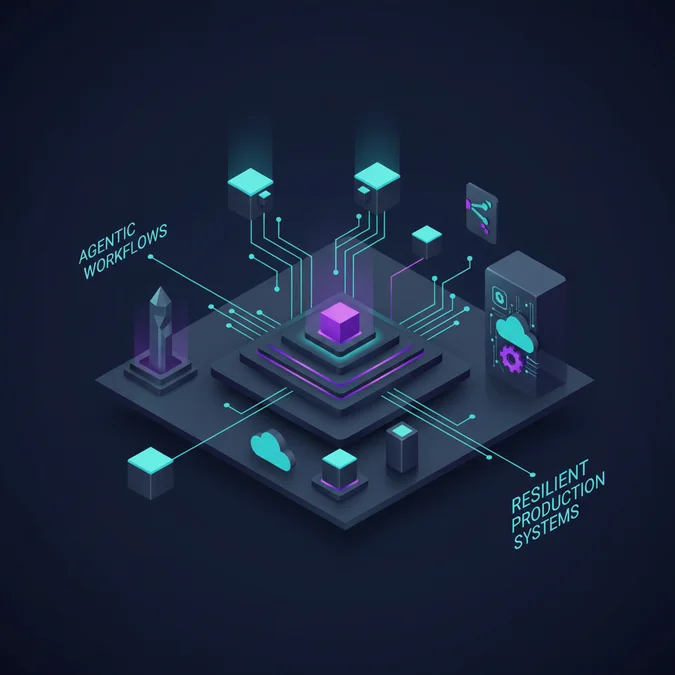

Agentic workflows are computational architectures where large language models iteratively direct their own execution flow through continuous loops of perception, planning, tool invocation, and evaluation. Unlike static prompt chains that execute predetermined sequences from input to output, an agentic system evaluates intermediate runtime state, inspects external tool responses, and dynamically updates its execution path until achieving a target objective.
When engineering teams push beyond basic retrieval-augmented generation (RAG) and zero-shot prompt pipelines, they encounter fundamental barriers: non-deterministic execution paths, context window pollution, state drift, and compounding error cascades. Moving from experimental prototypes to mission-critical infrastructure requires treating agent control loops not as mystical black boxes, but as stateful distributed systems governed by strict execution boundaries, cycle limits, and deterministic validation guardrails.
This technical guide dissects the architectural foundations of agentic workflows. We analyze core design patterns, contrast dynamic loops against deterministic pipelines across cost and latency profiles, implement production-grade state machines in code, and establish observability strategies necessary to run autonomous agents reliably in production.
Agentic Workflow Definition and Core Mechanics
An agentic workflow definition centers on iterative control: an autonomous loop where an LLM functions as an execution engine rather than a static text generator. In traditional software pipelines, control flow is hardcoded in application logic via conditionals, loops, and function calls. In pure prompt chains, the sequence of model calls is similarly rigid: step A pipes directly into step B. Conversely, agentic workflows hand the control pointer to the model, allowing it to determine which function to invoke, assess the result, and determine whether further action is necessary.
+--------------------------------------------------------------+
| Agent Execution Loop |
+--------------------------------------------------------------+
 |
 v
 +--------------------+
 | 1. Perceive State | <-----------------+
 +--------------------+ |
 | |
 v |
 +--------------------+ |
 | 2. Plan & Reason | |
 +--------------------+ |
 | |
 v |
 +--------------------+ |
 | 3. Take Action | |
 | (Tool Call) | |
 +--------------------+ |
 | |
 v |
 +--------------------+ |
 | 4. Evaluate Output | |
 +--------------------+ |
 | |
 +------------+------------+ |
 | | |
 [Task Incomplete] [Task Complete] |
 | | |
 v v |
 Update Context State Emit Result |
 | |
 +------------------------------------------+
The execution cycle operates across four deterministic phases:
- Perceive State: The system serializes the execution environment into the model context window. This includes the initial objective, scratchpad memory, conversational history, and structured outputs from prior operations.
- Plan and Reason: The agent assesses the delta between the current state and the target objective. It determines whether to generate a final answer or execute an intermediate tool to gather telemetry or mutate state.
- Take Action: The agent emits a structured tool invocation (such as JSON-schema validated parameters) targeting an external API, database, or compute sandbox.
- Evaluate Output: The system captures tool execution outputs, inspects them for runtime exceptions or semantic errors, updates the environment state, and loops back to perception.
System Rule: Dynamic loops must always be bounded by an outer state machine. Without deterministic loop limits, timeout boundaries, and circuit breakers, an agentic loop exposed to unexpected API payloads will run indefinitely, rapidly exhausting token quotas.
The Four Design Patterns Driving AI Agentic Workflows
When architecting ai agentic workflows, engineers typically leverage four foundational design patterns identified across modern autonomous agent research: Reflection, Tool Use, Planning, and Multi-Agent Collaboration. Each pattern represents a distinct topological approach to managing state, reasoning, and execution accuracy.
1. Reflection (Self-Correction Loops)
Reflection decouples generation from validation. In a reflective loop, an initial actor model produces an artifact (such as SQL queries, Python scripts, or schema migrations). A secondary evaluator persona (or a deterministic test harness) critiques the artifact against defined constraints. The critique is fed back into the actor context for iterative refinement before returning the output to the caller.
2. Tool Use
Tool use grants the model agency to interact with external environments via structured interfaces. Rather than relying on static training weights, the agent invokes REST endpoints, vector databases, or shell execution runtimes. The critical production hurdle here is schema adherence: ensuring the model outputs syntactically valid arguments matching the required parameter types.
3. Planning
Planning involves breaking a complex, non-linear goal into discrete, manageable subtasks before execution. Implementations range from single-pass task decomposition (such as Plan-and-Solve) to dynamic tree searches (such as Tree of Thoughts). In dynamic planning, the agent actively revises its task queue when intermediate subtasks fail or unearth unexpected data dependencies.
4. Multi-Agent Collaboration
Multi-agent patterns partition a problem domain across specialized agent personas (such as Researcher, Coder, Reviewer). Each agent maintains its own isolated context window, operating system prompt, and subset of tools. Agents coordinate via structured message buses, passing state artifacts rather than sharing a monolithic context window.
| Pattern | Primary Strength | Dominant Failure Mode | Production Latency Overhead |
|---|---|---|---|
| Reflection | Higher quality outputs on code and structured data | Semantic cycling (repeating the same error) | High (2x to 4x base model latency) |
| Tool Use | Grounding in real-time external state | Hallucinated tool arguments and schema drift | Medium (1x LLM call + network roundtrip) |
| Planning | Structured execution of multi-step business logic | Plan drift and brittle early-stage assumptions | High (Multiple LLM calls before execution) |
| Multi-Agent | Context window separation and persona specialization | State divergence and high token consumption | Very High (Compounding multi-turn rounds) |
Architectural Insight: Multi-agent systems look elegant in architectural diagrams, but they add substantial operational complexity. For 80% of enterprise automation use cases, a single-agent loop paired with robust tools and a reflection pass outperforms multi-agent swarms in both latency and determinism.
Deterministic Chains vs Agentic Workflow Automation
A common engineering dilemma is determining when to employ agentic workflow automation versus remaining with deterministic directed acyclic graphs (DAGs) or static prompt chains. Dynamic agency introduces non-determinism, increased latency, and token cost variance. Selecting the appropriate architectural topology requires evaluating task complexity against operational risk.
| Evaluation Metric | Deterministic DAG Pipeline | Single-Agent ReAct Loop | Multi-Agent Swarm |
|---|---|---|---|
| Control Flow | Static, hardcoded branching logic | Dynamic, model-directed transitions | Dynamic, inter-agent message passing |
| p95 Latency | Low (1s to 5s) | Moderate to High (5s to 30s) | Extreme (30s to 120s+) |
| Token Cost per Run | Predictable, fixed baseline ($0.002 to $0.01) | Variable, loop-dependent ($0.02 to $0.15) | High and volatile ($0.20 to $1.50+) |
| Handling Novel Edge Cases | Poor (Fails on unmapped conditions) | High (Explores alternative paths) | Very High (Collaborative problem solving) |
| Debuggability | High (Deterministic stack traces) | Medium (Traceable step events) | Low (Emergent multi-agent behaviors) |
| Primary Failure Mode | Uncaught exceptions at unhandled branches | Infinite execution loops and tool drift | Deadlocks, hallucinated consensus |
Deterministic DAG pipelines (such as standard LangChain chains or Airflow DAGs) are ideal when input variability is low and the execution steps are known beforehand. For example, summarizing a standard customer call recording follows an invariant sequence: transcribe audio, extract sentiment, write to CRM. An agent adds unnecessary volatility and cost to such workflows.
Conversely, agentic workflows shine when the solution space is wide, inputs are unpredictable, and recovery from intermediate failures requires semantic interpretation. Examples include investigating security incidents, fixing arbitrary unit test failures, or navigating poorly structured enterprise data lakes.
Production Agentic Workflows Examples and State Machine Implementation
Concrete agentic workflows examples in enterprise engineering include autonomous vulnerability patching, data reconciliation across fragmented ledgers, and agentic retrieval-augmented generation. In agentic RAG, rather than executing a single vector search, the agent inspects the retrieved document chunks, detects missing information, refines query parameters, and executes multiple retrieval passes across different index types.
The standard architectural pattern for running production agentic systems is a finite state machine (FSM). Implementing agent loops as state graphs guarantees that every transition is logged, checkpoints are persisted to disk or Redis, and maximum iteration bounds are enforced deterministically.
import json
from typing import Annotated, Dict, List, Literal, TypedDict
from pydantic import BaseModel, Field

# Define structured application state
class AgentState(TypedDict):
 objective: str
 task_queue: List[str]
 completed_tasks: List[str]
 tool_history: List[Dict[str, str]]
 current_iteration: int
 max_iterations: int
 final_response: str | None
 is_terminal: bool

class ToolCallDefinition(BaseModel):
 tool_name: str
 arguments: Dict[str, str]

class AgentDecision(BaseModel):
 thought: str = Field(description="Internal reasoning for this step")
 action_type: Literal["tool", "complete", "fail"]
 tool_call: ToolCallDefinition | None = None
 final_output: str | None = None

def mock_llm_reasoning_node(state: AgentState) -> AgentDecision:
 """Simulates structured LLM step with deterministic bounds."""
 # In production, replace with structured tool-calling client (e.g. OpenAI, Anthropic)
 if state["current_iteration"] >= state["max_iterations"]:
 return AgentDecision(
 thought="Exceeded maximum allowed iterations. Gracefully terminating.",
 action_type="fail",
 final_output="Operation timed out before completion."
 )

 if not state["task_queue"]:
 return AgentDecision(
 thought="All queued tasks completed successfully.",
 action_type="complete",
 final_output="Workflow executed all actions successfully."
 )

 next_task = state["task_queue"][0]
 return AgentDecision(
 thought=f"Executing task: {next_task}",
 action_type="tool",
 tool_call=ToolCallDefinition(
 tool_name="execute_database_migration",
 arguments={"task": next_task}
 )
 )

def execute_tool(tool_name: str, arguments: Dict[str, str]) -> Dict[str, str]:
 """Mock deterministic tool execution engine."""
 # Production implementation must wrap tools in try/except and emit telemetry
 return {"status": "success", "output": f"Executed {tool_name} with {json.dumps(arguments)}"}

def run_agent_loop(initial_objective: str, tasks: List[str], max_steps: int = 5) -> AgentState:
 state: AgentState = {
 "objective": initial_objective,
 "task_queue": tasks,
 "completed_tasks": [],
 "tool_history": [],
 "current_iteration": 0,
 "max_iterations": max_steps,
 "final_response": None,
 "is_terminal": False
 }

 while not state["is_terminal"]:
 state["current_iteration"] += 1
 decision = mock_llm_reasoning_node(state)

 if decision.action_type == "complete":
 state["final_response"] = decision.final_output
 state["is_terminal"] = True
 elif decision.action_type == "fail":
 state["final_response"] = decision.final_output
 state["is_terminal"] = True
 elif decision.action_type == "tool" and decision.tool_call:
 tool_result = execute_tool(
 decision.tool_call.tool_name,
 decision.tool_call.arguments
 )
 state["tool_history"].append({
 "tool": decision.tool_call.tool_name,
 "args": json.dumps(decision.tool_call.arguments),
 "result": tool_result["output"]
 })
 completed = state["task_queue"].pop(0)
 state["completed_tasks"].append(completed)

 return state

# Execution invocation
if __name__ == "__main__":
 plan = ["validate_schema", "apply_migration_index", "verify_health"]
 final_state = run_agent_loop("Database Optimization", plan, max_steps=4)
 print(f"Final Status: {final_state['final_response']}")
 print(f"Completed Steps: {len(final_state['completed_tasks'])}")
Production Implementation Checklist
- [x] Explicit state models defined via TypedDict or Pydantic to ensure type safety between nodes
- [x] Hardcoded upper loop iteration limits (circuit breakers) to block runaways
- [x] Structured, schema-enforced output mode for tool calling
- [x] Checkpointing of the state payload after each node execution to enable crash recovery
- [x] Isolated execution runtimes for dangerous operations (e.g. Docker sandboxes for arbitrary code)
Failure Modes, Guardrails, and Context Window Budgeting
Deploying autonomous loops into mission-critical systems exposes failure modes that do not exist in traditional deterministic applications. Without defensive runtime architecture, agent systems deteriorate rapidly under real-world conditions.
1. Context Window Saturation and Information Dilution
As an agent loops, each tool execution payload and reasoning step appends tokens to the context window. Within 5 to 10 iterations, the context fills with verbose API responses, causing “needle in a haystack” degradation. The model loses track of its original goal and begins hallucinating arguments. Solution: Implement active context pruning. Convert full tool outputs into concise summaries before state injection, and maintain a fixed sliding window for raw conversation turns.
2. Infinite Execution Loops and Semantic Cycling
When a tool returns an error (such as an HTTP 404 or SQL syntax error), agents often enter an infinite cycle where they retry the exact same arguments repeatedly. Solution: Implement a deterministic repetition detector. If the state machine identifies that the agent emitted identical tool names and arguments across two sequential iterations, it forcibly halts the loop and triggers an alternative fallback strategy.
3. Tool Hallucination and Poisoning
Under context saturation, models frequently invent non-existent tool parameters or invoke tools not present in the current tool registry. Solution: Enforce strict deterministic JSON schema validation using tools like Pydantic. If tool parameters fail schema validation, the execution environment intercepts the call before it hits network infrastructure, injecting a structured error message back to the model.
Human-in-the-Loop (HITL) Pause Mechanics
For operations that mutate critical state (such as dropping a database table, transferring financial assets, or sending bulk emails), agent autonomy must be gated by a human-in-the-loop pause state. The state machine persists its state vector, emits a webhook to an approvals service (such as Slack or an internal portal), and yields execution until a human administrator signs off.
def human_in_the_loop_gate(action_name: str, payload: dict) -> bool:
 """
 Evaluates action risk profile and manages human-in-the-loop authorization.
 Suspends agent execution until explicit confirmation is returned.
 """
 DESTRUCTIVE_ACTIONS = {"drop_table", "execute_payment", "delete_s3_bucket"}

 if action_name in DESTRUCTIVE_ACTIONS:
 # Persist checkpoint to database
 checkpoint_id = "chk_" + str(hash(json.dumps(payload)))
 print(f"CRITICAL ACTION DETECTED: {action_name}. Execution suspended.")
 print(f"State checkpoint saved with ID: {checkpoint_id}")

 # In production: send Slack interactive message or PagerDuty alert
 # Wait for callback endpoint: POST /api/v1/resumptions/{checkpoint_id}
 user_approval = False # Simulating non-blocking wait / approval gate
 return user_approval

 return True
Guardrail Architecture: Never grant an agent destructive or write-level privileges without an intervening deterministic gate. The agent may propose the mutation, but a deterministic policy engine must authorize it.
Selecting Orchestration Frameworks: LangGraph, CrewAI, and AutoGen
The ecosystem for building agentic architectures has matured substantially. Modern frameworks have moved away from black-box wrappers toward explicit graph engines that grant developers full visibility and control over state transitions.
| Framework | Core Abstraction | State Management | Production Ergonomics | Best Fit Enterprise Use Case |
|---|---|---|---|---|
| LangGraph | Cyclical Directed Graphs (Nodes & Edges) | Centralized Typed State with built-in persistence | High (Native tracing, human-in-the-loop checkpoints) | Mission-critical enterprise workflows requiring strict state machines |
| CrewAI | Role-based Agent Crews & Tasks | Implicit sequential/hierarchical state passing | Medium (Rapid prototyping, less granular graph control) | Content generation pipelines, research task decomposition |
| AutoGen | Event-driven conversational multi-agent actors | Distributed actor-based message passing | Medium (Complex multi-agent protocols, high token usage) | Multi-agent simulations, emergent group reasoning problems |
Framework Selection Criteria
- State Predictability: Does the framework allow you to define exact types for the global execution state, or does it hide state changes behind natural language message strings?
- Checkpointing and Resumption: Can an in-flight workflow be serialized to a Redis or PostgreSQL backend and resumed hours later after receiving human approval?
- Telemetry Integration: Does the framework natively emit OpenTelemetry-compliant spans to track step latency, token consumption, and tool execution status?
- Deterministic Routing: Can you combine deterministic business rules alongside probabilistic LLM routing within the same execution graph?
Frequently Asked Questions
What is the core difference between prompt chains and agentic workflows?
Prompt chains execute hardcoded, sequential LLM steps where control flow is static. In contrast, agentic workflows grant language models iterative autonomy to dynamically plan steps, call external tools, evaluate intermediate outputs, and self-correct through feedback loops until achieving a defined goal.
How do ai agentic workflows handle execution errors?
AI agentic workflows handle errors using automated reflection and retry mechanisms. When a tool call or validation check fails, the error output is injected back into the LLM context, enabling the model to diagnose the fault, modify parameters, and re-execute autonomously.
What are primary production agentic workflows examples in modern software?
Common examples include automated codebase refactoring, multi-step financial compliance analysis, and agentic RAG. In agentic RAG, agents actively reformulate ambiguous user queries, retrieve documents, verify relevance, and synthesize cross-corpus findings with minimal human intervention.
Why is agentic workflow automation more resource-intensive than standard automation?
Agentic workflow automation requires multiple iterative LLM calls to plan, execute, and verify tasks. This dynamic cycling consumes significantly more tokens and increases overall wall-clock latency compared to deterministic scripts or single-pass zero-shot inference pipelines.
Agentic workflows represent a fundamental architectural leap from static prompt chains, providing the dynamic decision-making and tool-grounded autonomy required to solve open-ended enterprise challenges. However, building resilient production systems requires stripping away the mysticism of artificial agency. Successful implementations treat agents as stateful distributed compute nodes that require rigorous boundaries, deterministic circuit breakers, and comprehensive telemetry.
By structuring agent operations as finite state machines, enforcing schema-validated tool interfaces, pruning context windows defensively, and implementing human-in-the-loop checkpoints for irreversible actions, engineering teams can harness the adaptive power of language models without sacrificing reliability, budget discipline, or system security.